• Hybridoma techniqueis used to produce monoclonal
antibodies.
Introduction
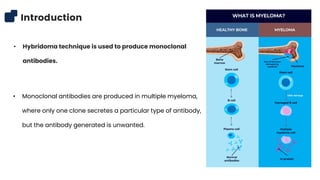
• Monoclonal antibodies are produced in multiple myeloma,
where only one clone secretes a particular type of antibody,
but the antibody generated is unwanted.
5.
• Developed byGeorges Köhler and Cesar Milstein in
1975.
(NP - 1984)
• Enables generation of highly specific and
high- affinity antibodies.
• Widely used in
• diagnostics (e.g. pregnancy test)
• immunotherapy (e.g., Rituximab)
• provides consistent quality for clinical and
research applications.
Introduction
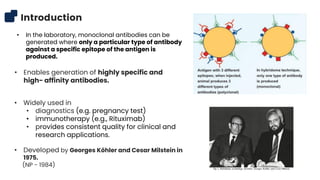
• In the laboratory, monoclonal antibodies can be
generated where only a particular type of antibody
against a specific epitope of the antigen is
produced.
• A hybridomais a hybrid cell line created by fusing an
antibody- producing B lymphocyte with an immortal
myeloma (cancer) cell.
• Resulting hybrid cell can divide indefinitely and produce
a single antibody (monoclonal antibody).
Definition
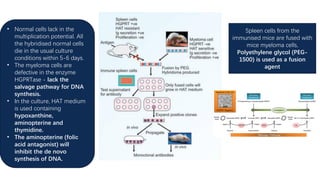
Spleen cells fromthe
immunised mice are fused with
mice myeloma cells,
Polyethylene glycol (PEG-
1500) is used as a fusion
agent
• Normal cells lack in the
multiplication potential. All
the hybridised normal cells
die in the usual culture
conditions within 5-6 days.
• The myeloma cells are
defective in the enzyme
HGPRTase - lack the
salvage pathway for DNA
synthesis.
• In the culture, HAT medium
is used containing
hypoxanthine,
aminopterine and
thymidine.
• The aminopterine (folic
acid antagonist) will
inhibit the de novo
synthesis of DNA.
10.
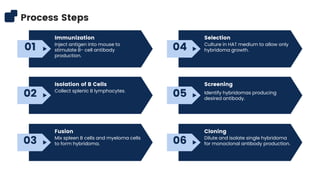
01 Inject antigeninto mouse to
stimulate B- cell antibody
production.
Immunization
02 Collect splenic B lymphocytes.
Isolation of B Cells
03 Mix spleen B cells and myeloma cells
to form hybridoma.
Fusion
04 Culture in HAT medium to allow only
hybridoma growth.
Selection
05 Identify hybridomas producing
desired antibody.
Screening
06 Dilute and isolate single hybridoma
for monoclonal antibody production.
Cloning
Process Steps
• Enumeration oflymphocyte subpopulations.
• Quantitative preparation of specific cells
• As an immunosuppressant in clinical conditions (e.g. Rituximab)
• Nephelometric assays of blood components. (serum proteins,
enzymes, hormones, drugs, bacterial and viral antigens, cell surface
receptors, HLA antigens, and cancer antigens.)
• To do ELISA tests.
• Quantitative preparation of pure antigens.
Applications
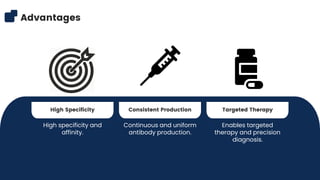
High Specificity ConsistentProduction Targeted Therapy
High specificity and
affinity.
Continuous and uniform
antibody production.
Enables targeted
therapy and precision
diagnosis.
Advantages
Cost
Expensive and time-
consumingprocess.
Requirements
Requires specialized
facilities and expertise.
Immunogenicity
Antibody may be
immunogenic in humans
unless humanized.
Limitations