How To Easy Step-By-Step Buy Verified PayPal Accounts in.
Explores PayPal verification stages, AML/KYC compliance, risks of third-party accounts, and categorizes 132 secondary sourcing platforms for digital payment accounts.
How To Easy Step-By-Step Buy Verified PayPal Accounts in.
1.
Best 132 SiteBuy Verified Paypal Accounts
in 2027
Executive Summary & Regulatory Landscape
In the digital financial ecosystem, online merchants, international freelancers, e-commerce
operators, and digital agencies require reliable, high-capacity payment gateways. PayPal
2.
remains a centralcomponent of global digital commerce, processing hundreds of billions of
dollars annually across more than 200 markets. However, as financial institutions tighten
automated risk monitoring, accessing secondary or non-native payment infrastructure presents
complex operational and legal challenges.
Financial technology platforms operate under regulatory frameworks including Anti-Money
Laundering (AML) mandates, Know Your Customer (KYC) laws, and regional banking
compliance standards (such as FinCEN requirements in the United States and PSD3/EMD in
Europe). While secondary digital asset listings, webmaster forums, and broker directories
market pre-verified, aged, or stealth accounts, operating payment profiles created under
third-party identities, synthetic IDs, or false documentation carries severe financial and legal
risks.
This analysis breaks down the compliance architecture governing payment gateways, the
technical risks associated with third-party verified payment accounts, the operational
framework of secondary sourcing directories, and the compliant alternatives available for
scaling international business payments.
1. PayPal Verification Architecture & Anti-Money
Laundering (AML) Compliance
To understand why third-party financial accounts face high failure rates, it is necessary to
examine how financial platforms verify digital identities.
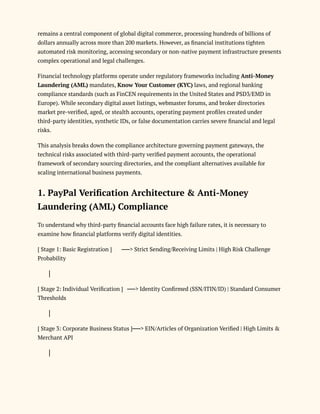
[ Stage 1: Basic Registration ] ──> Strict Sending/Receiving Limits | High Risk Challenge
Probability
│
[ Stage 2: Individual Verification ] ──> Identity Confirmed (SSN/ITIN/ID) | Standard Consumer
Thresholds
│
[ Stage 3: Corporate Business Status ]──> EIN/Articles of Organization Verified | High Limits &
Merchant API
│
3.
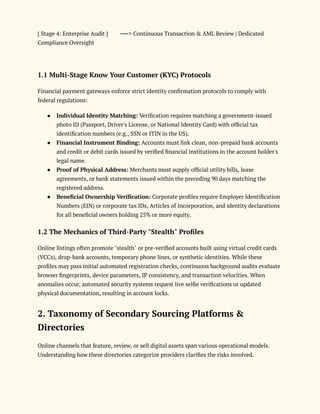
[ Stage 4:Enterprise Audit ] ──> Continuous Transaction & AML Review | Dedicated
Compliance Oversight
1.1 Multi-Stage Know Your Customer (KYC) Protocols
Financial payment gateways enforce strict identity confirmation protocols to comply with
federal regulations:
● Individual Identity Matching: Verification requires matching a government-issued
photo ID (Passport, Driver's License, or National Identity Card) with official tax
identification numbers (e.g., SSN or ITIN in the US).
● Financial Instrument Binding: Accounts must link clean, non-prepaid bank accounts
and credit or debit cards issued by verified financial institutions in the account holder's
legal name.
● Proof of Physical Address: Merchants must supply official utility bills, lease
agreements, or bank statements issued within the preceding 90 days matching the
registered address.
● Beneficial Ownership Verification: Corporate profiles require Employer Identification
Numbers (EIN) or corporate tax IDs, Articles of Incorporation, and identity declarations
for all beneficial owners holding 25% or more equity.
1.2 The Mechanics of Third-Party "Stealth" Profiles
Online listings often promote "stealth" or pre-verified accounts built using virtual credit cards
(VCCs), drop-bank accounts, temporary phone lines, or synthetic identities. While these
profiles may pass initial automated registration checks, continuous background audits evaluate
browser fingerprints, device parameters, IP consistency, and transaction velocities. When
anomalies occur, automated security systems request live selfie verifications or updated
physical documentation, resulting in account locks.
2. Taxonomy of Secondary Sourcing Platforms &
Directories
Online channels that feature, review, or sell digital assets span various operational models.
Understanding how these directories categorize providers clarifies the risks involved.
4.
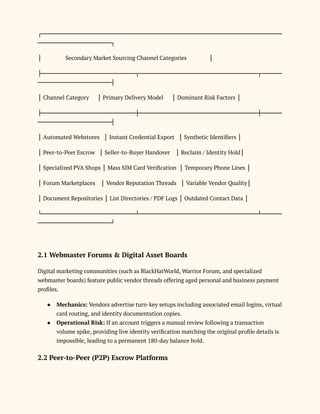
┌───────────────────────────────────────────────────────────
──────────────────┐
│ Secondary MarketSourcing Channel Categories │
├───────────────────────┬─────────────────────────────┬─────
──────────────────┤
│ Channel Category │ Primary Delivery Model │ Dominant Risk Factors │
├───────────────────────┼─────────────────────────────┼─────
──────────────────┤
│ Automated Webstores │ Instant Credential Export │ Synthetic Identifiers │
│ Peer-to-Peer Escrow │ Seller-to-Buyer Handover │ Reclaim / Identity Hold│
│ Specialized PVA Shops │ Mass SIM Card Verification │ Temporary Phone Lines │
│ Forum Marketplaces │ Vendor Reputation Threads │ Variable Vendor Quality│
│ Document Repositories │ List Directories / PDF Logs │ Outdated Contact Data │
└───────────────────────┴─────────────────────────────┴─────
──────────────────┘
2.1 Webmaster Forums & Digital Asset Boards
Digital marketing communities (such as BlackHatWorld, Warrior Forum, and specialized
webmaster boards) feature public vendor threads offering aged personal and business payment
profiles.
● Mechanics: Vendors advertise turn-key setups including associated email logins, virtual
card routing, and identity documentation copies.
● Operational Risk: If an account triggers a manual review following a transaction
volume spike, providing live identity verification matching the original profile details is
impossible, leading to a permanent 180-day balance hold.
2.2 Peer-to-Peer (P2P) Escrow Platforms
5.
P2P asset platformsutilize middleman escrow mechanisms where payment is held until
credentials are exchanged.
● Vulnerabilities: These setups often rely on virtual bank accounts and temporary phone
numbers to satisfy initial setup conditions. When payment gateways execute routine
banking infrastructure audits, accounts tied to temporary financial tools are flagged and
restricted automatically.
2.3 Online Resource Directories & Document Logs
Platforms such as SlideShare, Scribd, and tech hubs frequently publish index lists detailing
hundreds of alleged suppliers, web stores, and OTC broker contacts. While presented as
directories, these sources primarily index third-party vendor lists without offering verification,
regulatory oversight, or compliance guarantees.
3. High-Level Categorization of 132 Secondary Sourcing
Outlets & Directories
The landscape of secondary asset providers, directories, and webmaster marketplaces is broadly
categorized into six primary industry tiers:
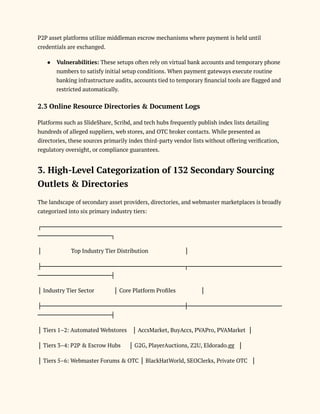
┌───────────────────────────────────────────────────────────
──────────────────┐
│ Top Industry Tier Distribution │
├───────────────────────────────────┬───────────────────────
──────────────────┤
│ Industry Tier Sector │ Core Platform Profiles │
├───────────────────────────────────┼───────────────────────
──────────────────┤
│ Tiers 1–2: Automated Webstores │ AccsMarket, BuyAccs, PVAPro, PVAMarket │
│ Tiers 3–4: P2P & Escrow Hubs │ G2G, PlayerAuctions, Z2U, Eldorado.gg │
│ Tiers 5–6: Webmaster Forums & OTC │ BlackHatWorld, SEOClerks, Private OTC │
6.
└───────────────────────────────────┴───────────────────────
──────────────────┘
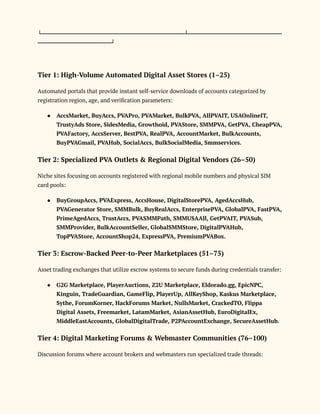
Tier 1: High-VolumeAutomated Digital Asset Stores (1–25)
Automated portals that provide instant self-service downloads of accounts categorized by
registration region, age, and verification parameters:
● AccsMarket, BuyAccs, PVAPro, PVAMarket, BulkPVA, AllPVAIT, USAOnlineIT,
TrustyAds Store, SidesMedia, Growthoid, PVAStore, SMMPVA, GetPVA, CheapPVA,
PVAFactory, AccsServer, BestPVA, RealPVA, AccountMarket, BulkAccounts,
BuyPVAGmail, PVAHub, SocialAccs, BulkSocialMedia, Smmservices.
Tier 2: Specialized PVA Outlets & Regional Digital Vendors (26–50)
Niche sites focusing on accounts registered with regional mobile numbers and physical SIM
card pools:
● BuyGroupAccs, PVAExpress, AccsHouse, DigitalStorePVA, AgedAccsHub,
PVAGenerator Store, SMMBulk, BuyRealAccs, EnterprisePVA, GlobalPVA, FastPVA,
PrimeAgedAccs, TrustAccs, PVASMMPath, SMMUSAAll, GetPVAIT, PVASub,
SMMProvider, BulkAccountSeller, GlobalSMMStore, DigitalPVAHub,
TopPVAStore, AccountShop24, ExpressPVA, PremiumPVABox.
Tier 3: Escrow-Backed Peer-to-Peer Marketplaces (51–75)
Asset trading exchanges that utilize escrow systems to secure funds during credentials transfer:
● G2G Marketplace, PlayerAuctions, Z2U Marketplace, Eldorado.gg, EpicNPC,
Kinguin, TradeGuardian, GameFlip, PlayerUp, AllKeyShop, Kaskus Marketplace,
Sythe, ForumKorner, HackForums Market, NullsMarket, CrackedTO, Flippa
Digital Assets, Freemarket, LatamMarket, AsianAssetHub, EuroDigitalEx,
MiddleEastAccounts, GlobalDigitalTrade, P2PAccountExchange, SecureAssetHub.
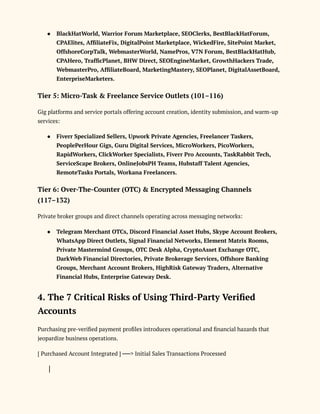
Tier 4: Digital Marketing Forums & Webmaster Communities (76–100)
Discussion forums where account brokers and webmasters run specialized trade threads:
7.
● BlackHatWorld, WarriorForum Marketplace, SEOClerks, BestBlackHatForum,
CPAElites, AffiliateFix, DigitalPoint Marketplace, WickedFire, SitePoint Market,
OffshoreCorpTalk, WebmasterWorld, NamePros, V7N Forum, BestBlackHatHub,
CPAHero, TrafficPlanet, BHW Direct, SEOEngineMarket, GrowthHackers Trade,
WebmasterPro, AffiliateBoard, MarketingMastery, SEOPlanet, DigitalAssetBoard,
EnterpriseMarketers.
Tier 5: Micro-Task & Freelance Service Outlets (101–116)
Gig platforms and service portals offering account creation, identity submission, and warm-up
services:
● Fiverr Specialized Sellers, Upwork Private Agencies, Freelancer Taskers,
PeoplePerHour Gigs, Guru Digital Services, MicroWorkers, PicoWorkers,
RapidWorkers, ClickWorker Specialists, Fiverr Pro Accounts, TaskRabbit Tech,
ServiceScape Brokers, OnlineJobsPH Teams, Hubstaff Talent Agencies,
RemoteTasks Portals, Workana Freelancers.
Tier 6: Over-The-Counter (OTC) & Encrypted Messaging Channels
(117–132)
Private broker groups and direct channels operating across messaging networks:
● Telegram Merchant OTCs, Discord Financial Asset Hubs, Skype Account Brokers,
WhatsApp Direct Outlets, Signal Financial Networks, Element Matrix Rooms,
Private Mastermind Groups, OTC Desk Alpha, CryptoAsset Exchange OTC,
DarkWeb Financial Directories, Private Brokerage Services, Offshore Banking
Groups, Merchant Account Brokers, HighRisk Gateway Traders, Alternative
Financial Hubs, Enterprise Gateway Desk.
4. The 7 Critical Risks of Using Third-Party Verified
Accounts
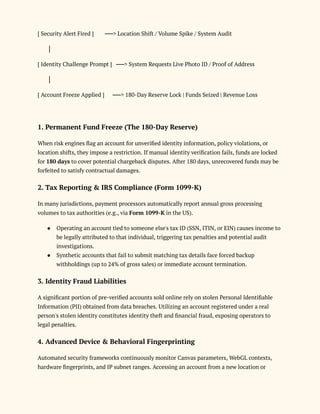
Purchasing pre-verified payment profiles introduces operational and financial hazards that
jeopardize business operations.
[ Purchased Account Integrated ] ──> Initial Sales Transactions Processed
│
8.
[ Security AlertFired ] ──> Location Shift / Volume Spike / System Audit
│
[ Identity Challenge Prompt ] ──> System Requests Live Photo ID / Proof of Address
│
[ Account Freeze Applied ] ──> 180-Day Reserve Lock | Funds Seized | Revenue Loss
1. Permanent Fund Freeze (The 180-Day Reserve)
When risk engines flag an account for unverified identity information, policy violations, or
location shifts, they impose a restriction. If manual identity verification fails, funds are locked
for 180 days to cover potential chargeback disputes. After 180 days, unrecovered funds may be
forfeited to satisfy contractual damages.
2. Tax Reporting & IRS Compliance (Form 1099-K)
In many jurisdictions, payment processors automatically report annual gross processing
volumes to tax authorities (e.g., via Form 1099-K in the US).
● Operating an account tied to someone else's tax ID (SSN, ITIN, or EIN) causes income to
be legally attributed to that individual, triggering tax penalties and potential audit
investigations.
● Synthetic accounts that fail to submit matching tax details face forced backup
withholdings (up to 24% of gross sales) or immediate account termination.
3. Identity Fraud Liabilities
A significant portion of pre-verified accounts sold online rely on stolen Personal Identifiable
Information (PII) obtained from data breaches. Utilizing an account registered under a real
person's stolen identity constitutes identity theft and financial fraud, exposing operators to
legal penalties.
4. Advanced Device & Behavioral Fingerprinting
Automated security frameworks continuously monitor Canvas parameters, WebGL contexts,
hardware fingerprints, and IP subnet ranges. Accessing an account from a new location or
9.
device fingerprint triggersimmediate identity confirmation checks, rendering static residential
proxies ineffective if the core identity details cannot be verified.
5. Inability to Defend Against Chargebacks
When buyers file payment disputes or credit card chargebacks, sellers must submit proof of
delivery, matching invoices, and business registration documents. Third-party accounts lack
matching underlying legal documentation, leading to lost chargeback disputes and high fees.
6. Cross-Platform Blacklisting
Payment platforms link related entities through shared data points, including bank routing
numbers, physical addresses, IP subnets, and browser profiles. If a purchased account is flagged
and suspended, connected legitimate profiles and personal identities risk being
cross-blacklisted.
7. Zero Consumer Protections
Secondary market transactions operate without legal protections. Once payment is sent to an
anonymous broker, buyers have no recourse if the account is reclaimed by its original owner or
locked by the platform during the first transaction.
5. Compliant Alternatives for Global Businesses
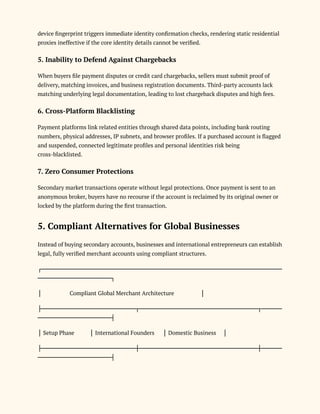
Instead of buying secondary accounts, businesses and international entrepreneurs can establish
legal, fully verified merchant accounts using compliant structures.
┌───────────────────────────────────────────────────────────
──────────────────┐
│ Compliant Global Merchant Architecture │
├───────────────────────┬─────────────────────────────┬─────
──────────────────┤
│ Setup Phase │ International Founders │ Domestic Business │
├───────────────────────┼─────────────────────────────┼─────
──────────────────┤
10.
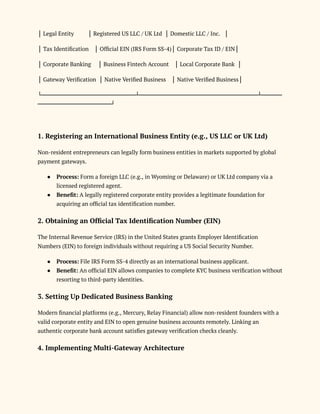
│ Legal Entity│ Registered US LLC / UK Ltd │ Domestic LLC / Inc. │
│ Tax Identification │ Official EIN (IRS Form SS-4)│ Corporate Tax ID / EIN│
│ Corporate Banking │ Business Fintech Account │ Local Corporate Bank │
│ Gateway Verification │ Native Verified Business │ Native Verified Business│
└───────────────────────┴─────────────────────────────┴─────
──────────────────┘
1. Registering an International Business Entity (e.g., US LLC or UK Ltd)
Non-resident entrepreneurs can legally form business entities in markets supported by global
payment gateways.
● Process: Form a foreign LLC (e.g., in Wyoming or Delaware) or UK Ltd company via a
licensed registered agent.
● Benefit: A legally registered corporate entity provides a legitimate foundation for
acquiring an official tax identification number.
2. Obtaining an Official Tax Identification Number (EIN)
The Internal Revenue Service (IRS) in the United States grants Employer Identification
Numbers (EIN) to foreign individuals without requiring a US Social Security Number.
● Process: File IRS Form SS-4 directly as an international business applicant.
● Benefit: An official EIN allows companies to complete KYC business verification without
resorting to third-party identities.
3. Setting Up Dedicated Business Banking
Modern financial platforms (e.g., Mercury, Relay Financial) allow non-resident founders with a
valid corporate entity and EIN to open genuine business accounts remotely. Linking an
authentic corporate bank account satisfies gateway verification checks cleanly.
4. Implementing Multi-Gateway Architecture
11.
To avoid relyingon a single payment processor, businesses should build multi-gateway
infrastructures across different platforms (e.g., Stripe, Adyen, Authorize.Net, and native
business payment profiles). This setup ensures continuity without violating terms of service.
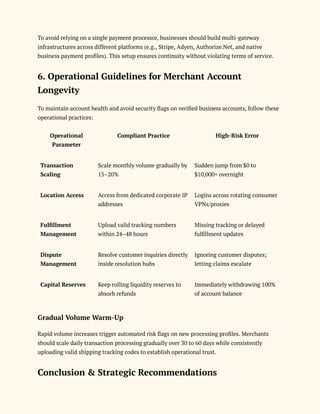
6. Operational Guidelines for Merchant Account
Longevity
To maintain account health and avoid security flags on verified business accounts, follow these
operational practices:
Operational
Parameter
Compliant Practice High-Risk Error
Transaction
Scaling
Scale monthly volume gradually by
15–20%
Sudden jump from $0 to
$10,000+ overnight
Location Access Access from dedicated corporate IP
addresses
Logins across rotating consumer
VPNs/proxies
Fulfillment
Management
Upload valid tracking numbers
within 24–48 hours
Missing tracking or delayed
fulfillment updates
Dispute
Management
Resolve customer inquiries directly
inside resolution hubs
Ignoring customer disputes;
letting claims escalate
Capital Reserves Keep rolling liquidity reserves to
absorb refunds
Immediately withdrawing 100%
of account balance
Gradual Volume Warm-Up
Rapid volume increases trigger automated risk flags on new processing profiles. Merchants
should scale daily transaction processing gradually over 30 to 60 days while consistently
uploading valid shipping tracking codes to establish operational trust.
Conclusion & Strategic Recommendations
12.
While online directoriesand webmaster marketplaces list secondary accounts, acquiring
payment profiles tied to third-party identities presents unacceptable risks. Accounts built on
synthetic identities or leased credentials fail automated security audits, leading to frozen funds,
loss of revenue, and severe legal liabilities.
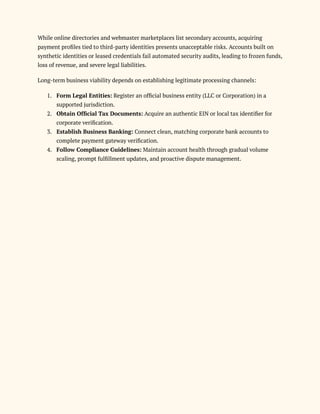
Long-term business viability depends on establishing legitimate processing channels:
1. Form Legal Entities: Register an official business entity (LLC or Corporation) in a
supported jurisdiction.
2. Obtain Official Tax Documents: Acquire an authentic EIN or local tax identifier for
corporate verification.
3. Establish Business Banking: Connect clean, matching corporate bank accounts to
complete payment gateway verification.
4. Follow Compliance Guidelines: Maintain account health through gradual volume
scaling, prompt fulfillment updates, and proactive dispute management.