Home - Time Tracking - How to Calculate Overtime Pay?
Importance and tips
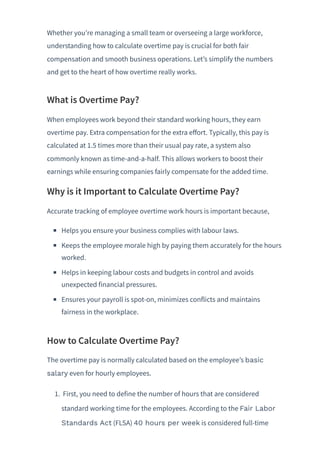
How To Calculate Overtime Pay? Importance And
Tips
Shabana Shaik
 October 8, 2024

Rewarding employees with overtime pay is a great way to show you value
their extra effort. But figuring out how much to pay can get complicated when
you have different rates, hours, and legal requirements in the mix.
How do you ensure accuracy while staying compliant with labour laws? If you
cannot answer this question, this blog is for you! In this blog, I will break down
the step-by-step process for you.
Whether you’re managing a small team or overseeing a large workforce,
understanding how to calculate overtime pay is crucial for both fair
compensation and smooth business operations. Let’s simplify the numbers
and get to the heart of how overtime really works.
What is Overtime Pay?
When employees work beyond their standard working hours, they earn
overtime pay. Extra compensation for the extra effort. Typically, this pay is
calculated at 1.5 times more than their usual pay rate, a system also
commonly known as time-and-a-half. This allows workers to boost their
earnings while ensuring companies fairly compensate for the added time.
Why is it Important to Calculate Overtime Pay?
Accurate tracking of employee overtime work hours is important because,
Helps you ensure your business complies with labour laws.
Keeps the employee morale high by paying them accurately for the hours
worked.
Helps in keeping labour costs and budgets in control and avoids
unexpected financial pressures.
Ensures your payroll is spot-on, minimizes conflicts and maintains
fairness in the workplace.
How to Calculate Overtime Pay?
The overtime pay is normally calculated based on the employee’s basic
salary even for hourly employees.
1. First, you need to define the number of hours that are considered
standard working time for the employees. According to the Fair Labor
Standards Act (FLSA) 40 hours per week is considered full-time
standard working hours. Any hours worked beyond 40 are considered
overtime.
2. Now that you have determined the standard hours, go ahead with
determining the employee’s regular hourly rate or salary.
Example: If an employee earns $20 per hour, that is their base rate.
3. Now calculate the overtime, which is typically paid at a higher rate, often
1.5 times more than the regular hourly rate (time-and-a-half). For a $20
per hour base rate, the overtime rate would be $30 per hour (i.e. $20 x
1.5).
4. To accurately keep track of the overtime hours, you need to keep a record
of the number of hours worked beyond the standard workweek.
Example: If an employee works 10 hours of overtime in a week, track
these extra hours.
5. Here, multiply the overtime hours by the overtime rate.
Example: For 10 hours of overtime at $30 per hour, the calculation would
be 10 hours x $30 = $300.
6. Now, go on and add the overtime pay to the regular earnings to get the
total pay amount.
Example: If the employee worked 40 regular hours at a $20 per hour base
rate, their regular pay will be $800 per week. Adding $300 in overtime pay
from earlier to the base pay, their total pay for the week will be $1,100.
Here’s a summarized version, if you are in a hurry,
Determine standard hours and base rate.
Calculate the overtime rate (usually 1.5 times the base rate).
Track and calculate total overtime hours.
Multiply overtime hours by the overtime rate and add to regular pay.
How to Calculate Overtime Pay for Salaried Employees?
You can calculate the overtime pay for salaried employees using this formula,
The elements include,
DA= Dearness Allowance
RA= Retaining Allowance
Overtime Wage = Regular Hourly Rate × Overtime Multiplier (1.5)
Hourly overtime wage = 2 * [Basic Pay + DA + RA / (Total no. of days in a
month (26-30 days)) * Maximum working hours per day (8-9 hours)] * overtime
hours worked.
How to Calculate Overtime Pay for Hourly Employees?
Overtime wage = Basic pay / (Total no. of days (26-30)) * Maximum working
hours per day (8-9 hours)
How to Calculate with an Example
Let’s try to calculate with an example here,
Peter will be our imaginary employee here, so Peter works in a software
company as a software trainee, works for 40 hours a week and earns $15 per
hour as his base salary.
This week Peter worked 10 hours overtime, let’s calculate Peter’s overall
weekly and monthly salary.
Peter’s monthly salary if he worked the same 10 hours overtime = ($600 * 4 =
The base salary per week = 15 * 40 = $600
Overtime salary per hour = 15 * 1.5 = $22.5
Overtime salary per week = 22.5 * 10 = $225
Total salary per week = $600 + $225 = $825
$2400) + (225 * 4 = 900) = $3300
Here Peter has earned $225 more than his regular pay amount per week and
earned $900 per month.
Overtime Rules and Laws
Overtime laws vary depending on the state and country you live in according
to the government rules.
Here are some key overtime rules outlined by the Fair Labor Standards Act,
1. Discretionary bonuses
Overtime Pay Requirement: Non-exempt employees are entitled to 1.5
times their regular pay for any hours worked beyond 40 hours per week.
This ensures fair compensation for extra hours put in.
Age Restrictions: For employees aged 16 and older, there’s no limit on
the number of hours they can work each week.
Weekend & Holiday Work: When working on Saturdays, Sundays,
holidays, or days off, you may feel that you are working extra, but
overtime pay is only given if the total hours worked in the week is more
than 40 hours.
Workweek Definition: A workweek is a fixed period of 168 hours (seven
consecutive 24-hour days). It doesn’t have to match the calendar week, it
can start on any day or time that suits the business.
No Hour Averaging: Averaging hours over multiple weeks to dodge
overtime pay is not allowed. Each week stands on its own.
Timely Payment: All overtime worked must be paid on the regular
payday for the pay period, with no exceptions.
Regular Pay Rate: Employees must be paid at least the minimum wage,
and their regular rate includes most forms of compensation, with a few
exceptions like:
2. Gifts
3. Payments for vacation, holidays, or illness
Make sure you follow these rules so that you avoid legal complications in
future.
Multiple Pay Types: For those who are paid on a piece rate, salary or
commission basis, overtime is calculated based on the average hourly
earnings for that particular week.
Multiple Jobs: If an employee juggles multiple jobs with different pay
rates, the weighted average of those rates is used to calculate overtime.
Non-cash Payments: Any other form of remuneration like goods or
services, other than cash must be adjusted to the hourly or monthly
wage rate of the employees.
Lump Sum Payments: Simply offering a lump sum for overtime hours
doesn’t meet the standard for overtime premiums unless it’s tied to the
actual hours worked.
Fixed Salary Over 40 Hours: A fixed salary covering more than 40 hours
per week doesn’t get an employer off the hook. They’re still responsible
for paying additional overtime for hours beyond the 40-hour mark.
Waiving Overtime: Overtime pay can’t be waived or negotiated away.
Whether it’s authorized or not, if an employee works overtime, they must
be compensated for it.
Mistakes to Avoid While Calculating
Failing to Track All Hours Worked: It’s important to log every hour
worked accurately. If you miss time worked before or after regular hours,
it can mess up your overtime pay. Make sure to track all your employee
hours to get the calculations right.
Ignoring State and Local Regulations: Federal laws are only one of
the factors. State and local laws might have their own rules about
overtime. Stay up-to-date with these local regulations so that you do not
miss out on anything.
Misclassifying Employees: Classify your employees as exempt or non-
exempt based on their job salary. Misclassifying them might lead to
errors in the payroll and might even cause legal issues in the future.
Regularly review and adjust the classifications as needed.
Averaging Hours Over Multiple Weeks: Avoid the temptation to average
hours over several weeks to skip overtime. Each workweek is treated
separately for calculating overtime. Stick to weekly calculations to stay
compliant.
Not Including All Forms of Compensation: Make sure you’re including
all forms of compensation in the regular pay rate, except for things like
discretionary bonuses or gifts. This helps in getting the overtime rate
right.
Miscalculating the Regular Rate: In computing overtime, the basic
wage rate should be the average of the employee’s hourly rate. Calculate
piece rate, commission or salary earnings correctly to an hourly rate.
Overlooking Non-Cash Compensation: If employees receive non-cash
benefits, then the value of these benefits should be included in the
regular pay rate. Failure to do this can result in an underpayment.
Using Lump Sum Payments: Do not depend on the lump sum payments
for overtime. Overtime should be calculated on the basis of actual hours
worked. Make sure that any lump sum payments are justified by the
number of overtime hours worked.
Not Paying Overtime on Time: Overtime pay must be included in the
regular payday for the pay period it was earned. Delays in payment can
create issues and dissatisfaction. Ensure timely payment to avoid
problems.
Waiving Overtime Pay: Overtime pay can’t be waived, no matter the
agreement. Employees are entitled to overtime for hours worked beyond
40 hours a week. Follow the legal requirements to ensure fair
compensation.
Tips to Calculate
1. If you want to ensure accurate overtime calculations, I am sure you
would like to implement these best practices in your workplace.
2. Do not forget to regularly update your HR policies to align with the
changing labour laws.
3. Train your HR staff to use the correct methods and tools for calculating
overtime such as time tracking tools.
4. Maintain accurate records of your employee work hours and overtime
hours.
5. Make sure your employees clearly understand the overtime policies by
clearly communicating with them.
6. Perform regular audits of the overtime calculation process to identify any
issues and solve them.
Track Overtime Hours with Time Champ
Ensure pinpoint accuracy in calculating your employees’ overtime pay with
Time Champ. Time Champ is one of the best time and productivity
tracking tools which provides comprehensive time tracking and employee
monitoring features along with productivity reports.
Time Champ streamlines timesheet creation, automatically tracking regular
and overtime hours, so you can easily see exactly how many hours your
employees have worked and calculate payroll with precision. No more
errors, no more guesswork – just clear, accurate data that saves you time and
reduces the hassle of payroll processing.
Timesheets are automatically generated, and employees can edit them before
submission, making payroll processing smoother. Admins can easily review
and approve these timesheets, ensuring efficient and seamless operations.
Struggling to manage employee attendance? Time Champ handles that too. It
automatically monitors attendance based on clock-ins, leaves, and
work hours, ensuring you’re always on top of your team’s schedules.
In addition to accurate time tracking, Time Champ offers complete visibility
into your workforce’s productivity, including activity monitoring, task
progress, location tracking, and even screenshots and screen recordings.
Conclusion
Overtime Pay plays an important role in motivating employees to put extra
effort into completing their jobs.
Ensure you do not make any mistakes while calculating your employee
overtime pay because these payments can really make a big difference.
Before getting started to calculate overtime, read what not to do while
calculating and then you can start off strong with the calculations.
Try our best practices and see the difference for yourself.
Frequently Asked Questions
Simplify How You Manage Time Tracking, Overtime,
Payroll, And Employee Performance.
Don’t miss out - start improving your workflow today!
Free Signup Book Demo





What is overtime pay?
What if I work overtime without my employer’s approval?
Is overtime taxed differently?
How does overtime affect benefits?
Are part-time employees eligible for overtime wages?
Supercharge your Employee Productivity with Time Champ!
Signup for Free!
 All
EXPLORE ALL CATEGORIES
 Employee Monitoring
 Automatic Attendance & Time Tracking
 Activity Tracking
 Employee Productivity Tracking & Efficiency
 HR Glossary
 Time Tracking
 HR Management
 Project Management
 Workforce Management
 Outsourcing 
 Work Culture
 Remote and Hybrid Teams 
Here are Some Related Articles You may Find
Interesting
Employee Attendance Tracker: A Complete
Guide for Businesses
Employee attendance tracker helps businesses maintain accurate
work hour records, ensure labor law compliance, manage overtime,
and prevent legal issues.
Thasleem Shaik | 15 March 2025
The Key Benefits of Using a Work Time
Tracker
Learn the benefits of a work time tracker, from boosting
productivity to improving accuracy and streamlining workflow for
better efficiency.
Thasleem Shaik | 13 March 2025
Free Attorney Time Tracking Templates –
Excel, PDF, and Word
Get free attorney time tracking templates in Excel, PDF, and Word to
streamline billing, improve accuracy, and manage billable hours
Thasleem Shaik | 12 March 2025
How to Track Time for Remote Workers: A
Complete Guide
Learn how to track time for remote workers with the best tools,
methods, and practices to boost productivity and accountability.
Thasleem Shaik | 8 November 2024
Time Sheet Automation Professional Services
Explore how Time Sheet Automation Professional Services can
transform your operations with seamless time tracking and
customized reporting solutions.
Jahnavi Pulluri | 8 November 2024
What is a Timesheet and What are its Uses
and Advantages?
Learn what a timesheet is, its uses, and how it improves work hour
tracking, project management, and business efficiency.
Jahnavi Pulluri | 26 October 2024
Features
Employee Monitoring
Productivity Tracking
Audio Tracking
Time Tracking
Timesheet Management
Location Tracking
Realtime Reporting
Mobile Tracking
Company
About Us
Contact Us
Blog
Become Partner
Pricing
User Guide
Privacy Policy
Comparisons
Time Champ Vs ActivTrak
Time Champ Vs DeskTime
Time Champ Vs Hubstaff
Time Champ Vs Teramind
Time Champ Vs Time Doctor
Ready to get started
Book Demo
Follow us on:
    
Call us at: +91 9281471772

2008-2025 Time Champ. All rights reserved

GDPR
HIPAA
Terms and Conditions
ISO 27001:2022
ISO 9001:2015
For Support:
For Support: support@timechamp.io
support@timechamp.io
For Sales:
For Sales: sales@timechamp.io
sales@timechamp.io