How Azure Migration Enhances
Operational Efficiency and ROI
When businesses evaluate IT spending, the conversation often comes down to one
key point: is the return worth it?
Technology decisions today are financial decisions as much as operational ones. In
fact, a Forrester Total Economic Impact study found that organizations adopting
Azure Arc achieved a 304% ROI within three years, underlining that cloud migration
is not just a technical choice, it is a major & strategic financial decision.
This is why Azure Migration is more than just a move to the cloud; it is a rethinking of
how organizations spend on infrastructure, how they extract value from their systems,
and how they scale without waste.
The Financial Drag of On-Premises Infrastructure
Managing your own servers and data center often seems simple until the costs start
adding up. Companies frequently find that a lot of their capital is tied up in systems
that sit idle much of the time.
The initial investment is heavy. Servers, networking gear, cooling systems, and
backup equipment can run into millions for mid-to-large businesses. Even after
purchase, hardware continues to lose value while still requiring maintenance.
After a few years, aging equipment must be refreshed, creating additional spending.
Running infrastructure carries its own costs. Power, security, spare parts, and skilled
staff keep the bills coming, even when servers sit idle.
Managing these costs can drain your resources quite heavily. Money that could fund
new initiatives or growth remains locked into maintaining systems, which only limits
flexibility and stagnates progress.
Shifting From Capital Expenditure to Operational Expenditure
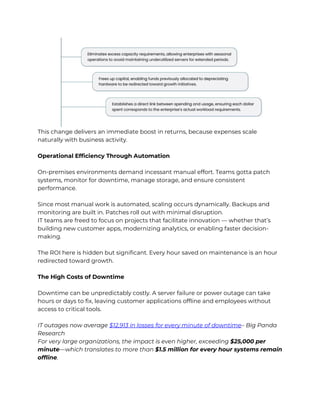
The ability to move from CapEx to OpEx is one of the most significant ROI
advantages of Azure Migration Services . You have an array of cloud billing models at
your disposal that you can easily align with actual consumption. So, how does this
really help?
This change delivers an immediate boost in returns, because expenses scale
naturally with business activity.
Operational Efficiency Through Automation
On-premises environments demand incessant manual effort. Teams gotta patch
systems, monitor for downtime, manage storage, and ensure consistent
performance.
Since most manual work is automated, scaling occurs dynamically. Backups and
monitoring are built in. Patches roll out with minimal disruption.
IT teams are freed to focus on projects that facilitate innovation — whether that’s
building new customer apps, modernizing analytics, or enabling faster decision-
making.
The ROI here is hidden but significant. Every hour saved on maintenance is an hour
redirected toward growth.
The High Costs of Downtime
Downtime can be unpredictably costly. A server failure or power outage can take
hours or days to fix, leaving customer applications offline and employees without
access to critical tools.
IT outages now average $12,913 in losses for every minute of downtime– Big Panda
Research
For very large organizations, the impact is even higher, exceeding $25,000 per
minute—which translates to more than $1.5 million for every hour systems remain
offline.
When these figures are mapped against a year of operations, the numbers often
dwarf the apparent savings of staying on-prem.
Azure Migration reduces these risks with:
• Built-in redundancy.
• Geo-replication across regions.
• Automatic failover systems.
Speed as a Competitive Advantage
Time-to-market carries measurable ROI. More often than not, on-prem
environments demand weeks of lead time for hardware procurement and
configuration before a new service can be launched. This delay translates directly
into lost opportunities.
By migrating to Microsoft Azure, businesses can shorten that cycle to days or even
hours:
• Templates allow rapid testing
• Ready-to-use services speed up deployment
• Scalable infrastructure supports faster rollouts
Security as a Safeguard to ROI
Security often gets treated as just another line in the budget. Yet its true value
shows up when something goes awry. One data breach can cost a fortune —
remediation, legal fees, regulatory penalties, and most importantly, the erosion of
customer trust all pile up fast.
On-premises security is relentless work. Systems need constant patching,
vulnerabilities must be addressed, and threats must be monitored every hour. Many
teams simply don’t have the bandwidth to cover everything or react immediately
when an incident occurs. The result is risk that grows quietly, sometimes unnoticed,
until it hits hard.
Azure Cloud Migration Services offer a different value proposition. With Microsoft’s
global security operations, real-time threat intelligence, and compliance coverage
across multiple geographies, the likelihood of a breach is reduced. Avoiding even a
single major incident can justify the financial case for migration.
Compliance and Audit Savings
Regulatory requirements demand ongoing attention, particularly in industries like
banking, healthcare, and insurance, to name a few. Errors can lead to serious
consequences, which is why teams need to keep certifications up to date. They need
to handle auditing tools effectively to make sure all processes conform to the
compliance norms in place.
Azure includes compliance-ready frameworks and detailed reporting as part of its
services. For CIOs and CFOs, this reduces the time and money spent on audits.
The ROI is measurable both in cost savings and in reduced risk exposure.
Energy Efficiency and Sustainability
Energy consumption in private data centers is not just a utility bill; it is a strategic
cost. With global focus on sustainability, organizations are being asked to show
carbon accountability.
By moving workloads to Azure, businesses inherit Microsoft’s energy-optimized data
centers that run on renewable sources.
This lowers direct energy expenses and strengthens ESG reporting. Investors and
customers increasingly reward organizations with strong sustainability credentials,
meaning ROI extends beyond balance sheets into market reputation.
Planning With the Azure Migration Tool
For many IT leaders, the challenge lies in predicting costs and outcomes before
migration. The Azure Migration Tool addresses this by mapping current workloads,
dependencies, and resource consumption. It provides an accurate forecast of what
those workloads will cost in Azure, factoring in scaling behavior and licensing.
This planning capability means financial decisions are made with data, not
estimates. Leaders can run different scenarios and zero in on the most economical
strategy.
Microsoft Azure Tools for Migration and Operations
Assessment and Planning
Azure Migrate lays the groundwork:
• Maps workloads, dependencies, and performance metrics.
• Identifies bottlenecks and potential risks with utmost ease.
• Chalks out an effective migration plan to curb downtime.
Paired with Azure Advisor:
• Right-sizes compute, storage, and network resources.
• Aligns capacity with actual usage patterns.
• Eliminates idle infrastructure and reduces costs.
Automation and Operational Efficiency
Azure Automation removes routine burdens from IT teams:
• Automates patch management and backup schedules.
• Orchestrates scaling pipelines for workloads.
• Frees IT staff to focus on innovation and strategic projects.
Cost Governance
Azure Cost Management + Billing provides fiscal visibility:
• Tracks budgets in real time.
• Flags unusual consumption patterns.
• Generates actionable insights for predictable cloud spending.
Hybrid and Multi-Cloud Control
Azure Arc simplifies complex environments:
• Centralizes management of on-premises and multi-cloud resources.
• Applies policies consistently across all workloads.
• Offers unified monitoring and clear performance visibility.
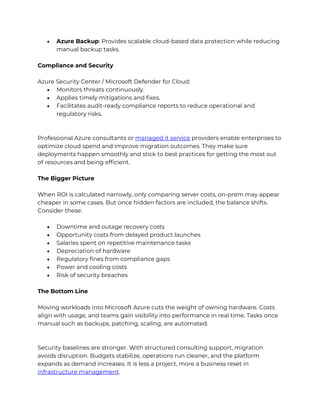
Resilience and Continuity
• Azure Site Recovery: Replicates critical workloads and manages failover
during outages.
• Azure Backup: Provides scalable cloud-based data protection while reducing
manual backup tasks.
Compliance and Security
Azure Security Center / Microsoft Defender for Cloud:
• Monitors threats continuously.
• Applies timely mitigations and fixes.
• Facilitates audit-ready compliance reports to reduce operational and
regulatory risks.
Professional Azure consultants or managed it service providers enable enterprises to
optimize cloud spend and improve migration outcomes. They make sure
deployments happen smoothly and stick to best practices for getting the most out
of resources and being efficient.
The Bigger Picture
When ROI is calculated narrowly, only comparing server costs, on-prem may appear
cheaper in some cases. But once hidden factors are included, the balance shifts.
Consider these:
• Downtime and outage recovery costs
• Opportunity costs from delayed product launches
• Salaries spent on repetitive maintenance tasks
• Depreciation of hardware
• Regulatory fines from compliance gaps
• Power and cooling costs
• Risk of security breaches
The Bottom Line
Moving workloads into Microsoft Azure cuts the weight of owning hardware. Costs
align with usage, and teams gain visibility into performance in real time. Tasks once
manual such as backups, patching, scaling, are automated.
Security baselines are stronger. With structured consulting support, migration
avoids disruption. Budgets stabilize, operations run cleaner, and the platform
expands as demand increases. It is less a project, more a business reset in
infrastructure management.
How Azure Migration Enhances Operational Efficiency and ROI.pdf