How Apex Predators Adapt and Sustain Ecosystem Stability
Explores apex predator adaptations across physical, behavioral, physiological, and ecological domains and their critical role in regulating ecosystems, supporting biodiversity, and the consequences of their decline.
How Apex Predators Adapt and Sustain Ecosystem Stability
1.
Maksudul
Shadat Akash
How ApexPredators Adapt and
Why Ecosystems Need Them
Apex predators are not merely powerful hunters. Their
physical, behavioral, physiological, and ecological
adaptations allow them to shape food webs, regulate
prey and mesopredators, and support biodiversity.
Akash MS. "Masters of survival: A mini-review of apex
predator adaptations." World Journal of Advanced Research and
Reviews (2026). DOI: 10.30574/wjarr.2026.31.1.1576
2.
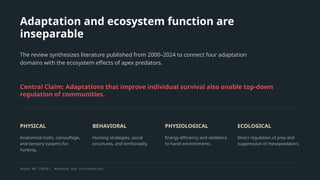
Adaptation and ecosystemfunction are
inseparable
The review synthesizes literature published from 2000–2024 to connect four adaptation
domains with the ecosystem effects of apex predators.
Central Claim: Adaptations that improve individual survival also enable top-down
regulation of communities.
PHYSICAL
Anatomical traits, camouflage,
and sensory systems for
hunting.
BEHAVIORAL
Hunting strategies, social
structures, and territoriality.
PHYSIOLOGICAL
Energy efficiency and resilience
to harsh environments.
ECOLOGICAL
Direct regulation of prey and
suppression of mesopredators.
Akash MS (2026). Methods and Introduction.
3.
Form follows function
Physicaladaptations are the foundational tools of an apex predator. They improve the capture
and processing of prey, reduce detection during ambush, and extend the predator’s perceptual
range.
ANATOMY
Sharp claws and robust skulls allow
predators to grasp, crush, and process
difficult prey efficiently.
Examples: Coconut crabs, durophagous crabs,
tyrannosaurids
CONCEALMENT
Camouflage coloration and patterns allow
predators to blend into environments,
facilitating ambush and avoiding detection.
SENSES
Acute sensory systems, such as enhanced
olfaction or echolocation, are paramount
for detecting prey across vast or complex
environments.
Examples: Tyrannosaurids (olfaction), Killer
whales (marine sensory)
Akash (2026), refs. 9–14; supporting studies: 10.1371/journal.pone.0166108, 10.1073/pnas.1600140113.
4.
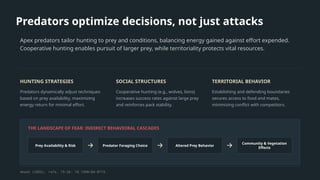
Predators optimize decisions,not just attacks
Apex predators tailor hunting to prey and conditions, balancing energy gained against effort expended.
Cooperative hunting enables pursuit of larger prey, while territoriality protects vital resources.
HUNTING STRATEGIES
Predators dynamically adjust techniques
based on prey availability, maximizing
energy return for minimal effort.
SOCIAL STRUCTURES
Cooperative hunting (e.g., wolves, lions)
increases success rates against large prey
and reinforces pack stability.
TERRITORIAL BEHAVIOR
Establishing and defending boundaries
secures access to food and mates,
minimizing conflict with competitors.
THE LANDSCAPE OF FEAR: INDIRECT BEHAVIORAL CASCADES
Prey Availability & Risk Predator Foraging Choice Altered Prey Behavior
Community & Vegetation
Effects
Akash (2026), refs. 15–26; 10.1890/04-0719.
5.
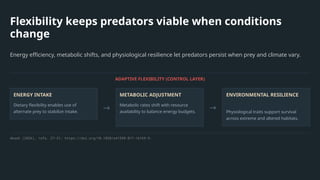
Flexibility keeps predatorsviable when conditions
change
Energy efficiency, metabolic shifts, and physiological resilience let predators persist when prey and climate vary.
ADAPTIVE FLEXIBILITY (CONTROL LAYER)
ENERGY INTAKE
Dietary flexibility enables use of
alternate prey to stabilize intake.
→
METABOLIC ADJUSTMENT
Metabolic rates shift with resource
availability to balance energy budgets.
→
ENVIRONMENTAL RESILIENCE
Physiological traits support survival
across extreme and altered habitats.
Akash (2026), refs. 27–31; https://doi.org/10.1038/s41598-017-16169-9.
6.
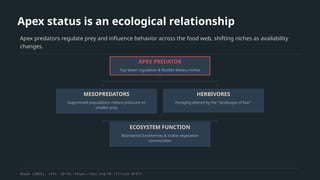
Apex status isan ecological relationship
Apex predators regulate prey and influence behavior across the food web, shifting niches as availability
changes.
APEX PREDATOR
Top-down regulation & flexible dietary niches
MESOPREDATORS
Suppressed populations reduce pressure on
smaller prey
HERBIVORES
Foraging altered by the "landscape of fear"
ECOSYSTEM FUNCTION
Maintained biodiversity & stable vegetation
communities
Akash (2026), refs. 28–42; https://doi.org/10.1111/oik.01977.
7.
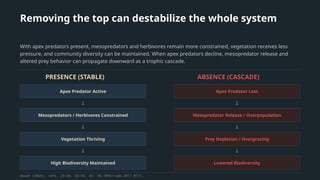
Removing the topcan destabilize the whole system
With apex predators present, mesopredators and herbivores remain more constrained, vegetation receives less
pressure, and community diversity can be maintained. When apex predators decline, mesopredator release and
altered prey behavior can propagate downward as a trophic cascade.
PRESENCE (STABLE)
Apex Predator Active
↓
Mesopredators / Herbivores Constrained
↓
Vegetation Thriving
↓
High Biodiversity Maintained
ABSENCE (CASCADE)
Apex Predator Lost
↓
Mesopredator Release / Overpopulation
↓
Prey Depletion / Overgrazing
↓
Lowered Biodiversity
Akash (2026), refs. 25–26, 32–34, 42; 10.1098/rspb.2017.0111.
8.
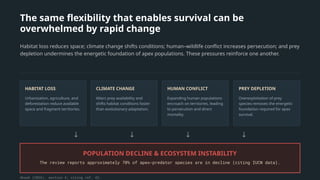
The same flexibilitythat enables survival can be
overwhelmed by rapid change
Habitat loss reduces space; climate change shifts conditions; human–wildlife conflict increases persecution; and prey
depletion undermines the energetic foundation of apex populations. These pressures reinforce one another.
HABITAT LOSS
Urbanization, agriculture, and
deforestation reduce available
space and fragment territories.
CLIMATE CHANGE
Alters prey availability and
shifts habitat conditions faster
than evolutionary adaptation.
HUMAN CONFLICT
Expanding human populations
encroach on territories, leading
to persecution and direct
mortality.
PREY DEPLETION
Overexploitation of prey
species removes the energetic
foundation required for apex
survival.
↓ ↓ ↓ ↓
POPULATION DECLINE & ECOSYSTEM INSTABILITY
The review reports approximately 70% of apex-predator species are in decline (citing IUCN data).
Akash (2026), section 4; citing ref. 43.
9.
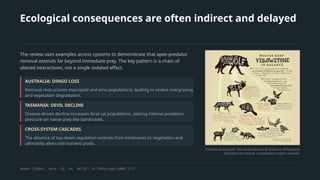
Ecological consequences areoften indirect and delayed
The review uses examples across systems to demonstrate that apex-predator
removal extends far beyond immediate prey. The key pattern is a chain of
altered interactions, not a single isolated effect.
AUSTRALIA: DINGO LOSS
Removal restructures macropod and emu populations, leading to severe overgrazing
and vegetation degradation.
TASMANIA: DEVIL DECLINE
Disease-driven decline increases feral cat populations, placing intense predation
pressure on native prey like bandicoots.
CROSS-SYSTEM CASCADES
The absence of top-down regulation extends from herbivores to vegetation and
ultimately alters soil nutrient pools.
Contextual example: The reintroduction of wolves to Yellowstone
illustrates the reverse, a restorative trophic cascade.
Akash (2026), refs. 25, 34, 48–52; 10.1098/rspb.2006.3711.
10.
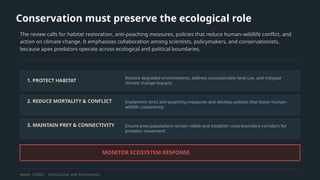
Conservation must preservethe ecological role
The review calls for habitat restoration, anti-poaching measures, policies that reduce human–wildlife conflict, and
action on climate change. It emphasizes collaboration among scientists, policymakers, and conservationists,
because apex predators operate across ecological and political boundaries.
1. PROTECT HABITAT
Restore degraded environments, address unsustainable land use, and mitigate
climate change impacts.
2. REDUCE MORTALITY & CONFLICT Implement strict anti-poaching measures and develop policies that foster human-
wildlife coexistence.
3. MAINTAIN PREY & CONNECTIVITY Ensure prey populations remain viable and establish cross-boundary corridors for
predator movement.
MONITOR ECOSYSTEM RESPONSE
Akash (2026), Conclusion and Discussion.
11.
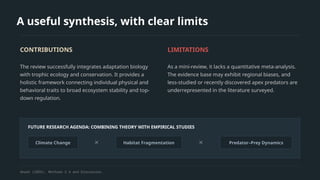
A useful synthesis,with clear limits
CONTRIBUTIONS
The review successfully integrates adaptation biology
with trophic ecology and conservation. It provides a
holistic framework connecting individual physical and
behavioral traits to broad ecosystem stability and top-
down regulation.
LIMITATIONS
As a mini-review, it lacks a quantitative meta-analysis.
The evidence base may exhibit regional biases, and
less-studied or recently discovered apex predators are
underrepresented in the literature surveyed.
FUTURE RESEARCH AGENDA: COMBINING THEORY WITH EMPIRICAL STUDIES
Climate Change ✕ Habitat Fragmentation ✕ Predator–Prey Dynamics
Akash (2026), Methods 2.4 and Discussion.
12.
Protecting apex predatorsprotects system resilience
KEY TAKEAWAYS
1 Apex-predator adaptations span body, behavior,
physiology, and food-web roles.
2 Their presence stabilizes prey, limits mesopredators, and
supports diversity.
3 Declines can trigger cascades from herbivores to
vegetation.
4 Conservation must protect habitat, connectivity, prey, and
coexistence together.
SELECTED REFERENCES
Akash MS. Masters of survival: A mini review (2026).
‑
Ripple et al. Status and ecological effects of the world’s largest
carnivores (2014).
Ritchie & Johnson. Predator interactions, mesopredator release and
conservation (2009).
Morris & Letnic. Removal of an apex predator initiates a trophic
cascade (2017).
Johnson, Isaac & Fisher. Rarity of a top predator triggers
continent wide collapse (2006).
‑
"THE STRONGEST PREDATORS ARE ALSO AMONG THE MOST CONSEQUENTIAL
ECOSYSTEM ENGINEERS."
THANK YOU!