Ganga Institute ofHealth Sciences
SF No.442 Post, NGGO Colony, Vattamalaipalayam, Coimbatore, Tamil Nadu 641022
Mrs. Yositha.J
Nursing Tutor
Department of Nursing Foundation
GIHS
DEFINITION
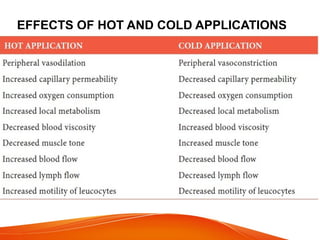
HOT APPLICATION
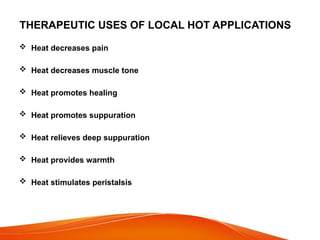
Hot applicationis the application of hot
agent, warmer than skin either in a moist or
dry form on the surface of the body to
relieve pain and congestion, to provide
warmth, to promote suppuration, to promote
healing, to decrease muscle tone and to
softens the exudates.
4.
DEFINITION
COLD APPLICATION
Cold applicationis the application of cold
agent, cooler than skin either in a moist or
dry form on the surface of the body to
relieve pain and body temperature, to
anaesthetize an area, to check hemorrhage,
to control growth of bacteria, to prevent
gangrene, to prevent oedema and reduce
inflammation.
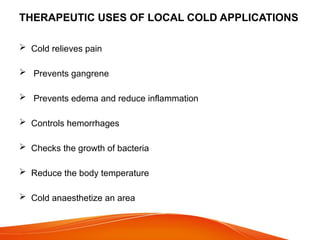
THERAPEUTIC USES OFLOCAL COLD APPLICATIONS
Cold relieves pain
Prevents gangrene
Prevents edema and reduce inflammation
Controls hemorrhages
Checks the growth of bacteria
Reduce the body temperature
Cold anaesthetize an area
10.
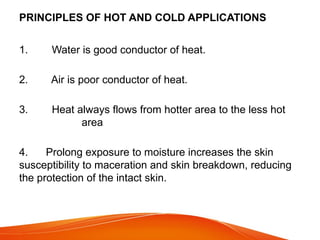
PRINCIPLES OF HOTAND COLD APPLICATIONS
1. Water is good conductor of heat.
2. Air is poor conductor of heat.
3. Heat always flows from hotter area to the less hot
area
4. Prolong exposure to moisture increases the skin
susceptibility to maceration and skin breakdown, reducing
the protection of the intact skin.
11.
PRINCIPLES OF HOTAND COLD APPLICATIONS
5. Moisture left on the skin cause rapid cooling due to
evaporation of the moisture.
6. Presence of steam increases the temperature of the
hot application
7. Oil acts as the insulator and delays the transmission
of the heat.
8. Woolen materials absorb moisture slowly, but hold the
moisture longer and cold off less quickly than the cotton
materials.
12.
PRINCIPLES OF HOTAND COLD APPLICATIONS
9. When immersed in water the body becomes
buoyant therefore the exercises are performed under water
with less effort.
10. The temperature tolerance varies with individuals and
according to the site and area covered.
11. The end organs of the sensory nerves of the skin
convey the sensation of cold, heat pain and pressure. The
sensation is interpreted in the brain.
12. Friction produces heat
13.
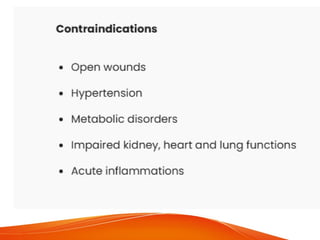
CONTRAINDICATIONS OF HOTAPPLICATIONS
· Heat is not used in malignancies
· Heat is not used in patients with heart, kidney and
lung diseases
· Should not used in acute inflamed areas.
· Should not be applied on patients with paralysis.
· Should not be applied on open wounds
14.
CONTRAINDICATIONS OF COLDAPPLICATIONS
Cold should not be applied on clients who are in the stage of shock and
collapse
Cold should not be applied when there is edema.
Cold should not be applied on clients with circulatory disorders.
Cold should not be applied on patients with decreased sensation
Patients with shivering and very low temperature,
Cold should not be applied when there is infected wound.