Hospital Pharmacy andits Organization – Part 1
NAME AND AFFILIATION OF FACULTY-IN-CHARGE:
Dr. VINAY B.C.
ASSISTANT PROFESSOR
DEPARTMENT OF PHARMACY PRACTICE
BAPUJI PHARMACY COLLEGE
2.
Content:
• Introduction
• Definitionof hospital pharmacy
• Functions of hospital pharmacy
• Functions of hospital pharmacist
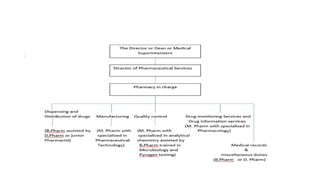
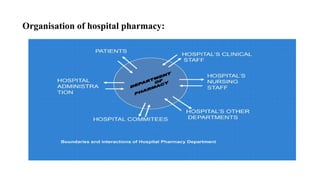
• Organisation of hospital pharmacy
• Reference
3.
Introduction:
• In the1990’s the American Pharmaceutical Association (APhA)
developed a modern, widely acceptable definition to pharmacy.
• They defined pharmacy as a “Patient oriented health service that
applies a scientific knowledge to improve health and promote health
through assurance of safety and efficacy in drug usage and drug
related therapy”.
4.
• Definition ofHospital Pharmacy: Hospital pharmacy is a department
of the hospital. Traditionally activities like procurement, preservation,
storage, manufacturing, packaging, quality control, dispensing and
distribution of medications to the hospitalised and outpatients were
carried out by hospital pharmacies through professionally competent
and legally qualified pharmacists working in the hospital services.
5.
Functions of hospitalpharmacy:
• Preparation, modification and publication of the Hospital Formulary.
• To make policies and take the decisions as per the recommendations and
suggestions of the Pharmacy and Therapeutic Committee (P & TC).
• Procurement, storage, inventory control and distribution of drugs for the hospital.
• Dispensing of medicines and other pharmaceutical preparations for inpatients,
outpatients and discharged patients.
• The concept of Ward Pharmacy (WP) WP concepts were developed with the
objective of providing safe and timely supply of medicines in wards in response
to medical and nursing demands.
6.
• Compounding ofdrugs, chemicals and other pharmaceutical
preparations for inpatients, outpatients and discharged patients.
• Maintenance of a running stock account for all dispensed items with
special importance for alcoholic items, restricted medicines and
narcotic preparations.
• Manufacturing, packing and distribution of certain selected categories
of drugs like IV fluids surgical irrigation fluids, dialysis solutions,
tablets, capsules, ointments etc. for in house use.
7.
• Re-packing andpre-packing of drugs and maintenance of unit dose programme.
• Quality and quality control and quality drugs assurance of pharmaceuticals
purchased from the market and those items, which are prepared in the hospital
pharmacy.
• The drug information service for the health care professionals has always been
an essential part of the hospital pharmacy services.
• Educational and training hospital programmes.
• Drug monitoring, toxicity studies and medication auditing.
• Pharmaceutical care activities like patient education and medication counselling.
8.
• Research activities.
•Performing therapeutic equivalence assessments on drugs.
• Teaching pharmacy students and giving training to the new and in
service pharmacists.
• Preparation of periodical reports about the working of hospital
pharmacy services.
9.
Functions of ahospital pharmacist:
• To provide and evaluate pharmaceutical services and thereby supporting
the medical staff, with due consideration of the objectives and policies of
the hospital.
• To draw a plan for hospital pharmacy administration and to evolve
responsibilities of each category of personnel involved in pharmaceutical
services such as assistant pharmacist, storekeeper, nursing staff etc.
• To establish liaison between administrative authorities (Director
Superintendent, Managing Trustee etc.) and medical doctors who will
order medicines and ancillary products in the hospital.
10.
• To estimatethe requirements for the department and enforce the
policies and procedures for the recruitment of adequate and competent
staff.
• To provide the means and methods by which personnel can work with
other groups in interpreting the objectives and policies of the hospital.
• To develop and maintain an effective system of clinical and
administrative records and reports.
11.
• To Participateand adhere to the safety programs of the hospital.
• To provide and to put into practice a programme of continuing
education of all personnel.
• To participate and/or facilitate all educational programmes which
include student experiences in the department.
• To participate in and adhere to the safety programme of the hospital.
Reference:
• A textbookof hospital pharmacy by Ramesh K.Goyal, Eleventh
edition, Chapter 3 - The Hospital pharmacy and its organisation, Page
no: 21-28.
• Practice of Hospital, Clinic and Community Pharmacy by Mohd. Aqil,
Chapter 3 – Hospital pharmacy, Page no: 21-35.
• A textbook of pharmacy practice by K.G. Revikumar and B.D.
Miglani Chapter 2-Hospital pharmacy, Page no: 39-110.
• Hospital and clinical pharmacy by Urwashi K. Tiwari, Second edition,
Chapter 2- Hospital Pharmacy, Page no: 12- 19.
Staff
Hospital pharmacy andits
organization-Part II
NAME AND AFFILIATION OF FACULTY-IN-CHARGE:
Dr. VINAY B.C.
ASSISTANT PROFESSOR
DEPARTMENT OF PHARMACY PRACTICE
BPC
17.
Content:
• Location andlayout
• Staff requirements
• Qualifications and abilities required for a hospital pharmacist
18.
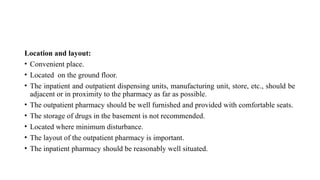
Location and layout:
•Convenient place.
• Located on the ground floor.
• The inpatient and outpatient dispensing units, manufacturing unit, store, etc., should be
adjacent or in proximity to the pharmacy as far as possible.
• The outpatient pharmacy should be well furnished and provided with comfortable seats.
• The storage of drugs in the basement is not recommended.
• Located where minimum disturbance.
• The layout of the outpatient pharmacy is important.
• The inpatient pharmacy should be reasonably well situated.
19.
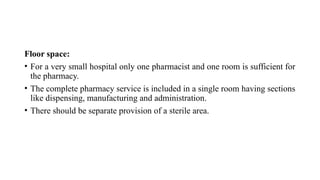
Floor space:
• Fora very small hospital only one pharmacist and one room is sufficient for
the pharmacy.
• The complete pharmacy service is included in a single room having sections
like dispensing, manufacturing and administration.
• There should be separate provision of a sterile area.
20.
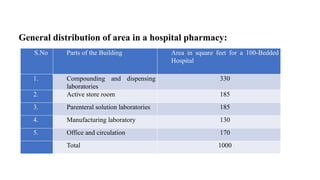
General distribution ofarea in a hospital pharmacy:
S.No Parts of the Building Area in square feet for a 100-Bedded
Hospital
1. Compounding and dispensing
laboratories
330
2. Active store room 185
3. Parenteral solution laboratories 185
4. Manufacturing laboratory 130
5. Office and circulation 170
Total 1000
21.
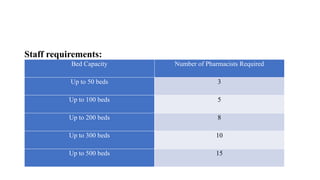
Staff requirements:
Bed CapacityNumber of Pharmacists Required
Up to 50 beds 3
Up to 100 beds 5
Up to 200 beds 8
Up to 300 beds 10
Up to 500 beds 15
22.
Qualifications and abilitiesrequired for a hospital pharmacist:
A qualified and competent hospital pharmacist should possess the following
abilities:
• Depth and thorough knowledge of the pharmaceutical sciences subjects.
• Good information of the operation and protocols used in pharmacy.
• Ability to understand written prescription, formulary and medication
history.
• Knowledge to understand the composition and therapeutic uses of a large
variety of medicines.
23.
• Ability tomeasure accurately and maintain proper packaging of drugs.
• Ability to coordinate well with the physicians and other health personnel.
• Ability to use computer programmes and internet services for day-to-day
office assignments.
• Ability to provide accurate decision-making in professional duties.
• Good physical and mental health to meet the demands of the position.
24.
Reference:
• A textbookof hospital pharmacy by Ramesh K.Goyal, Eleventh edition,
Chapter 3 - The Hospital pharmacy and its organisation, Page no: 21-28.
• Practice of Hospital, Clinic and Community Pharmacy by Mohd. Aqil,
Chapter 3 – Hospital pharmacy, Page no: 21-35.
• A textbook of pharmacy practice by K.G. Revikumar and B.D. Miglani
Chapter1-Hospital pharmacy, Page no: 39-110.
• Hospital and clinical pharmacy by Urwashi K. Tiwari, Second edition,
Chapter 2- Hospital Pharmacy, Page no: 12- 19.
• Hospital and clinical pharmacy by Randhir Singh Dahiya, Second edition,
Chapter 1- Hospital Organisation, Page no: 1.1- 1.24.
Staff
Hospital pharmacy andits
organization-Part III
NAME AND AFFILIATION OF FACULTY-IN-CHARGE:
Dr. VINAY B.C.
ASSISTANT PROFESSOR
DEPARTMENT OF PHARMACY PRACTICE
BPC
27.
Content:
• Functions andresponsibilities of the head of the department pharmacy
and his staff
• Inpatient or Indoor Pharmacists Responsibilities
• Outdoor pharmacists responsibilities.
28.
Inpatient or IndoorPharmacists Responsibilities:
• Central Dispensing Area
• Patient Care Areas
• Direct Patient care Areas
29.
Central Dispensing Area:
•To ensure that all drugs are stored dispensed correctly
• To check the accuracy of the dosages prepared
• To keep proper records and preparation of bills
• To co-ordinate the over all pharmaceutical needs of the "patient care"
• To ensure that the established policies and procedures
30.
• To ensurethat the established policies and procedures
• To communicate with all pharmacy staff regarding new developments
• To ensure that new personnel in his section are properly trained in the
policies
31.
Patient Care Areas:
• To maintain a liaison with other health care professionals
• Medication review
• To provide instruction and assistance to the junior pharmacists
32.
Direct Patient careAreas
• Identification of drugs brought into the hospital by the patient
• Obtaining patients medical history and
• To assist in the selection of drugs products and their identities
• To monitor patients total drugs therapy
• Counselling patients
• General responsibilities
Reference:
• A textbookof hospital pharmacy by Ramesh K.Goyal, Eleventh
edition, Chapter 3 - The Hospital pharmacy and its organisation, Page
no: 21-28.
• Practice of Hospital, Clinic and Community Pharmacy by Mohd. Aqil,
Chapter 3 – Hospital pharmacy, Page no: 21-35.
• A textbook of pharmacy practice by K.G. Revikumar and B.D.
Miglani Chapter1-Hospital pharmacy, Page no: 39-110.
 Most read
 Most read
 Most read