Presented by:
Deepa Manandhar
Lecturer
SMAH, CON
Homeopathy:
Content:
 Introduction of homeopathy
 History of homeopathy
 Preparation of homeopathy
 Uses of homeopathy
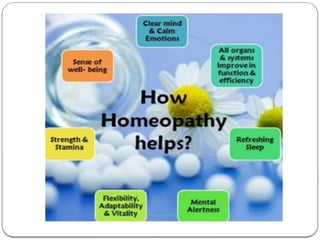
 Beneficial effects of homeopathy
 Mechanism of homeopathy
 Side effects of homeopathy
 Related article
 Summary and references
Introduction of homeopathy:
 Homeopathy is derived from Greek word “Homos- similar”
and “pathos means suffering or disease”.
 Homeopathy, or Homeopathic Medicine, is the practice of
medicine that embraces a holistic, natural approach to the
treatment of the sick.
 Homeopathy is holistic because it treats the person as a
whole, rather than focusing on a diseased part or a labeled
sickness.
Introduction…..
 Homeopathy is a medical system that was developed in
Germany more than 200 years ago. It is based on two
unconventional theories:
 “Like cures like”—the notion that a disease can be cured by a
substance that produces similar symptoms in healthy people
 “Law of minimum dose”—the notion that the lower the dose
of the medication, the greater its effectiveness. Many

homeopathic products are so diluted that no molecules of the
original substance remain.
History of homeopathy:
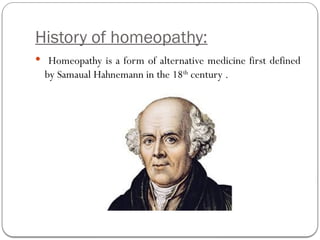
 Homeopathy is a form of alternative medicine first defined
by Samaual Hahnemann in the 18th
century .
History of Homeopathy…..
 It claims that a substance that causes the symptoms of a
disease in healthy people would cure similar symptoms in
sick people.
 Hahnemann came to believe that all effective drugs produce
symptoms in healthy individuals similar to those of the
diseases that they treat, in accord with the "law of similars"
that had been proposed by ancient physicians.
History of homeopathy…..:
 Hahnemann began to test what effects substances produced in
humans, a procedure that would later become known as
"homeopathic proving".
 He published a collection of provings in 1805, and a second
collection of 65 preparations appeared in his book, Materia
Medica Pura, in 1810.
 Homeopathy achieved its greatest popularity in the 19th
century. It was introduced to the United States in 1825 by Hans
Birch Gram, a student of Hahnemann.
History of homeopathy…..:
 The first homeopathic school in the US opened in 1835, and in
1844, the first US national medical association, the
American Institute of Homeopathy, was established.
 In 19th century, dozens of homeopathic institutions appeared in
Europe and the United States, and by 1900, there were 22
homeopathic colleges and 15,000 practitioners in the United
States.
 The reason of growing popularity of homeopathy was its apparent
success in treating people suffering from infectious disease
epidemics.
History of homeopathy….
 During 19th-century epidemics of diseases such as
cholera, death rates in homeopathic hospitals were often
lower than in conventional hospitals, where the
treatments used at the time were often harmful and did
little or nothing to combat the diseases.
History of homeopathy…..:
 In 20th
century, the Nazi regime in Germany was fascinated by
homeopathy, and spent large sums of money on researching its
mechanisms, but without gaining a positive result.
 In the United States, the Food, Drug, and Cosmetic Act of 1938
(sponsored by Royal Copeland, a Senator from New York and
homeopathic physician) recognized homeopathic preparations as
drugs.
 Bruce Hood has argued that the increased popularity of homeopathy
in recent times may be due to the comparatively long consultations
practitioners are willing to give their patients, and to an irrational
preference for "natural" products, which people think are the basis
of homeopathic preparations.
History of homeopathy…..:
 In 21st
century, A series of meta analysis has further shown that
therapeutic claims of Homeopathy lack scientific justification.
 In a 2010 report, the Science and Technology Committee of the
United Kingdom House of Commons recommended that
homeopathy should no longer be a beneficiary due its lack of
scientific credibility.
 In March 2015, the National Health and Medical Research Council
of Australia published an information paper on Homeopathy and
findings of the report were 'there are no health conditions for
which there is reliable evidence that homeopathy is effective".
 But even though homeopathy is praticised throughout the world.
Preparation of homeopathic medicine:
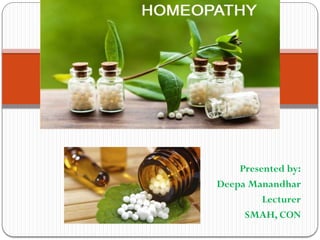
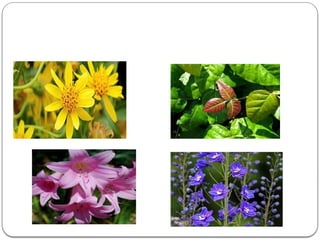
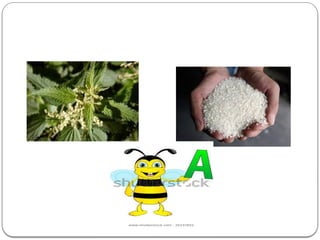
 Homeopathic products come from plants such as red onion,
arnica (mountain herb), poison ivy, belladonna (deadly
nightshade), and stinging nettle, minerals (such as white
arsenic), or animals (such as crushed whole bees).
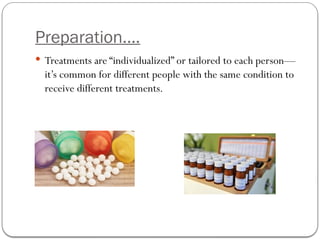
 Homeopathic products are often made as sugar pellets to be
placed under the tongue; they may also be in other forms,
such as ointments, gels, drops, creams, and tablets.
Preparation….
 Treatments are “individualized” or tailored to each person—
it’s common for different people with the same condition to
receive different treatments.
Uses of homeopathy:
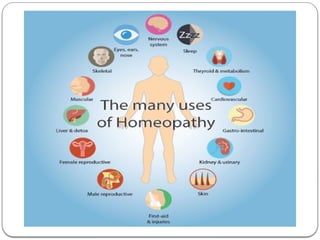
 Homeopathy can be used at every age and for a great number
of diseases and complaints.
 Chronic illness, recurring complaints
 Lack of energy, sleeplessness, stress, burn-out
 Menopause symptoms, menstruation complaints
 Headaches
 Ear infections
 Skin break-outs
 Behavioral problems in children
 Learning problems and insecurity
Beneficial Effects of Homeopathy:
 Respiratory issues like asthma, upper respiratory tract infections,
chronic rhinitis, and cough
 Skin conditions like dermatitis, eczema
 Mental ailments like anxiety, stress, and depression.
 Allergies like hay fever, skin allergies, and food allergies,
 Musculoskeletal issues like arthritis, osteoarthritis, rheumatoid
arthritis, fibromyalgia, and multiple sclerosis
 Digestive ailments such as irritable bowel syndrome and Crohn’s
disease
 Dental problems such as tooth extraction, gum abscess, toothache
with decay, swelling in the gums, and pain after dental surgery
Beneficial effects…..
 Migraines and headaches
 High blood pressure
 Ear infections
 Chronic fatigue
 Menopausal symptoms and premenstrual syndrome
How Does It Work?
 A basic belief behind homeopathy is “like cures like.”
 For example, red onion makes your eyeswater so it is used in
homeopathic remedies for allergies.
 Treatments for other ailments are made from poison ivy,
white arsenic, crushed whole bees, and an herb called arnica.
 Homeopathic doctors (who also are called “homeopaths”)
weaken these ingredients by adding water or alcohol. Then
they shake the mixture as part of a process called
“potentization” which transfers the healing essence.
 Homeopaths also believe that the lower the dose, the more
powerful the medicine. In fact, many of these remedies no
longer contain any molecules of the original substance.They
come in a variety of forms, like sugar pellets, liquid drops,
creams, gels, and tablet.
Common side effects
 Constipation
 Decreased Sweating
 Nausea
 Vomiting
Rare side effects
 BlurredVision
 Decreased Breast Milk Production
 Dry Mouth
 Feel LikeThrowing Up
 Decrease in blood pressure on standing
 Confusion
 Increase in pressure in eye
 Rashes and inflammation of the skin
Side effects……
 Dilated pupil
 Difficult or painful urination
 Feeling weak
 Headache
 Loss of memory
 Drowsiness
Research Article:
 Clare Ralter, Katy Cooper et al conducted a study on “Prevalence
of Homeopathy use by the general population worldwide;
 Systematic review was done and published on May 2017 and
Studies were identified via database searches to October 2015.
 Study quality was assessed using a six-item tool.All estimates were
in the context of a survey which also reported prevalence of any
complementary and alternative medicine use.
 This review summarizes 12-month prevalence of homeopathy use
from surveys conducted in eleven countries (USA, UK, Australia,
Israel, Canada, Switzerland, Norway, Germany, South Korea,
Japan and Singapore).
Article….:
 Each year a small but significant percentage of these general
populations use homeopathy. This includes visits to
homeopaths as well as purchase of over-the-counter
homeopathic medicines.
References:
 Kozhier;s and Erb’s Fundamental of Nursing concept,
process and pratice; 10th
edition
 Rai Lalita; Nursing Concepts Theories and Principles;2nd
edition
 https://cuppingresource.com/homeopathy-benefits-
formulation-risks-and-contraindications/
 https://www.britishhomeopathic.org/homeopathy/what-is-
homeopathy/
 https://nccih.nih.gov/health/homeopathy
 https://homeopathyusa.org/homeopathic-medicine.html
 http://www.homeopathiejavelle.nl/homeopathy-indications
-and-symptoms/
References…..
 https://www.britishhomeopathic.org/charity/how-we-can-
help/articles/homeopathic-medicines/p/a-closer-look-at-pu
lsatilla/
 https://www.webmd.com/drugs/2/drug-153567/homeop
athic-calcium-belladonna-alk-chamomile-oral/details/list-sid
eeffects
 https://www.webmd.com/balance/what-is-homeopathy#1
 https://www.sciencedirect.com/science/article/pii/
S1475491617300231