HISTORY, DEVELOPMENT &
SCOPE OF
PAHRMACOGNOSY
Nature always stands as a golden mark to exemplify the outstanding
phenomenon of symbiosis.
 The biotic (living things) and abiotic elements (water, light,
radiation, temperature, humidity, atmosphere, and soil) of nature are all
interdependent.
 The plants are indispensible to man for his life.
 The three important necessities of life – food, clothing and shelter and a host
of other useful products are supplied to him by the plant kingdom.
 Nature has provided a complete store house of remedies to cure all ailments of
mankind.
 The knowledge of drugs has accumulated over thousands of years as a result
mans inquisitive nature so that today we possess many effective means of ensuring
health care.
The vegetable kingdom was already there when man made his appearance on
Earth. As man began to acquire closure acquaintance with his environment, he
began to know more about plants, as there were the only curative agents he had.
he progressed and evolved, he was not only able to sort on as to which plant served
for eating and which did not, but he went beyond and began to associate curative
characteristics with certain plants, classifying them as painkillers, febrifuge,
antiphlogistic, soporific and so on.
It is like trial and error and possibly some deaths in the beginning also, but as it
happened antidotes against poisons were also discovered.
As we shall see later, drug substitutes were also forthcoming.
All these states of affairs indicate that the origin of pharmacognosy, i.e. the study of
natural curative agents points towards the accent of human beings on mother earth,
and its historical account makes it clear that pharmacognosy in its totality is not the
work of just one or two continental areas but the overall outcome of the steadfast
of many of the bygone civilizations like the Chinese, Egyptian, Indian, Persian,
Babylonian, Assyrian and many more.
 Many of today's wonderful modern drugs find their roots in the medicine
developed by the tribal traditions in the various parts of the world.
PHARMACOGNOSY
Plants have universal role in the treatment of diseases in the major systems of medicine.
 The word "Pharmacognosy" derived from the Greek word

 "Pharmakon“ means a drug, or medicine.
"gignosco“ means to acquire knowledge of
 Pharmacognosy is defined as a branch of bioscience which treats in detail medicinal
and related products of crude or primary type obtained from plant, animal, marine,
microbial and mineral origins.
 It encompasses the knowledge of the history, distribution, cultivation, collection,
processing for market and preservation, the study of sensory, physical,
chemical and structural characters and the uses of crude drugs.
 It also includes study of other materials used in pharmacy such as suspending,
disintegrating and flavouring agents, filtering aids, etc. and substances like
antibiotics, allergens, hallucinogenic and poisonous plants, immunizing
agents, pesticides, raw materials for the production of oral contraceptives, etc.
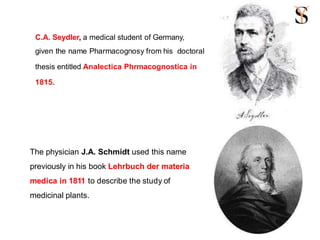
C.A. Seydler, a medical student of Germany,
given the name Pharmacognosy from his doctoral
thesis entitled Analectica Phrmacognostica in
1815.
The physician J.A. Schmidt used this name
previously in his book Lehrbuch der materia
medica in 1811 to describe the study of
medicinal plants.
CRUDE
DRUGS
 Crude drugs are plants or animals or their parts which after collection are
subjected only to drying or making them into transverse or longitudinal slices or
peeling them in some cases.
 They are vegetable or animal drugs that consist of natural substances that have
undergone only the processes of collection and drying.
 The term natural substances refers to those substances found in nature, such as
 Whole plants or organs of plants, e.g. leaves, flowers, seeds, and barks, or
vegetable saps, extracts and secretions
 Whole animals; glands or other animal organs, extracts, secretions; that have
not had changes made in their molecular structure (as found in nature)
CRUDE
DRUGS
 Also, means any product that has not been advanced in value or improved in
condition by grinding, chipping, crushing, distilling, evaporating, extracting, artificial
mixing with other substance or by any other process or treatment beyond what is
essential to its proper packing and the prevention of decay or deterioration pending
in manufacture.
 Crude drugs are used infrequently as therapeutic agents; more often their chief
principles (derivatives or extractives
separated by various means.
 Sources of Crude Drugs:
which contains active constituents) are
o Plant sources, e.g. Senna, Digitalis, Datura, Cascara, Cinchona, Clove,
Opium, etc.
musk,
o
o
o Animal sources, e.g. cochineal, cantharidin, honey, cod liver oil,
thyroxin, etc.
Marine sources, e.g. sponges, red algae, agar, etc.
Mineral sources, e.g. talc, kaolin, kieselguhr, etc.
NATURAL
PRODUCT
A natural product is a substance obtained from a natural source.
 A crude drug , e.g. Senna, Cascara, Cinchona, etc.
 A galenical preparation of a crude drug e.g. extracts and tinctures,
 A pure compound, e.g. morphine, atropine, digoxin, etc..
 A semithynthetic product, e.g. etoposide, teniposide, hyoscine
bromide etc.
butyl
USES OF NATURALPRODUCTS
 As drugs for the treatment of a wide range of diseases, e.g.
morphine, atropine, digoxin, hormones, antibiotics, etc.
 As pharm. aids in pharm. industry, e.g. suspending & emulsifying
agents, suppository bases, binders, excipients, sweetening &
colouring agents, etc.
 In cosmetics as flavouring & colouring agents, etc.
 In culture media for the propagation of M.O.
laboratories & biotechnology.
in microbiology
 General uses e.g. in food industries, as dusting powders, as
indicators and in perfumery.
PHARMACO
POEIAS
 Government is aiming to standardize the quality, efficacy and safety of drugs in order
that many traditional herbs meet legal requirements of different countries.
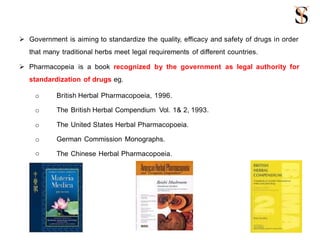
 Pharmacopeia is a book recognized by the government as legal authority for
standardization of drugs eg.
o British Herbal Pharmacopoeia, 1996.
o The British Herbal Compendium Vol. 1& 2, 1993.
o The United States Herbal Pharmacopoeia.
o German Commission Monographs.
o The Chinese Herbal Pharmacopoeia.
MONOG
RAPH
The descriptive material pertaining to any of the drugs in the Pharmacopoeia
is known as the monograph.
In the monograph of a crude drug, the following information are generally
covered:
English, Arabic, Latin, French names, definition, description, special condition
for collection or preparation for the market, identity tests, tests for adulterants,
method of assay, special storage requirements, dose , natural or biological
origin.
OFFICIAL DRUG is one that is listed and described as being a definite
therapeutic agent in the pharmacopoeia.
UNOFFICIAL DRUG is that one that are not recognized in the pharmacopoeia
and is used as therapeutic agent.
HISTORY OF
PHARMACOGNOSY
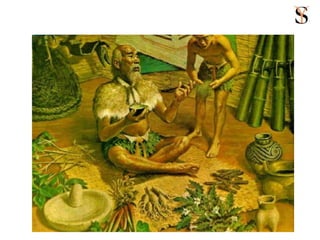
 In early period, primitive man went in search of food and ate at random, plants or
their parts like tubers, fruits, leaves etc.
 If no harmful effects observed, they were taken as edible materials and they
show any harmful effects they were considered as inedible materials.
 If it caused diarrhoea it was used as purgative, if it caused vomiting it was used as
emetic and if it was found poisonous and death was caused, he used it as arrow
poison.
 The knowledge was empirical and was obtained by trial and error.
 He used drugs as such or as their infusions and decoctions.
 The history of herbal medicines is as old as human civilization.
 The documents, many of which are of great antiquity, revealed that plants were
used medicinally in China, India, Egypt and Greece long before the beginning of
the Christian era.
ANCIENT
EGYPT
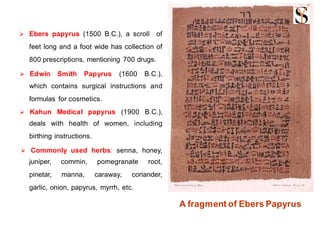
 Ebers papyrus (1500 B.C.), a scroll of
feet long and a foot wide has collection of
800 prescriptions, mentioning 700 drugs.
 Edwin Smith Papyrus (1600 B.C.),
which contains surgical instructions and
formulas for cosmetics.
 Kahun Medical papyrus (1900 B.C.),
deals with health of women, including
birthing instructions.
 Commonly used herbs: senna, honey,
juniper, commin, pomegranate root,
pinetar, manna, caraway, coriander,
garlic, onion, papyrus, myrrh, etc.
A fragment of Ebers Papyrus
ANCIENT
CHINA
 In china, many medicinal plants had been in use since 5000 B.C.
 The oldest known herbal, PenT-sao or Native Herbal, written by emperor
Shen Nung around 2700 B.C.
 It contains 365 drugs, one for each day of the year.
 These were subdivided as follows
o
o 120 emperor herbs of high, food grade quality which are nontoxic and
long period of time
120 minister herbs, some mildly toxic and some not, having stronger
therapeutic action to heal diseases
o 125 servant herbs that having specific action to treat disease and
eliminate stagnation. Most of these being toxic, are not intended to be
used daily over a prolonged period of weeks and months.
ANCIENT
CHINA
 The most important clinical manual of traditional Chinese medicine is the Shang
Hang Lun (Treatise on the Treatment of Acute Diseases Caused by Cold) written by
Chang Chung-Ching (142-220).
 The historical origin of the most important classical herbal formulas present in the
above book have become the basis of Chinese and Japanese herbalism (called
Kampo).
 With the interest in alchemy came the development of pharmaceutical science and
the creation of number of books including Tao Hong Jing’s (456-356), compilation
of Pen T sao describes 730 herbs and classified in six categories.
Stone (minerals)
Insects and animals
grasses and trees
fruits and vegetables
grains
named but not used.
ANCIENT
CHINA
ANCIENT
INDIA
In India knowledge of medicinal plants is very old, and medicinal
properties of plants are described in Rigveda and in Atharvaveda
(3500-1500 B.C.) from which Ayurveda has developed.
The basic medicinal texts in this world region – The ayurvedic
writings or treatises can be divided into three main ones
Charaka Samhita, Susruta Samhita,Astanga Hrdayam Samhita
and three minor ones
Sarangadara Samhita, Bhava Prakasa Samhita, Madhava Nidanam
Samhita.
A large portion of Indian population even today depends on the Indian
system of medicine – Ayurveda, An ancient science of life.
ANCIENT
INDIA
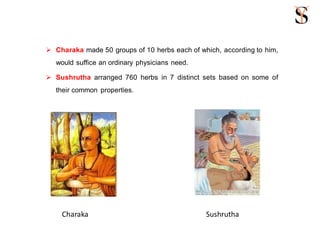
 Charaka made 50 groups of 10 herbs each of which, according to him,
would suffice an ordinary physicians need.
 Sushrutha arranged 760 herbs in 7 distinct sets based on some of
their common properties.
Charaka Sushrutha
ANCIENT GREECE
AND ROME
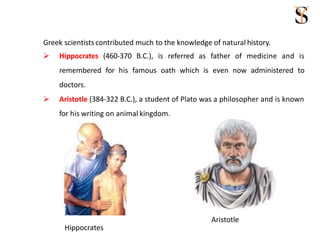
Greek scientists contributed much to the knowledge of natural history.
 Hippocrates (460-370 B.C.), is referred as father of medicine and is
remembered for his famous oath which is even now administered to
doctors.
 Aristotle (384-322 B.C.), a student of Plato was a philosopher and is known
for his writing on animal kingdom.
Hippocrates
Aristotle
ANCIENT GREECE AND ROME
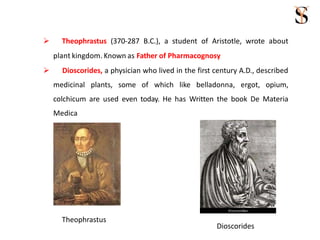
 Theophrastus (370-287 B.C.), a student of Aristotle, wrote about
plant kingdom. Known as Father of Pharmacognosy
 Dioscorides, a physician who lived in the first century A.D., described
medicinal plants, some of which like belladonna, ergot, opium,
colchicum are used even today. He has Written the book De Materia
Medica
Theophrastus
Dioscorides
ANCIENT GREECE AND ROME
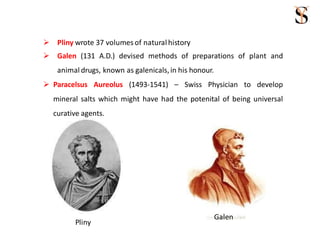
 Pliny wrote 37 volumes of naturalhistory
 Galen (131 A.D.) devised methods of preparations of plant and
animal drugs, known as galenicals,in his honour.
 Paracelsus Aureolus (1493-1541) – Swiss Physician to develop
mineral salts which might have had the potenital of being universal
curative agents.
Pliny
Galen
HISTORY OF PHARMACOGNOSY –
EARLY MODERNERA
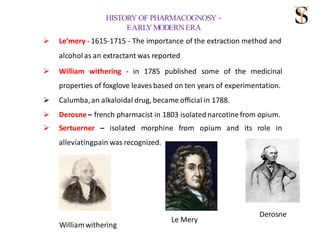
 Le’mery - 1615-1715 - The importance of the extraction method and
alcohol as an extractant was reported
 William withering - in 1785 published some of the medicinal
properties of foxglove leaves based on ten years of experimentation.
 Calumba,an alkaloidal drug, became official in 1788.
 Derosne – french pharmacist in 1803 isolated narcotinefrom opium.
 Sertuerner – isolated morphine from opium and its role in
alleviatingpain was recognized.
Le Mery
Williamwithering
Derosne
DEVELOPMENT OF
PHARMACOGNOSY
 In the next few years, strychnine (1817), emetine (1817). Brucine (1819),
piperine (1819), quinine (1820) and colchicine (1820) were isolated.
 Pelletier – french pharmacist, reported the isolation of strychnine from ignatius
beans and later from nux vomica seeds in 1818.
 Stass and Otto – a new extraction process for alkaloid wasdeveloped in 1852.
 Posseltand Reimann– isolatednicotine from tobacco leavesin 1828.
 Neumann – isolatedcocaine in 1860.
 Hardy and Gallows – isolatedouabain in 1877.
 Gerrard and Hardy – isolatedpilocarpine in 1875.
 Nagai – isolated ephedrine in 1887.
 Kuersten – isolated podophyllotoxin in 1891.
 20th Century - Isolation of ergometrine, digoxin, reserpine, theophylline and
quinidine are the significant discoveries
BINOMIAL SYSTEM OF CLASSIFICATION
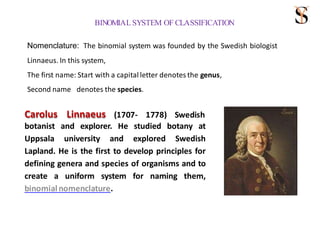
Nomenclature: The binomial system was founded by the Swedish biologist
Linnaeus. In this system,
The first name: Start with a capital letter denotes the genus,
Second name denotes the species.
Carolus Linnaeus (1707- 1778) Swedish
botanist and explorer. He studied botany at
Uppsala university and explored Swedish
Lapland. He is the first to develop principles for
defining genera and species of organisms and to
create a uniform system for naming them,
binomialnomenclature.
BINOMIALSYSTEM OF CLASSIFICATION
Genus and species name is followed by
author’s name who first
described the species or variety.
 e.g Artemisia cina Berg., Caryophyllos
 Sometimes, species name is derived from author’s name,
e.g. the
 species of Cinchona named after Charles Ledger, who
brought its seeds from Brazil in 1865, is known as Cinchona
ledergiana.
BINOMIAL SYSTEM OF CLASSIFICATION
The species name is usually chosen to indicate certain characteristics of the plant:
Striking characteristic of the plant
Cassia acutifolia (sharp pointed leaflets)
Cassia angustifolia (narrow leaflets)
Glycyrrhiza glabra (glabrous – smooth)
Atropa belladonna (bella – beautiful, donna – lady)
Characteristic colour
Piper nigrum (black) Digitalis purpurea (purple)
Digitalis lutea (yellow) Brassica nigra (black)
An aromatic plant (certain aroma)
Myristica fragrans (nice aroma) Caryophyllus aromaticus (refers to aroma)
BINOMIALSYSTEM OF CLASSIFICATION
Geographical source
Hydrastis Canadensis (growing in Canada)
Tamarindus indica (growing in India)
Pharmacological activity:
Papaver sominferum (inducing sleep)
Strychnos nux-vomica (causing vomiting)
Ipomoea purge (purgative action)
The generic name may indicate certain characters of the plant:
e.g. Atropa means fate who cuts the thread of life
Glycyrrhiza means gluco = sweet, riza = root,
Linum, Linea = thread)
FURTHER
PROGRESS
The progress achieved in botanical studies during 19th century had a direct
influence on pharmacognosy.
Bentham and Hooker – plant classification was further developed in 1862-1863.
G. Mendel – importantobservationson planthybrids were published in 1865.
The introduction of microscope, as an important analytical tool, was a landmark
advancement in botanical research, especially due to the development of
several techniques like clearing, mounting and stainingof the preparations.
Berg – anatomicalatlasof crude drugs was published in 1865.
Voehl and Tschirch – reported the anatomical characters of several powdered
drugs which proved to be of great significance especially at a period when
adulterationin both drugs and food articles was common.
Greenish and Collin – an anatomical atlas of powdered vegetable drugs was
complied in 1904.
DEVELOPMENT OF PHARMACOGNOSY –
MODERNERA
 The development of modern pharmacognosy took place later during the
period 1934-1960 by simultaneous application of disciplines like organic
chemistry, biochemistry, biosynthesis, pharmacology and modern methods and
techniques of analytical chemistry including paper, thin layer and gas
chromatography and spectrophotometry.
The substances from the plants were isolated, their structures elucidated and
pharmacological activeconstituentsstudied.
MODERNDEVELOPMENT OF CRUDE DRUGS
Some of the important aspects of the natural products that led to the modern
developmentof durgs and pharmaceuticalsare as follows:
 Isolationof phytochemicals
 Structure activity relationship
 Drugs obtained by partial synthesis of natural products
 Natural products as models for synthesis of new drugs
 Drugs of direct therapeutic uses
 Biosyntheticpathways
 Progress from 1960 onwards
 Technical products
 Pharmaceuticalaids
 Discovery of new medicines from plants – nutraceutical use versus drug
development
SCOPE OF
PHARMACOGNOSY
 Crude of drugs of natural origin that is obtained from plants, animals and
mineral sources and their active chemical constituents are the core subject
matter of pharmacognosy.
 These are also used for the treatment of various diseases besides being used
in cosmetic, textile and food industries.
 First half of 19th century – herbal mixtures, extracts and juices
 Second half of 19th century – pure active constituents.
 Today applied science of pharmacognosy has a far better knowledge of the
active constituents and their prominent therapeutic activity on the human
beings.
 Just like terrestrial germplasm, investigators had also diverted their attention to
marine flora and fauna, and wonderful marine natural products and their
activities have been studied.
SCOPE OF
PHARMACOGNOSY
 Genetic engineering and tissue culture biotechnology have already
been successful for the production of genetically engineered molecules
and biotransformed natural products, respectively.
 Crude drugs and their products are of economical importance and
profitable commercial products.
 When these were collected from wild sources, the amount collected
could only be small and the price commanded was exorbitantly high.
 Many of the industrially important species which produced equally large
economic profits are cultivated for large scale crop production.
 Drug plants, standardized extracts and therapeutically active pure
constituents have become a significant market commodity in the
international trade.
SCOPE OF PHARMACOGNOSY
 In the light of these glorious facts, scope of pharmacognosy seems to be
enormous in the field of medicine, bulk drugs, food supplements,
pharmaceutical necessities, pesticides, dyes, tissue culture biotechnology,
engineering and so on.
 The pharmacognosist would serve in various aspects as follows
 Academics
 Private industry
 Government
 Undoubtedly, the plant kingdom still holds large number of species with
medicinal value which have yet to be discovered.
 A lot of plants were screened for their pharmacological values like
hypoglycemic, hepatoprotective, hypotensive, etc.
 Pharmacognosists with a multidisciplinary background are able to make
valuable contributions in the field of phytomedicines