ANTIHISTAMINES
AY-2019-20
Purushotham K N
Assistant professor
Dept. of Ph. Chemistry
SACCP.
1
HISTAMINE
AND
ANTIHISTAMINES
2
3
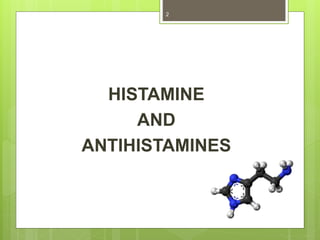
 Histamine (β-Aminoethyl imidazole or [2-(imidazol-
4-yl)ethylamine]) is a hydrophilic molecule
consisting of an imidazole ring with amino group
connected by two methylene groups.
 Analogs of histamine activated the four classes of
histamine receptors (H1, H2, H3 and H4).
 2-Methylhistamine and 4(5)-Methyl histamine have a
preferential effect on H1 and H2 receptors
respectively.
HISTAMINE4
 Histamine or B-imidazolylethylamine is synthesized from L-histidine by
histidine decarboxylase, an enzyme that is expressed in many
mammalian tissues including gastricmucosa parietal cells, mast cells,
and basophils and the central nervous system (CNS).
 As a result, histamine plays an important role in human physiology
including regulation of the cardiovascular system, smooth muscle,
exocrine glands, the immune system, and central nerve function.
 It is also involved in embryonic development, the proliferation and
differentiation of cells, hematopoiesis, inflammation, and wound healing.
 Histamine exerts its diverse biologic effects through four types of
receptors.
5
 The involvement of histamine in the mediation of immune and
hypersensitivity reactions and the regulation of gastric acid secretion has
led to the development of important drug classes useful in the treatment
of symptoms associated with allergic and gastric hypersecretory
disorders.
6
H1-Receptors
Mediate effects on smooth muscle leading to
vasodilation, increased vascular permeability, and
contraction of nonvascular smooth muscle.
H2-Receptors
Mediate histamine stimulation of gastric acid
secretion and may be involved in cardiac
stimulation.
H3-Receptors
Feedback inhibitors in CNS, gastrointestinal tract,
lung, heart.
Types7
DISTRIBUTION
 Widely distributed in animal kingdom and is
presented in venoms, bacteria and plants.
 Particularly tissues having high concentration
of histamine and that contain large number of
mast cells such as skin, bronchial tree mucosa
and intestinal mucosa.
8
SYNTHESIS, STORAGE AND METABOLISM
OF HISTAMINE
Histamine is a dibasic vasoactive substance
formed from the decarboxylation of the
amino acid histidine by the enzyme L-
histidine decarboxylase.
SSM9
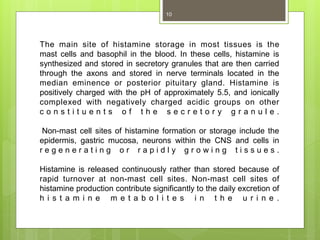
The main site of histamine storage in most tissues is the
mast cells and basophil in the blood. In these cells, histamine is
synthesized and stored in secretory granules that are then carried
through the axons and stored in nerve terminals located in the
median eminence or posterior pituitary gland. Histamine is
positively charged with the pH of approximately 5.5, and ionically
complexed with negatively charged acidic groups on other
c o n s t i t u e n t s o f t h e s e c r e t o r y g r a n u l e .
Non-mast cell sites of histamine formation or storage include the
epidermis, gastric mucosa, neurons within the CNS and cells in
r e g e n e r a t i n g o r r a p i d l y g r o w i n g t i s s u e s .
Histamine is released continuously rather than stored because of
rapid turnover at non-mast cell sites. Non-mast cell sites of
histamine production contribute significantly to the daily excretion of
h i s t a m i n e m e t a b o l i t e s i n t h e u r i n e .
10
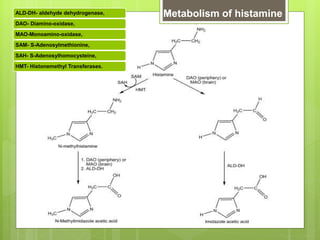
Metabolism of histamineALD-DH- aldehyde dehydrogenase,
DAO- Diamino-oxidase,
MAO-Monoamino-oxidase,
SAM- S-Adenosylmethionine,
SAH- S-Adenosylhomocysteine,
HMT- Histonemethyl Transferases.
11
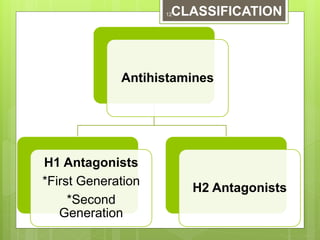
Antihistamines
H1 Antagonists
*First Generation
*Second
Generation
H2 Antagonists
CLASSIFICATION12
First Generation Antihistamines (Sedative Type)
 Alkylamines- Diphenhydramine HCL,
Bromo Diphenhydramine HCL,
DimenHydrinate,
Doxylaminesuccinate.
 Ethylenediamines- Tripelennamine Citrate,
Tripelennamine HCl,
Pyrilamine Maleate.
 Piperazines (Cyclizines)-Cyclizines HCl,
Cyclizines Lactate,
ChloroCyclizines HCl,
Meclizine HCl.
 Propylamines- Pheniramine Malete,
Chlorpheniramine Malete,
DexChlorpheniramine Malete,
BromoPheniramine Malete,
DexbromoPheniramine Malete,
 Phenothiazines- Promethazine HCl,
Trimeprazine Tartaret.
 Dibenzocycloheptenes & Dibenzocycloheptanes-
Cyproheptidine HCl,
Azatadine Maleate,
H-1 1st Gen.13
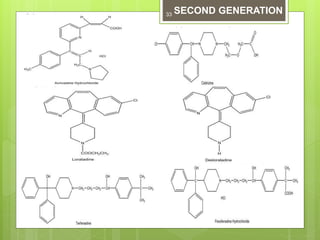
Second Generation Antihistamines (Non- Sedative Type)
 Fexofenadine HCl,
 Terfenadine
 Loratadine
 Cetirizine
 Acrivastine
H-1 2nd Gen.14
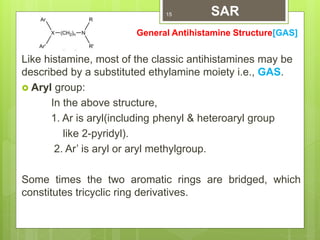
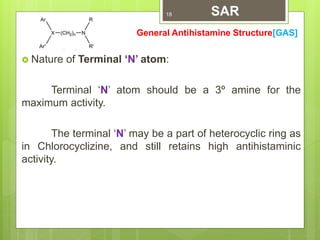
Like histamine, most of the classic antihistamines may be
described by a substituted ethylamine moiety i.e., GAS.
 Aryl group:
In the above structure,
1. Ar is aryl(including phenyl & heteroaryl group
like 2-pyridyl).
2. Ar’ is aryl or aryl methylgroup.
Some times the two aromatic rings are bridged, which
constitutes tricyclic ring derivatives.
General Antihistamine Structure[GAS]
SAR15
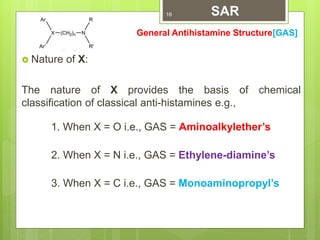
 Nature of X:
The nature of X provides the basis of chemical
classification of classical anti-histamines e.g.,
1. When X = O i.e., GAS = Aminoalkylether’s
2. When X = N i.e., GAS = Ethylene-diamine’s
3. When X = C i.e., GAS = Monoaminopropyl’s
General Antihistamine Structure[GAS]
SAR16
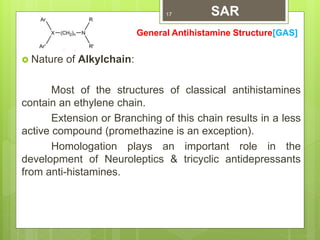
 Nature of Alkylchain:
Most of the structures of classical antihistamines
contain an ethylene chain.
Extension or Branching of this chain results in a less
active compound (promethazine is an exception).
Homologation plays an important role in the
development of Neuroleptics & tricyclic antidepressants
from anti-histamines.
General Antihistamine Structure[GAS]
SAR17
 Nature of Terminal ‘N’ atom:
Terminal ‘N’ atom should be a 3º amine for the
maximum activity.
The terminal ‘N’ may be a part of heterocyclic ring as
in Chlorocyclizine, and still retains high antihistaminic
activity.
General Antihistamine Structure[GAS]
SAR18
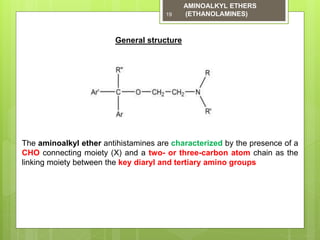
AMINOALKYL ETHERS
(ETHANOLAMINES)
General structure
The aminoalkyl ether antihistamines are characterized by the presence of a
CHO connecting moiety (X) and a two- or three-carbon atom chain as the
linking moiety between the key diaryl and tertiary amino groups
19
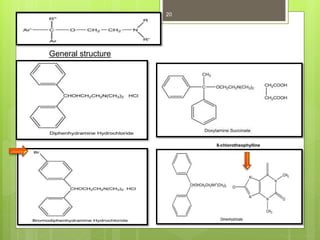
General structure
20
8-chlorotheophylline
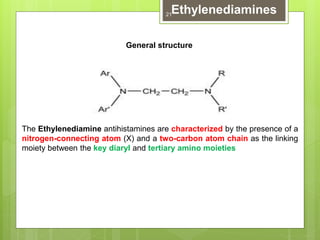
Ethylenediamines
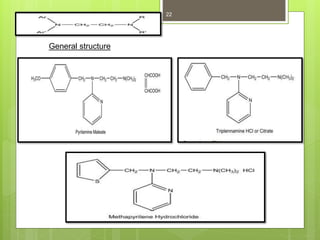
The Ethylenediamine antihistamines are characterized by the presence of a
nitrogen-connecting atom (X) and a two-carbon atom chain as the linking
moiety between the key diaryl and tertiary amino moieties
General structure
21
General structure
22
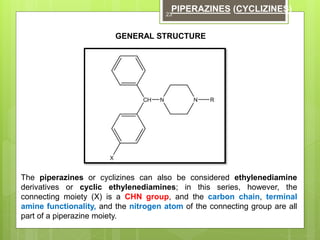
PIPERAZINES (CYCLIZINES)
The piperazines or cyclizines can also be considered ethylenediamine
derivatives or cyclic ethylenediamines; in this series, however, the
connecting moiety (X) is a CHN group, and the carbon chain, terminal
amine functionality, and the nitrogen atom of the connecting group are all
part of a piperazine moiety.
GENERAL STRUCTURE
23
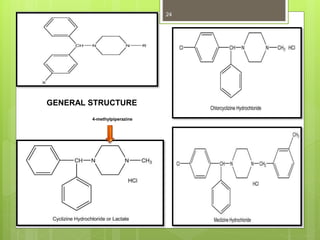
GENERAL STRUCTURE
24
4-methylpiperazine
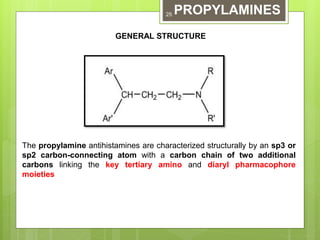
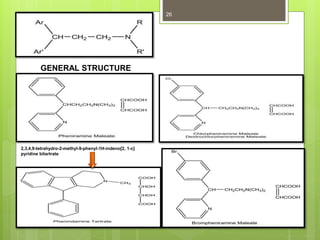
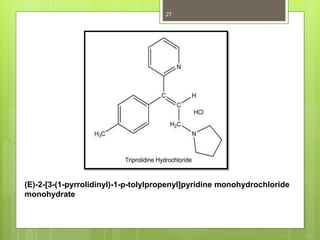
PROPYLAMINES
The propylamine antihistamines are characterized structurally by an sp3 or
sp2 carbon-connecting atom with a carbon chain of two additional
carbons linking the key tertiary amino and diaryl pharmacophore
moieties
GENERAL STRUCTURE
25
GENERAL STRUCTURE
26
2,3,4,9-tetrahydro-2-methyl-9-phenyl-1H-indeno[2, 1-c]
pyridine bitartrate
(E)-2-[3-(1-pyrrolidinyl)-1-p-tolylpropenyl]pyridine monohydrochloride
monohydrate
27
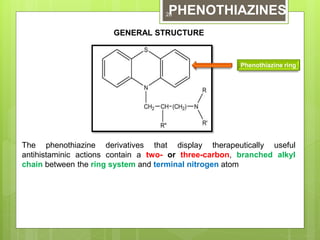
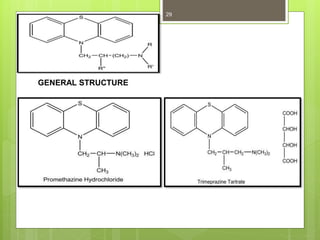
PHENOTHIAZINES
The phenothiazine derivatives that display therapeutically useful
antihistaminic actions contain a two- or three-carbon, branched alkyl
chain between the ring system and terminal nitrogen atom
GENERAL STRUCTURE
28
Phenothiazine ring
GENERAL STRUCTURE
29
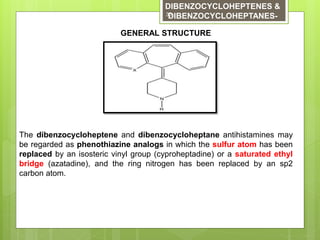
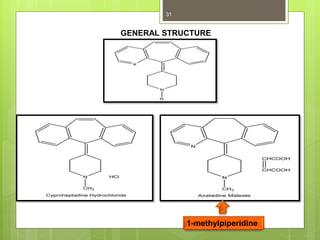
DIBENZOCYCLOHEPTENES &
DIBENZOCYCLOHEPTANES-
GENERAL STRUCTURE
The dibenzocycloheptene and dibenzocycloheptane antihistamines may
be regarded as phenothiazine analogs in which the sulfur atom has been
replaced by an isosteric vinyl group (cyproheptadine) or a saturated ethyl
bridge (azatadine), and the ring nitrogen has been replaced by an sp2
carbon atom.
30
GENERAL STRUCTURE
31
1-methylpiperidine
 The first generation antihistamines penetrate
blood brain barrier and also possess
anticholinergic properties.
 This has lead to the development of second
generation antagonists known as non sedating
antihistamines.
i.e. the second generation antihistamines do not
penetrate the Blood Brain Barrier and as such do
not cause drowsiness.
SECOND GENERATION32
SECOND GENERATION33
Drugs whose pharmacological action primarily involves antagonism of the
action of histamine at its H2-receptors find therapeutic application in the
treatment of acid-peptic disorders including heartburn, gastroesophageal
reflux disease (GERD), erosive esophagitis, gastric and duodenal
ulcers, and gastric acid pathologic hypersecretory diseases such as
Zollinger-Ellison syndrome.
They are also useful in combination with H1-antihistamines for the treatment
of chronic urticaria and for the itching of anaphylaxis and pruritis.
H2-RECEPTORS ANTAGONIST34
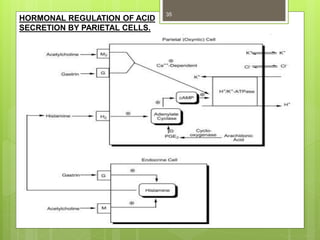
HORMONAL REGULATION OF ACID
SECRETION BY PARIETAL CELLS.
35
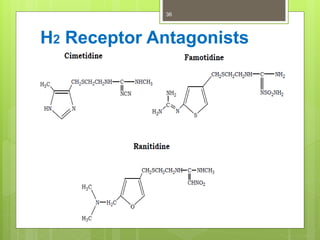
H2 Receptor Antagonists
36
37
REFERENCES
 Wilson and Gisvold’s Textbook of Organic medicinal
& pharmaceutical chemistry edition -12, pg.no :733-
755
 https://en.wikipedia.org/wiki/Antihistamine
 https://en.wikipedia.org/wiki/Histamine
38