My name is Faye Anderson. I am director of All That Philly Jazz, a place-based
public history project that is documenting and contextualizing Philadelphia’s
golden age of jazz. I am a member of Avenging The Ancestors Coalition, the
group that spearheaded the President’s House memorial on Independence
Mall. Although the site lacks architectural integrity, it tells the story of George
Washington’s slaves.
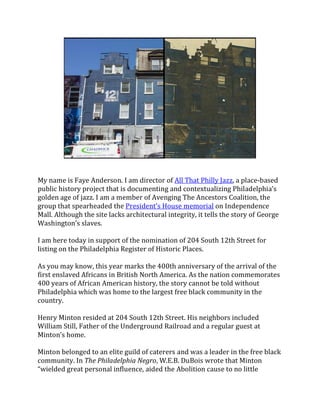
I am here today in support of the nomination of 204 South 12th Street for
listing on the Philadelphia Register of Historic Places.
As you may know, this year marks the 400th anniversary of the arrival of the
first enslaved Africans in British North America. As the nation commemorates
400 years of African American history, the story cannot be told without
Philadelphia which was home to the largest free black community in the
country.
Henry Minton resided at 204 South 12th Street. His neighbors included
William Still, Father of the Underground Railroad and a regular guest at
Minton’s home.
Minton belonged to an elite guild of caterers and was a leader in the free black
community. In The Philadelphia Negro, W.E.B. DuBois wrote that Minton
“wielded great personal influence, aided the Abolition cause to no little
degree, and made Philadelphia noted for its cultivated and well-to-do Negro
citizens.”
There is not much more to add other than Minton provided freedom fighter
John Brown “with bed and board” shortly before his raid upon Harper’s Ferry.
It should also be noted that Minton is listed on the iconic Civil War poster,
“Men of Color, To Arms!” Clearly, the nomination satisfies Criteria A and J for
Designation.
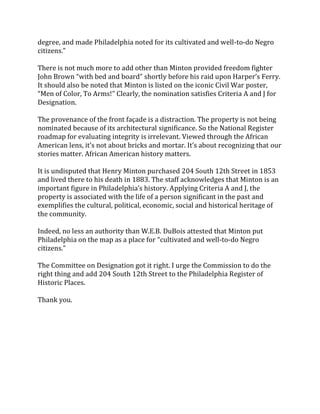
The provenance of the front façade is a distraction. The property is not being
nominated because of its architectural significance. So the National Register
roadmap for evaluating integrity is irrelevant. Viewed through the African
American lens, it’s not about bricks and mortar. It’s about recognizing that our
stories matter. African American history matters.
It is undisputed that Henry Minton purchased 204 South 12th Street in 1853
and lived there to his death in 1883. The staff acknowledges that Minton is an
important figure in Philadelphia’s history. Applying Criteria A and J, the
property is associated with the life of a person significant in the past and
exemplifies the cultural, political, economic, social and historical heritage of
the community.
Indeed, no less an authority than W.E.B. DuBois attested that Minton put
Philadelphia on the map as a place for “cultivated and well-to-do Negro
citizens.”
The Committee on Designation got it right. I urge the Commission to do the
right thing and add 204 South 12th Street to the Philadelphia Register of
Historic Places.
Thank you.