Harnessing the Power of Synergy for Organizational and Personal Success
Explore the principles and foundations of synergy, emphasizing collaboration, trust, unity, and shared vision to achieve extraordinary results in business and life.
MEET THE RESOURCEPERSON
RASHEED, OLUWASEGUN KAZEEM (Ph.D)
+234 - 8051700164, +234 - 7066867887
kazeemrasheed1440@gmail.com
My resource world
https://www.slideshare.net/kazeemrasheed1440/slideshows
https://fliphtml5.com/edit-book/upload?lang=en
https://www.scribd.com/uploads
https://www.noor-book.com/en/upload
Lead Principal Facilitator at HEED – A - DINK CONSULT
3.
Introduction
In an increasinglyinterconnected and complex world, no individual, organization, or nation
can achieve lasting success in isolation. The most remarkable accomplishments throughout
history have not been the result of individual brilliance alone, but of people combining
their talents, knowledge, and resources to pursue a common purpose. This transformative
principle is known as synergy—the dynamic process through which collaborative efforts
generate outcomes far greater than the sum of individual contributions. Simply expressed,
synergy means that THE WHOLE IS GREATER THAN THE SUM OF ITS PARTS, where 1 + 1
BECOMES GREATER 2 through unity, cooperation, and shared vision.
The power of synergy extends beyond teamwork; it is the ability to harness diverse
strengths, perspectives, and experiences to create innovative solutions, overcome
challenges, and achieve goals that would otherwise be unattainable. Whether in families,
educational institutions, businesses, communities, governments, or religious organizations,
synergy fosters trust, mutual respect, effective communication, and collective
responsibility. It transforms competition into collaboration, differences into complementary
strengths, and individual potential into collective excellence.
4.
Nature itself demonstratesthe remarkable effectiveness of synergy. Birds flying in formation
conserve energy by working together, ants build intricate colonies through coordinated
effort, and the human body functions harmoniously because billions of cells and organs
perform specialized roles in unity. These natural examples illustrate a timeless truth:
sustained success is built on cooperation rather than isolation.
From a leadership perspective, synergy is the cornerstone of organizational effectiveness and
sustainable development. Leaders who cultivate collaboration inspire innovation, strengthen
relationships, enhance productivity, and build resilient teams capable of adapting to
changing circumstances. Organizations that embrace synergy consistently outperform those
driven solely by individual effort because they leverage the collective intelligence, creativity,
and commitment of their members.
5.
In every sphereof life, the power of synergy demonstrates that
extraordinary achievements are born from unity of purpose, mutual
trust, and coordinated action. It is the driving force behind innovation,
effective leadership, social cohesion, and national development. As
societies face increasingly complex challenges that no single person or
institution can solve alone, embracing the principles of synergy has
become not merely an advantage but a necessity. Understanding and
applying the power of synergy equips individuals and organizations to
maximize their collective potential, transform challenges into
opportunities, and create lasting impact through purposeful
collaboration.
6.
Synergy is theprinciple that the combined efforts of
individuals, organizations, or systems produce results
far greater than the sum of their separate
contributions. It is commonly expressed by the phrase:
"TOGETHER, WE ARE STRONGER THAN APART."
It represents cooperation, teamwork, mutual support,
and shared vision toward achieving common
objectives. Whether in families, businesses,
educational institutions, governments, communities,
or religious organizations, synergy transforms ordinary
efforts into extraordinary accomplishments.
Synergy does notoccur by chance; it is built upon a set of core
foundations that enable individuals and groups to work together
effectively. These foundations create an environment where collective
effort produces results that surpass individual achievements.
1. Unity
Unity is the cornerstone of synergy. It refers to the harmonious coming
together of individuals despite their differences in background, culture,
skills, or perspectives. Unity does not require uniformity; rather, it
encourages people to remain distinct while working toward a common
objective. When unity exists, conflicts are minimized, trust is
strengthened, and collective energy is directed toward achieving shared
goals. A united team is more resilient, adaptable, and capable of
overcoming challenges than a group divided by personal interests or
internal conflicts.
9.
2. Shared Vision
Ashared vision provides a clear sense of direction and
purpose for everyone involved. It ensures that all
members understand and embrace the same long-term
objectives, creating alignment in decision-making and
actions. Without a shared vision, individuals may
pursue conflicting priorities, resulting in confusion and
inefficiency. A common vision motivates people to
commit their talents and resources toward achieving
collective success while inspiring perseverance during
difficult times.
10.
3. Trust
Trust isthe foundation upon which every successful
relationship and team is built. It develops through
honesty, integrity, transparency, consistency, and
reliability. In an atmosphere of trust, individuals feel
safe to express ideas, admit mistakes, and rely on one
another without fear of exploitation or criticism. Trust
encourages collaboration, reduces suspicion,
strengthens interpersonal relationships, and enhances
productivity by eliminating unnecessary barriers to
cooperation.
11.
4. Cooperation
Cooperation isthe willingness of individuals to work
together by sharing responsibilities, resources, ideas,
and expertise. Rather than competing against one
another, cooperative individuals recognize that
collective success benefits everyone involved. Effective
cooperation promotes teamwork, encourages mutual
assistance, reduces duplication of effort, and enables
groups to accomplish tasks more efficiently than
isolated individuals working independently.
12.
5. Mutual Respect
Mutualrespect involves recognizing and appreciating
the dignity, abilities, opinions, and contributions of
every individual regardless of their status, age,
gender, culture, or educational background. Respect
creates an inclusive environment where everyone
feels valued and motivated to contribute their best.
Teams characterized by mutual respect experience
fewer conflicts, stronger relationships, and greater
openness to learning from one another.
13.
6. Effective Communication
Communicationis the lifeblood of synergy. It involves the
clear, honest, timely, and respectful exchange of
information, ideas, expectations, and feedback among
team members. Effective communication minimizes
misunderstandings, facilitates informed decision-making,
promotes transparency, and strengthens collaboration. It
also encourages active listening, where members
genuinely seek to understand one another rather than
simply expressing their own opinions. Open
communication fosters trust, innovation, and unity within
any organization or community.
14.
7. Diversity ofStrengths
Every individual possesses unique talents, experiences,
knowledge, and perspectives. Synergy thrives when
these diverse strengths are recognized, appreciated,
and integrated into collective efforts. Diversity
stimulates creativity, broadens problem-solving
capabilities, and generates innovative solutions that
would not emerge from a homogeneous group. By
leveraging individual strengths while compensating for
one another's weaknesses, teams become more
effective, adaptable, and competitive.
15.
8. Collective Responsibility
Collectiveresponsibility means that every member the
group. Rather than assigning blame when difficulties
arise, members work together to identify solutions and
improve performance. This principle promotes
accountability, commitment, discipline, and shared
ownership of outcomes. Individuals recognize that their
personal contributions directly influence the overall
success of the team, encouraging greater dedication and
responsibility.
16.
9. Common Purpose
Acommon purpose unites people around a meaningful
objective that transcends individual interests. It
provides motivation, direction, and a sense of
belonging while ensuring that every effort contributes
toward achieving a shared goal. When individuals
understand the importance of their collective mission,
they become more committed, focused, and willing to
collaborate. A common purpose transforms separate
efforts into coordinated action and inspires
perseverance even during adversity.
17.
10. Sacrifice forthe Greater Good
True synergy often requires individuals to place the
interests of the group above personal ambitions or
preferences. Sacrifice may involve sharing resources,
compromising on personal opinions, investing additional
time, or supporting others without expecting immediate
personal gain. Such selflessness strengthens unity, builds
trust, and reinforces commitment to the collective mission.
Throughout history, the greatest achievements in families,
organizations, communities, and nations have been made
possible by individuals willing to make personal sacrifices
for the benefit of the larger group.
THE POWER OFSYNERGY IN BUSINESS ORGANIZATIONS
In today's highly competitive and rapidly changing business environment, organizational success
depends not only on the quality of products or services but also on the ability of people to work
together effectively. No successful business is built solely on the efforts of one individual. Behind
every thriving organization is a network of employees, managers, executives, investors,
customers, suppliers, and stakeholders whose combined efforts contribute to the achievement
of organizational goals. This collaborative strength is known as synergy.
Synergy in business organizations refers to the strategic integration of people, ideas, resources,
technologies, and processes to create greater value than could be achieved by individuals or
departments working independently. It is the principle that collective effort produces results far
greater than the simple addition of individual contributions. Organizations that embrace synergy
foster teamwork, innovation, trust, effective communication, and shared responsibility, enabling
them to achieve sustainable growth and maintain a competitive advantage.
20.
1. Increases OrganizationalProductivity
One of the greatest advantages of synergy in business is improved
productivity. When employees collaborate across departments, tasks
are completed more efficiently and resources are utilized more
effectively. Rather than duplicating efforts or working in isolation,
team members coordinate their activities to achieve common
objectives.
Employees who understand their roles and support one another are
able to complete projects more quickly while maintaining high
standards of quality. This collaborative approach reduces waste,
improves workflow, and enhances overall organizational performance.
21.
2. Encourages Innovationand Creativity
Innovation thrives in environments where people are encouraged to exchange
ideas freely. Employees from different educational backgrounds, professional
experiences, and areas of expertise bring unique perspectives that contribute to
creative problem-solving.
Cross-functional collaboration often produces innovative products, improved
services, and more efficient business processes. Brainstorming sessions,
collaborative research, and knowledge-sharing platforms enable organizations to
identify opportunities that might otherwise remain undiscovered.
Many of the world's most successful organizations owe their achievements to
teams that transformed diverse ideas into groundbreaking innovations through
effective collaboration.
22.
3. Improves Decision-Making
Businessdecisions become more effective when they are informed by
multiple perspectives rather than the opinions of a single individual.
Synergy encourages consultation among managers, employees,
specialists, and stakeholders before strategic decisions are made.
Collaborative decision-making reduces the likelihood of costly
mistakes by allowing organizations to evaluate risks, consider
alternatives, and develop comprehensive solutions. The collective
intelligence of a well-coordinated team often exceeds the knowledge
of any one individual.
23.
4. Strengthens Teamwork
Successfulorganizations cultivate a culture in which employees
recognize that individual success is closely connected to team success.
Synergy promotes cooperation rather than unhealthy competition
among colleagues.
Effective teamwork develops trust, strengthens interpersonal
relationships, improves coordination, and increases employee
commitment to organizational objectives. When individuals appreciate
each other's strengths and willingly support one another, the entire
organization benefits from improved morale and higher performance.
24.
5. Enhances EmployeeMotivation and Job Satisfaction
Employees are generally more motivated when they work in
environments characterized by trust, respect, recognition, and
collaboration. Synergy creates a workplace where every
employee feels valued and understands the importance of his
or her contribution to organizational success.
Collaborative organizations often experience lower staff
turnover, higher employee engagement, greater loyalty, and
increased job satisfaction because employees feel connected to
both their colleagues and the organization's mission.
25.
6. Improves CustomerSatisfaction
Customers ultimately benefit when internal organizational synergy
is strong. Effective collaboration among marketing, production,
finance, logistics, customer service, and quality assurance
departments enables businesses to deliver products and services
that consistently meet or exceed customer expectations.
Prompt communication, coordinated service delivery, and efficient
problem resolution contribute to stronger customer relationships,
increased customer loyalty, and a positive corporate reputation.
26.
7. Maximizes ResourceUtilization
Organizations operate with limited financial, human,
technological, and physical resources. Synergy enables
businesses to maximize these resources by promoting
collaboration rather than duplication of effort.
Departments share information, equipment, expertise, and
technology, reducing operational costs while increasing
efficiency. Strategic partnerships with suppliers, investors, and
external stakeholders further enhance organizational capacity
and competitiveness.
27.
8. Strengthens OrganizationalAdaptability
Modern businesses face constant changes in technology,
customer preferences, government regulations, and global
economic conditions. Organizations characterized by synergy
adapt more effectively because employees cooperate in
identifying challenges, developing solutions, and implementing
change.
Collaborative organizations respond more quickly to market
opportunities, recover faster from setbacks, and remain resilient
during periods of uncertainty.
28.
9. Promotes LeadershipDevelopment
Synergy creates opportunities for leadership at every level of
the organization. Employees learn to communicate effectively,
solve problems collaboratively, mentor colleagues, and assume
greater responsibility.
Leaders who encourage teamwork rather than authoritarian
control build organizations characterized by trust, innovation,
accountability, and continuous improvement. Such leadership
cultivates future managers capable of sustaining organizational
success.
29.
10. Creates SustainableCompetitive Advantage
Perhaps the greatest benefit of synergy is the creation of a lasting
competitive advantage. Products, technologies, and business
strategies can often be copied by competitors, but a strong
organizational culture built on trust, collaboration, and shared
purpose is much more difficult to imitate.
Organizations that consistently leverage the collective talents of
their workforce are better positioned to innovate, satisfy customers,
retain skilled employees, and achieve long-term profitability.
-
30.
HOW IT WORKSIN AN ORGANIZATION
Synergy is evident in many successful business practices with:
Cross-functional teams collaborating to develop new products.
Marketing and sales departments coordinating promotional strategies.
Finance and operations departments working together to optimize budgets and improve
efficiency.
Human resource departments partnering with management to recruit, train, and retain
talented employees.
Customer service teams collaborating with production units to improve product quality based
on customer feedback.
Strategic alliances between businesses to expand markets, share technology, and reduce
operational costs.
These collaborative efforts enable organizations to achieve outcomes that individual
departments working independently could not accomplish.
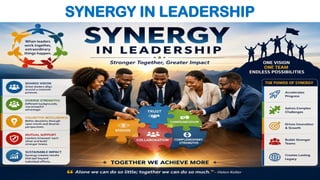
THE POWER OFSYNERGY IN LEADERSHIP
Leadership is more than holding a position of authority or directing the activities of others; it is the
ability to inspire, influence, and unite people toward the achievement of a common vision.
Effective leadership recognizes that lasting success is rarely the product of one person's efforts
alone. Instead, it emerges when leaders harness the diverse talents, experiences, ideas, and
strengths of those they lead.
The power of synergy in leadership lies in creating an environment where individuals work
together with trust, mutual respect, shared responsibility, and a common purpose. A synergistic
leader does not seek personal glory but empowers others to contribute meaningfully to
organizational success. Such leaders understand that the collective intelligence and commitment
of a united team produce results far greater than the efforts of isolated individuals.
In today's dynamic world, where organizations face complex challenges and rapid change, leaders
who cultivate synergy are better equipped to promote innovation, solve problems, inspire
commitment, and achieve sustainable success.
33.
1.Creates a SharedVision
One of the primary responsibilities of a leader is to establish a
clear and inspiring vision that unites people around common
goals. Synergy begins when everyone understands where the
organization is heading and why their contributions matter.
A shared vision aligns individual efforts with organizational
objectives, eliminates confusion, and fosters commitment.
When people believe in the vision and recognize their role in
achieving it, they work with greater enthusiasm, dedication,
and purpose.
34.
2. Inspires Collaboration
Synergisticleaders encourage teamwork rather than unhealthy
competition. They create opportunities for individuals from different
backgrounds, departments, and areas of expertise to collaborate in
solving problems and achieving organizational objectives.
By promoting cooperation, leaders cultivate an atmosphere where
knowledge is shared, creativity flourishes, and every team member
feels valued. Collaboration strengthens interpersonal relationships
and enables organizations to benefit from diverse perspectives and
collective wisdom.
35.
3. Builds Trustand Credibility
Trust is one of the most valuable assets of effective
leadership. Leaders who demonstrate honesty, integrity,
fairness, transparency, and consistency earn the confidence
of those they lead.
When trust exists, employees communicate openly, express
innovative ideas without fear, accept constructive feedback, and
remain committed even during periods of uncertainty. Trust
strengthens organizational unity and provides the foundation upon
which synergy is built.
36.
4. Empowers Others
Greatleaders recognize that leadership is not about controlling
people but about enabling them to reach their full potential.
Synergy flourishes when leaders delegate responsibilities,
encourage initiative, and provide opportunities for professional
growth.
Empowered employees become more confident, creative, and
accountable. They develop leadership skills of their own, creating
a culture where responsibility and innovation are shared across
the organization rather than concentrated in a single individual.
37.
5. Enhances Decision-Making
Leaderswho embrace synergy understand the value of consultation
and collective wisdom. Rather than making decisions in isolation,
they seek input from experienced colleagues, team members, and
stakeholders.
Collaborative decision-making brings together diverse perspectives,
identifies potential risks, and generates more comprehensive
solutions. It also increases employee commitment because people
are more likely to support decisions in which they have
participated.
38.
6. Promotes Innovationand Creativity
Innovation thrives in organizations where leaders encourage open
communication and value diverse opinions. Synergistic leaders create
environments in which individuals feel free to share ideas, experiment
with new approaches, and challenge conventional thinking.
By bringing together people with different experiences and expertise,
leaders stimulate creativity that leads to improved products, services,
processes, and organizational strategies. Many groundbreaking
innovations result from collaborative efforts rather than individual
achievements.
39.
7. Strengthens TeamPerformance
A leader who cultivates synergy transforms a group of individuals
into a cohesive, high-performing team. By recognizing each
member's strengths and assigning responsibilities accordingly,
leaders maximize productivity and efficiency.
Synergistic teams communicate effectively, support one another
during challenges, celebrate collective achievements, and remain
focused on shared objectives. Such teams consistently outperform
groups characterized by poor communication and internal
competition.
40.
8. Develops FutureLeaders
One of the greatest responsibilities of leadership is
preparing others to lead. Synergistic leaders invest in
mentoring, coaching, and developing future leaders who
can continue the organization's mission.
By sharing knowledge, encouraging continuous learning,
and providing leadership opportunities, they create a
sustainable leadership culture that ensures organizational
continuity and long-term success.
41.
9. Resolves ConflictConstructively
Conflict is inevitable wherever people work together. However,
effective leaders view conflict not as a threat but as an
opportunity for growth and improvement.
Synergistic leaders promote respectful dialogue, active listening,
fairness, and mutual understanding when resolving
disagreements. Rather than allowing conflicts to divide teams,
they transform differences into opportunities for innovation,
stronger relationships, and improved decision-making.
42.
10. Achieves SustainableOrganizational Success
The ultimate objective of leadership is not merely achieving short-term
results but building organizations capable of sustained excellence. Synergistic
leadership strengthens organizational culture by promoting collaboration,
accountability, trust, innovation, and continuous improvement.
Organizations led by synergistic leaders are more resilient during crises,
adapt more effectively to change, retain talented employees, and maintain
stronger relationships with customers and stakeholders. Their success is built
upon collective commitment rather than dependence on a single individual.
43.
HOW IT WORKS
A school principal working collaboratively with teachers, parents, students, and the
community to improve academic performance.
A business executive encouraging cross-functional teams to develop innovative
products and services.
A hospital administrator coordinating doctors, nurses, pharmacists, and support staff
to deliver high-quality patient care.
A project manager bringing together professionals from different disciplines to
complete complex projects successfully.
Community leaders partnering with government agencies, non-governmental
organizations, and citizens to address social challenges.
In each of these situations, success is achieved through collaboration rather than
individual effort.
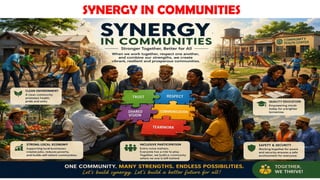
THE POWER OFSYNERGY IN COMMUNITIES
A community is more than a geographical location where people live; it is a network of individuals,
families, institutions, businesses, religious organizations, and leaders who share common interests,
responsibilities, values, and aspirations. The strength of any community is determined not merely
by its resources but by the willingness of its members to work together for the common good.
The power of synergy in communities lies in the ability of diverse individuals and groups to
combine their knowledge, skills, resources, and experiences to address shared challenges and
achieve collective progress. Communities that embrace synergy foster unity, cooperation, trust,
mutual respect, and active participation. Such communities are better equipped to promote peace,
improve living standards, respond to emergencies, and create sustainable development for present
and future generations.
Throughout history, the most prosperous and resilient communities have been those where
citizens recognized that collective effort is more powerful than individual action. When people
unite around shared goals, they create an environment where everyone benefits from the success
of the whole.
46.
1. Promotes Unityand Social Cohesion
One of the greatest benefits of synergy in a community is the
promotion of unity. Communities often consist of people from
different ethnic, cultural, religious, educational, and economic
backgrounds. Synergy enables these differences to become
sources of strength rather than causes of division.
When community members cooperate, respect one another,
and pursue common objectives, social harmony is strengthened.
Unity reduces conflict, builds trust, encourages peaceful
coexistence, and creates a sense of belonging among residents.
47.
2. Encourages CommunityDevelopment
Community development is most successful when residents actively
participate in identifying needs and implementing solutions. Synergy
encourages individuals, community leaders, local governments,
businesses, and voluntary organizations to collaborate in improving
infrastructure, education, healthcare, sanitation, security, and
environmental sustainability.
Whether constructing schools, maintaining roads, providing clean
water, or organizing environmental sanitation campaigns, collective
effort produces greater and more sustainable results than isolated
initiatives.
48.
3. Strengthens SocialSupport Systems
Strong communities care for one another. Synergy enables
members to provide assistance during times of illness,
bereavement, unemployment, natural disasters, and financial
hardship.
Community members often organize charitable activities,
neighborhood associations, cooperative societies, youth
groups, and volunteer organizations to support vulnerable
individuals. Such acts of compassion strengthen relationships
and foster resilience during difficult times.
49.
4. Enhances PublicSafety and Security
Safe communities are built through cooperation between
residents, traditional leaders, religious institutions, law
enforcement agencies, and local governments. Community
synergy encourages people to report suspicious activities,
participate in neighborhood watch programs, educate young
people against crime, and work together to maintain public order.
Collective vigilance and mutual responsibility contribute
significantly to crime prevention and the creation of peaceful
living environments.
50.
5. Promotes EconomicGrowth
Economic development flourishes where people collaborate.
Entrepreneurs, farmers, artisans, financial institutions, investors,
and local authorities working together create employment
opportunities, encourage innovation, and improve living
standards.
Community cooperatives, vocational training programs, local
markets, and small business partnerships demonstrate how
synergy can increase productivity, reduce poverty, and stimulate
sustainable economic development.
51.
6. Improves Educationand Youth Development
Communities play a vital role in supporting educational
institutions and the development of young people. Parents,
teachers, community leaders, alumni associations, religious
organizations, and local businesses can work together to
provide scholarships, mentorship programs, learning materials,
and safe environments for children and adolescents.
Such collaboration helps reduce school dropout rates, improves
academic performance, and prepares young people to become
responsible citizens and future leaders.
52.
7. Encourages EnvironmentalSustainability
Environmental protection requires collective responsibility.
Synergy motivates community members to participate in
tree planting, waste management, sanitation exercises,
recycling initiatives, and conservation projects.
Communities that work together to protect their
environment create healthier living conditions, reduce
pollution, preserve natural resources, and ensure a better
quality of life for future generations.
53.
8. Strengthens DisasterPreparedness and Emergency
Response
Communities often face emergencies such as floods, fires,
disease outbreaks, accidents, or other natural and human-
made disasters. Synergy enables residents, emergency
responders, healthcare providers, volunteers, and government
agencies to coordinate relief efforts effectively.
Prepared communities develop emergency response plans,
organize volunteer teams, and share resources during crises,
reducing the impact of disasters and accelerating recovery.
54.
9. Preserves Culturaland Moral Values
Every community possesses unique cultural traditions, moral
values, and historical heritage. Through synergy, elders,
religious leaders, educators, parents, and youth work together
to preserve these values while adapting positively to social
change.
Community festivals, educational programs, cultural
exhibitions, and intergenerational dialogue strengthen
identity, promote mutual understanding, and transmit
valuable traditions to younger generations.
55.
10. Builds Sustainableand Inclusive Communities
The ultimate goal of community synergy is to create inclusive
communities where every individual has the opportunity to
contribute and benefit. Synergistic communities encourage
participation regardless of age, gender, ethnicity, religion, or
socioeconomic status.
Inclusive participation strengthens democracy, promotes social
justice, improves governance, and ensures that development
benefits all members rather than a privileged few.
56.
HOW IT WORKS
Residentsorganizing neighborhood sanitation and environmental cleanup campaigns.
Community leaders partnering with local governments to construct roads, schools, and health
centers.
Religious organizations providing educational, healthcare, and humanitarian services.
Youth organizations organizing literacy campaigns, sports competitions, and vocational
training.
Community cooperatives supporting farmers, traders, and small-scale entrepreneurs.
Volunteers working together during emergencies to provide food, shelter, and medical
assistance.
Each of these examples demonstrates how collective action produces greater social impact
than isolated individual efforts.
The Power ofSynergy in National Development
National development is the comprehensive process of improving the economic, political, social,
educational, technological, cultural, environmental, and spiritual well-being of a nation and its citizens.
It is measured not only by economic growth but also by the quality of life, social justice, good
governance, national unity, security, innovation, and sustainable development. Achieving these
objectives requires far more than the efforts of government alone. It demands the active participation
and collaboration of all sectors of society.
The power of synergy in national development lies in the ability of governments, private organizations,
educational institutions, religious bodies, civil society organizations, traditional institutions,
communities, and citizens to work together toward a common national vision. When every stakeholder
contributes its unique strengths, resources, knowledge, and expertise, the nation becomes stronger,
more prosperous, and better prepared to address both present and future challenges.
History demonstrates that the world's most developed nations have advanced not solely because of
abundant natural resources but because their people embraced cooperation, innovation, discipline,
accountability, and a shared commitment to national progress. Sustainable national development is
therefore the product of collective responsibility rather than individual achievement.
59.
1. Promotes NationalUnity
Unity is the foundation of every prosperous nation. Countries often
consist of diverse ethnic groups, cultures, languages, religions, and
political ideologies. Synergy transforms this diversity into a source of
strength by encouraging citizens to work together despite their
differences.
National unity promotes peaceful coexistence, mutual understanding,
patriotism, and social cohesion. When citizens place national interest
above personal, ethnic, or sectional interests, they create an environment
where development can flourish. A united nation is more resilient during
crises and more capable of achieving long-term progress.
60.
2. Strengthens GoodGovernance
Effective governance depends upon collaboration between
government institutions and the people they serve. Synergy
encourages transparency, accountability, public participation, and
constructive dialogue between policymakers, civil servants, private
organizations, and citizens.
Governments that actively engage stakeholders in planning, policy
implementation, and evaluation are more likely to develop practical
solutions to national challenges. Public participation strengthens
democracy, builds trust in institutions, and ensures that development
policies address the genuine needs of the population.
61.
3. Accelerates EconomicGrowth
Economic development is significantly enhanced when governments,
investors, entrepreneurs, financial institutions, industries, and workers
cooperate effectively. Synergy encourages partnerships that stimulate
investment, create employment opportunities, increase productivity, and
expand national wealth.
Public-private partnerships, industrial collaborations, technological
innovation, and entrepreneurial development enable nations to
maximize their economic potential. A cooperative economy attracts
investment, encourages business expansion, and improves the standard
of living for citizens.
62.
4. Improves EducationalDevelopment
Education is the foundation of national transformation. Synergy
among governments, schools, universities, teachers, parents,
private organizations, and development partners enhances
educational quality and accessibility.
Collaborative efforts support curriculum development, teacher
training, educational research, technological advancement,
scholarship programs, and infrastructure development. An
educated population possesses the knowledge and skills necessary
to drive innovation, productivity, and national competitiveness.
63.
5. Enhances HealthcareSystems
National health outcomes improve when governments, healthcare
professionals, research institutions, pharmaceutical companies,
international organizations, and local communities work together to
promote quality healthcare.
Collaborative healthcare initiatives improve disease prevention,
medical research, public health awareness, vaccination programs,
emergency response, and access to essential healthcare services.
Healthy citizens are more productive and contribute significantly to
national development.
64.
6. Promotes Scientificand Technological Innovation
Modern national development is driven by science, technology,
and innovation. Synergy among universities, research institutes,
industries, government agencies, and technology companies
accelerates scientific discovery and technological advancement.
Collaborative research leads to innovations in agriculture,
healthcare, renewable energy, artificial intelligence,
manufacturing, transportation, and communication. Nations
that invest in research partnerships remain globally competitive
and economically resilient.
65.
7. Strengthens NationalSecurity
Security is a shared responsibility. Synergy between security
agencies, government institutions, traditional rulers, religious
leaders, community organizations, and citizens creates safer
and more stable societies.
Community policing, intelligence sharing, public awareness,
and civic responsibility contribute significantly to crime
prevention, conflict resolution, and national stability. Peaceful
societies attract investment, encourage tourism, and provide an
enabling environment for sustainable development.
66.
8. Encourages EnvironmentalSustainability
Protecting the environment requires cooperation across all
sectors of society. Governments, environmental agencies,
businesses, educational institutions, and citizens must work
together to address issues such as climate change, pollution,
deforestation, biodiversity loss, and waste management.
Collaborative environmental policies promote renewable
energy, conservation, sustainable agriculture, responsible
industrial practices, and climate resilience, ensuring that natural
resources remain available for future generations.
67.
9. Fosters SocialJustice and Inclusive Development
National progress cannot be sustained if significant segments of the
population are excluded from opportunities. Synergy promotes
inclusive development by ensuring that women, youth, persons with
disabilities, rural communities, minorities, and vulnerable populations
participate fully in national life.
Collaboration among government agencies, civil society organizations,
private institutions, and communities helps reduce poverty, improve
access to education and healthcare, protect human rights, and create
equal opportunities for all citizens.
68.
10. Builds aSustainable Future
The ultimate objective of synergy in national development is to create
a nation capable of meeting present needs without compromising the
ability of future generations to meet theirs. Sustainable development
requires long-term planning, responsible leadership, prudent resource
management, innovation, and collective responsibility.
When citizens and institutions embrace a shared national vision, they
build resilient economies, strong institutions, peaceful communities,
and prosperous societies capable of adapting to changing global
circumstances.
69.
HOW IT WORKS
Governmentspartnering with private companies to build roads, railways, airports, and power
infrastructure.
Universities collaborating with industries to develop research, innovation, and skilled manpower.
Public health agencies working with communities during disease prevention and vaccination
campaigns.
Security agencies cooperating with local communities to improve intelligence gathering and
crime prevention.
Civil society organizations partnering with government to promote education, environmental
protection, and poverty reduction. International development partners supporting national
programs in healthcare, agriculture, technology, and education.
These collaborative initiatives demonstrate how collective action accelerates national progress
and improves citizens' quality of life.
70.
PRACTICAL WAYS TODEVELOP SYNERGY
Synergy is the ability of individuals, teams, departments, or organizations to work together
in such a way that their combined effort produces a result greater than what each person
could achieve independently.
1. Establish a Common Vision
Everyone involved should understand what they are working toward. A shared vision gives
people a common direction and reduces conflict caused by competing priorities.
Practical action: Define clear goals and ensure every team member understands how
their role contributes to the bigger picture.
2. Build Effective Communication
Synergy cannot thrive where communication is poor. Team members should communicate
openly, respectfully, clearly, and regularly.
Practical action: Hold regular meetings, encourage feedback, listen actively, and
avoid assumptions.
71.
3. Develop Trust
Trustis the foundation of effective collaboration. People must believe that others will keep
their commitments and act in the best interest of the team.
Practical action: Keep promises, be transparent, acknowledge mistakes, and give people
the benefit of the doubt.
4. Recognise and Respect Individual Strengths
People have different skills, experiences, personalities, and perspectives. Synergy occurs when
these differences complement one another.
Practical action: Identify each person's strengths and assign responsibilities according to
competence and interest.
5. Promote Collaboration Instead of Competition
Healthy competition can motivate people, but excessive competition can destroy teamwork.
Practical action: Reward team achievements alongside individual accomplishments and
encourage people to support one another.
72.
6. Encourage Diversityof Ideas
A synergistic team does not require everyone to think alike. Different perspectives can
produce more creative and effective solutions.
Practical action: Create an environment where people can respectfully disagree and
present alternative ideas without fear.
7. Define Roles and Responsibilities
Confusion about who should do what often creates duplication, conflict, and frustration.
Practical action: Clearly define responsibilities, authority, deadlines, and expected
outcomes.
8. Develop Emotional Intelligence
Synergy requires people who can understand and manage their own emotions while
responding appropriately to the emotions of others.
Practical action: Practice empathy, patience, self-control, active listening, and
constructive conflict management.
73.
9. Manage ConflictsConstructively
Conflict is inevitable whenever people work together. The objective is not to eliminate every
disagreement but to prevent disagreement from becoming destructive.
Practical action: Address problems early, focus on issues rather than personalities, and
search for win-win solutions.
10. Create a Culture of Mutual Support
Team members should feel that they are not working alone. Helping colleagues strengthens
relationships and improves collective performance.
Practical action: Share knowledge, assist colleagues who are struggling, and celebrate
one another's successes.
11. Establish Accountability
Synergy requires everyone to take responsibility for their contribution.
Practical action: Set measurable expectations, monitor progress, and hold people
accountable fairly without creating a blame culture.
74.
12. Celebrate CollectiveSuccess
Recognition reinforces positive behaviour and reminds people that success is often a product of
collective effort.
Practical action: Celebrate milestones, appreciate contributions publicly, and recognise
both visible and behind-the-scenes efforts.
13. Learn and Grow Together
A team becomes stronger when its members continuously learn from one another.
Practical action: Organise mentoring, peer learning, training sessions, workshops, and
knowledge-sharing activities.
14. Use Technology to Connect People
Technology can improve collaboration when properly used.
Practical action: Use shared documents, communication platforms, project-management
tools, and virtual meetings to keep everyone connected and informed.
75.
15. Lead byExample
Leaders play a major role in creating synergy. A leader who demonstrates
cooperation, humility, fairness, openness, and respect encourages others to behave
similarly.
Practical action: Model the behaviour you expect from the team.
A SIMPLE FORMULA FOR SYNERGY
Shared Vision + Trust + Communication + Complementary Strengths +
Collaboration + Accountability = Synergy
Ultimately, synergy is not simply people working together only; it is people
working together intelligently, intentionally, and harmoniously to achieve a
result greater than the sum of their individual efforts.