Guidelines for Streamlining Credit Flow and Financial Support in Fisheries Sector for Farmers and Fishers
Credit flow processes, challenges, and financial supporting schemes for farmers and fishers under various schemes of central &state government's initiatives to boost fisheries and aquaculture for food security and economic growth.
Guidelines for Streamlining Credit Flow and Financial Support in Fisheries Sector for Farmers and Fishers
1.
1 Farmers arethe backbone of any country as they are supplying food to population by struggling in
field. Let us recognize their efforts and we must transparently serving them must be our first priority
to ensure they continue the farming and food security to the population- Bhaskar, Indian Fisheries
Guidelines Note for scheduled Banks on credit flow in fisheries sector under various
schemes and way forward for financing to farmers, fishers and small scale enterprises
in farming sector
Bhukya Bhaskar, Fisheries
This Standard Operating Procedure (SOP) outlines the standardized workflow for
streamlining and facilitating credit flow to the fisheries sector under various schemes of
Government of India and State/UT’s Govt. initiatives in fisheries sector: PMMSY, FIDF,
PM-MKSSY, KCC, other central and state scheme in fisheries.
1. General Framework & Workflow Steps: The credit flow process for major
infrastructure (FIDF) and beneficiary projects follows a structured, multi-tier evaluation
and approval workflow
Step 1: Project Identification & Application: Eligible entities (fishers,
entrepreneurs, cooperatives, FFPOs) prepare a Detailed Project Report (DPR) aligned
with the scheme's unit costs. Applications are submitted to the District Fisheries
Officer (DFO) or directly to the lending institution (Banks/NABARD) depending on
scheme guidelines.
Step 2: Scrutiny & Appraisal:
The DFO or State Fisheries Department verifies beneficiary eligibility and technical
feasibility. Banks conduct financial due diligence, assess creditworthiness, and verify
collateral or Credit Guarantee Fund coverage.
Step 3: Approval & Sanction: for other scheme District/State Level Committees
approve the subsidy component. For FIDF scheme, proposals are appraised by Nodal
Implementing Agencies (NIAs) like National Fisheries Development Board (NFDB)
and placed before the Central Approval and Monitoring Committee (CAMC).
Step 4: Disbursement: The bank sanctions the term loan and releases the first
instalment. Back-ended subsidies (if applicable under subsidy based fisheries
schemes) are claimed and parked in a designated account, adjusted against the loan at
the end of the lock-in period.
2. Monitoring & Compliance Quarterly Reviews: The State Level Bankers'
Committee (SLBC) and District Level Committees (DLCs) must review KCC and
term loan disbursal metrics every quarter.
Digital Tracking: All applications, sanctions, and disbursals must be logged into the
respective scheme portals (e.g., the official PMMSY Portal).
3. Challenges in loan sanction/supporting from Banks to farmers/small scale fisheries
business enterprises
i. Majority of traditional fishers are land/property less
ii. Majority of scheme with limited subsidy and actual needy/poor beneficiaries
unable to come forward due to lack of beneficiaries contribution and poor
support from banks to poor/needy due to lack of property/ assets for collateral
mortgage.
iii. Climate changes/Fluctuating prices and un predicted market demand
iv. Poor awareness on fisheries projects and economic benefits among young
banks officials and limited subsidy schemes.
2.
2 Farmers arethe backbone of any country as they are supplying food to population by struggling in
field. Let us recognize their efforts and we must transparently serving them must be our first priority
to ensure they continue the farming and food security to the population- Bhaskar, Indian Fisheries
4. Advantages of Fisheries sector and way forward towards financial support to
stakeholders including farmers& Fishers in food production sector:
Even
Majority of fishers are land less/property less people, in view of this Infrastructure
itself may be considered as asset for collateral mortgage or asset for repayment
security.
Multidimensional support from Banks is appreciated, by connecting relevant schemes
towards addressing beneficiaries’ specific challenges for helping them on time with
loan/financial support. Which may be acknowledged by beneficiaries once their
project work operational they might able to repay the loan earliest as fisheries and
aquaculture sector is the one of fastest growing food production sector in the world
and providing employment opportunities in fisheries value chain.
5. Rational approach/risk mitigation strategies for financing/loan supporting to
fishers/farmers:
i. Food is the basic and essential requirement for world population, however
limited land resources, over exploited human for commercial business, as
result of these land resources under farming reduced over the years its directly
impacting over food production to raising population future demands, in
addition to recent global warming, climate change, disease outbreaks,
desertification challenges in front of humanity, posing risk food
production/food security to the population. Hence it may be treated as ethical
responsibility of every one/officials or public representatives to design
exceptional schemes/ initiatives to collectively supporting farmers by
withstanding with them towards encouragement to doubling production and
raising their income with on time sanction of loans, digital tracking cum
special supporting initiatives for preventing mediators corruption in subsidy
schemes provided to farmers.
ii. Increase price of farmers produce, however there is a adequate demand for
fish in India due to its nutritional benefits to humans eg: a 100gram portion of
raw fish fillet provides roughly 100-150 kilo calories, along with benefits as
high quality protein, omega-3 fatty acids, and essential vitamins and minerals
that support heart, brain and muscle health.
iii. However due to increased awareness on public health, even uneducated people
started preferring fish as its called as poor man chicken, while its price varies
upto Rs. 100 to Over >1000/Kg based on varieties of fin fishes as catla, rohu,
mrigal, common carp, silver carp, grass carp, big head carp, Murrel, climbing
pearch, pangassius, tilapia, fresh water shark & other cat fishes, magur,
bhetki/seabss, pompano, pearlspot, roopchand, rainbow trout, mahsheers and
shell fishes as shrimps, crabs and lobsters. In view othis fisheries may be
trated as potential source for repayment once business run properly even a
small scale business entriprise can repay the loans within 5 years. Further
helping farmers/fishers with lowest interest rated loans may great initiative by
govt/scheduled banks public representatives for uplifting poor, encouraging
farmers/fishers for farming and boosting doubling their income and
employment generation in food production sector value chain.
3.
3 Farmers arethe backbone of any country as they are supplying food to population by struggling in
field. Let us recognize their efforts and we must transparently serving them must be our first priority
to ensure they continue the farming and food security to the population- Bhaskar, Indian Fisheries
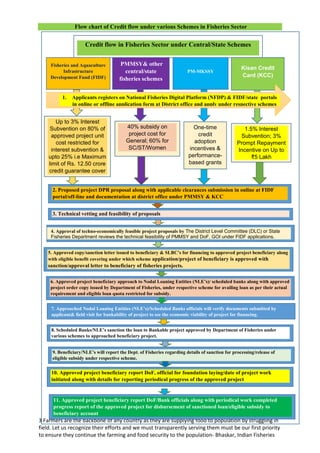
Flow chart of Credit flow under various Schemes in Fisheries Sector
Credit flow in Fisheries Sector under Central/State Schemes
Fisheries and Aquaculture
Infrastructure
Development Fund (FIDF)
PMMSY& other
central/state
fisheries schemes
PM-MKSSY
Kisan Credit
Card (KCC)
1. Applicants registers on National Fisheries Digital Platform (NFDP) & FIDF/state portals
in online or offline application form at District office and apply under respective schemes
Up to 3% Interest
Subvention on 80% of
approved project unit
cost restricted for
interest subvention &
upto 25% i.e Maximum
limit of Rs. 12.50 crore
credit guarantee cover
40% subsidy on
project cost for
General; 60% for
SC/ST/Women
One-time
credit
adoption
incentives &
performance-
based grants
1.5% Interest
Subvention; 3%
Prompt Repayment
Incentive on Up to
₹5 Lakh
2. Proposed project DPR proposal along with applicable clearances submission in online at FIDF
portal/off-line and documentation at district office under PMMSY & KCC
4. Approval of techno-economically feasible project proposals by The District Level Committee (DLC) or State
Fisheries Department reviews the technical feasibility of PMMSY and DoF, GOI under FIDF applications.
5. Approved copy/sanction letter issued to beneficiary & SLBC’s for financing to approved project beneficiary along
with eligible benefit covering under which scheme application/project of beneficiary is approved with
sanction/approval letter to beneficiary of fisheries projects.
6. Approved project beneficiary approach to Nodal Loaning Entities (NLE’s)/ scheduled banks along with approved
project order copy issued by Department of Fisheries, under respective scheme for availing loan as per their actual
requirement and eligible loan quota restricted for subsidy.
8. Scheduled Banks/NLE’s sanction the loan to Bankable project approved by Department of Fisheries under
various schemes to approached beneficiary project.
7. Approached Nodal Loaning Entities (NLE’s)/Scheduled Banks officials will verify documents submitted by
applicant& field visit for bankability of project to see the economic viability of project for financing.
9. Beneficiary/NLE’s will report the Dept. of Fisheries regarding details of sanction for processing/release of
eligible subsidy under respective scheme.
10. Approved project beneficiary report DoF, official for foundation laying/date of project work
initiated along with details for reporting periodical progress of the approved project
3. Technical vetting and feasibility of proposals
11. Approved project beneficiary report DoF/Bank officials along with periodical work completed
progress report of the approved project for disbursement of sanctioned loan/eligible subsidy to
beneficiary account