MANIPULATION OF THEFUNCTIONAL
GROUPS
When disconnection fails to produce reliable reactions, the functional groups must
undergo the following changes:
Functional Group Interconversion (FGI),
Functional Group Addition (FGA),
Functional Group Removal (FGR),
and the unmasking of latent functional groups by deprotection or other
conversions.
Functional group manipulation can result in significant reductions in molecular
complexity.
3.
FUNCTIONAL GROUP
INTERCONVERSION (FGI):
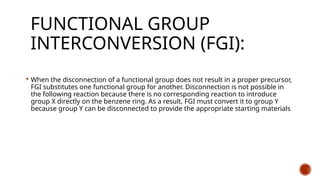
When the disconnection of a functional group does not result in a proper precursor,
FGI substitutes one functional group for another. Disconnection is not possible in
the following reaction because there is no corresponding reaction to introduce
group X directly on the benzene ring. As a result, FGI must convert it to group Y
because group Y can be disconnected to provide the appropriate starting materials
4.
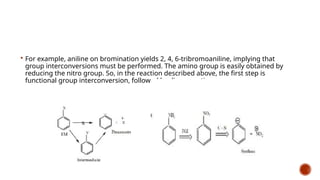
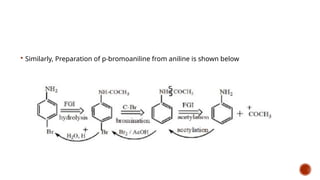
For example,aniline on bromination yields 2, 4, 6-tribromoaniline, implying that
group interconversions must be performed. The amino group is easily obtained by
reducing the nitro group. So, in the reaction described above, the first step is
functional group interconversion, followed by disconnection
FUNCTIONAL GROUP ADDITION(FGA):
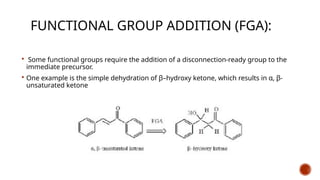
Some functional groups require the addition of a disconnection-ready group to the
immediate precursor.
One example is the simple dehydration of β–hydroxy ketone, which results in α, β-
unsaturated ketone
7.
FUNCTIONAL GROUP
REMOVAL (FGR)
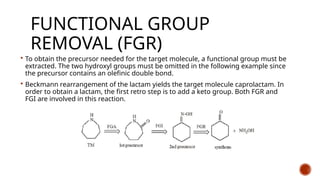
To obtain the precursor needed for the target molecule, a functional group must be
extracted. The two hydroxyl groups must be omitted in the following example since
the precursor contains an olefinic double bond.
Beckmann rearrangement of the lactam yields the target molecule caprolactam. In
order to obtain a lactam, the first retro step is to add a keto group. Both FGR and
FGI are involved in this reaction.
8.
INTERCONVERTIBLE
FUNCTIONAL GROUPS
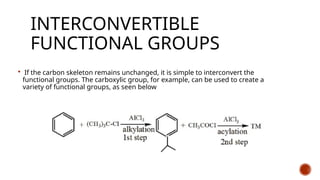
Ifthe carbon skeleton remains unchanged, it is simple to interconvert the
functional groups. The carboxylic group, for example, can be used to create a
variety of functional groups, as seen below
9.
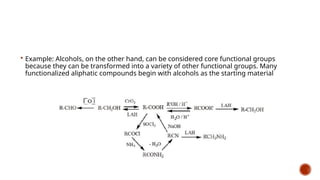
Example: Alcohols,on the other hand, can be considered core functional groups
because they can be transformed into a variety of other functional groups. Many
functionalized aliphatic compounds begin with alcohols as the starting material