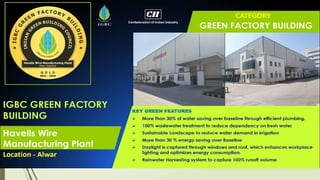
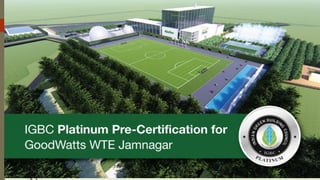
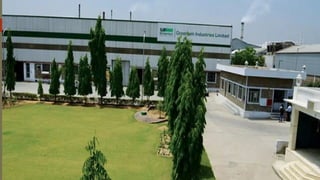
Green Factory
Buildings
Jit Kumar Gupta,
Former Advisor, Town Planning , PUDA
Former Chairperson, Chandigarh Chapter, IGBC
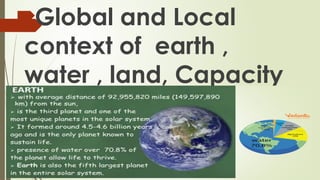
Global and Local
context of earth ,
water , land, Capacity
Holding Capacity of planet earth
 Earth’s human carrying capacity ranges
widely from- 2 billion to over 1 trillion- ,
depending on consumption levels &
technology
 Estimates also suggest - sustainable limit
between 8 -11 billion people.
 Currently, humanity consuming resources
@1.6 times sustainable rate,
Global population already> 8 billion in 2022.
Few models suggest - at current
consumption rate , planet's carrying
capacity is 4.09 billion-- driven by carbon
emissions
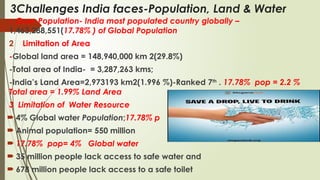
3Challenges India faces-Population, Land & Water
1. Over-Population- India most populated country globally –
1,463,288,551(17.78% ) of Global Population
2 Limitation of Area
-Global land area = 148,940,000 km 2(29.8%)
-Total area of India- = 3,287,263 kms;
-India’s Land Area=2,973193 km2(1.996 %)-Ranked 7th
. 17.78% pop = 2.2 %
Total area = 1.99% Land Area
3 Limitation of Water Resource
 4% Global water Population;17.78% p
 Animal population= 550 million
 17.78% pop= 4% Global water
 35 million people lack access to safe water and
 678 million people lack access to a safe toilet
Context of Buildings&
Making Buildings Green
Advantages of G. Buildings
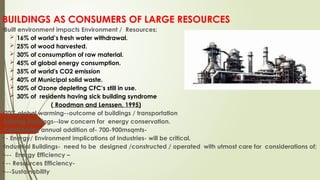
BUILDINGS AS CONSUMERS OF LARGE RESOURCES
•Built environment impacts Environment / Resources:
 16% of world’s fresh water withdrawal.
 25% of wood harvested.
 30% of consumption of raw material.
 45% of global energy consumption.
 35% of world's CO2 emission
 40% of Municipal solid waste.
 50% of Ozone depleting CFC’s still in use.
 30% of residents having sick building syndrome
( Roodman and Lenssen, 1995)
•70% global warming--outcome of buildings / transportation
•Existing buildings--low concern for energy conservation.
•Considering annual addition of- 700-900msqmts-
• - Energy/ Environment implications of Industries- will be critical.
•Industrial Buildings- need to be designed /constructed / operated with utmost care for considerations of;
•--- Energy Efficiency –
• -- Resources Efficiency-
•---Sustainability
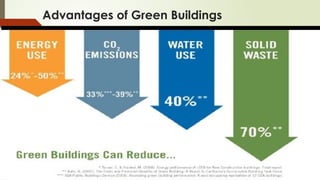
Advantages of Green Buildings
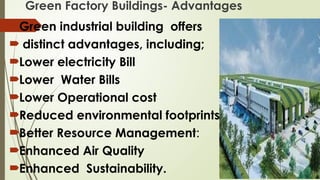
Green Factory Buildings- Advantages
Green industrial building offers
 distinct advantages, including;
Lower electricity Bill
Lower Water Bills
Lower Operational cost
Reduced environmental footprints
Better Resource Management:
Enhanced Air Quality
Enhanced Sustainability.
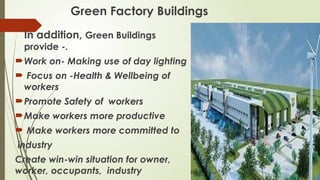
Green Factory Buildings

In addition, Green Buildings
provide -.
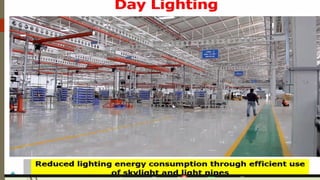
Work on- Making use of day lighting
 Focus on -Health & Wellbeing of
workers
Promote Safety of workers
Make workers more productive
 Make workers more committed to
industry
Create win-win situation for owner,
worker, occupants, industry
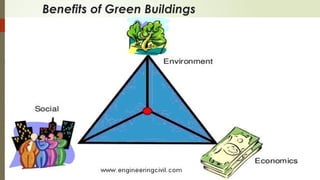
Benefits of Green Buildings
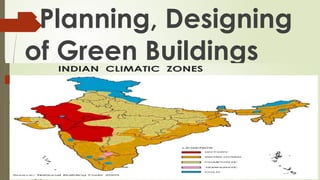
Planning, Designing
of Green Buildings
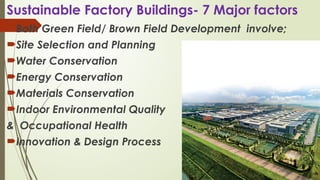
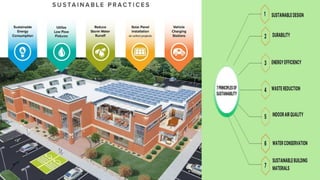
Sustainable Factory Buildings- 7 Major factors
Both Green Field/ Brown Field Development involve;
Site Selection and Planning
Water Conservation
Energy Conservation
Materials Conservation
Indoor Environmental Quality
& Occupational Health
Innovation & Design Process
Daylighting
Local materials
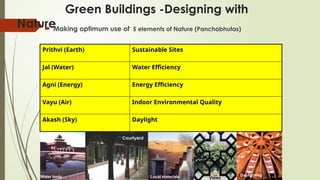
Green Buildings -Designing with
Nature
 Making optimum use of 5 elements of Nature (Panchabhutas)
Prithvi (Earth) Sustainable Sites
Jal (Water) Water Efficiency
Agni (Energy) Energy Efficiency
Vayu (Air) Indoor Environmental Quality
Akash (Sky) Daylight
Views
Water body
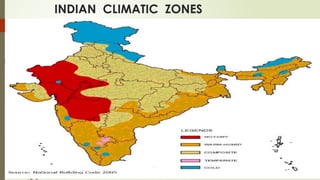
INDIAN CLIMATIC ZONES
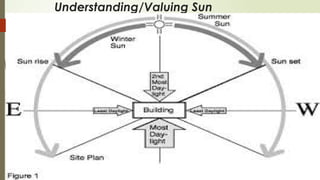
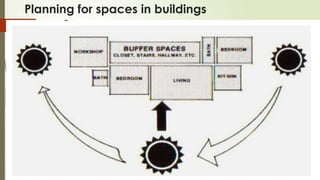
Understanding/Valuing Sun
Planning for spaces in buildings
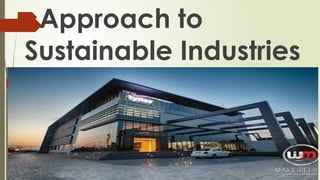
Approach to
Sustainable Industries
Role and Relevance of Green Buildings
 Industry runs on quality of machinery, quality of processes, quality of manpower, quality of buildings
 State of art machinery and process add to production
 Quality of Manpower as important as quality of Machinery
 Similarly state of art buildings& Green Buildings play crucial role in -
 -- improving productivity, profitability and bottom line of industries
 - Making manpower happy , healthy & more productive
 -- Reducing adverse environmental impact.
 - focusing on producing goods/ services in an environmentally friendly,
 -Designing Building/ processes- which minimize use of water/ energy, generation of waste
 - minimize pollution -- while maximizing resource efficiency. .
 Operating Industry – to Protect Environmental - mitigating climate change- using renewable
resources-- decreases reliance on fossil fuels. --improving air & water quality
 promoting sustainability – make industries low-carbon economy & achieving climate goals.
 Help achieve national agenda- of zero carbon by 2070
 Governments increasingly support-- green buildings through incentives, -- regulations, funding for
sustainable projects

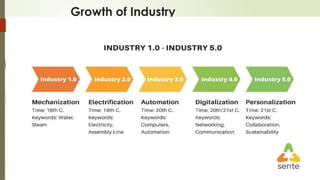
Growth of Industry
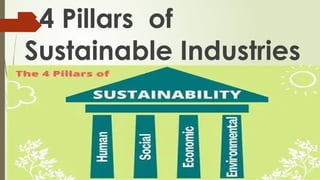
4 Pillars of
Sustainable Industries
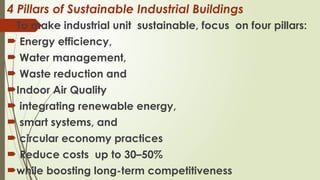
4 Pillars of Sustainable Industrial Buildings
To make industrial unit sustainable, focus on four pillars:
 Energy efficiency,
 Water management,
 Waste reduction and
Indoor Air Quality
 integrating renewable energy,
 smart systems, and
 circular economy practices
 Reduce costs up to 30–50%
while boosting long-term competitiveness
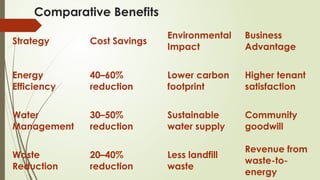
Comparative Benefits
Strategy Cost Savings
Environmental
Impact
Business
Advantage
Energy
Efficiency
40–60%
reduction
Lower carbon
footprint
Higher tenant
satisfaction
Water
Management
30–50%
reduction
Sustainable
water supply
Community
goodwill
Waste
Reduction
20–40%
reduction
Less landfill
waste
Revenue from
waste-to-
energy
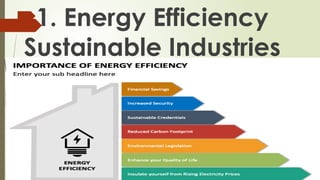
1. Energy Efficiency
Sustainable Industries
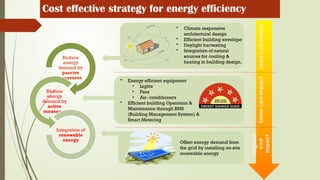
Cost effective strategy for energy efficiency
Reduce
energy
demand by
passive
measures
Reduce
energy
demand by
active
measures
Integration of
renewable
energy
Least
cost
impact
Some
cost
impact
Highest
cost
impact
• Climate responsive
architectural design
• Efficient building envelope
• Daylight harvesting
• Integration of natural
sources for cooling &
heating in building design.
Offset energy demand from
the grid by installing on-site
renewable energy
• Energy efficient equipment
• Lights
• Fans
• Air- conditioners
• Efficient building Operation &
Maintenance through BMS
(Building Management System) &
Smart Metering
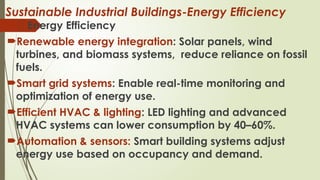
Sustainable Industrial Buildings-Energy Efficiency
🌱 Energy Efficiency
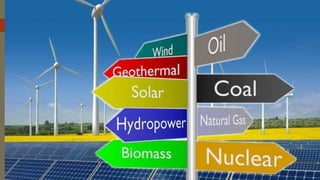
Renewable energy integration: Solar panels, wind
turbines, and biomass systems, reduce reliance on fossil
fuels.
Smart grid systems: Enable real-time monitoring and
optimization of energy use.
Efficient HVAC & lighting: LED lighting and advanced
HVAC systems can lower consumption by 40–60%.
Automation & sensors: Smart building systems adjust
energy use based on occupancy and demand.
Cavity Walls
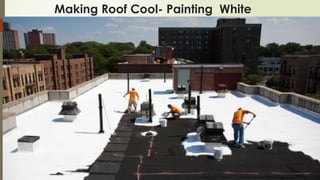
Making Roof Cool- Painting White
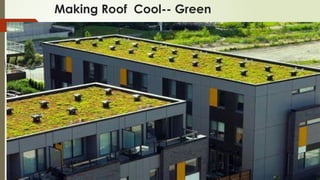
Making Roof Cool-- Green
Green Wallas- Covered With Coloured Creepers
Sun pipe- Day Light Harvesting
Sun Pipes used to lit
basement,
Viswa Syamalam, IGBC Platinum
2 Water Efficiency
Sustainable Industries
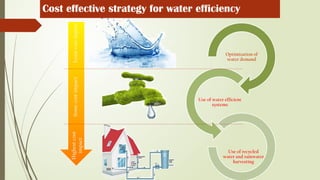
Optimization of
water demand
Use of water efficient
systems
Use of recycled
water and rainwater
harvesting
Some
cost
impact
Highest
cost
impact
Least
cost
impact
Cost effective strategy for water efficiency
Water Management
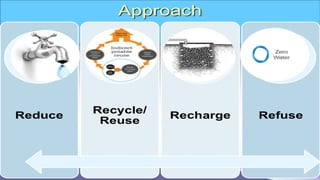
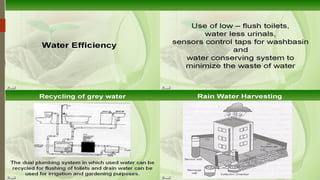
Rainwater harvesting: Collects and stores water
for non-potable uses.
Wastewater recycling: On-site treatment plants
reduce freshwater demand.
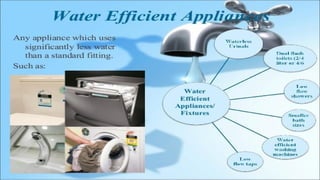
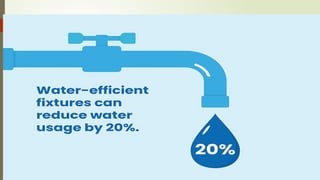
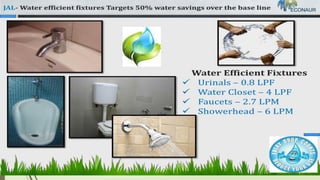
Water-efficient fixtures: Low-flow taps and
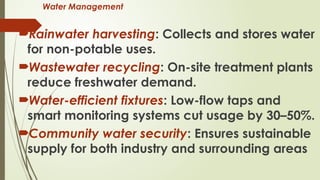
smart monitoring systems cut usage by 30–50%.
Community water security: Ensures sustainable
supply for both industry and surrounding areas
3 Waste Reduction
Sustainable Industries
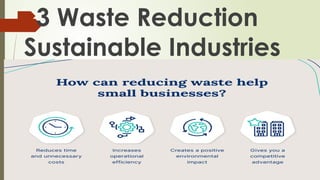
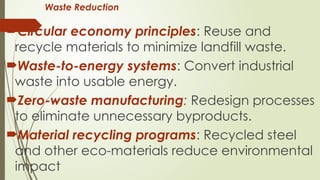
Waste Reduction
Circular economy principles: Reuse and
recycle materials to minimize landfill waste.
Waste-to-energy systems: Convert industrial
waste into usable energy.
Zero-waste manufacturing: Redesign processes
to eliminate unnecessary byproducts.
Material recycling programs: Recycled steel
and other eco-materials reduce environmental
impact
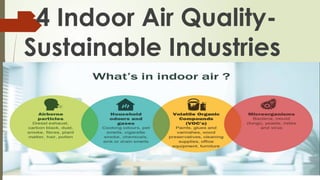
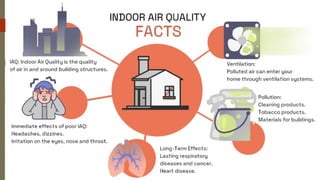
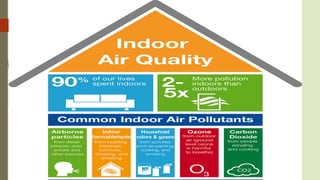
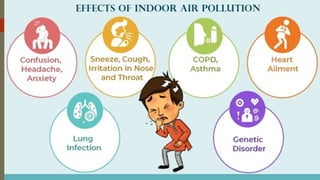
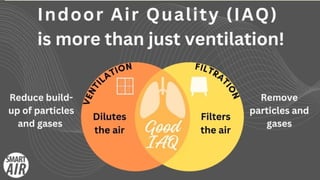
4 Indoor Air Quality-
Sustainable Industries
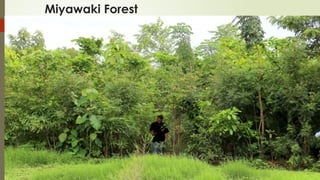
Combating Climate Change - Plant Trees
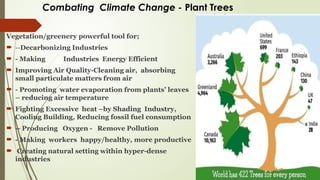
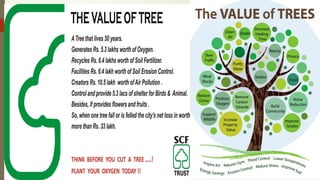
Vegetation/greenery powerful tool for;
 --Decarbonizing Industries
 - Making Industries Energy Efficient
 Improving Air Quality-Cleaning air, absorbing
small particulate matters from air
 - Promoting water evaporation from plants’ leaves
– reducing air temperature
 Fighting Excessive heat –by Shading Industry,
Cooling Building, Reducing fossil fuel consumption
 -- Producing Oxygen - Remove Pollution
 - Making workers happy/healthy, more productive
 Creating natural setting within hyper-dense
industries
Miyawaki Forest
Thanks for your time,
attention and patience