Google App Engine and
Social Apps
Chris Schalk, Developer Advocate, Google
Ikai Lan, Developer Programs Engineer, Google
Dave Westwood, Creator of BuddyPoke

January 20, 2010
Google App Engine


       • Easy to build
       • Easy to maintain
       • Easy to scale


    Leveraging Google’s platform to better serve your customers

2
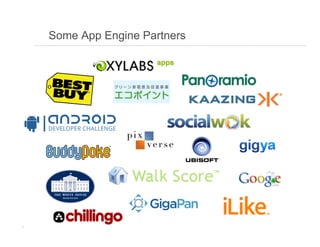
Some App Engine Partners


3
Gartner’s view on Cloud Computing


    •  Correctly sees App Engine as a “Platform as a Service”

       •  Just focus on the code, don’t worry about infrastructure
            •  Application infrastructure
           •  System infrastructure

       •  Rapid application deployment and change

       •  Fully delegated data center responsibility


4                                         * Source: Yefim Natis, Gartner, AADI 2009
App Engine Platform Details


5
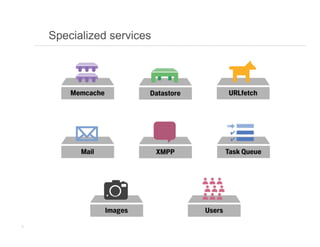
Specialized services


6
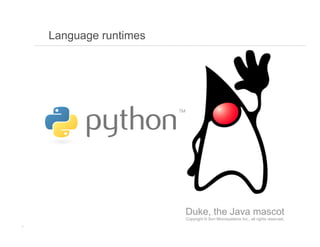
Language runtimes


                        Duke, the Java mascot
                        Copyright © Sun Microsystems Inc., all rights reserved.
7
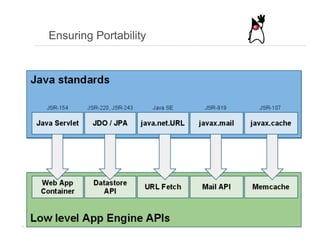
Ensuring Portability


8
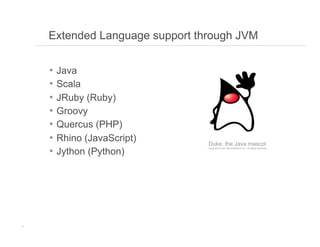
Extended Language support through JVM


    •  Java
    •  Scala
    •  JRuby (Ruby)
    •  Groovy
    •  Quercus (PHP)
    •  Rhino (JavaScript)       Duke, the Java mascot
    •  Jython (Python)
                                Copyright © Sun Microsystems Inc., all rights reserved.


9
Application management in the cloud


10
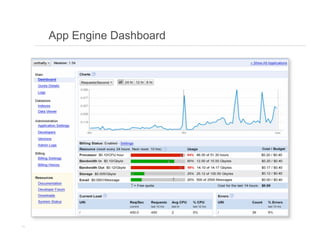
App Engine Dashboard


11
Development Tools for App Engine


12
Google App Engine Launcher


13
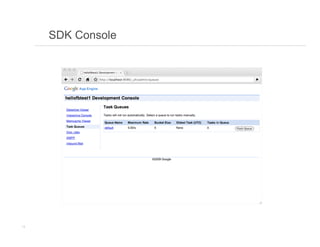
SDK Console


14
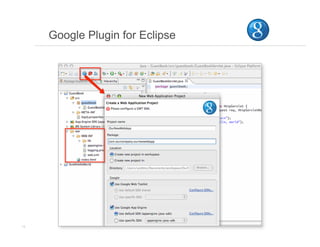
Google Plugin for Eclipse


15
Feature Roadmap


16
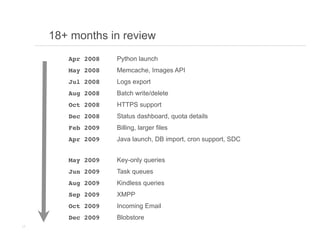
18+ months in review
        Apr 2008
   Python launch
        May 2008
   Memcache, Images API
        Jul 2008
   Logs export
        Aug 2008
   Batch write/delete
        Oct 2008
   HTTPS support
        Dec 2008
   Status dashboard, quota details
        Feb 2009
   Billing, larger files
        Apr 2009
   Java launch, DB import, cron support, SDC


        May 2009
   Key-only queries
        Jun 2009
   Task queues
        Aug 2009
   Kindless queries
        Sep 2009
   XMPP
        Oct 2009
   Incoming Email
        Dec 2009
   Blobstore
17
Demos!


      •  Dashboard
      •  AppLauncher
      •  Eclipse Plugin


18
App Engine as a Social Platform


19
App Engine + Social Apps (mobile too!)


     •  App Engine works well as a backend server for
      Social Apps of all types
       –  OpenSocial
          •  Tutorials, example code - “Building an OpenSocial App with
            Google App Engine”
          •  http://wiki.opensocial.org/index.php?
            title=Building_an_OpenSocial_App_with_Google_App_Engine
       –  Facebook
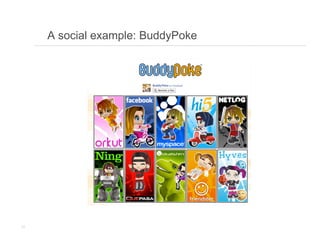
          •  BuddyPoke
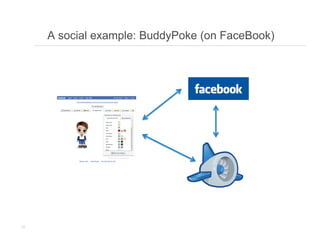
              –  Dave Westwood here to speak on his FB implementation
                  of BuddyPoke on GAE


20
A social example: BuddyPoke


21
A social example: BuddyPoke (on FaceBook)


22
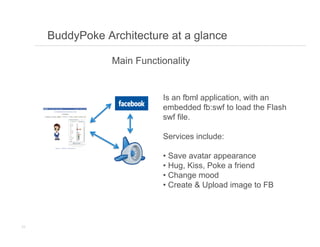
BuddyPoke Architecture at a glance

                 Main Functionality


                            Is an fbml application, with an
                            embedded fb:swf to load the Flash
                            swf file.

                            Services include:

                            •  Save avatar appearance
                            •  Hug, Kiss, Poke a friend
                            •  Change mood
                            •  Create & Upload image to FB


23
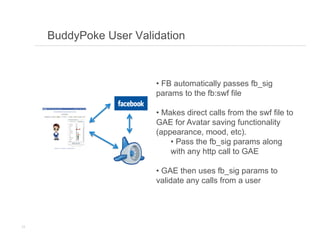
BuddyPoke User Validation


                        •  FB automatically passes fb_sig
                        params to the fb:swf file

                        •  Makes direct calls from the swf file to
                        GAE for Avatar saving functionality
                        (appearance, mood, etc).
                             •  Pass the fb_sig params along
                             with any http call to GAE

                        •  GAE then uses fb_sig params to
                        validate any calls from a user


24
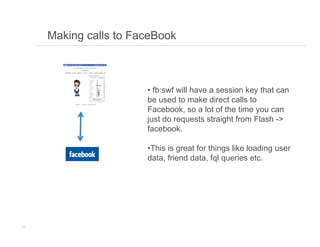
Making calls to FaceBook


                       •  fb:swf will have a session key that can
                       be used to make direct calls to
                       Facebook, so a lot of the time you can
                       just do requests straight from Flash ->
                       facebook.

                       • This is great for things like loading user
                       data, friend data, fql queries etc.


25
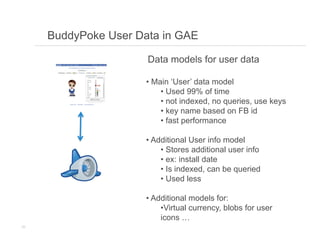
BuddyPoke User Data in GAE

                      Data models for user data

                      •  Main ‘User’ data model
                           •  Used 99% of time
                           •  not indexed, no queries, use keys
                           •  key name based on FB id
                           •  fast performance

                      •  Additional User info model
                           •  Stores additional user info
                           •  ex: install date
                           •  Is indexed, can be queried
                           •  Used less

                      •  Additional models for:
                           • Virtual currency, blobs for user
                           icons …
26
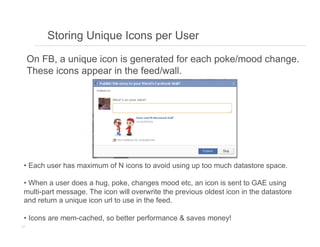
Storing Unique Icons per User

     On FB, a unique icon is generated for each poke/mood change.
     These icons appear in the feed/wall.


 •  Each user has maximum of N icons to avoid using up too much datastore space.

 •  When a user does a hug, poke, changes mood etc, an icon is sent to GAE using
 multi-part message. The icon will overwrite the previous oldest icon in the datastore
 and return a unique icon url to use in the feed.

 •  Icons are mem-cached, so better performance & saves money!
27
Updating profile page FBML

     •  BuddyPoke has a box on the profile page. It contains fbml that shows icons for
     the last 4 activities.

     • When you hug a friend it will update your profile page, and your friend's profile
     page. Facebook's servers can be very slow.. So rather than tie up App Engine I
     create a facebook batch request, sign it on App Engine, and then pass it back to
     the Flash swf client.

     • The client then makes the call to FaceBook's servers with the signed request to
     update the profile data.

     • For OpenSocial, I'd just make the calls directly from App Engine to an OpenSocial
     server. But if you have 4+ operations to do on facebook those calls can take a long
     time, so I just get the Flash client to send the request and do all the waiting.


28
Updating profile page FBML, cont.

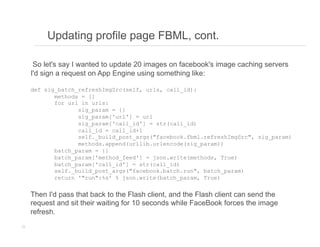
      So let's say I wanted to update 20 images on facebook's image caching servers
     I'd sign a request on App Engine using something like:

     def sig_batch_refreshImgSrc(self, urls, call_id):
            methods = []
            for url in urls:
                   sig_param = {}
                   sig_param['url'] = url
                   sig_param['call_id'] = str(call_id)
                   call_id = call_id+1
                   self._build_post_args("facebook.fbml.refreshImgSrc", sig_param)
                   methods.append(urllib.urlencode(sig_param))
            batch_param = {}
            batch_param['method_feed'] = json.write(methods, True)
            batch_param['call_id'] = str(call_id)
            self._build_post_args("facebook.batch.run", batch_param)
            return '"run":%s' % json.write(batch_param, True)


     Then I'd pass that back to the Flash client, and the Flash client can send the
     request and sit their waiting for 10 seconds while FaceBook forces the image
     refresh.
29
Payments using Paypal

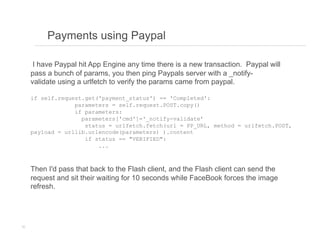
      I have Paypal hit App Engine any time there is a new transaction. Paypal will
     pass a bunch of params, you then ping Paypals server with a _notify-
     validate using a urlfetch to verify the params came from paypal.

     if self.request.get('payment_status') == 'Completed':
                  parameters = self.request.POST.copy()
                  if parameters:
                    parameters['cmd']='_notify-validate’
                     status = urlfetch.fetch(url = PP_URL, method = urlfetch.POST,
     payload = urllib.urlencode(parameters) ).content
                     if status == "VERIFIED":
                         ...


     Then I'd pass that back to the Flash client, and the Flash client can send the
     request and sit their waiting for 10 seconds while FaceBook forces the image
     refresh.


30
Communicating with via Email


       “Use the email API to send yourself
       messages about anything important.

       Very soon, with the FaceBook changes, I
       expect I'll be using the email API a lot more.

       And the beauty of App Engine is I can just
       pay for as much email quota as I need. No
       hassles setting up email servers..”


31
code.google.com/appengine

                  twitter.com/cschalk
                  twitter.com/ikai
     Thank you!   twitter.com/app_engine


32