The “Genome” is a complete set of genetic material within an organism.
It is an organism’s complete set of Deoxyribonucleic acid (DNA) including all of its genes and all other fuctionals and non-functionals DNA sequences.
Genomes
The word“Genome” coined by general Botanist Hans Winkler in
1920, was derived simply by combining gene and the final syllable of
Chromosome.
The “Genome” is a complete set of genetic material within an
organism.
It is an organism’s complete set of Deoxyribonucleic acid (DNA)
including all of its genes and all other fuctionals and non-functionals
DNA sequences.
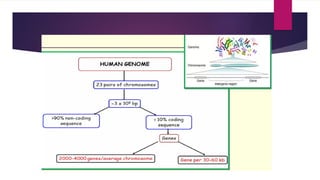
The size of human genome is 3.2 billion or 3200 million of base pairs.
There are about 20,000 to 25,000 genes in a human genome.
4.
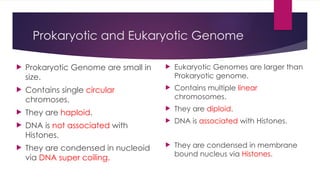
Prokaryotic and EukaryoticGenome
Prokaryotic Genome are small in
size.
Contains single circular
chromoses.
They are haploid.
DNA is not associated with
Histones.
They are condensed in nucleoid
via DNA super coiling.
Eukaryotic Genomes are larger than
Prokaryotic genome.
Contains multiple linear
chromosomes.
They are diploid.
DNA is associated with Histones.
They are condensed in membrane
bound nucleus via Histones.
Chromatin
Nucleus containsthread like coiled structure called
cromatin structure or chromatin fibre.
This chromatin undergoes furture condensation to
form Chrosome .
The chromatin fibre remains suspended in the
Nucleosome.
They can be euchromatin or heterochromatin.
Euchromatin is uncoiled and coiled.
Heterochromatin is condensed and active.
9.
Histones
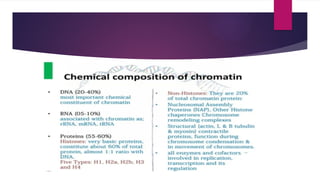
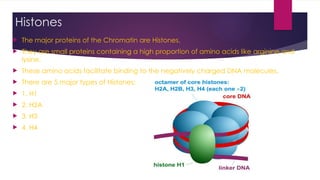
The majorproteins of the Chromatin are Histones.
They are small proteins containing a high proportion of amino acids like arginine and
lysine.
These amino acids facilitate binding to the negatively charged DNA molecules.
There are 5 major types of Histones:
1. H1
2. H2A
3. H3
4. H4
10.
Nucleosome
Chromatin iscomposed of repeating 200 base pair units called
nucleosomes.
Nucleosomes are condensed several times to form the intact chromatids.
So, nucleosome is the basic structural unit of DNA packaging in
eukaryotes.
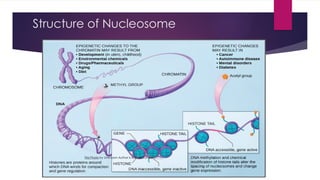
Nucleosome is a segment of DNA wound around 8 histone protein cores.
It contains two copies of H2A, H2B, H3 and H4, H1 is a linker histone Size of
the Nucleosome is 11 nm. It is approximately 200 base pairs long.
The binding of proteins to DNA in chromatin protects regions of the DNA
from nuclease digestion so that, the enzyme can attack DNA only at sites
separated by approximately 200 base pairs.
Chromatin fibres have a beaded appearance with the beads spaced at
intervals of approximately 200 base pairs.
Genome Organization
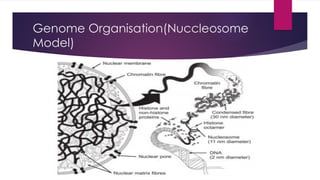
Genomeorganization can be explained by nucleosome model. There are three levels of
organization in nucleosome model:
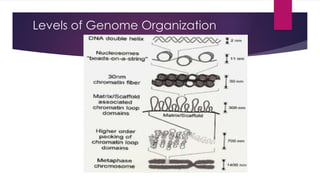
1. DNA wrapping around nucleosomes: The string on beads structure.
2. A 30 nm condensed chromatin fibre consisting of nucleosome arrays in their mostcompact
form: The solenoid structure
3. Higher levels of packing into metaphase chromosome: The loops, domains and scaffold
structure.
The packagingof DNA into nucleosomes yields a chromatin fibre approximately 11
nm in diameter.
The chromatin is further condensed by coiling into a 30 nm solenoid fibre containing
about 6 nucleosomes per turn. Folding of 30 nm fibres upon themselves can lead to
further condensation of chromatin within the cell.
In interphase (non-dividing cells) most of the chromatin is called euchromatin.
Most of this euchromatin in interphase nuclei appears to be in the form of 30 nm or
somewhat more condensed 60-130 nm chromatin fibres. About 10% of interphase
chromatin is called heterochromatin.
Heterochromatin is transcriptionally inactive and contains highly repeated DNA
sequences such as those present in centromere and telomere.
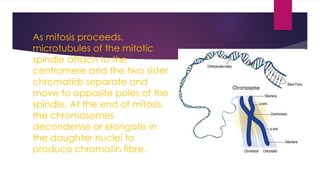
chromosome is a compact thick ribbon like coiled structure of nucleic acids and
chromosome is a compact thick ribbon like coiled structure of nucleic acids and
protein found in the nucleus.
The metaphase chromosome consists of two identical sister chromatids. These sister
chromatids are held together at the centromere
15.
As mitosis proceeds.
microtubulesof the mitotic
spindle attach to the
centromere and the two sister
chromatids separate and
move to opposite poles of the
spindle. At the end of mitosis,
the chromosomes
decondense or elongate in
the daughter nuclei to
produce chromatin fibre.
16.
References:
Cellular andMoleccular Pharmacology by Dr. Pratap
Sahu and Dr. Prashant Tiwari
Genome Organization of Prokaryotrs and Eukaryotes
from Slideshare
https://www.slideshare.net/ArunViswanathan3/
genome-organisation
https://image.slidesharecdn.com/prokaryoticneukaryoticgenome-160514180458/85/prokaryotic-
and-eukaryotic-genome-5-320.jpg?cb=1665779356
https://static.javatpoint.com/biology/images/
chromosome.jpg

 Most read

 Most read
 Most read