3
Video 1: AMechanic Lifting a Car
Using a Hydraulic Jack
Observe
1. What did you observe in the
video?
2. What object is being lifted?
3. What machine is being used to lift
the car?
4.
4
Video 1: AMechanic Lifting a Car
Using a Hydraulic Jack
Analyze
4. Do you think the mechanic is strong enough to
lift the car using only his hands? Why or why not?
5. Why do you think the mechanic can lift such a
heavy car with little effort?
6. What do you think is happening inside the
hydraulic jack that allows it to lift the car?
6
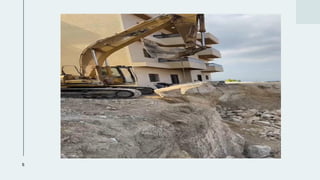
Video 2: AnExcavator Lifting Heavy
Rocks
Observe
1. What task is the excavator
performing?
2. Which parts of the excavator are
moving?
7.
7
Video 2: AnExcavator Lifting Heavy
Rocks
Analyze
3. Why do you think the excavator can lift such
heavy rocks without breaking?
4. What do you think helps the excavator produce
such a large lifting force?
5. If the operator only moves small control levers,
how does the excavator generate enough force to
lift massive objects?
9
Video 3: AHydraulic Car Lift in an
Auto Repair Shop
Observe
1. What happened when the mechanic
activated the lift?
2. What happened to the car?
10.
10
Analyze
3. How cana machine lift an entire vehicle
safely?
4. Where do you think the lifting force comes
from?
5. What do you think is inside the hydraulic
lift that allows it to raise such a heavy load?
Video 3: A Hydraulic Car Lift in an
Auto Repair Shop
11.
11
1. What iscommon among the three videos?
2. What type of work do these machines
perform?
3. What do these machines use to lift or move
heavy objects?
4. How do you think a small effort can produce a
much larger lifting force?
5. If you were to explain how these machines
work, what scientific idea would you suggest?
General Processing Questions
12.
The Physics ofFluids:
Hydraulic Systems
and Pascal’s Principle
Prepared by:
CHRISTINE A. SINGSON, LPT
13.
13
Learning Objectives
By theend of this lesson, the learners
should be able to:
1. Explain pressure, force, and area.
2. Describe Pascal’s Principle.
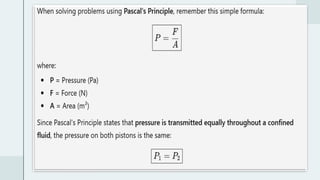
3. Solve problems using P = F/A.
4. Explain how hydraulic systems
enhance machines.
14.
IMPORTANT CONCEPTS
Pressure
• isthe amount of force over an area
• In fluids, pressure can be transmitted
throughout the fluid, not just at the point
where force is applied.
• Measured in Pascals (Pa)
15.
Pascal’s Principle
• statesthat the pressure applied to
a confined fluid is transmitted
equally in all directions.
• Pressure remains undiminished as it
travels through the fluid.
IMPORTANT CONCEPTS
16.
Pascal’s Principle
• isthe foundation of all hydraulic
systems.
• explains how hydraulic systems
efficiently perform heavy tasks.
IMPORTANT CONCEPTS
17.
Pascal’s Principle
• Whenyou apply pressure to a
liquid inside a closed container, that
pressure is passed on equally to
every part of the liquid.
IMPORTANT CONCEPTS
18.
Pascal’s Principle isthe idea that:
• when you apply pressure to a
confined liquid, that pressure is
transmitted equally to every part
of the liquid.
IMPORTANT CONCEPTS
19.
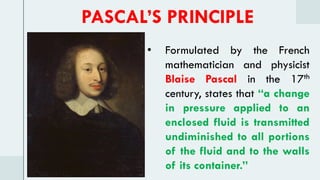
• Formulated bythe French
mathematician and physicist
Blaise Pascal in the 17th
century, states that “a change
in pressure applied to an
enclosed fluid is transmitted
undiminished to all portions
of the fluid and to the walls
of its container.”
PASCAL’S PRINCIPLE
20.
• Hydraulic mechanismsare based on
Pascal’s principle, which states that pressure
applied to a fluid in a closed system is
transmitted equally in all directions
• In hydraulic systems, this principle is
leveraged to generate and transmit force for
tasks such as lifting, pressing, or moving
heavy objects.
PASCAL’S PRINCIPLE
21.
Hydraulic System
• isa system that uses a confined
liquid (usually oil) to transmit force
and perform work.
IMPORTANT CONCEPTS
22.
Piston
• is amovable, tightly fitting component
that slides back and forth inside a
cylinder to transmit force or pressure.
• is a part of a machine that moves
inside a cylinder to push or be pushed
by a fluid or gas.
IMPORTANT CONCEPTS
23.
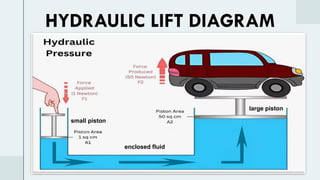
Hydraulic System (Howit works)
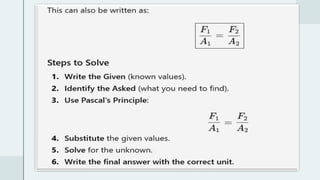
1. A force is applied to a small
piston.
2. This creates pressure in the
confined liquid.
IMPORTANT CONCEPTS
24.
Hydraulic System (Howit works)
3. The pressure is transmitted equally
throughout the liquid (according to
Pascal's Principle).
4. The pressure pushes on a larger
piston, producing a greater lifting force.
IMPORTANT CONCEPTS
25.
Hydraulic System
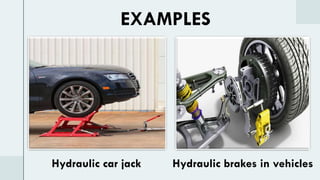
• Hydrauliccar jack
• Hydraulic brakes in vehicles
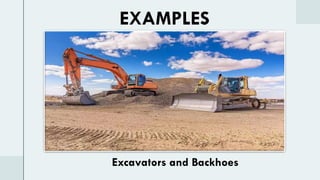
• Excavators and backhoes
• Hydraulic lifts (e.g., car repair shops)
• Garbage trucks
EXAMPLES
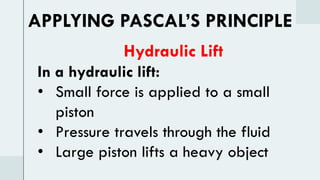
Hydraulic Lift
In ahydraulic lift:
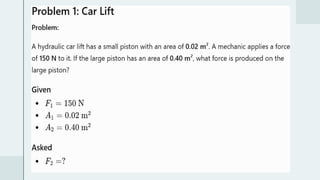
• Small force is applied to a small
piston
• Pressure travels through the fluid
• Large piston lifts a heavy object
APPLYING PASCAL’S PRINCIPLE
For a hydraulicsystem to function
properly:
• Enclosed fluid is required
• Pressure spreads equally
• Pressure is not reduced
KEY IDEAS
34.
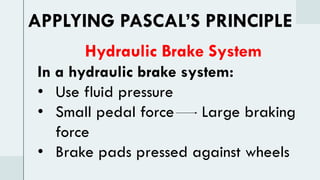
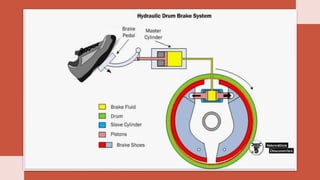
Hydraulic Brake System
Ina hydraulic brake system:
• Use fluid pressure
• Small pedal force Large braking
force
• Brake pads pressed against wheels
APPLYING PASCAL’S PRINCIPLE
36.
Hydraulic Brake System
Ina hydraulic brake system:
• A small force applied pedal creates a
pressure in the brake fluid.
• This pressure is transmitted to the brake
pads increasing the force applied to the
wheels. This allows vehicles to stop
effectively with minimal effort.
APPLYING PASCAL’S PRINCIPLE
37.
Hydraulic Brake System
•In a hydraulic brake system, pressing
the brake applies force to a small
piston in the master cylinder. This
creates pressure that travels to the
brake fluid and pushes larger piston
at the wheels.
APPLYING PASCAL’S PRINCIPLE
38.
Hydraulic Brake System
•The increase force allows the brake
pedal to press tightly against the
wheels, slowing or stopping the
vehicle.
APPLYING PASCAL’S PRINCIPLE
Hydraulic System
• arewidely used in heavy duty machines
such as garbage trucks and excavators.
These machines rely on fluid pressure to
lift, push, and move heavy loads.
• allows precise control using small input
forces
APPLICATIONS OF HYDRAULICS
41.
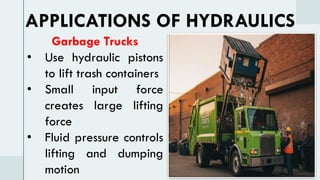
Garbage Trucks
• Usehydraulic pistons
to lift trash containers
• Small input force
creates large lifting
force
• Fluid pressure controls
lifting and dumping
motion
APPLICATIONS OF HYDRAULICS
42.
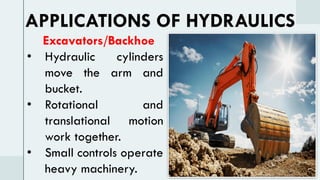
Excavators/Backhoe
• Hydraulic cylinders
movethe arm and
bucket.
• Rotational and
translational motion
work together.
• Small controls operate
heavy machinery.
APPLICATIONS OF HYDRAULICS
43.
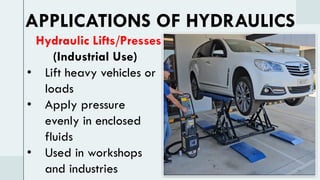
Hydraulic Lifts/Presses
(Industrial Use)
•Lift heavy vehicles or
loads
• Apply pressure
evenly in enclosed
fluids
• Used in workshops
and industries
APPLICATIONS OF HYDRAULICS
44.
44
SUMMARY
Hydraulic systems workbecause:
✓ Pressure is transmitted equally throughout a
confined fluid.
✓ By applying Pascal’s principle, a small force
becomes large force. This makes heavy lifting
and powerful motion become possible. This
allow a small force to be transformed into a
much larger force. As a result, heavy tasks
become easier and more manageable.
IMPORTANT CONCEPTS
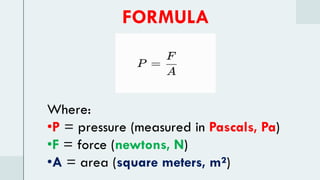
1. Pressure(P)
• is the amount of force over an area
• In an enclosed fluid, spreads evenly in all
direction and does not weaken at it
travels.
• This property allows hydraulic systems to
function efficiently.
• Measured in Pascals (Pa)
48.
IMPORTANT CONCEPTS
1. Pressure(P)
• When the same force is applied to a
smaller area, the pressure increases.
• It helps us understand how force behave
when distributed across surfaces.
• Pressure increases when area decreases.
• Pressure decreases when area increases.
49.
IMPORTANT CONCEPTS
2. Force(F)
• A push or pull acting on an object.
• Causes changes in motion or shape (are always
involve when motion occurs)
• In fluids, force creates pressure when applied over an
area.
• In hydraulic systems, a small applied force can
generate large output of forces due to pressure
transmission.
• Measured in Newtons (N)
50.
IMPORTANT CONCEPTS
3. Area(A)
• Surface where force is applied
• The size of the area affects how pressure
is distributed.
• Measured in square meters (m²)
• Smaller areas result in higher pressure
while larger areas reduce pressure.
51.
IMPORTANT CONCEPTS
4. Fluid
•is a substance that can flow and take the
shape of its container.
• Includes liquids like oil and water.
• Liquids are commonly used in hydraulic systems
because they transmit pressure efficiently.
• Allow force to be distributed throughout an
enclosed system
52.
IMPORTANT CONCEPTS
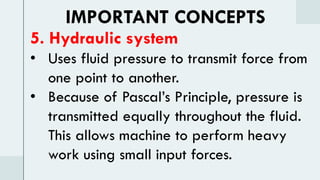
5. Hydraulicsystem
• Uses fluid pressure to transmit force from
one point to another.
• Because of Pascal’s Principle, pressure is
transmitted equally throughout the fluid.
This allows machine to perform heavy
work using small input forces.
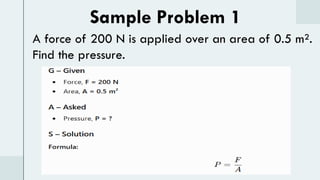
Sample Problem 1
Aforce of 200 N is applied over an area of 0.5 m².
Find the pressure.
55.
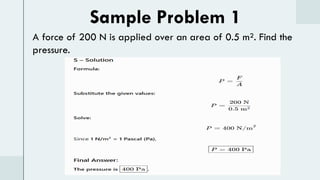
Sample Problem 1
Aforce of 200 N is applied over an area of 0.5 m². Find the
pressure.
56.
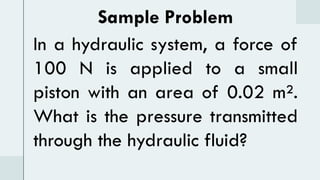
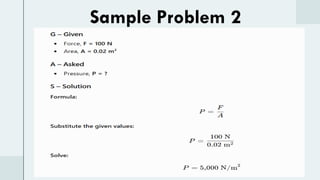
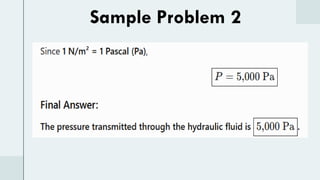
Sample Problem
In ahydraulic system, a force of
100 N is applied to a small
piston with an area of 0.02 m².
What is the pressure transmitted
through the hydraulic fluid?
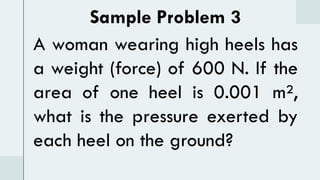
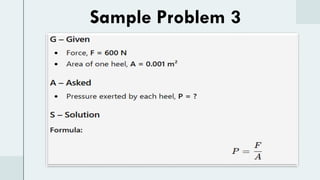
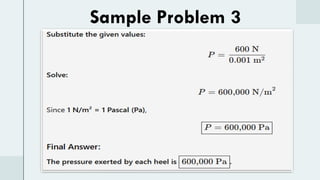
Sample Problem 3
Awoman wearing high heels has
a weight (force) of 600 N. If the
area of one heel is 0.001 m²,
what is the pressure exerted by
each heel on the ground?
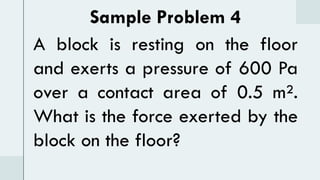
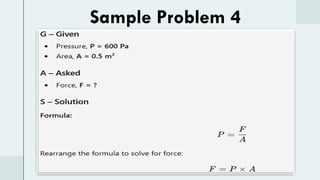
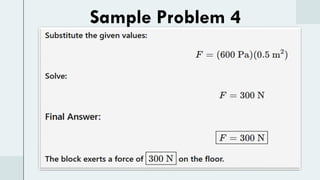
Sample Problem 4
Ablock is resting on the floor
and exerts a pressure of 600 Pa
over a contact area of 0.5 m².
What is the force exerted by the
block on the floor?
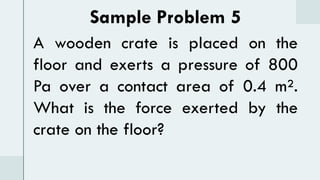
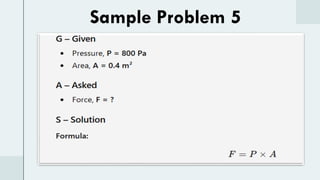
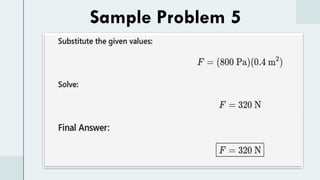
Sample Problem 5
Awooden crate is placed on the
floor and exerts a pressure of 800
Pa over a contact area of 0.4 m².
What is the force exerted by the
crate on the floor?
Sample Problem 6
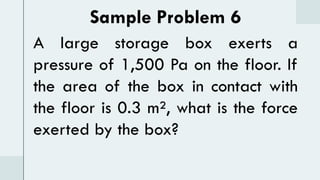
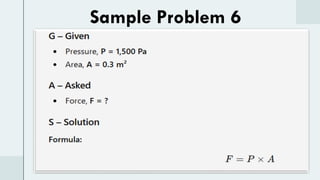
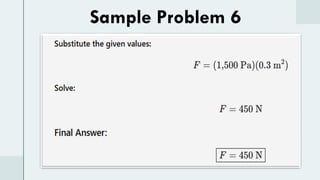
Alarge storage box exerts a
pressure of 1,500 Pa on the floor. If
the area of the box in contact with
the floor is 0.3 m², what is the force
exerted by the box?
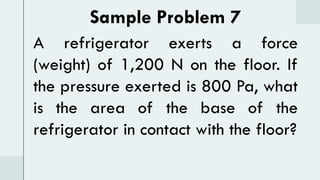
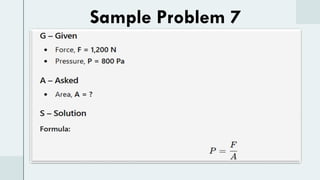
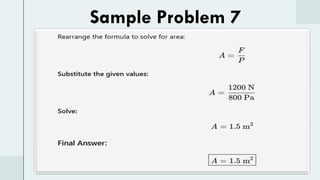
Sample Problem 7
Arefrigerator exerts a force
(weight) of 1,200 N on the floor. If
the pressure exerted is 800 Pa, what
is the area of the base of the
refrigerator in contact with the floor?
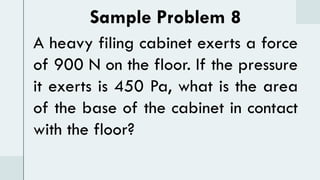
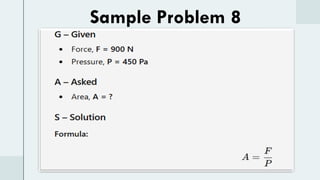
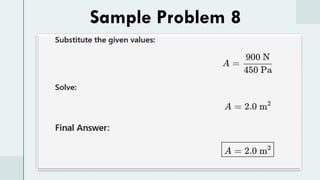
Sample Problem 8
Aheavy filing cabinet exerts a force
of 900 N on the floor. If the pressure
it exerts is 450 Pa, what is the area
of the base of the cabinet in contact
with the floor?
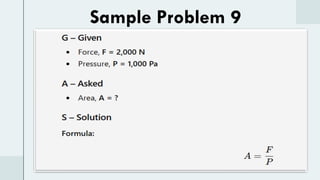
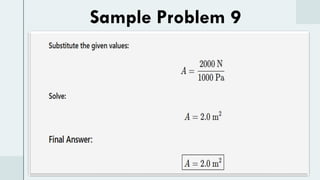
Sample Problem 9
Alarge aquarium exerts a force of
2,000 N on the floor. If the pressure
exerted by the aquarium is 1,000
Pa, what is the area of the
aquarium's base in contact with the
floor?
Instructions: Read andunderstand
each problem carefully. Then, solve
each problem using the GAS Method
(Given, Asked, and Solution). Show
all the necessary computations. Then
box your final answer with the
correct unit.
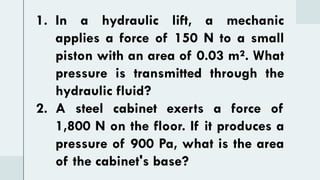
85.
1. In ahydraulic lift, a mechanic
applies a force of 150 N to a small
piston with an area of 0.03 m². What
pressure is transmitted through the
hydraulic fluid?
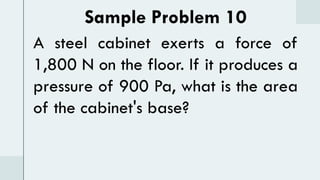
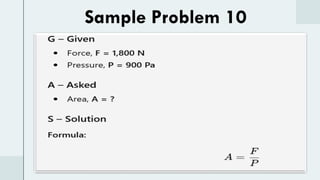
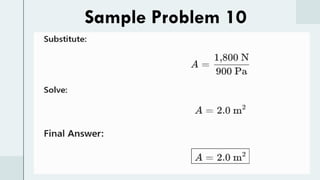
2. A steel cabinet exerts a force of
1,800 N on the floor. If it produces a
pressure of 900 Pa, what is the area
of the cabinet's base?
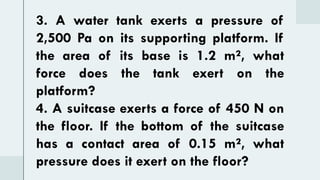
86.
3. A watertank exerts a pressure of
2,500 Pa on its supporting platform. If
the area of its base is 1.2 m², what
force does the tank exert on the
platform?
4. A suitcase exerts a force of 450 N on
the floor. If the bottom of the suitcase
has a contact area of 0.15 m², what
pressure does it exert on the floor?
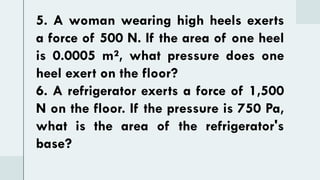
87.
5. A womanwearing high heels exerts
a force of 500 N. If the area of one heel
is 0.0005 m², what pressure does one
heel exert on the floor?
6. A refrigerator exerts a force of 1,500
N on the floor. If the pressure is 750 Pa,
what is the area of the refrigerator's
base?
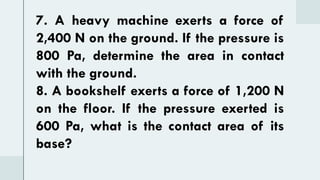
88.
7. A heavymachine exerts a force of
2,400 N on the ground. If the pressure is
800 Pa, determine the area in contact
with the ground.
8. A bookshelf exerts a force of 1,200 N
on the floor. If the pressure exerted is
600 Pa, what is the contact area of its
base?
89.
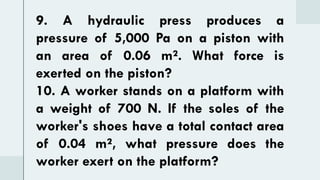
9. A hydraulicpress produces a
pressure of 5,000 Pa on a piston with
an area of 0.06 m². What force is
exerted on the piston?
10. A worker stands on a platform with
a weight of 700 N. If the soles of the
worker's shoes have a total contact area
of 0.04 m², what pressure does the
worker exert on the platform?