PREPARED BY
Prof. ASHISH N. UMALE
M. PHARM IN PHARMACOLOGY
ASSISTANT PROFESSOR
SHRADDHA INSTITUTE OF PHARMACY, WASHIM-
444505
PHARMACOLOGY-I
General Anesthetics
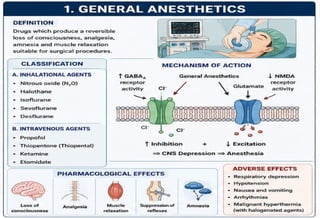
General anesthetics are drugs that produce a reversible loss of
consciousness along with analgesia, amnesia, and muscle
relaxation, allowing surgical procedures to be performed safely.
The process of anesthesia occurs in stages, beginning with
analgesia, followed by excitement, surgical anesthesia, and finally
medullary depression if overdose occurs.
Classification
1. Inhalational Anesthetics
These agents are administered through inhalation and are
absorbed via alveoli into the bloodstream.
Gases: Nitrous oxide
Volatile liquids: Halothane, Isoflurane, Sevoflurane,
Desflurane
2. Intravenous Anesthetics
These drugs are administered intravenously and are mainly used
for induction of anesthesia.
Ultra-short acting barbiturate: Thiopentone sodium
Non-barbiturate: Propofol, Etomidate
Dissociative anesthetic: Ketamine
Mechanism of Action
General anesthetics act primarily by enhancing inhibitory
neurotransmission mediated by GABA-A receptors, leading to
increased chloride ion influx and neuronal hyperpolarization.
At the same time, they inhibit excitatory neurotransmission
mediated by NMDA receptors, particularly in the case of
ketamine and nitrous oxide.
The combined effect results in generalized CNS depression.
Pharmacokinetics (Inhalational Agents)
Inhalational anesthetics are absorbed through alveoli, and their
onset depends on blood-gas solubility.
Drugs with low solubility produce rapid induction and recovery.
Intravenous anesthetics are highly lipid-soluble and rapidly
cross the blood-brain barrier, producing quick onset of action.
Most agents are metabolized in the liver and eliminated through
lungs or kidneys.
Pharmacological Effects
General anesthetics produce depression of the CNS in a graded
manner, leading to loss of consciousness, suppression of reflexes,
analgesia, and skeletal muscle relaxation.
They also depress respiration and cardiovascular function
depending on dose.
Adverse Effects
Adverse effects include respiratory depression, hypotension due to
myocardial depression, arrhythmias, postoperative nausea and
vomiting, and in rare cases, malignant hyperthermia.
Important drug examples
1. Propofol
Propofol is a short-acting intravenous anesthetic that produces
rapid induction and smooth recovery.
It enhances GABA-A receptor activity, leading to CNS depression.
It is highly lipid-soluble, rapidly distributed, and metabolized in
the liver.
It is used for induction & maintenance of anesthesia and sedation.
It may cause hypotension, respiratory depression, and pain at the
injection site.
2. Ketamine
Ketamine produces anesthesia by blocking NMDA receptors,
thereby inhibiting excitatory neurotransmission.
It has rapid onset and provides strong analgesia.
It is particularly useful in emergency settings and in
asthmatic patients due to bronchodilation.
Adverse effects include hallucinations, increased blood
pressure, and emergence delirium.
Pre-Anesthetic Medication
Pre-anesthetic drugs are administered before anesthesia to reduce
anxiety, decrease secretions, prevent reflex responses, and improve
the overall safety and effectiveness of anesthesia
Classification with Pharmacological Basis
Sedatives and anxiolytics (Benzodiazepines) such as diazepam
are used to reduce anxiety and produce amnesia by enhancing
GABA activity.
Anticholinergics such as atropine reduce salivary and bronchial
secretions and prevent bradycardia by blocking muscarinic
receptors.
Opioid analgesics such as morphine provide preoperative
analgesia by acting on opioid receptors in CNS.
Antiemetics such as ondansetron act on 5-HT3 receptors to
prevent nausea and vomiting.
Sedatives, Hypnotics and Centrally Acting Muscle Relaxants
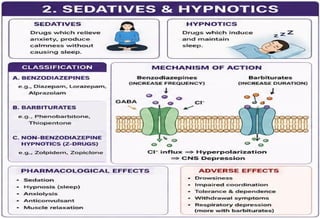
Sedatives and Hypnotics
Sedatives are drugs that reduce excitement and anxiety, whereas
hypnotics induce sleep resembling natural sleep.
The same drug can act as a sedative at low doses and as a
hypnotic at higher doses.
Classification
1. Benzodiazepines
Examples include diazepam, lorazepam, alprazolam, and
nitrazepam.
2. Barbiturates
Examples include phenobarbitone and thiopentone.
3. Non-benzodiazepine hypnotics
Examples include zolpidem and zopiclone.
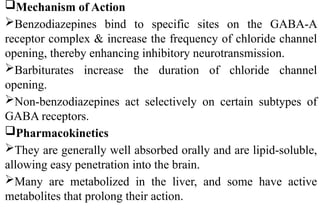
Mechanism of Action
Benzodiazepines bind to specific sites on the GABA-A
receptor complex & increase the frequency of chloride channel
opening, thereby enhancing inhibitory neurotransmission.
Barbiturates increase the duration of chloride channel
opening.
Non-benzodiazepines act selectively on certain subtypes of
GABA receptors.
Pharmacokinetics
They are generally well absorbed orally and are lipid-soluble,
allowing easy penetration into the brain.
Many are metabolized in the liver, and some have active
metabolites that prolong their action.
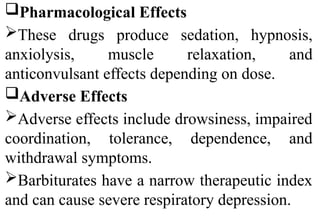
Pharmacological Effects
These drugs produce sedation, hypnosis,
anxiolysis, muscle relaxation, and
anticonvulsant effects depending on dose.
Adverse Effects
Adverse effects include drowsiness, impaired
coordination, tolerance, dependence, and
withdrawal symptoms.
Barbiturates have a narrow therapeutic index
and can cause severe respiratory depression.
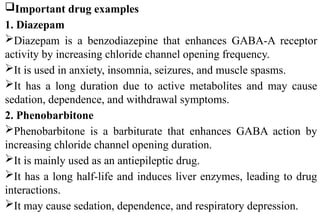
Important drug examples
1. Diazepam
Diazepam is a benzodiazepine that enhances GABA-A receptor
activity by increasing chloride channel opening frequency.
It is used in anxiety, insomnia, seizures, and muscle spasms.
It has a long duration due to active metabolites and may cause
sedation, dependence, and withdrawal symptoms.
2. Phenobarbitone
Phenobarbitone is a barbiturate that enhances GABA action by
increasing chloride channel opening duration.
It is mainly used as an antiepileptic drug.
It has a long half-life and induces liver enzymes, leading to drug
interactions.
It may cause sedation, dependence, and respiratory depression.
Centrally Acting Muscle Relaxants
Centrally acting muscle relaxants reduce muscle spasm
by acting on the CNS rather than directly on muscle fibers.
Classification
Common drugs include baclofen, tizanidine, and
diazepam.
Mechanism of Action
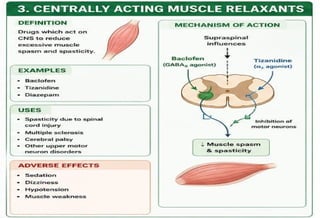
Baclofen acts as a GABA-B receptor agonist, reducing
excitatory neurotransmitter release.
Tizanidine acts as an alpha-2 adrenergic agonist,
inhibiting motor neuron activity.
Diazepam enhances GABA-mediated inhibition.
Uses
They are used in conditions such as spasticity (muscle
stiffness, spasms i.e. muscle contraction) due to spinal cord
injury, multiple sclerosis, and cerebral palsy
Adverse Effects
Common adverse effects include sedation, dizziness,
muscle weakness, and hypotension.
Important drug example
Baclofen acts on GABA-B receptors to reduce muscle
tone and spasticity.
It is well absorbed and excreted via kidneys.
It is used in spasticity disorders and may cause sedation
and withdrawal-related seizures if stopped abruptly.
Anti-Epileptics (Anti-Seizure Drugs)
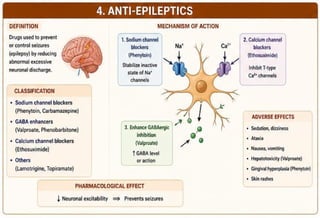
Antiepileptic drugs are used to prevent or reduce the
frequency of seizures by stabilizing neuronal membranes
and suppressing abnormal electrical activity in the brain.
Classification Based on Mechanism
1. Sodium Channel Blockers
 Phenytoin and carbamazepine act by prolonging the
inactivated state of sodium channels, thereby reducing
repetitive neuronal firing.
2. GABA Enhancers
 Valproate and benzodiazepines increase GABA levels
or enhance its action, leading to increased inhibition.
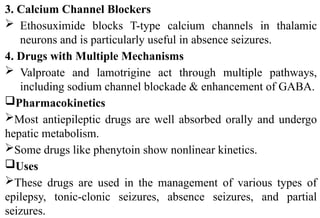
3. Calcium Channel Blockers
 Ethosuximide blocks T-type calcium channels in thalamic
neurons and is particularly useful in absence seizures.
4. Drugs with Multiple Mechanisms
 Valproate and lamotrigine act through multiple pathways,
including sodium channel blockade & enhancement of GABA.
Pharmacokinetics
Most antiepileptic drugs are well absorbed orally and undergo
hepatic metabolism.
Some drugs like phenytoin show nonlinear kinetics.
Uses
These drugs are used in the management of various types of
epilepsy, tonic-clonic seizures, absence seizures, and partial
seizures.
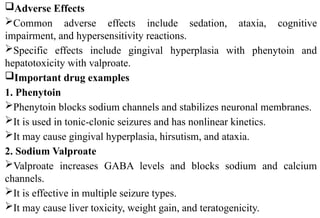
Adverse Effects
Common adverse effects include sedation, ataxia, cognitive
impairment, and hypersensitivity reactions.
Specific effects include gingival hyperplasia with phenytoin and
hepatotoxicity with valproate.
Important drug examples
1. Phenytoin
Phenytoin blocks sodium channels and stabilizes neuronal membranes.
It is used in tonic-clonic seizures and has nonlinear kinetics.
It may cause gingival hyperplasia, hirsutism, and ataxia.
2. Sodium Valproate
Valproate increases GABA levels and blocks sodium and calcium
channels.
It is effective in multiple seizure types.
It may cause liver toxicity, weight gain, and teratogenicity.
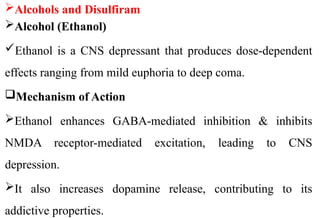
Alcohols and Disulfiram
Alcohol (Ethanol)
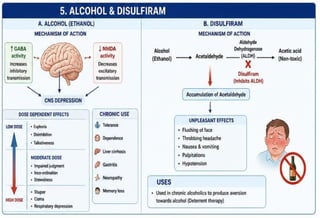
Ethanol is a CNS depressant that produces dose-dependent
effects ranging from mild euphoria to deep coma.
Mechanism of Action
Ethanol enhances GABA-mediated inhibition & inhibits
NMDA receptor-mediated excitation, leading to CNS
depression.
It also increases dopamine release, contributing to its
addictive properties.
Pharmacokinetics
Ethanol is rapidly absorbed from the gastrointestinal tract and is
metabolized in the liver by alcohol dehydrogenase to acetaldehyde,
which is further metabolized by aldehyde dehydrogenase.
 Effects
At low doses, ethanol produces disinhibition (failure to control of
brain impulse) and euphoria (strong feeling of happiness,
excitement).
At higher doses, it causes sedation, impaired coordination, and
respiratory depression.
Disulfiram
Disulfiram inhibits the enzyme aldehyde dehydrogenase,
resulting in accumulation of acetaldehyde when alcohol is
consumed.
Effect
The accumulation of acetaldehyde produces unpleasant
symptoms such as flushing, headache, nausea, vomiting, and
palpitations, which discourage alcohol intake.
 Therapeutic Use
Disulfiram is used as a deterrent therapy in chronic alcohol
dependence.
Precautions
Patients must be warned to avoid alcohol in all forms,
including medications and food products containing alcohol.
General Anaesthetic, Sedatives & Hypnotics, Antiepileptic, Alcohol & Disulfiram.pptx