Gender equality in the public
  administration (GEPA):
Gender balance in Public administration
   : UNDP interim research findings
       By Soma Chakrabarti Fezzardi
UNDP GEPA project
• 2011/12 global stocktaking project to assess
  gender balance, obstacles and issues, as well
  as identify initiatives and models in the PA
• 2 European case studies: Kyrgyz Republic and
  Romania, also 2-3 from other regions,
  covering a range of contexts
• Publication in 2012
• PA definition: executive branch of
  government, or ‘civil service
GEPA status in region
• Wide variation in the extent, to which GEPA is
  ‘on the agenda’
• Women in Leadership is often almost
  synonymous with women’s political
  representation and private sector, rather than
  PA
• As much on the agenda of high GDP countries
  eg France, UK as on that of emerging
  economies
Wide variation in entry points
…but some common themes:

1. PA reform: after independence, regional
    integration, conflict or economic crisis eg
    Azerbaijan
2. Gender mainstreaming:
   (a) top down through GE legislation, NAPs eg
       Croatia
   (b) bottom-up eg regional police initiative
3. Women’s political representation eg Kyrgyz Republic
4. Individuals and leaders eg France
Different issues at different levels
1. Top leadership eg ministerial positions: 2 main
routes, entailing different sets of issues and
possible approaches:
• Career-based system, where employees work
   their way up
• Lateral entry through competence-based or
   political appointment

2. Senior and ‘decision-making’ positions, rest of PA
(recruitment, career planning, retention, work-life
balance)
Some trends and patterns: Numbers
• All countries appear to have the classic
  ‘pyramid’ structure, with few women decision-
  makers at top and more women at bottom,
  and more administrative rather than
  professional positions
• Wide variation in pyramid dimensions, with
  some countries like Finland & ex-FSU having
  more women than men as a whole (eg
  Ukraine, 75% - but 13% at top)
Lessons learned from Kyrgyzstan 1
• 30% PA quota was a result of civil society action
  for political representation, and civil society is
  now established partner for gender equality
  machinery and parliament, appointed to key
  positions by President
• Quotas not well understood/ appreciated, ex-
  Soviet legacy
• 45% women in PA, 15% in senior management,
  but 30% quota was ‘heard’ despite downward
  trend…and therefore became a ceiling
Lessons from Kyrgyzstan 2
• Many good policy measures were not
  implemented due to weak enforcement,
  organizational culture and other priorities
• Capacity building for officials implementing
  relevant legislation and at entry level for public
  servants in general, rather than for women in
  particular, as they have high education levels –
  visibility more an issue.
• Political will of the (woman) President has
  clearly moved this agenda forward
Lessons from Romania 1
• EU a major catalyst in GE generally BUT…PA not a
  priority in EU Strategy for Equality between
  Women and Men 2010-2015
• PA shrinking so gender biases in performance
  evaluation systems potentially impact on who is
  made redundant
• New government means new executive due to
  lack of separation between the legislative and
  executive
• Lack of transparency in promotions
• Long working hours
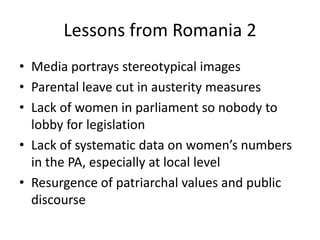
Lessons from Romania 2
• Media portrays stereotypical images
• Parental leave cut in austerity measures
• Lack of women in parliament so nobody to
  lobby for legislation
• Lack of systematic data on women’s numbers
  in the PA, especially at local level
• Resurgence of patriarchal values and public
  discourse
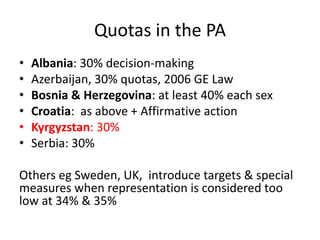
Quotas in the PA
•   Albania: 30% decision-making
•   Azerbaijan, 30% quotas, 2006 GE Law
•   Bosnia & Herzegovina: at least 40% each sex
•   Croatia: as above + Affirmative action
•   Kyrgyzstan: 30%
•   Serbia: 30%

Others eg Sweden, UK, introduce targets & special
measures when representation is considered too
low at 34% & 35%
Special measures
Azerbaijan
UNDP-supported GEPA project, building on PAR
project, focus on legislation & staff
France
Guegot report 2011 on equality in the PA
Sweden
Women’s Career Advancement in Swedish Central
Administration 2009-2010, €2m
UK
Senior Women’s network, LeadersUnlimited
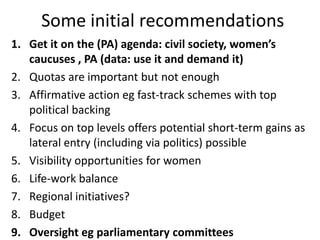
Some initial recommendations
1. Get it on the (PA) agenda: civil society, women’s
   caucuses , PA (data: use it and demand it)
2. Quotas are important but not enough
3. Affirmative action eg fast-track schemes with top
   political backing
4. Focus on top levels offers potential short-term gains as
   lateral entry (including via politics) possible
5. Visibility opportunities for women
6. Life-work balance
7. Regional initiatives?
8. Budget
9. Oversight eg parliamentary committees
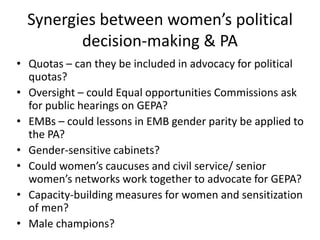
Synergies between women’s political
         decision-making & PA
• Quotas – can they be included in advocacy for political
  quotas?
• Oversight – could Equal opportunities Commissions ask
  for public hearings on GEPA?
• EMBs – could lessons in EMB gender parity be applied to
  the PA?
• Gender-sensitive cabinets?
• Could women’s caucuses and civil service/ senior
  women’s networks work together to advocate for GEPA?
• Capacity-building measures for women and sensitization
  of men?
• Male champions?