UNITED NATIONS CONFERENCE ON TRADE AND DEVELOPMENT 
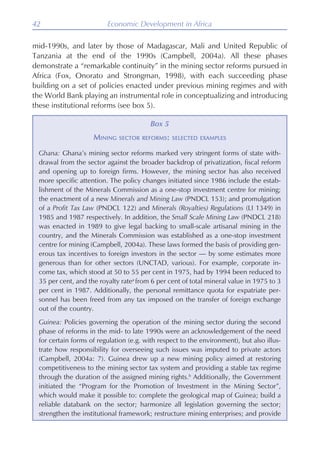
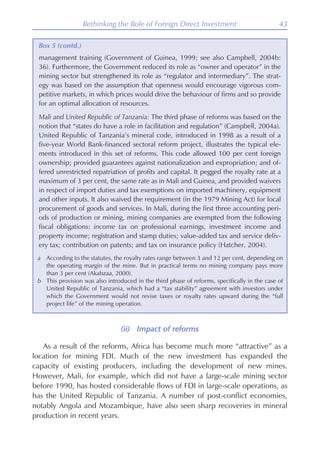
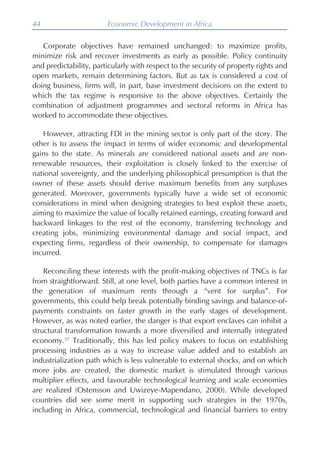
Geneva 
ECONOMIC DEVELOPMENT 
IN AFRICA 
Rethinking the Role of 
Foreign Direct Investment 
UNITED NATIONS 
New York and Geneva, 2005
NOTE 
Symbols of United Nations documents are 
composed of capital letters combined with 
figures. Mention of such a symbol indicates a 
reference to a United Nations document. 
The designations employed and the 
presentation of the material in this publication 
do not imply the expression of any opinion 
whatsoever on the part of the Secretariat of the 
United Nations concerning the legal status of 
any country, territory, city or area, or of its 
authorities, or concerning the delimitation of its 
frontiers or boundaries. 
Material in this publication may be freely 
quoted or reprinted, but acknowledgement is 
requested, together with a reference to the 
document number. A copy of the publication 
containing the quotation or reprint should be 
sent to the UNCTAD secretariat. 
UNCTAD/GDS/AFRICA/2005/1 
UNITED NATIONS PUBLICATION 
Sales No. E.05.II.D.12 
ISBN 92-1-112671-1 
Copyright © United Nations, 2005 
All rights reserved
Rethinking the Role of Foreign Direct Investment iii 
CONTENTS 
Page 
A. Introduction ............................................................................................ 1 
B. FDI to Africa: facts and fables ............................................................... 4 
1. Some stylized facts ............................................................................... 4 
2. Analytical perspectives and methodological caveats ........................... 14 
3. FDI flows to Africa: the limits of conventional wisdom ....................... 20 
C. Adjustment failures, FDI and the African growth story revisited ....... 26 
D. Some sectoral experiences with FDI in Africa .................................... 37 
1. Enclaves and chains in the primary sector .......................................... 37 
(a) FDI in the Mining Sector: New opportunities or a “race 
to the bottom”? ........................................................................... 39 
(b) Agro chains and FDI .................................................................... 52 
2. Manufacturing FDI success in Africa: lessons from Asia ...................... 54 
E. Rethinking the FDI policy framework for Africa ................................... 64 
1. National policy perspectives ............................................................... 66 
2. Regional initiatives ............................................................................. 73 
3. International agenda .......................................................................... 76 
F. Conclusions .......................................................................................... 82 
Appendix tables ........................................................................................ 84 
Notes ......................................................................................................... 88 
References ................................................................................................ 95
iv Economic Development in Africa 
List of Boxes 
Box Page 
1. South Africa’s expanding investment in Africa ................................... 10 
2. Evaluating FDI: an UNCTAD perspective .......................................... 18 
3. FDI data: harmonized approach is vital for policy analysis ................. 19 
4. Determinants of FDI to Africa: How different? .................................. 27 
5. Mining sector reforms: selected examples ......................................... 42 
6. Some lessons from managing FDI in East Asia .................................... 57 
7. FDI and the Mauritian success story .................................................. 62 
List of Figures 
Figure 
1. FDI inward stocks of African landlocked countries 
compared to other Africa, 1985 and 2003 .......................................... 7 
2. FDI inflows to African fuel- and mineral-exporting countries 
compared to other Africa, 1970 and 2003 ........................................ 12 
3. Relationship between GDP growth and FDI inflows, 1970–2003 ...... 25 
4. Africa’s gold rush: Selected indicators for 
Ghana and the United Republic of Tanzania ..................................... 49 
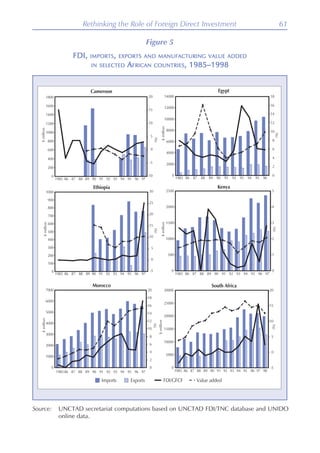
5. FDI, imports, exports and manufacturing value added 
in selected African countries, 1985–1998 ......................................... 61 
List of Tables 
Table 
1. FDI inflows and shares to developing regions, 1970–2003 .................. 5 
2. Developing-country groups: Top 5 and top 10 recipients of FDI, 
1999–2003 ......................................................................................... 8 
3. Volatility of FDI inflows, 1970–2003 ................................................. 13 
4. Africa’s technology gap ..................................................................... 24 
5. Capital flight and FDI in selected African countries, 1970–1996 ........ 33 
6. Major economic and social indicators for the Republic of Korea, 
the second-tier NIEs and sub-Saharan Africa ..................................... 56
Rethinking the Role of Foreign Direct Investment v 
List of Appendix Tables 
Table Page 
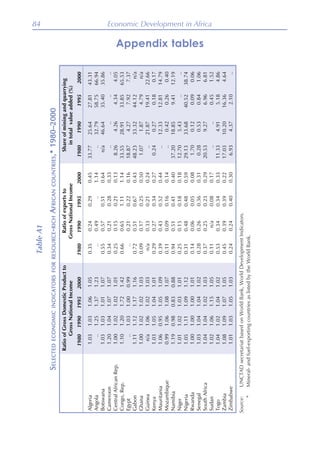
A1 Selected economic indicators for resource-rich African countries, 
1980–2000 ....................................................................................... 84 
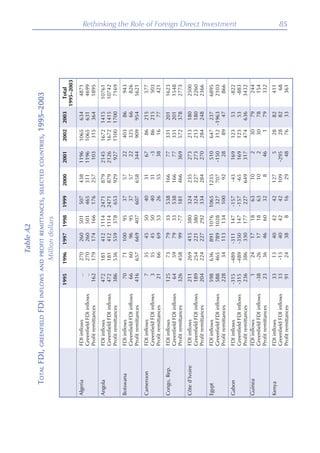
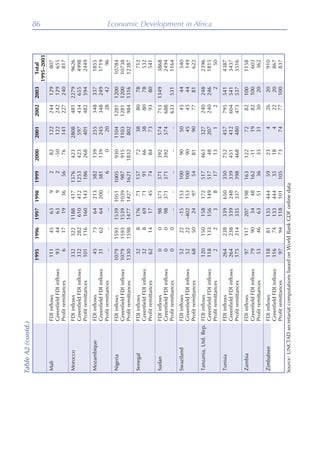
A2 Total FDI, greenfield FDI inflows and profit remittances, 
selected countries, 1995–2003 ......................................................... 85 
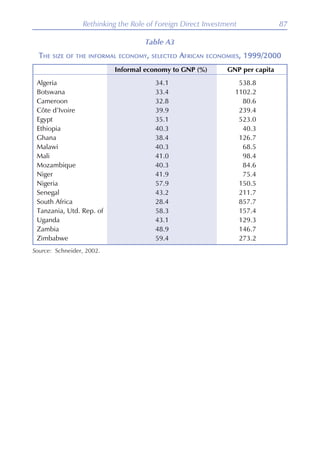
A3 The size of the informal economy, selected African economies, 
1999/2000 ........................................................................................ 87 
Explanatory Notes 
The $ sign refers to the US dollar. 
Sub-Saharan Africa (SSA): Except where otherwise stated, this includes 
South Africa. 
North Africa: Unlike in the UNCTAD Handbook of Statistics, in this 
publication Sudan is classified as part of sub-Saharan Africa, not North 
Africa.
vi Economic Development in Africa 
Abbreviations 
ACP African, Caribbean and Pacific (group of States) 
AEC African Economic Community 
AGOA African Growth and Opportunity Act 
AU African Union 
BCEAO Banque Centrale des Etats de l’Afrique de l’Ouest 
BEAC Banque des Etats de l’Afrique Centrale 
CEN-SAD Community of Sahel-Saharan States 
CEPR Centre for Economic Policy Research 
CODELCO National Copper Corporation (Chile) 
COMESA Common Market for Eastern and Southern Africa 
DBSA Development Bank of South Africa 
DFID Department for International Development (UK) 
ECA Economic Commission for Africa 
ECCAS Economic Community of Central African States 
ECLAC Economic Commission for Latin America and the Caribbean 
ECOWAS Economic Community of West African States 
EIR Extractive Industries Review 
EPA Economic Partnership Agreement 
EPZ export processing zone 
EU European Union 
FAO Food and Agriculture Organization 
FDI foreign direct investment 
FTA Free Trade Area 
GATT General Agreement on Tariffs and Trade 
GATS General Agreement on Trade in Services 
GDP gross domestic product 
GFCF gross fixed capital formation 
GNP gross national product 
G24 Intergovernmental Group of Twenty-Four on International 
Monetary Affairs 
ICSID International Center for Settlement of Investment Disputes 
IDC Industrial Development Corporation 
IFC International Finance Corporation 
IFI international finance institution
Rethinking the Role of Foreign Direct Investment vii 
IGAD Inter-Governmental Authority on Development 
ILO International Labour Organization 
IMF International Monetary Fund 
IMF-BOP International Monetary Fund – Balance of Payment 
ITRS International Transactions Reporting System 
LDCs least developed countries 
M&As mergers and acquisitions 
MDGs Millennium Development Goals 
MFA Multi-Fibre Arrangement 
MIGA Multilateral Investment Guarantee Agency 
MVA manufacturing value added 
NEPAD New Partnership for Africa’s Development 
NGO non-governmental organization 
NIE newly-industrialized economy 
ODA official development assistance 
OECD Organisation for Economic Co-operation and Development 
PRSP Poverty Reduction Strategy Paper 
R&D research and development 
RTA regional trading arrangement 
SADC Southern African Development Community 
SACU Southern African Customs Union 
SOE state-owned enterprise 
SSA sub-Saharan Africa 
TNC transnational corporation 
TRIMs trade-related investment measures 
TRIPs trade-related aspects of intellectual property rights 
UK United Kingdom 
UMA Arab Maghreb Union 
UNECE United Nations Economic Commission for Europe 
UNIDO United Nations Industrial Development Organization 
UNU United Nations University 
US United States of America 
VAT value added tax 
WBG World Bank Group 
WTO World Trade Organization
Rethinking the Role of Foreign Direct Investment 1 
A. Introduction 
In the face of inadequate resources to finance long-term development in 
Africa and with poverty reduction and other Millennium Development Goals 
(MDGs) looking increasingly difficult to achieve by 2015, attracting foreign 
direct investment (FDI) has assumed a prominent place in the strategies of 
economic renewal being advocated by policy makers at the national, regional 
and international levels. The experience of a small number of fast-growing East 
Asian newly industrialized economies (NIEs), and recently China, has 
strengthened the belief that attracting FDI is key to bridging the resource gap of 
low-income countries and avoiding further build-up of debt while directly 
tackling the causes of poverty. Since the Asian crisis, while on the one hand a 
more cautionary note has been sounded about premature financial 
liberalization, on the other hand calls for an accelerated pace of opening up to 
FDI have intensified, on the assumption that this will bring not only more stable 
capital inflows but also greater technological know-how, higher-paying jobs, 
entrepreneurial and workplace skills, and new export opportunities (Prasad et 
al., 2003). 
This is not an altogether new direction in development policy thinking, 
particularly in the African context. Immediately following independence, policy 
makers across the region hoped that attracting FDI, often with the bait of high 
tariff protection and generous incentive packages, would provide the catalyst 
for a “late industrialization” drive (Mkandawire, 2001: 306). And following the 
debt crisis of the early 1980s, the architects of structural adjustment also saw 
increased FDI as key to sustained economic recovery, this time in conformity 
with “market fundamentals”. From this perspective, the pursuit of responsible 
macroeconomic policies combined with an accelerating pace of liberalization, 
deregulation and, above all, privatization were expected to attract FDI to Africa 
(World Bank, 1997: 51; IMF, 1999). 
Despite the efforts of African governments to comply with this policy advice, 
the record of the past two decades with respect to reducing poverty and 
attracting FDI has been disappointing at best. In response, a second generation 
of reforms, introduced in the late 1990s, has sought to address shortcomings in 
programme design and implementation by placing much greater emphasis on
2 Economic Development in Africa 
poverty reduction, combined with policy ownership, credibility and 
transparency. Here too, the promise of getting governance right has been 
greater flows of FDI, which, along with related measures to improve the 
investment climate, are expected to spur economic growth and thereby reduce 
poverty. In this latest attempt to forge consensus on African development, the 
contrast between relatively high returns on FDI in Africa and the persistently 
low level of actual flows is seen as not only indicative of past policy mistakes but 
also suggestive of the potential rewards awaiting the region if it can improve its 
governance image in the eyes of international business (World Bank, 2002: 
102; Collier and Patillo, 1999). In this vein, a recent report by the OECD (2002: 
8) attributes the “spectacular failure” of African countries to attract FDI to a mix 
of unsustainable national economic policies, poor-quality services, closed trade 
regimes, and problems of political legitimacy, thus advising governments to 
redesign their macroeconomic, trade and industrial policies to attract FDI. 
Recent surges of FDI to some countries have been taken as a sign that opening 
Africa up to international business can bring about a rapid and region-wide 
“economic renaissance”.1 
This year’s report proceeds from the need to take a more critical approach 
to evaluating the size and impact of FDI in African countries. Building on past 
years’ reports, it first suggests that the exclusive emphasis on market-oriented 
reform and governance as determinants of the size of FDI flows to Africa is 
misleading. Once it is recognized that in most countries these flows tend to be 
more a lagging than a leading factor in the growth and development process, 
the role of FDI in Africa cannot be properly assessed independently of the 
disappointing record of reform programmes with respect to growth, capital 
accumulation and economic diversification. Indeed, while these programmes 
have been designed and promoted with the aim, inter alia, of attracting foreign 
investors, this record goes much further in explaining the region’s FDI 
performance than the governance failures routinely compiled to describe 
Africa’s poor investment climate. 
Secondly, the report argues that FDI carries costs as well as benefits for the 
host country; consequently, policy makers must fully evaluate the impact of FDI 
if it is to become a complementary component of a wider package of 
development measures needed to raise growth, create jobs and diversify into 
more dynamic activities. Any such evaluation needs to take account of 
structural biases in African economies, including their longstanding
Rethinking the Role of Foreign Direct Investment 3 
dependence on commodity exports as well as a deindustrialization trend 
following the debt crisis of the early 1980s. The report suggests that failure to 
design policies with these challenges in mind runs the danger of recreating a 
pattern of FDI-led enclave development even if, as has recently been the case 
in the mining sector, FDI begins to flow to the region on a larger scale. Indeed, 
while programmes designed to deregulate the mining sector can claim some 
success in attracting FDI in recent years, a positive developmental impact has 
failed to materialize. Accordingly, the report calls for a rethinking of the one-sided 
emphasis on attracting FDI and its replacement with a more balanced and 
more strategic approach tailored to African economic conditions and 
development challenges.
4 Economic Development in Africa 
B. FDI to Africa: facts and fables 
1. Some stylized facts 
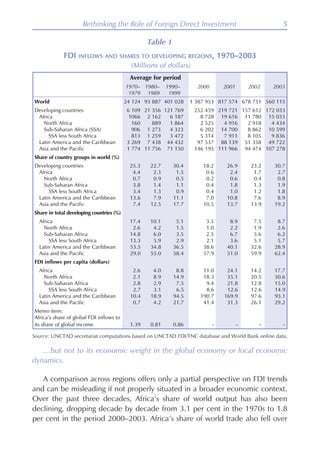
The volume of flows to Africa is very low compared to flows to other 
developing regions… 
Average annual FDI flows to Africa doubled during the 1980s to $2.2 billion 
compared to the 1970s, but increased significantly to $6.2 billion and $13.8 
billion respectively during the 1990s and 2000–2003. On a per capita basis, 
this translates into a more than fourfold increase compared to the 1980s. 
Nevertheless, a casual comparison of these figures with flows to other 
developing regions is likely to give rise to a simple story about Africa’s 
marginalization in today’s increasingly globalizing world: Africa receives a very 
low share of total global flows and flows to developing countries, and both have 
been on a steady downward trend for three decades (table 1); the continent 
now accounts for just 2 to 3 per cent of global flows, down from a peak of 6 per 
cent in the mid-1970s, and for less than 9 per cent of developing-country flows 
compared to an earlier peak of 28 per cent in 1976. Stock figures (though less 
reliable) show a similar picture; indeed, the descent is perhaps even more 
precipitous given that Africa ended the 1960s with a relatively large stock of FDI 
in comparison to most other developing regions (Dunning, 1984, table 5.2). 
Even on a per capita basis, the gap between Africa and other developing regions 
widened significantly in the 1990s and remains very large despite a recent 
narrowing (table 1). 
A corollary of these trends is that, in contrast with all other developing 
regions, Africa has remained aid-dependent, with FDI generally lagging behind 
official development assistance (ODA); between 1970 and 2003, FDI 
accounted for just one-fifth of all capital flows to Africa. That lag is evident in 
sub-Saharan Africa (SSA). In North Africa and a few SSA countries, FDI has also 
trailed labour remittances as a source of foreign savings (although this trend 
appears to have been reversed in recent years). However, since the early 1990s 
— when Africa experienced a “lost decade” in terms of declining aid flows — 
the share of FDI has risen sharply averaging roughly one-third of total capital 
inflows to Africa during 2000–2003.
Rethinking the Role of Foreign Direct Investment 5 
Table 1 
FDI INFLOWS AND SHARES TO DEVELOPING REGIONS, 1970––––2003 
(Millions of dollars) 
Average for period 
1970– 1980– 1990– 2000 2001 2002 2003 
1979 1989 1999 
World 24 124 93 887 401 028 1 387 953 817 574 678 751 560 115 
Developing countries 6 109 21 356 121 769 252 459 219 721 157 612 172 033 
Africa 1066 2 162 6 187 8 728 19 616 11 780 15 033 
North Africa 160 889 1 864 2 525 4 916 2 918 4 434 
Sub-Saharan Africa (SSA) 906 1 273 4 323 6 202 14 700 8 862 10 599 
SSA less South Africa 813 1 259 3 472 5 314 7 911 8 105 9 836 
Latin America and the Caribbean 3 269 7 438 44 432 97 537 88 139 51 358 49 722 
Asia and the Pacific 1 774 11 756 71 150 146 195 111 966 94 474 107 278 
Share of country groups in world (%) 
Developing countries 25.3 22.7 30.4 18.2 26.9 23.2 30.7 
Africa 4.4 2.3 1.5 0.6 2.4 1.7 2.7 
North Africa 0.7 0.9 0.5 0.2 0.6 0.4 0.8 
Sub-Saharan Africa 3.8 1.4 1.1 0.4 1.8 1.3 1.9 
SSA less South Africa 3.4 1.3 0.9 0.4 1.0 1.2 1.8 
Latin America and the Caribbean 13.6 7.9 11.1 7.0 10.8 7.6 8.9 
Asia and the Pacific 7.4 12.5 17.7 10.5 13.7 13.9 19.2 
Share in total developing countries (%) 
Africa 17.4 10.1 5.1 3.5 8.9 7.5 8.7 
North Africa 2.6 4.2 1.5 1.0 2.2 1.9 2.6 
Sub-Saharan Africa 14.8 6.0 3.5 2.5 6.7 5.6 6.2 
SSA less South Africa 13.3 5.9 2.9 2.1 3.6 5.1 5.7 
Latin America and the Caribbean 53.5 34.8 36.5 38.6 40.1 32.6 28.9 
Asia and the Pacific 29.0 55.0 58.4 57.9 51.0 59.9 62.4 
FDI inflows per capita (dollars) 
Africa 2.6 4.0 8.8 11.0 24.1 14.2 17.7 
North Africa 2.1 8.9 14.9 18.3 35.1 20.5 30.6 
Sub-Saharan Africa 2.8 2.9 7.5 9.4 21.8 12.8 15.0 
SSA less South Africa 2.7 3.1 6.5 8.6 12.6 12.6 14.9 
Latin America and the Caribbean 10.4 18.9 94.5 190.7 169.9 97.6 93.1 
Asia and the Pacific 0.7 4.2 21.7 41.4 31.3 26.1 29.2 
Memo item: 
Africa’s share of global FDI inflows to 
its share of global income 1.39 0.81 0.86 - - - - 
Source: UNCTAD secretariat computations based on UNCTAD FDI/TNC database and World Bank online data. 
…but not to its economic weight in the global economy or local economic 
dynamics. 
A comparison across regions offers only a partial perspective on FDI trends 
and can be misleading if not properly situated in a broader economic context. 
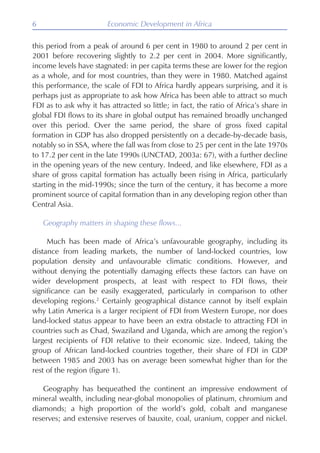
Over the past three decades, Africa’s share of world output has also been 
declining, dropping decade by decade from 3.1 per cent in the 1970s to 1.8 
per cent in the period 2000–2003. Africa’s share of world trade also fell over
6 Economic Development in Africa 
this period from a peak of around 6 per cent in 1980 to around 2 per cent in 
2001 before recovering slightly to 2.2 per cent in 2004. More significantly, 
income levels have stagnated: in per capita terms these are lower for the region 
as a whole, and for most countries, than they were in 1980. Matched against 
this performance, the scale of FDI to Africa hardly appears surprising, and it is 
perhaps just as appropriate to ask how Africa has been able to attract so much 
FDI as to ask why it has attracted so little; in fact, the ratio of Africa’s share in 
global FDI flows to its share in global output has remained broadly unchanged 
over this period. Over the same period, the share of gross fixed capital 
formation in GDP has also dropped persistently on a decade-by-decade basis, 
notably so in SSA, where the fall was from close to 25 per cent in the late 1970s 
to 17.2 per cent in the late 1990s (UNCTAD, 2003a: 67), with a further decline 
in the opening years of the new century. Indeed, and like elsewhere, FDI as a 
share of gross capital formation has actually been rising in Africa, particularly 
starting in the mid-1990s; since the turn of the century, it has become a more 
prominent source of capital formation than in any developing region other than 
Central Asia. 
Geography matters in shaping these flows... 
Much has been made of Africa’s unfavourable geography, including its 
distance from leading markets, the number of land-locked countries, low 
population density and unfavourable climatic conditions. However, and 
without denying the potentially damaging effects these factors can have on 
wider development prospects, at least with respect to FDI flows, their 
significance can be easily exaggerated, particularly in comparison to other 
developing regions.2 Certainly geographical distance cannot by itself explain 
why Latin America is a larger recipient of FDI from Western Europe, nor does 
land-locked status appear to have been an extra obstacle to attracting FDI in 
countries such as Chad, Swaziland and Uganda, which are among the region’s 
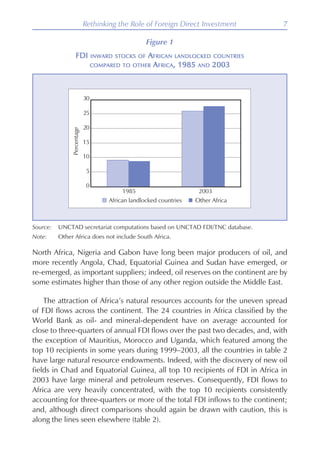
largest recipients of FDI relative to their economic size. Indeed, taking the 
group of African land-locked countries together, their share of FDI in GDP 
between 1985 and 2003 has on average been somewhat higher than for the 
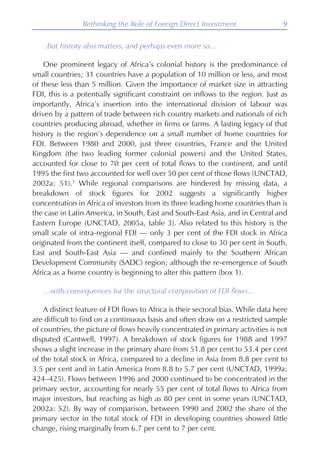
rest of the region (figure 1). 
Geography has bequeathed the continent an impressive endowment of 
mineral wealth, including near-global monopolies of platinum, chromium and 
diamonds; a high proportion of the world’s gold, cobalt and manganese 
reserves; and extensive reserves of bauxite, coal, uranium, copper and nickel.
Rethinking the Role of Foreign Direct Investment 7 
Figure 1 
FDI INWARD STOCKS OF AFRICAN LANDLOCKED COUNTRIES 
COMPARED TO OTHER AFRICA, 1985 AND 2003 
Percentage 
2003 
30 
25 
20 
15 
10 
5 
0 
1985 
African landlocked countries Other Africa 
Source: UNCTAD secretariat computations based on UNCTAD FDI/TNC database. 
Note: Other Africa does not include South Africa. 
North Africa, Nigeria and Gabon have long been major producers of oil, and 
more recently Angola, Chad, Equatorial Guinea and Sudan have emerged, or 
re-emerged, as important suppliers; indeed, oil reserves on the continent are by 
some estimates higher than those of any other region outside the Middle East. 
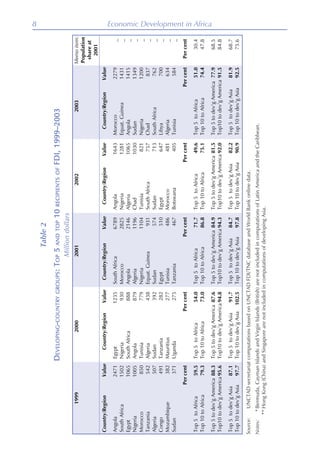
The attraction of Africa’s natural resources accounts for the uneven spread 
of FDI flows across the continent. The 24 countries in Africa classified by the 
World Bank as oil- and mineral-dependent have on average accounted for 
close to three-quarters of annual FDI flows over the past two decades, and, with 
the exception of Mauritius, Morocco and Uganda, which featured among the 
top 10 recipients in some years during 1999–2003, all the countries in table 2 
have large natural resource endowments. Indeed, with the discovery of new oil 
fields in Chad and Equatorial Guinea, all top 10 recipients of FDI in Africa in 
2003 have large mineral and petroleum reserves. Consequently, FDI flows to 
Africa are very heavily concentrated, with the top 10 recipients consistently 
accounting for three-quarters or more of the total FDI inflows to the continent; 
and, although direct comparisons should again be drawn with caution, this is 
along the lines seen elsewhere (table 2).
8 Economic Development in Africa 
Table 2 
DEVELOPING-COUNTRY GROUPS: TOP 5 AND TOP 10 RECIPIENTS OF FDI, 1999––––2003 
Million dollars 
1999 2000 2001 2002 2003 Memo item: 
Population 
share at 
2001 
Country/Region Value Country/Region Value Country/Region Value Country/Region Value Country/Region Value 
Angola 2471 Egypt 1235 South Africa 6789 Angola 1643 Morocco 2279 _ 
South Africa 1502 Nigeria 930 Morocco 2825 Nigeria 1281 Equat. Guinea 1431 _ 
Egypt 1065 South Africa 888 Angola 2146 Algeria 1065 Angola 1415 _ 
Nigeria 1005 Angola 879 Algeria 1196 Chad 1030 Sudan 1349 _ 
Morocco 850 Tunisia 779 Nigeria 1104 Tunisia 821 Nigeria 1200 _ 
Tanzania 542 Algeria 438 Equat. Guinea 931 South Africa 757 Chad 837 _ 
Algeria 507 Sudan 392 Sudan 574 Sudan 713 South Africa 762 _ 
Congo 491 Tanzania 282 Egypt 510 Egypt 647 Libya 700 _ 
Mozambique 382 Mauritius 277 Tunisia 486 Morocco 481 Algeria 634 _ 
Sudan 371 Uganda 275 Tanzania 467 Botswana 405 Tunisia 584 _ 
Per cent Per cent Per cent Per cent Per cent Per cent 
Top 5 to Africa 59.5 Top 5 to Africa 54.0 Top 5 to Africa 71.7 Top 5 to Africa 49.6 Top 5 to Africa 51.0 30.4 
Top 10 to Africa 79.3 Top 10 to Africa 73.0 Top 10 to Africa 86.8 Top 10 to Africa 75.1 Top 10 to Africa 74.4 47.8 
Top 5 to dev’g America 88.3 Top 5 to dev’g America 87.6 Top 5 to dev’g America 84.9 Top 5 to dev’g America 81.5 Top 5 to dev’g America 77.9 68.5 
Top10 to dev’g America 95.6 Top10 to dev’g America 94.8 Top10 to dev’g America 94.3 Top10 to dev’g America 92.0 Top10 to dev’g America 91.5 84.8 
Top 5 to dev’g Asia 87.1 Top 5 to dev’g Asia 91.7 Top 5 to dev’g Asia 84.7 Top 5 to dev’g Asia 82.2 Top 5 to dev’g Asia 81.9 68.7 
Top 10 to dev’g Asia 97.7 Top 10 to dev’g Asia 102.5 Top 10 to dev’g Asia 97.8 Top 10 to dev’g Asia 90.9 Top 10 to dev’g Asia 92.5 75.6 
Source: UNCTAD secretariat computations based on UNCTAD FDI/TNC database and World Bank online data. 
Notes: *Bermuda, Cayman Islands and Virgin Islands (British) are not included in computations of Latin America and the Caribbean. 
** Hong Kong (China) and Singapore are not included in computations of developing Asia.
Rethinking the Role of Foreign Direct Investment 9 
..but history also matters, and perhaps even more so... 
One prominent legacy of Africa’s colonial history is the predominance of 
small countries; 31 countries have a population of 10 million or less, and most 
of these less than 5 million. Given the importance of market size in attracting 
FDI, this is a potentially significant constraint on inflows to the region. Just as 
importantly, Africa’s insertion into the international division of labour was 
driven by a pattern of trade between rich country markets and nationals of rich 
countries producing abroad, whether in firms or farms. A lasting legacy of that 
history is the region’s dependence on a small number of home countries for 
FDI. Between 1980 and 2000, just three countries, France and the United 
Kingdom (the two leading former colonial powers) and the United States, 
accounted for close to 70 per cent of total flows to the continent, and until 
1995 the first two accounted for well over 50 per cent of those flows (UNCTAD, 
2002a: 51).3 While regional comparisons are hindered by missing data, a 
breakdown of stock figures for 2002 suggests a significantly higher 
concentration in Africa of investors from its three leading home countries than is 
the case in Latin America, in South, East and South-East Asia, and in Central and 
Eastern Europe (UNCTAD, 2005a, table 3). Also related to this history is the 
small scale of intra-regional FDI — only 3 per cent of the FDI stock in Africa 
originated from the continent itself, compared to close to 30 per cent in South, 
East and South-East Asia — and confined mainly to the Southern African 
Development Community (SADC) region; although the re-emergence of South 
Africa as a home country is beginning to alter this pattern (box 1). 
…with consequences for the structural composition of FDI flows… 
A distinct feature of FDI flows to Africa is their sectoral bias. While data here 
are difficult to find on a continuous basis and often draw on a restricted sample 
of countries, the picture of flows heavily concentrated in primary activities is not 
disputed (Cantwell, 1997). A breakdown of stock figures for 1988 and 1997 
shows a slight increase in the primary share from 51.8 per cent to 53.4 per cent 
of the total stock in Africa, compared to a decline in Asia from 8.8 per cent to 
3.5 per cent and in Latin America from 8.8 to 5.7 per cent (UNCTAD, 1999a: 
424–425). Flows between 1996 and 2000 continued to be concentrated in the 
primary sector, accounting for nearly 55 per cent of total flows to Africa from 
major investors, but reaching as high as 80 per cent in some years (UNCTAD, 
2002a: 52). By way of comparison, between 1990 and 2002 the share of the 
primary sector in the total stock of FDI in developing countries showed little 
change, rising marginally from 6.7 per cent to 7 per cent.
10 Economic Development in Africa 
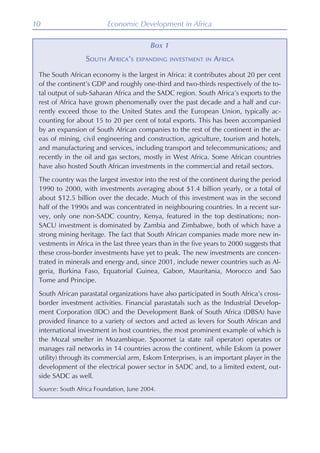
Box 1 
SOUTH AFRICA’’’’S EXPANDING INVESTMENT IN AFRICA 
The South African economy is the largest in Africa: it contributes about 20 per cent 
of the continent’s GDP and roughly one-third and two-thirds respectively of the to-tal 
output of sub-Saharan Africa and the SADC region. South Africa’s exports to the 
rest of Africa have grown phenomenally over the past decade and a half and cur-rently 
exceed those to the United States and the European Union, typically ac-counting 
for about 15 to 20 per cent of total exports. This has been accompanied 
by an expansion of South African companies to the rest of the continent in the ar-eas 
of mining, civil engineering and construction, agriculture, tourism and hotels, 
and manufacturing and services, including transport and telecommunications; and 
recently in the oil and gas sectors, mostly in West Africa. Some African countries 
have also hosted South African investments in the commercial and retail sectors. 
The country was the largest investor into the rest of the continent during the period 
1990 to 2000, with investments averaging about $1.4 billion yearly, or a total of 
about $12.5 billion over the decade. Much of this investment was in the second 
half of the 1990s and was concentrated in neighbouring countries. In a recent sur-vey, 
only one non-SADC country, Kenya, featured in the top destinations; non- 
SACU investment is dominated by Zambia and Zimbabwe, both of which have a 
strong mining heritage. The fact that South African companies made more new in-vestments 
in Africa in the last three years than in the five years to 2000 suggests that 
these cross-border investments have yet to peak. The new investments are concen-trated 
in minerals and energy and, since 2001, include newer countries such as Al-geria, 
Burkina Faso, Equatorial Guinea, Gabon, Mauritania, Morocco and Sao 
Tome and Principe. 
South African parastatal organizations have also participated in South Africa’s cross-border 
investment activities. Financial parastatals such as the Industrial Develop-ment 
Corporation (IDC) and the Development Bank of South Africa (DBSA) have 
provided finance to a variety of sectors and acted as levers for South African and 
international investment in host countries, the most prominent example of which is 
the Mozal smelter in Mozambique. Spoornet (a state rail operator) operates or 
manages rail networks in 14 countries across the continent, while Eskom (a power 
utility) through its commercial arm, Eskom Enterprises, is an important player in the 
development of the electrical power sector in SADC and, to a limited extent, out-side 
SADC as well. 
Source: South Africa Foundation, June 2004.
Rethinking the Role of Foreign Direct Investment 11 
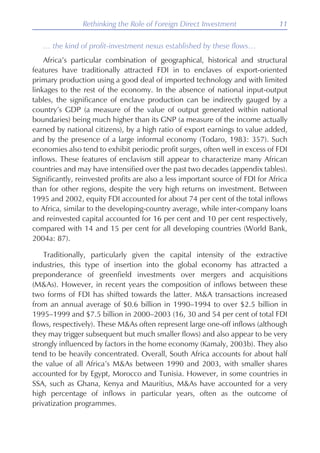
… the kind of profit-investment nexus established by these flows… 
Africa’s particular combination of geographical, historical and structural 
features have traditionally attracted FDI in to enclaves of export-oriented 
primary production using a good deal of imported technology and with limited 
linkages to the rest of the economy. In the absence of national input-output 
tables, the significance of enclave production can be indirectly gauged by a 
country’s GDP (a measure of the value of output generated within national 
boundaries) being much higher than its GNP (a measure of the income actually 
earned by national citizens), by a high ratio of export earnings to value added, 
and by the presence of a large informal economy (Todaro, 1983: 357). Such 
economies also tend to exhibit periodic profit surges, often well in excess of FDI 
inflows. These features of enclavism still appear to characterize many African 
countries and may have intensified over the past two decades (appendix tables). 
Significantly, reinvested profits are also a less important source of FDI for Africa 
than for other regions, despite the very high returns on investment. Between 
1995 and 2002, equity FDI accounted for about 74 per cent of the total inflows 
to Africa, similar to the developing-country average, while inter-company loans 
and reinvested capital accounted for 16 per cent and 10 per cent respectively, 
compared with 14 and 15 per cent for all developing countries (World Bank, 
2004a: 87). 
Traditionally, particularly given the capital intensity of the extractive 
industries, this type of insertion into the global economy has attracted a 
preponderance of greenfield investments over mergers and acquisitions 
(M&As). However, in recent years the composition of inflows between these 
two forms of FDI has shifted towards the latter. M&A transactions increased 
from an annual average of $0.6 billion in 1990–1994 to over $2.5 billion in 
1995–1999 and $7.5 billion in 2000–2003 (16, 30 and 54 per cent of total FDI 
flows, respectively). These M&As often represent large one-off inflows (although 
they may trigger subsequent but much smaller flows) and also appear to be very 
strongly influenced by factors in the home economy (Kamaly, 2003b). They also 
tend to be heavily concentrated. Overall, South Africa accounts for about half 
the value of all Africa’s M&As between 1990 and 2003, with smaller shares 
accounted for by Egypt, Morocco and Tunisia. However, in some countries in 
SSA, such as Ghana, Kenya and Mauritius, M&As have accounted for a very 
high percentage of inflows in particular years, often as the outcome of 
privatization programmes.
12 Economic Development in Africa 
…and the stability of the investment climate. 
There is a general belief that FDI in the oil and mining sectors tends to be 
more volatile than for other sectors, particularly manufacturing, given the 
combination of capital-intensive projects and the sensitivity of profits to world 
commodity prices. (World Bank, 2005a: 97). Moreover, strong growth in these 
sectors can often assume boom-like conditions, with potentially adverse 
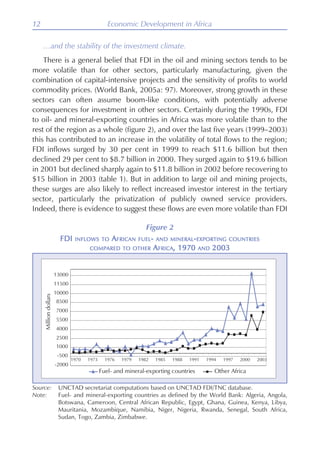
consequences for investment in other sectors. Certainly during the 1990s, FDI 
to oil- and mineral-exporting countries in Africa was more volatile than to the 
rest of the region as a whole (figure 2), and over the last five years (1999–2003) 
this has contributed to an increase in the volatility of total flows to the region; 
FDI inflows surged by 30 per cent in 1999 to reach $11.6 billion but then 
declined 29 per cent to $8.7 billion in 2000. They surged again to $19.6 billion 
in 2001 but declined sharply again to $11.8 billion in 2002 before recovering to 
$15 billion in 2003 (table 1). But in addition to large oil and mining projects, 
these surges are also likely to reflect increased investor interest in the tertiary 
sector, particularly the privatization of publicly owned service providers. 
Indeed, there is evidence to suggest these flows are even more volatile than FDI 
FDI INFLOWS TO AFRICAN FUEL- AND MINERAL-EXPORTING COUNTRIES 
13000 
11500 
10000 
8500 
7000 
5500 
4000 
2500 
1000 
-500 
-2000 
Figure 2 
COMPARED TO OTHER AFRICA, 1970 AND 2003 
1970 1973 1976 1979 1982 1985 1988 1991 1994 1997 2000 2003 
Million dollars 
Fuel- and mineral-exporting countries Other Africa 
Source: UNCTAD secretariat computations based on UNCTAD FDI/TNC database. 
Note: Fuel- and mineral-exporting countries as defined by the World Bank: Algeria, Angola, 
Botswana, Cameroon, Central African Republic, Egypt, Ghana, Guinea, Kenya, Libya, 
Mauritania, Mozambique, Namibia, Niger, Nigeria, Rwanda, Senegal, South Africa, 
Sudan, Togo, Zambia, Zimbabwe.
Rethinking the Role of Foreign Direct Investment 13 
to the primary sector (UNCTAD, 2002a, table III.3). Still, over the longer term, 
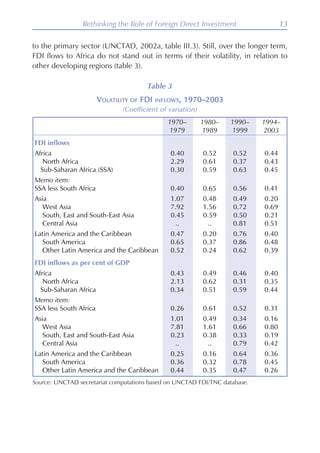
FDI flows to Africa do not stand out in terms of their volatility, in relation to 
other developing regions (table 3). 
Table 3 
VOLATILITY OF FDI INFLOWS, 1970––––2003 
(Coefficient of variation) 
1970– 1980– 1990– 1994– 
1979 1989 1999 2003 
FDI inflows 
Africa 0.40 0.52 0.52 0.44 
North Africa 2.29 0.61 0.37 0.43 
Sub-Saharan Africa (SSA) 0.30 0.59 0.63 0.45 
Memo item: 
SSA less South Africa 0.40 0.65 0.56 0.41 
Asia 1.07 0.48 0.49 0.20 
West Asia 7.92 1.56 0.72 0.69 
South, East and South-East Asia 0.45 0.59 0.50 0.21 
Central Asia .. .. 0.81 0.51 
Latin America and the Caribbean 0.47 0.20 0.76 0.40 
South America 0.65 0.37 0.86 0.48 
Other Latin America and the Caribbean 0.52 0.24 0.62 0.39 
FDI inflows as per cent of GDP 
Africa 0.43 0.49 0.46 0.40 
North Africa 2.13 0.62 0.31 0.35 
Sub-Saharan Africa 0.34 0.51 0.59 0.44 
Memo item: 
SSA less South Africa 0.26 0.61 0.52 0.31 
Asia 1.01 0.49 0.34 0.16 
West Asia 7.81 1.61 0.66 0.80 
South, East and South-East Asia 0.23 0.38 0.33 0.19 
Central Asia .. .. 0.79 0.42 
Latin America and the Caribbean 0.25 0.16 0.64 0.36 
South America 0.36 0.32 0.78 0.45 
Other Latin America and the Caribbean 0.44 0.35 0.47 0.26 
Source: UNCTAD secretariat computations based on UNCTAD FDI/TNC database.
14 Economic Development in Africa 
2. Analytical perspectives 
and methodological caveats 
There is clearly a good deal more to evaluating FDI flows in Africa than 
explaining their comparatively small scale. And while it seems plausible to 
assume, in light of the economic gaps, weaknesses and distortions typical of less 
developed regions, that FDI could be playing a more constructive role in 
African development, identifying when, to what extent and with what effect the 
profit-making strategies of international firms overlap with the developmental 
strategies of policy makers is neither a clear nor a simple exercise. 
It is generally recognized that the size and distribution of global FDI flows 
cannot be explained by international capital arbitrage; otherwise, very large 
flows would be automatically attracted to capital-scarce Africa. Rather, national 
firms become transnational because they possess specific assets — such as a 
superior production technology, a distinct product design or managerial and 
marketing skills — which allow them to undertake profitable investments 
abroad despite the higher risks and additional costs that arise from coordinating 
production activities over greater geographical distances and across political 
borders. By implication, managing those assets within the firm’s own 
hierarchical structure must also be less costly than exploiting them through 
markets, including via exporting (UNCTAD, 1996a: 76–77). For poorer 
countries looking to climb the development ladder, gaining access to those 
same assets raises the prospect of filling various gaps in their own productive 
structure more rapidly and at lower cost than if they had to rely exclusively on 
the evolution of their own firms.4 But given that the additional costs incurred by 
internationalizing production through FDI tend to be positively correlated with 
the size of those same gaps, developing countries must also possess some clear 
advantages that can attract TNCs to their location, whether large markets, 
abundant natural resources or low wage costs. 
Much of the thinking on whether and to what extent corporate and country 
interests do converge around attracting FDI has centred on how best an eclectic 
mixing and matching of firm-specific assets and locational advantages can 
generate large efficiency gains. Such gains essentially hinge on the 
“internalization” of market failures by TNCs, which simultaneously allows them 
to deliver an asset “package” to a particular location through FDI that includes 
not only capital but also productivity enhancing technologies and best
Rethinking the Role of Foreign Direct Investment 15 
corporate norms and practices. Accordingly, and to the extent that there is a 
degree of “automatic progress” surrounding the unpacking of FDI once local 
operations are established, the development dimension reduces to the design 
of appropriate strategies by the host country to attract FDI by abandoning 
policies that might hinder the establishment of local affiliates and distort the 
way in which they are integrated into the global operations of the parent 
company.5 
However, the promise of automatic efficiency gains from hosting FDI hinges 
on a number of implicit assumptions. The first is that additions to the capital 
stock from attracting FDI are “bolted down” in new plant equipment, forcing 
firms into longer-term commitments and giving policy makers some degree of 
reciprocal bargaining power once such investments are in place. In reality, FDI 
can take the form of M&As as well as greenfield investments, and while from a 
corporate perspective both are additions to productive assets, this is not so for 
the economy of the host country. Although long-term considerations might play 
a role in M&As, these can also be greatly influenced by prospects of quick 
capital gains, particularly during periods of economic crisis (Krugman, 1998). In 
addition, where finance assumes a more prominent role in shaping 
international economic relations, liberalization of financial flows and related 
innovations in financial market instruments allow for hedging of FDI flows and a 
blurring of the distinction with other types of capital flow. Recognizing that “a 
firm may be doing one thing with its assets and something quite different with 
the way it finances them” opens the possibility to a much more “footloose” and 
less stable type of FDI (Hausmann and Fernandez-Arias, 2000: 8).6 
A second assumption is that the productive assets bundled into FDI readily 
spill over to the local economy through competition, imitation, labour turnover 
or vertical linkages. But in a world where markets fail, scale matters, 
oligopolistic power is significant, and opaque business practices such as transfer 
pricing and creative accounting are pervasive, keeping control over specific 
assets is key to a firm’s capacity to generate rents. In such a world, there are 
plenty of reasons why a one-sided focus on efficiency gains is likely to 
overestimate the size of positive spillovers from FDI and to underestimate the 
possible costs, as well as downplaying potential conflicts of interest between 
TNCs and host governments. Certainly, on balance, and taking account of the 
different methodologies employed, evidence of positive spillovers from FDI is 
mixed, but there is little evidence of this in low income developing countries, 
and virtually none on a significant scale.7
16 Economic Development in Africa 
A last assumption is that FDI will crowd in domestic investment given the 
right governance structures, including competitive markets, unrestricted entry 
and exit of firms, and minimal state intervention. However, it is questionable, 
particularly in late-industrializing economies, whether governance of the 
investment process is best left purely to the price mechanism. This is so in part 
because of information and incentive problems generated by high levels of 
uncertainty and by externalities and complementarities inherent in that process, 
but also because rapid capital accumulation depends on the “animal spirits” of 
domestic entrepreneurs, and competitive markets can often fail to generate 
profits on a sufficient scale and with the stability that encourages them to 
commit to the type of longer-term investment projects needed to expand 
productive capacity, create jobs or build technological depth.8 Rather, the 
governance of this process requires various institutional arrangements and 
interventions by the state to generate, distribute and revoke economic rents and 
to coordinate investments in a way that meets wider development goals. This 
implies ongoing interaction and bargaining between policy makers and local 
entrepreneurs. How this extends to the management of rents created by foreign 
firms, and their possible impact on the accumulation process, is likely to entail 
additional challenges for policy makers. Certainly no simple pattern of crowding 
in or out by FDI emerges from the data (UNCTAD, 2003a: 76–78). Whether or 
not the rents created by TNCs through FDI add to a local accumulation drive 
will likely depend on various factors, including corporate strategy set at 
headquarters; the levels of industrial, technological and skill development 
reached by local firms, which will have a direct bearing on the viability of any 
such investment projects; and the bargaining capacities of local state and 
private actors in the face of the asymmetric market power enjoyed by TNCs.9 
It follows, in light of these underlying assumptions, that the likely impact of 
FDI on economic growth and development cannot be derived from the details 
of corporate strategy but must be viewed in the context of existing domestic 
economic structures, capacities and strategies. Taking a more prudent view of 
the FDI package also implies that a high (low) share of FDI in total capital 
inflows or gross fixed capital formation should not be taken as an 
unambiguously positive (negative) benchmark of a healthy economic policy 
environment. Rather, a more balanced framework for evaluating FDI needs to 
weigh up a series of accompanying costs and benefits, and in relation to a range 
of development goals, many of which are country- and sector-specific. 
Adopting such an approach will recognize that the inflow of capital from FDI
Rethinking the Role of Foreign Direct Investment 17 
may be a benefit, but that the subsequent outflow of profits earned on the 
investment may be so high as to make it a very substantial cost. Again, the 
production of new foreign subsidiaries may be a benefit, but if it displaces 
existing production by local firms, this is an offsetting cost. Similarly, extra 
exports may require higher imports of materials or components. Where the firm 
does not create new assets, but merely takes over existing locally owned ones, 
the net benefits may be particularly hard to discern, except perhaps where 
access to new external markets is opened up (box 2). 
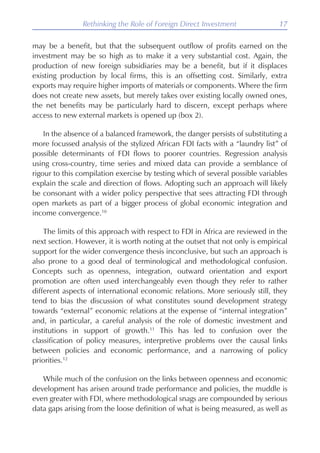
In the absence of a balanced framework, the danger persists of substituting a 
more focussed analysis of the stylized African FDI facts with a “laundry list” of 
possible determinants of FDI flows to poorer countries. Regression analysis 
using cross-country, time series and mixed data can provide a semblance of 
rigour to this compilation exercise by testing which of several possible variables 
explain the scale and direction of flows. Adopting such an approach will likely 
be consonant with a wider policy perspective that sees attracting FDI through 
open markets as part of a bigger process of global economic integration and 
income convergence.10 
The limits of this approach with respect to FDI in Africa are reviewed in the 
next section. However, it is worth noting at the outset that not only is empirical 
support for the wider convergence thesis inconclusive, but such an approach is 
also prone to a good deal of terminological and methodological confusion. 
Concepts such as openness, integration, outward orientation and export 
promotion are often used interchangeably even though they refer to rather 
different aspects of international economic relations. More seriously still, they 
tend to bias the discussion of what constitutes sound development strategy 
towards “external” economic relations at the expense of “internal integration” 
and, in particular, a careful analysis of the role of domestic investment and 
institutions in support of growth.11 This has led to confusion over the 
classification of policy measures, interpretive problems over the causal links 
between policies and economic performance, and a narrowing of policy 
priorities.12 
While much of the confusion on the links between openness and economic 
development has arisen around trade performance and policies, the muddle is 
even greater with FDI, where methodological snags are compounded by serious 
data gaps arising from the loose definition of what is being measured, as well as
18 Economic Development in Africa 
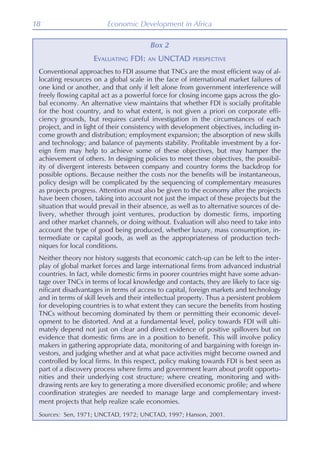
Box 2 
EVALUATING FDI: AN UNCTAD PERSPECTIVE 
Conventional approaches to FDI assume that TNCs are the most efficient way of al-locating 
resources on a global scale in the face of international market failures of 
one kind or another, and that only if left alone from government interference will 
freely flowing capital act as a powerful force for closing income gaps across the glo-bal 
economy. An alternative view maintains that whether FDI is socially profitable 
for the host country, and to what extent, is not given a priori on corporate effi-ciency 
grounds, but requires careful investigation in the circumstances of each 
project, and in light of their consistency with development objectives, including in-come 
growth and distribution; employment expansion; the absorption of new skills 
and technology; and balance of payments stability. Profitable investment by a for-eign 
firm may help to achieve some of these objectives, but may hamper the 
achievement of others. In designing policies to meet these objectives, the possibil-ity 
of divergent interests between company and country forms the backdrop for 
possible options. Because neither the costs nor the benefits will be instantaneous, 
policy design will be complicated by the sequencing of complementary measures 
as projects progress. Attention must also be given to the economy after the projects 
have been chosen, taking into account not just the impact of these projects but the 
situation that would prevail in their absence, as well as to alternative sources of de-livery, 
whether through joint ventures, production by domestic firms, importing 
and other market channels, or doing without. Evaluation will also need to take into 
account the type of good being produced, whether luxury, mass consumption, in-termediate 
or capital goods, as well as the appropriateness of production tech-niques 
for local conditions. 
Neither theory nor history suggests that economic catch-up can be left to the inter-play 
of global market forces and large international firms from advanced industrial 
countries. In fact, while domestic firms in poorer countries might have some advan-tage 
over TNCs in terms of local knowledge and contacts, they are likely to face sig-nificant 
disadvantages in terms of access to capital, foreign markets and technology 
and in terms of skill levels and their intellectual property. Thus a persistent problem 
for developing countries is to what extent they can secure the benefits from hosting 
TNCs without becoming dominated by them or permitting their economic devel-opment 
to be distorted. And at a fundamental level, policy towards FDI will ulti-mately 
depend not just on clear and direct evidence of positive spillovers but on 
evidence that domestic firms are in a position to benefit. This will involve policy 
makers in gathering appropriate data, monitoring of and bargaining with foreign in-vestors, 
and judging whether and at what pace activities might become owned and 
controlled by local firms. In this respect, policy making towards FDI is best seen as 
part of a discovery process where firms and government learn about profit opportu-nities 
and their underlying cost structure; where creating, monitoring and with-drawing 
rents are key to generating a more diversified economic profile; and where 
coordination strategies are needed to manage large and complementary invest-ment 
projects that help realize scale economies. 
Sources: Sen, 1971; UNCTAD, 1972; UNCTAD, 1997; Hanson, 2001.
Rethinking the Role of Foreign Direct Investment 19 
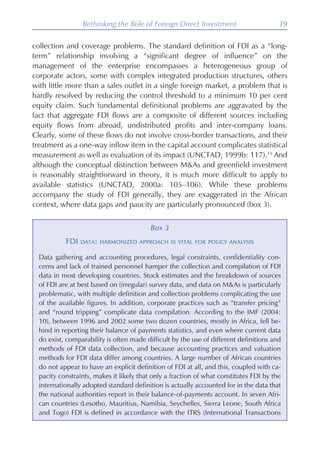
collection and coverage problems. The standard definition of FDI as a “long-term” 
relationship involving a “significant degree of influence” on the 
management of the enterprise encompasses a heterogeneous group of 
corporate actors, some with complex integrated production structures, others 
with little more than a sales outlet in a single foreign market, a problem that is 
hardly resolved by reducing the control threshold to a minimum 10 per cent 
equity claim. Such fundamental definitional problems are aggravated by the 
fact that aggregate FDI flows are a composite of different sources including 
equity flows from abroad, undistributed profits and inter-company loans. 
Clearly, some of these flows do not involve cross-border transactions, and their 
treatment as a one-way inflow item in the capital account complicates statistical 
measurement as well as evaluation of its impact (UNCTAD, 1999b: 117).13 And 
although the conceptual distinction between M&As and greenfield investment 
is reasonably straightforward in theory, it is much more difficult to apply to 
available statistics (UNCTAD, 2000a: 105–106). While these problems 
accompany the study of FDI generally, they are exaggerated in the African 
context, where data gaps and paucity are particularly pronounced (box 3). 
Box 3 
FDI DATA: HARMONIZED APPROACH IS VITAL FOR POLICY ANALYSIS 
Data gathering and accounting procedures, legal constraints, confidentiality con-cerns 
and lack of trained personnel hamper the collection and compilation of FDI 
data in most developing countries. Stock estimates and the breakdown of sources 
of FDI are at best based on (irregular) survey data, and data on M&As is particularly 
problematic, with multiple definition and collection problems complicating the use 
of the available figures. In addition, corporate practices such as “transfer pricing” 
and “round tripping” complicate data compilation. According to the IMF (2004: 
10), between 1996 and 2002 some two dozen countries, mostly in Africa, fell be-hind 
in reporting their balance of payments statistics, and even where current data 
do exist, comparability is often made difficult by the use of different definitions and 
methods of FDI data collection, and because accounting practices and valuation 
methods for FDI data differ among countries. A large number of African countries 
do not appear to have an explicit definition of FDI at all, and this, coupled with ca-pacity 
constraints, makes it likely that only a fraction of what constitutes FDI by the 
internationally adopted standard definition is actually accounted for in the data that 
the national authorities report in their balance-of-payments account. In seven Afri-can 
countries (Lesotho, Mauritius, Namibia, Seychelles, Sierra Leone, South Africa 
and Togo) FDI is defined in accordance with the ITRS (International Transactions
20 Economic Development in Africa 
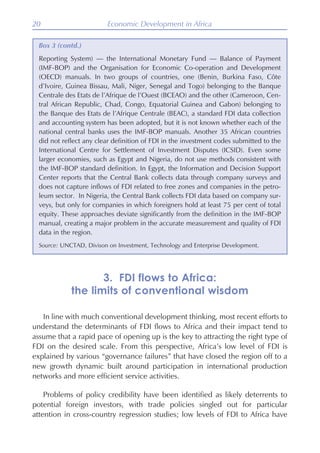
Box 3 (contd.) 
Reporting System) — the International Monetary Fund — Balance of Payment 
(IMF-BOP) and the Organisation for Economic Co-operation and Development 
(OECD) manuals. In two groups of countries, one (Benin, Burkina Faso, Côte 
d’Ivoire, Guinea Bissau, Mali, Niger, Senegal and Togo) belonging to the Banque 
Centrale des Etats de l’Afrique de l’Ouest (BCEAO) and the other (Cameroon, Cen-tral 
African Republic, Chad, Congo, Equatorial Guinea and Gabon) belonging to 
the Banque des Etats de l’Afrique Centrale (BEAC), a standard FDI data collection 
and accounting system has been adopted, but it is not known whether each of the 
national central banks uses the IMF-BOP manuals. Another 35 African countries 
did not reflect any clear definition of FDI in the investment codes submitted to the 
International Centre for Settlement of Investment Disputes (ICSID). Even some 
larger economies, such as Egypt and Nigeria, do not use methods consistent with 
the IMF-BOP standard definition. In Egypt, the Information and Decision Support 
Center reports that the Central Bank collects data through company surveys and 
does not capture inflows of FDI related to free zones and companies in the petro-leum 
sector. In Nigeria, the Central Bank collects FDI data based on company sur-veys, 
but only for companies in which foreigners hold at least 75 per cent of total 
equity. These approaches deviate significantly from the definition in the IMF-BOP 
manual, creating a major problem in the accurate measurement and quality of FDI 
data in the region. 
Source: UNCTAD, Divison on Investment, Technology and Enterprise Development. 
3. FDI flows to Africa: 
the limits of conventional wisdom 
In line with much conventional development thinking, most recent efforts to 
understand the determinants of FDI flows to Africa and their impact tend to 
assume that a rapid pace of opening up is the key to attracting the right type of 
FDI on the desired scale. From this perspective, Africa’s low level of FDI is 
explained by various “governance failures” that have closed the region off to a 
new growth dynamic built around participation in international production 
networks and more efficient service activities. 
Problems of policy credibility have been identified as likely deterrents to 
potential foreign investors, with trade policies singled out for particular 
attention in cross-country regression studies; low levels of FDI to Africa have
Rethinking the Role of Foreign Direct Investment 21 
been explained by the ad hoc and reversible nature of liberalization efforts and 
the abuse of trade policies for wider economic and social goals (Asiedu, 2002). 
Others have singled out unfavourable and unstable tax regimes (Gastanaga et 
al., 1998), the slow pace of public sector reform, particularly privatization, 
(Akingube, 2003; Pigatto, 2001) and the inadequacy of intellectual property 
protection (OECD, 2003) as erecting serious obstacles to FDI in Africa. In 
addition to this perceived policy deficit vis-à-vis other developing regions, 
excessive levels of corruption, regulation and political risk are believed to have 
further raised costs, adding to an unattractive “business climate” for FDI 
(Morrisett, 2000; Elbadawi and Mwega, 1997). 
Other studies have stressed macroeconomic policy failures as deflecting FDI 
flows from the region. According to this assessment, irresponsible fiscal and 
monetary policies have generated unsustainable budget deficits and inflationary 
pressures, raising local production costs, generating exchange rate instability, 
and making the region too risky a location for long-term investments, 
particularly in more dynamic non-traditional export sectors (Reinhart and 
Rogoff, 2002; Lyakurwa, 2003). Given a strong correlation between capital 
account openness and FDI inflows, sluggish financial liberalization has also been 
identified as adding to Africa’s poor macro performance in attracting FDI 
(Gastanaga et al., 1998; Bende-Nabende, 2002). 
These problems of poor policy and weak governance have, in turn, been 
traced to ingrained anti-colonial and nationalist sentiments, which have allowed 
obsolete policy thinking to persist longer in Africa than elsewhere (Moss et al., 
2004) and rent-seeking coalitions to resist systematic reforms (Basu and 
Srinivasan, 2002). Others have suggested that reverberations from just a few 
countries may have tainted the whole region as investor unfriendly (UNCTAD, 
1999c). Accordingly, better governance, understood to include increased 
openness, diminished public-sector control and more transparent and 
participatory policy procedures, should lower perceptions of risk and strengthen 
the hand of reformers in implementing adjustment programmes, thereby 
establishing a more appropriate and predictable incentive structure for 
attracting foreign investors (Pigatto, 2001). 
An immediate shortcoming of these explanations of “governance failure” 
deflecting FDI from Africa is that they coincide with a period of intensifying 
adjustment across the region, which has aimed to reduce the role of the state
22 Economic Development in Africa 
and covers all aspects of monetary and exchange rate policies, financial market 
reform (including opening up of the capital account), privatization, 
deregulation, and trade and FDI liberalization. In Africa these policies have 
been applied more repeatedly and vigorously than in any other region 
(UNCTAD, 2002b, section C).14 The fact that these efforts have still not 
attracted the expected inflows of FDI raises questions about the role of 
governance reforms, at least as this has been conventionally defined and 
implemented in Africa. 
As has been noted in past UNCTAD reports, a considerable amount of 
institutional diversity characterizes successful development experiences, 
including among today’s advanced economies, and judging Africa’s 
performance against a narrow and highly stylized standard of what constitutes 
good governance is likely to be misleading and perhaps counterproductive. 
Certainly, and as was suggested earlier, the successful management of trade in 
strong growth episodes, including in Africa (see box 7 in section D), has rarely 
followed a simple or unilinear pattern of accelerating liberalization; and while 
foreign affiliates, particularly those providing just one link in a longer cross-border 
value chain, may favour rapid trade liberalization, for developing-country 
policy makers the trade-investment nexus raises more complex issues, 
with the likely impact of liberalization on FDI depending on the type of FDI 
involved, as well as industry and country characteristics (Amiti and Wakelin, 
2003). Moreover, and while the identification of a good business climate with 
weak state institutions and regulations is anyway questionable, a recent 
comparative study of African competitiveness actually found that, “in terms of 
business environment (as measured by the World Bank), SSA does not fare 
badly relative to other developing regions” (Lall, 2004: 22). The countries in 
SSA have certainly been assiduous in establishing export processing zones 
(EPZs) — more so than any other developing region outside Asia — and in 
signing investment treaties (sometimes seen as a measure of good governance), 
without attracting the expected FDI (Hallward-Driemeier, 2003); and corporate 
tax rates in Africa do not appear to be at variance with those in other regions 
(Hanson, 2001: 4). Indeed, a cursory glance at the top of recent league tables of 
attracting FDI in Africa does not suggest that the responsiveness of TNCs to 
good political or corporate governance is the driving force behind large 
inflows.15
Rethinking the Role of Foreign Direct Investment 23 
The extent to which Africa has been more inflation prone than other regions 
over the past two decades is also debatable (UNCTAD, 2002b). Bosworth and 
Collins (2003) have ruled this out, along with other macroeconomic price 
distortions, as a significant explanatory factor in the region’s sub-standard 
growth performance over the past two decades. Findings to the contrary appear 
to give undue weight to the performance of a small number of conflict-ridden 
countries, where inflationary pressures have little to do with conventional 
notions of macroeconomic mismanagement. There also appears to be a 
tendency to underestimate the extent to which African countries have in 
practice established more open capital accounts, particularly with respect to 
FDI, where policy convergence among developing countries has been a strong 
trend over the past two decades (Ndikumana, 2003; Kobrin, 2005). Moreover, 
tracing the FDI shortfall to sluggish capital account liberalization ignores how 
such moves might, by increasing financial volatility, actually deter FDI, 
particularly where domestic financial markets are weak or missing, as is typically 
the case in SSA (Hermes and Lensink, 2003; UNCTAD, 1996b), or can attract a 
type of FDI with less favourable consequences for growth (Lensink and 
Morrisey, 2002). 
The fact that weak, missing or failing markets can deter and distort FDI is not 
limited to the financial dimension of the package. As was noted above, market 
failures are a principal reason why TNCs choose to exploit their technological 
advantages through investments abroad.16 However, a positive impact from 
hosting FDI is contingent on the presence of local technological capacities, and 
while there is no easy blueprint for building a dynamic learning environment in 
support of technological progress in poorer countries, there is agreement that it 
will involve a mix of learning on the job along with more formal training and 
public support, to ensure an adequate supply of skills and know-how with 
which to absorb, adapt and advance technology, including through attracting 
and utilizing FDI. Certainly, regarding a series of measures, including formal and 
vocational training, R&D expenditures and patents, it is clear that Africa faces 
severe structural deficits and lags behind other developing countries over the 
past two decades, with implications for FDI inflows (table 4). Cantwell (1997), 
for example, has suggested that most African countries lack the skill and 
technological infrastructure to effectively absorb larger flows of FDI even in the 
primary sector; and Lall (2004) sees the lack of “technological effort” in Africa 
as cutting it off from the most dynamic components of global FDI flows in 
manufacturing.
24 Economic Development in Africa 
Table 4 
AFRICA’’’’S TECHNOLOGY GAP 
Skills Technological Technology ICT 
effort imports Infrastructure 
Group or region Tertiary R&D Royalties Telephone Personal 
technical per capita and mainlines computers 
enrolment ($) technical fees (per 1,000 per 1,000 
(per 1,000 per capita ($) of pop.) of pop.) 
of pop.) 
1985 1998 1985 1998 1985 1998 1998 1998 
World 11.1 14.6 22.9 71.4 2.6 14.2 152.5 64.9 
Industrialized countries 34.3 40.1 122.3 402.4 12.0 66.2 571.1 316.5 
Transition economies .. 26.3 .. 8.8 .. 2.5 214.0 42.7 
Developing countries 6.3 8.7 0.6 4.6 0.6 3.9 62.6 14.2 
East Asia 4.6 9.2 … 8.7 .. 7.1 82.7 19.3 
East Asia less China 12.3 21.9 3.2 31.0 2.7 26.6 119.3 48.6 
South Asia 5.1 5.4 0.3 0.3 - 0.2 19.7 2.6 
Latin America and 
the Caribbean 16.6 17.3 1.1 6.3 1.9 5.3 122.3 33.3 
Sub-Saharan Africa .. 4.0 0.6 1.3 0.4 0.6 16.5 7.8 
Sub-Saharan Africa 
less South Africa 1.7 2.7 - - - 0.2 5.7 3.4 
Middle East and 
North Africa 13.6 20.5 0.4 1.4 0.1 3 115 14.8 
Source: UNIDO, Industrial Development Report 2004: 177 
Technological effort, however, is not independent of the expansion of 
productive capacity, both because technological change is often embodied in 
new equipment and because learning on the job depends on the availability of 
employment opportunities (UNCTAD, 2003a: 61–62). In all developing 
regions, strong complementarities and mutually reinforcing linkages among 
capital accumulation, technological progress, financial depth and structural 
change constitute the basis for rapid and sustained productivity growth and 
successful integration into the global economy. 
In the interplay of linkages that make up a virtuous growth regime, capital 
accumulation holds a central place in Africa, as elsewhere. This is potentially 
“good news” for Africa, given that, in the right environment, “domestic and 
foreign savings can be directed toward productive opportunities rapidly” 
(Freeman and Lindauer, 1999: 9). Previous UNCTAD research has also found a
Rethinking the Role of Foreign Direct Investment 25 
positive but weak relation between the share of FDI in GDP and the share of 
gross fixed capital formation, but also that a high share of domestic capital 
formation is generally a prerequisite for the positive impact of FDI to outweigh 
any negative effects (UNCTAD, 2003a: 76–78). Given a weak domestic 
accumulation dynamic, however, it is also possible that the two sets of 
investment decisions can be driven by different impulses. Among a selected 
group of 34 developing countries examined by UNCTAD, very few in Africa 
(Mauritius, Senegal and Zimbabwe) appeared to exhibit strong complementary 
linkages between domestic investment and FDI. Not surprisingly, while there 
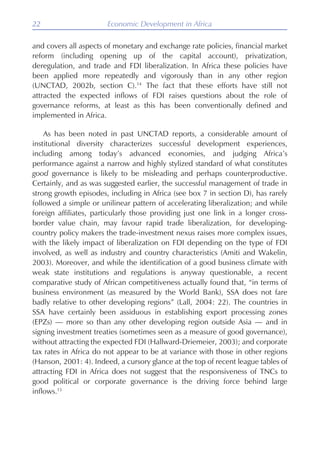
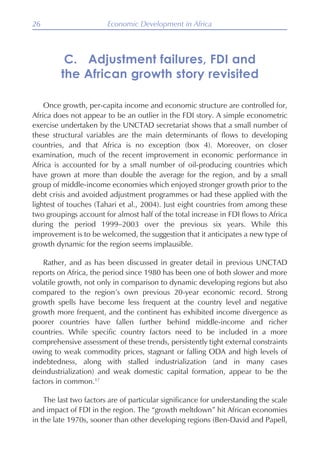
does appear to be a positive relation between FDI and growth in Africa, it is a 
very weak association and is unstable in the presence of one or two outliers 
(figure 3). These interdependencies in Africa’s investment process will be 
examined in greater detail in the next section. 
Figure 3 
RELATIONSHIP BETWEEN GDP GROWTH AND FDI INFLOWS, 1970––––2003 
(per cent) 
-8.00 -6.00 -4.00 -2.00 0.00 2.00 4.00 6.00 
y = 0.2261x + 0.6669 
R2 = 0.1353 
6.00 
4.00 
2.00 
0.00 
-2.00 
-4.00 
-6.00 
-8.00 
Change in average GDP growth* 
Change in ratio of FDI inflows 
to GDP ** Source: UNCTAD secretariat computations based on UNCTAD FDI/TNC database and World 
Bank online data. 
* The difference in average GDP growth during 1970-1979 compared to 1990–2003. 
** The difference between average ratio of FDI inflows to GDP for the periods 1970–1979 and 
1990–2003.
26 Economic Development in Africa 
C. Adjustment failures, FDI and 
the African growth story revisited 
Once growth, per-capita income and economic structure are controlled for, 
Africa does not appear to be an outlier in the FDI story. A simple econometric 
exercise undertaken by the UNCTAD secretariat shows that a small number of 
these structural variables are the main determinants of flows to developing 
countries, and that Africa is no exception (box 4). Moreover, on closer 
examination, much of the recent improvement in economic performance in 
Africa is accounted for by a small number of oil-producing countries which 
have grown at more than double the average for the region, and by a small 
group of middle-income economies which enjoyed stronger growth prior to the 
debt crisis and avoided adjustment programmes or had these applied with the 
lightest of touches (Tahari et al., 2004). Just eight countries from among these 
two groupings account for almost half of the total increase in FDI flows to Africa 
during the period 1999–2003 over the previous six years. While this 
improvement is to be welcomed, the suggestion that it anticipates a new type of 
growth dynamic for the region seems implausible. 
Rather, and as has been discussed in greater detail in previous UNCTAD 
reports on Africa, the period since 1980 has been one of both slower and more 
volatile growth, not only in comparison to dynamic developing regions but also 
compared to the region’s own previous 20-year economic record. Strong 
growth spells have become less frequent at the country level and negative 
growth more frequent, and the continent has exhibited income divergence as 
poorer countries have fallen further behind middle-income and richer 
countries. While specific country factors need to be included in a more 
comprehensive assessment of these trends, persistently tight external constraints 
owing to weak commodity prices, stagnant or falling ODA and high levels of 
indebtedness, along with stalled industrialization (and in many cases 
deindustrialization) and weak domestic capital formation, appear to be the 
factors in common.17 
The last two factors are of particular significance for understanding the scale 
and impact of FDI in the region. The “growth meltdown” hit African economies 
in the late 1970s, sooner than other developing regions (Ben-David and Papell,
Rethinking the Role of Foreign Direct Investment 27 
Box 4 
DETERMINANTS OF FDI TO AFRICA: HOW DIFFERENT? 
There is a large though inconclusive econometric literature on the determinants of FDI, 
including in Africa. Much of the recent literature has looked for governance failures be-hind 
the perceived shortfall in FDI flows to Africa, and has constructed and tested mod-els 
accordingly with, inter alia, trade policies, fiscal stance, inflation, financial liberaliza-tion 
and state ownership variously included. The UNCTAD secretariat ran its own series 
of regressions using panel data for 71 developing countries for the period 1982–2002, 
including 36 countries from SSA, for which separate regressions were also run. FDI as a 
percentage of GDP was regressed on a series of structural variables which included in-dustrial 
value added as a percentage of GDP, manufacturing exports as a share of total 
exports and manufacturing value added as a share of total GDP; infrastructure as meas-ured 
by the number of telephone lines; GDP growth and GDP per capita; and a (one-year) 
lagged FDI variable. Inflation was also included. The estimated technique used was 
the Generalized Least Squares with cross-section weights. 
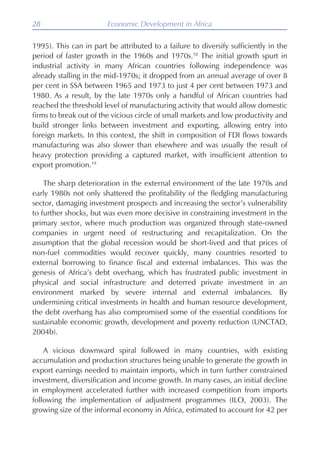
In general, UNCTAD secretariat estimations produced the expected results in terms of 
the sign and size of coefficients. The table below shows the outcome of two pool regres-sions 
for all developing and African countries in the sample. For all countries, lagged FDI 
is consistently and strongly significant, as are industry as a per cent of GDP, infrastruc-ture, 
growth and per capita income, although the latter is sensitive to the inclusion of the 
infrastructure variable. It is also clear that there are significant country effects, as meas-ured 
by the F-test on fixed effects. A dummy variable for Africa in these equations was 
not significant. Similar results were reported for the separate regressions run for African 
countries. Surprisingly, ores and metals as a percentage of GDP were significant but with 
the wrong sign for the period 1982–2002. There are also country-level effects in Africa. 
All countries African countries 
Results (1) (2) (3) (4) 
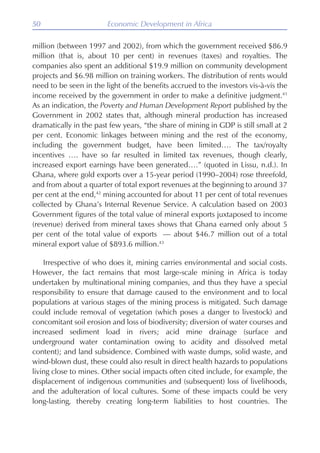
Constant 
Industry as a % of GDP 0.004* 0.004** 0.017** 0.019** 
Infrastructure 0.006* 0.006* 0.007** 0.007** 
GDP growth 0.014* 0.009* 
Inflation (average last 2 years) -0.0003* -0.0003* -0.009* -0.009* 
FDI (-1) 0.488* 0.487* 0.420* 0.417* 
F test on fixed effects 18.2* 243.1* 7.1* 6.9* 
R2 0.62 0.63 0.54 0.54 
F 689.0* 529.4* 246.3* 1986.2* 
DW 2.11 2.13 2.17 2.17 
Included observations 21 21 21 21 
Number of cross-sections 71 71 36 36 
Total panel 1323 1323 675 675 
Sample 1982-2002 1982-2002 1982-2002 1982-2002 
Source: World Development Indicators, The World Bank FDI database from UNCTAD. 
Notes: * Significant at the 1% level. 
** Significant at the 5% level.
28 Economic Development in Africa 
1995). This can in part be attributed to a failure to diversify sufficiently in the 
period of faster growth in the 1960s and 1970s.18 The initial growth spurt in 
industrial activity in many African countries following independence was 
already stalling in the mid-1970s; it dropped from an annual average of over 8 
per cent in SSA between 1965 and 1973 to just 4 per cent between 1973 and 
1980. As a result, by the late 1970s only a handful of African countries had 
reached the threshold level of manufacturing activity that would allow domestic 
firms to break out of the vicious circle of small markets and low productivity and 
build stronger links between investment and exporting, allowing entry into 
foreign markets. In this context, the shift in composition of FDI flows towards 
manufacturing was also slower than elsewhere and was usually the result of 
heavy protection providing a captured market, with insufficient attention to 
export promotion.19 
The sharp deterioration in the external environment of the late 1970s and 
early 1980s not only shattered the profitability of the fledgling manufacturing 
sector, damaging investment prospects and increasing the sector’s vulnerability 
to further shocks, but was even more decisive in constraining investment in the 
primary sector, where much production was organized through state-owned 
companies in urgent need of restructuring and recapitalization. On the 
assumption that the global recession would be short-lived and that prices of 
non-fuel commodities would recover quickly, many countries resorted to 
external borrowing to finance fiscal and external imbalances. This was the 
genesis of Africa’s debt overhang, which has frustrated public investment in 
physical and social infrastructure and deterred private investment in an 
environment marked by severe internal and external imbalances. By 
undermining critical investments in health and human resource development, 
the debt overhang has also compromised some of the essential conditions for 
sustainable economic growth, development and poverty reduction (UNCTAD, 
2004b). 
A vicious downward spiral followed in many countries, with existing 
accumulation and production structures being unable to generate the growth in 
export earnings needed to maintain imports, which in turn further constrained 
investment, diversification and income growth. In many cases, an initial decline 
in employment accelerated further with increased competition from imports 
following the implementation of adjustment programmes (ILO, 2003). The 
growing size of the informal economy in Africa, estimated to account for 42 per
Rethinking the Role of Foreign Direct Investment 29 
cent of output in 1999–2000, although reaching as high as 60 per cent in some 
countries (Schneider, 2002) is an indication of the near-collapse of the formal 
sector and the failure of these programmes to stimulate a sustained recovery 
across the region. An equally telling, and related, sign of the vicious spiral has 
been the “deindustrialization” trend across much of the region. The share of 
manufacturing output in GDP dropped sharply in SSA between 1980 and 1990 
before stalling at a level in the 1990s below that reached in 1960 (UNCTAD, 
2003a).20 In 1980, there had been seven countries in SSA with per-capita 
manufacturing comparable to, and often higher than, Thailand; by 2002, with 
the exception of Mauritius, all had been overtaken. Various cross-country 
studies have traced this trend to the sharp slowdown of output growth under 
adjustment programmes. Moreover, these studies also show that differences in 
productivity and export performance in the industrial sector explain much of 
the variance in growth performance within Africa over the post-debt crisis 
period.21 
For many countries in the region, dependence on commodity exports has, 
over this period, remained very high, and in some cases has risen even higher, 
although paradoxically Africa’s share of world commodity exports has actually 
declined. These countries have consequently been exposed to high price 
volatility, mainly from supply shocks, even as real prices continued their secular 
decline. The attendant terms of trade losses exacted heavy costs in terms of 
incomes, indebtedness, investment and development and made diversification 
even less likely. As is explained in greater detail elsewhere, this commodity trap 
has become a poverty trap for many countries (UNCTAD, 2002c and 2003b). 
Based on this record, it is clear that most adjustment programmes have done 
little to alter the region’s pattern of structural change and integration into the 
global economy, and, in the case of manufacturing, have almost certainly been 
regressive (UNCTAD, 2003a, part II). These programmes were essentially 
designed on the assumption that import-oriented growth strategies could 
effectively be switched to market-driven, outward-oriented strategies simply by 
eliminating inflation, downsizing the public sector and opening up to foreign 
trade and capital. While reporting some degree of success on these measures, 
most programmes have failed singularly to re-establish a pro-investment, pro-employment 
economic climate.22
30 Economic Development in Africa 
This record can in part be understood as a result of linking monetary and 
fiscal policy exclusively to price distortions rather than to more traditional 
macroeconomic concerns such as the level and composition of aggregate 
demand, the state of the business cycle and exchange rate management. As a 
result, domestic industry has encountered serious difficulties in financing 
investment both for restructuring and adding new capacity, with banks finding it 
more attractive to hold government paper or lend to foreign affiliates. 
Moreover, inconsistencies between macroeconomic, trade and industrial 
policies have hindered technological upgrading and contributed to weak 
productivity performance, leaving local firms, particularly the more export-oriented, 
vulnerable to wage and exchange rate pressures or unforeseen 
external shocks. 
These policy inconsistencies can in part be traced to an unduly narrow 
conception of a healthy investment climate in late industrializing economies. 
Previous UNCTAD research has shown that the profit-investment nexus has 
been weak in Africa, particularly since the debt crisis (UNCTAD, 1997), in large 
part because the mix of incentives and disciplinary pressures that could 
generate profits above market forces and steer those towards productive sectors 
has been missing. This problem has been compounded by the absence of large 
domestic enterprises with links to domestic financial institutions, which could 
augment investment from retained earnings with long-term bank lending.23 
Moreover, the establishment of a dynamic profit-investment nexus has been 
further impeded by declining public investment which could help crowd in 
private investment, as was the case in East Asia after the debt crisis (UNCTAD, 
2003a: 74–76) and has also been true of more successful African economies 
such as Botswana and Mauritius (UNCTAD, 1998: 125–126). 
A healthy investment climate is not characterized exclusively by a high 
investment ratio but must also support virtuous circles between investment, 
exports and growth in sectors with significant productivity and market potential. 
These are sectors where scale economies, technological dynamism and learning 
economies hold out the possibility of sustained improvement in wages and 
living standards and offer a more balanced integration into the global economy. 
However, recent UNCTAD studies have shown that in many countries 
undergoing adjustment programmes, a combination of rapid liberalization and 
wage compression, rather than diversification and upgrading, has been the 
driving force behind more export-oriented growth. Thus, among 26 selected
Rethinking the Role of Foreign Direct Investment 31 
developing countries between 1980 and 2000, wage compression and 
devaluation have been the principal means by which African economies have 
sought to improve their competitiveness; the danger is that these countries will 
be locked into traditional low-technology and low-income-elasticity exports 
(UNCTAD, 2003a: 106–121). This finding has been confirmed in a study of a 
larger group of African economies, which finds a structural reversal in the 
1990s, back to resource-based exports, and an emerging export profile at 
variance with global trends, and particularly with the most dynamic exporting 
regions. Only South Africa shows clear improvement in the share of medium-and 
high-technology products in total manufactured exports over the period 
1980–2000. However, even in this case, the gains were noticeably stronger in 
the 1980s than the 1990s, and there are few signs of South Africa’s breaking 
into markets for more sophisticated high-technology exports (Lall, 2004). 
This weak investment and diversification dynamic has a direct bearing on 
the kind of FDI that can be attracted to the region, as well as its impact. 
Obviously such trends will do little to attract market-seeking FDI, and all the less 
so with trade barriers declining across the region. But export-oriented seeking 
FDI is also unlikely to find this a hospitable climate, given that low wages are not 
by themselves sufficient to establish an attractive location. Robust local markets 
and the availability of intermediate inputs or low unit labour costs are far less 
important in some other sectors, such as mining, where the emergent profit-investment 
nexus responds more to external market demands and pressures. 
When TNCs invest in these enclaves similar opportunities are invariably denied 
to local firms, whether public or private. But because such FDI has tended to be 
greenfield and export-oriented, there is still some expectation that it will crowd 
in complementary domestic investment (Weber-Fahr et al., 2001: 446). 
In practice, the links are often quite tenuous. Ideally, the reinvestment of 
profits or their absorption by fiscal measures and their utilization for the 
financing of development should provide channels to bolster investment, 
incomes and savings. However, the nature of the rents generated in these 
sectors can often divert the efforts of local entrepreneurs away from wealth 
creation through new productive capacity, into strategies designed for profit 
capture and redistribution. Manufacturing, which could potentially absorb 
labour from the informal economy, is likely to be most vulnerable, all the more 
so where transnational firms are pushing for trade liberalization and there is 
weak state support for local industry. Not only does this reinforce the tendency
32 Economic Development in Africa 
of the enclave to rely solely on imported capital, intermediate and consumer 
goods, it also encourages the channelling of savings into more speculative high-return 
activities (Mhone, 2000). Under these conditions, capital outflows, 
which according to one estimate averaged $7 billion annually between 1970 
and 1996 in SSA (triple the figure for FDI), can further weaken the kind of 
profit-investment nexus needed to establish a sustainable growth path. Indeed, 
some of the largest recipients of FDI have also been those with the greatest 
capital flight, underscoring the perverse profit-investment nexus that has built 
up under adjustment programmes (table 5). 
Comparative research does report some evidence of crowding in by FDI in 
some African countries, and more so than in Latin America, although, as was 
noted earlier, this is not a region-wide result. 24 Moreover, the relation seems to 
have weakened in recent years, as an accelerated pace of liberalization 
combined with increased M&A activity, including through privatization, have 
become prominent features of Africa’s economic landscape. According to one 
recent study, the tendency of FDI to crowd out local investment rose in all 
developing regions, including SSA, in the period 1990–1997 compared with 
1983–1989.25 A more detailed assessment would need to look to country 
experiences. Such studies are scarce for Africa. However, a recent examination 
of the impact of FDI on financial markets in Côte d’Ivoire between 1974 and 
1987 finds that the better collateral and profitability of TNCs eases their access 
to local banks and concomitantly reduces that for local firms (Harrison and 
McMillan, 2002). A similar result has been reported in the case of Morocco 
between 1984 and 1992, where it was found that FDI intensified the risks 
facing firms in sectors dominated by local producers, restricting their access to 
local credit markets (Vora, 2001). Previous studies by UNCTAD have also 
shown that financial liberalization and the entry of foreign-owned banks into 
Africa have produced fragmented capital markets in which access to sizeable 
credit is biased in favour of larger foreign firms (UNCTAD, 1996a). 
A more indirect impact on the domestic investment climate from FDI, at 
least where raw materials are the primary draw for foreign investors, comes 
from potentially adverse macroeconomic effects, particularly through an 
appreciating exchange rate, which can damage prospects of diversification into 
more dynamic sectors in manufacturing. However, while there is some 
evidence to suggest that manufacturing value added and exports in mineral-dependent 
African economies are lower than predicted given their resource
Rethinking the Role of Foreign Direct Investment 33 
Table 5 
CAPITAL FLIGHT AND FDI IN SELECTED AFRICAN COUNTRIES, 1970––––1996 
Cumulative flight* FDI inflows 
(Millions of 1996 dollars) (Millions of dollars) 
Angola 17 033 3 103 
Benin -3 457 394 
Burkina Faso 1 266 90 
Burundi 819 34 
Cameroon 13 099 1 097 
Central African Republic 250 90 
Congo, Dem. Rep. of 10 099 566 
Congo 459 1 095 
Côte d’Ivoire 23 371 1 837 
Ethiopia 5 523 187 
Gabon 2 989 258 
Ghana 407 942 
Guinea 343 155 
Kenya 815 743 
Madagascar 1 649 183 
Malawi 705 217 
Mali -1 204 198 
Mauritania 1 131 97 
Mauritius -268 293 
Mozambique 5 311 274 
Niger -3 153 364 
Nigeria 86 762 15 658 
Rwanda 2 116 233 
Senegal -7 278 379 
Seychelles 567 351 
Sierra Leone 1 473 8 
Sudan 6 983 165 
Tanzania, United Republic of 1 699 473 
Uganda 2 155 398 
Zambia 10 624 1 101 
Source: Ndikumana 2004: 357 and UNCTAD FDI/TNC database. 
Note: Correlation ratio is 0.96. 
* Capital flight is measured here as the change in debt adjusted for cross-currency exchange 
rate fluctuations (taking into account the fact that a country’s debt is denominated in 
various currencies), direct foreign investment, the currrent account balance plus changes 
in stock of international reserves and net trade misinvoicing. Nominal values of capital 
flight are deflated to real values using the US producer price index (base 1996=100) and 
the accumulated stock of capital flight is computed by imputing interest earnings to past 
capital flight using US Treasury Bill rate.
34 Economic Development in Africa 
endowments, whether or not this can be attributed directly to the high 
proportion of FDI in mining has not been systematically explored.26 In fact, a 
more pressing macroeconomic challenge resulting from rapid financial 
liberalization in the context of a large existing stock of capital in enclave sectors 
is the potential for significant outflows and a strongly negative impact on the 
balance of payments. This has certainly happened in recent years to some 
African economies where profit remittances have surged above new FDI 
inflows, sometimes by several-fold, as in South Africa and Gabon (Woodward, 
2001: 164–170); also in cumulative terms, for example, in Botswana, Congo 
and Nigeria (Appendix table A2). While this does not exhaust the full impact of 
FDI inflows on the balance of payments, previous UNCTAD research has shown 
that the balance-of-payments constraint did not loosen for Africa in the 1990s 
even with greater FDI inflows. This situation is unlikely to be eased by the rising 
share of M&As in those inflows, particularly when these are in the non-tradeable 
sector. 
The bias in FDI flows towards the mining sector is almost certainly associated 
with very limited backward and forward linkages in Africa (UNCTAD, 2001a) 
and, while arguably an inherent feature of the sector, the problem is 
exaggerated in the absence of good local infrastructure (Belderbos et al., 2001). 
Similarly, while only a small number of studies have tried to measure the 
spillovers from FDI in the African context, these tend to confirm the wider 
conclusion, noted earlier, that these spillovers are limited in nature and only 
detectable in the presence of a robust domestic private sector.27 
Some crowding out and weak linkages and spillovers might still be 
acceptable if a “vent for export surplus” and related efficiency gains from 
hosting FDI translated into a growing number of high-paying jobs. But while 
evidence from Africa tends to confirm that TNC affiliates pay higher wages, 
their bias towards skilled labour runs counter to expectations (Gelb and Black, 
2004). Certainly, in sectors such as mining, where investment tends to be 
capital-intensive, there is little expectation that large numbers of unskilled jobs 
will be created (World Bank, 1992: 28). Moreover, in manufacturing and 
service activities the overall employment impact is difficult to estimate given 
that it hinges on a series of indirect effects through suppliers, subcontractors and 
service providers which are difficult to trace in practice (UNCTAD, 1999a). 
However, if, as seems likely, the employment effects of FDI are positively 
correlated with per-capita income, and given the scarcity of evidence on 
linkages and spillovers in Africa, it seems doubtful that job creation will be a
Rethinking the Role of Foreign Direct Investment 35 
significant feature of FDI flows to the region. This result has been confirmed in 
an econometric study of 41 countries from the mid-1980s to the late 1990s 
where FDI had no significant effect on employment in low-income countries 
and the positive impact for middle-income countries was less pronounced than 
for comparable levels of domestic investment (Spiezia, 2004), and by various 
country level studies where job creation linked to FDI outside a small number 
of EPZs appears to have been very limited (Gelb and Black, 2004; UNCTAD, 
various years). Again, given that M&As are less likely to create jobs (and more 
likely to cause retrenchment) than greenfield investment, recent trends can 
hardly be taken as encouraging in this respect (UNCTAD, 1999a). 
Enclave development can assume a particularly perverse form under 
conditions of conflict. Indeed, a bid for control over resources has historically 
linked FDI and civil strife in the region, although this need not always imply a 
causal relation. A recent UNCTAD study has reported an increasing incidence 
of poverty over the period 1981 to 1999 for a number of mineral-dependent 
exporters from SSA, with a notably more rapid rise in the period after 1987, as 
FDI was attracted back to the sector, in some countries, and exports began to 
recover (UNCTAD, 2002c: 124).28 
Two points are worth emphasizing from resituating the role of FDI in the 
broader context of African development over the past two decades. First, as 
elsewhere, past FDI flows in Africa are likely to influence subsequent flows, and 
their likelihood of becoming part of a self-sustaining and dynamic investment 
process with a strongly positive impact on productivity performance depends 
upon establishing positive complementary interactions with domestic 
investment in both the private and public sectors. The failure of capital 
formation to make a strong recovery since the debt crisis, the limited evidence 
of crowding in from FDI, the incidence of capital flight, and the fact that the 
ratio of FDI to gross fixed capital formation in Africa is close to the developing-country 
average all suggest that such cumulative interactions have not taken 
hold across most of the region during the past 20 years. Under such 
circumstances, the tendency of FDI to reinforce enclave-type development 
appears to be a real danger, with external integration privileged over the 
internal integration of the local economy. 
Secondly, the story of attracting FDI through greater openness and 
downsizing of the state has not been empirically proven and tends to draw 
attention away from more fundamental determinants of FDI — namely that
36 Economic Development in Africa 
market size and growth, resource endowments and infrastructure development 
are consistently among the most significant determinants of the pattern of FDI 
flows to Africa. While this is very much in line with the broader body of 
evidence, which finds that FDI is a lagging rather than a lead factor in the 
development process, the implications do not appear to have been adequately 
incorporated into development policy discussions, particularly for Africa.29 
It also follows that simply pointing to the higher returns on FDI in Africa as 
indicative of missed investment opportunities is a misleading guide to policy 
makers.30 Such numbers — to the extent they are reliable — indicate that from 
the firm’s point of view, FDI is attracted to high-risk sectors with the possibility 
of sizeable rents; from the country’s point of view, it means that FDI is an 
expensive way of financing development which can be of benefit if it generates 
significant government revenues but can only be really justified over the longer 
run if it brings significant technological spillovers and jobs. If not, FDI is likely to 
reproduce a low-level development trap, where the conditions that attract it are 
not necessarily the same as those required for faster capital formation, in either 
the private or public sectors.
Rethinking the Role of Foreign Direct Investment 37 
D. Some sectoral experiences 
with FDI in Africa 
None of the discussion to date should be taken to imply that FDI should be 
abandoned in designing development strategies for Africa. But it does suggest 
that existing approaches to attracting FDI in the expectation that these will kick-start 
domestic capital formation and strengthen productivity performance have 
not been successful. As such, future efforts to harness the potential contribution 
of FDI require a shift in perspective to how it can better serve development 
goals in light of the structural constraints and resource gaps facing the region. 
The place to begin that discussion is probably at the sectoral level. 
The following discussion will focus on cases from the primary and secondary 
sectors. This choice is dictated in part by a recognition that in the broader 
picture of structural change and development these sectors are the driving 
forces of sustainable growth in most countries, but also by the fact that more 
detailed evidence on the impact of recent FDI into the tertiary sector in Africa is 
difficult to come by (UNCTAD, 2004). In the face of recent increased flows to 
this sector, linked particularly to the privatization of public services, a more 
detailed discussion would require an extensive primary data collection exercise 
at the country level, which is beyond the scope of the present study. 
Nevertheless, privatization and the increasing inflow of FDI into the services 
sector and its impact deserve a critical analysis, particularly as there is growing 
controversy surrounding the provision by international firms of certain public 
services in African countries, such as water, electricity and telecommunications. 
1. Enclaves and chains in the primary sector 
In assessing the likely impact of FDI in the primary sector in Africa, a 
distinction needs to be made between processed and unprocessed products. 
Although there are unresolved classification issues, the former are usually 
identified as manufactures in industrial and employment statistics but as 
primary products in trade statistics. Processed and unprocessed primary 
products can be further broken down into agricultural goods and minerals,
38 Economic Development in Africa 
metals and fuels, with the latter accounting for most non-renewable resources. 
A further distinction can also be drawn between static and dynamic products, 
based on such qualities as export growth and income elasticity. 
FDI has historically assumed different roles in relation to these product 
groups. The immutability of geography, scale economies and high sunk costs, as 
well as technological demands, have created high barriers to entry in the mining 
sector and integrated value chains under TNC governance. By contrast, smaller 
sunk investments and multiple sourcing opportunities have tended to make for 
a clearer separation between production and processing in agricultural 
commodities, with control located at the buying end of the chain where 
intangible assets provide more reliable rents (McKern, 1999). 
In the case of Africa, the investment pattern in the primary sector was 
established under colonial relations, whether directly or through the nominally 
independent “white colony settlements”, but the pattern persisted in the years 
immediately following independence. However, disappointing returns to the 
host country in terms of jobs, fiscal revenues and foreign-exchange earnings 
eventually provoked state interventions, including nationalization of existing 
plant and equipment, not only in an effort to bolster reinvested profits and help 
build local linkages, but also to affirm national sovereignty over politically 
sensitive and strategic parts of the economy, particularly natural resources 
(Kennedy, 1991: 72). The record of these interventions has been a mixed one 
in Africa. Many state-owned enterprises have been high-cost, low-productivity 
operations and a drain on the public purse, often acting as a conduit for 
siphoning away rents to politically favoured groups and individuals. However, it 
should also be recognized that a number of countries did make more effective 
use of their primary rents through a combination of public intervention and 
market-based incentives, including attracting FDI, ranging from heavy reliance 
in some cases (such as diamonds in Botswana), to insignificant in others (such as 
sugar in Mauritius). In these cases, fiscal and other measures were used to 
channel resources from the primary sector to infrastructure development and to 
support efforts to diversify into new lines of activity, albeit with varying degrees 
of success. 31 
Recently, surges of FDI into primary-sector activities in some African 
countries have been welcomed as a potential source of increased employment, 
government revenues and foreign exchange earnings, and as a potential catalyst 
for a more diversified industrialization path. These surges have been triggered
Rethinking the Role of Foreign Direct Investment 39 
by privatization programmes, undertaken in the context of structural 
adjustment; by favourable price movements for some key strategic 
commodities, such as oil; and by technological developments. There has also 
been a good deal of optimism expressed that corporate behaviour and market 
conditions are, if not actually favourable, at least more benign than in the past. 
(a) FDI in the Mining Sector: 
New opportunities or a “race to the bottom”?32 
As was noted previously, a large proportion of FDI to Africa has gone into 
the mining sector. Moreover, it seems likely that mineral (and oil) exports have 
been a major driver of the recent growth recovery in the region, albeit unevenly 
distributed. The $15 billion invested in mining in Africa in 2004 represented 15 
per cent of the global total, up considerably (from 5 per cent) from the mid- 
1980s, and putting the region third in the investment league, behind Latin 
America and Oceania. Of the total investment, South Africa accounted for 48 
per cent, followed by Ghana (7 per cent), Mauritania (6 per cent), Democratic 
Republic of Congo and Côte d’Ivoire (4 per cent each) and some 30 per cent for 
other countries (Mining Journal, 2005). With the exception of South Africa, 
most investment was FDI. The hope is that despite this uneven distribution, a 
new profit-investment-export nexus will reinvigorate faster and more sustained 
growth across the region. 
The increase in mining investment in Africa can be attributed in part to 
major changes in mining codes that have helped orchestrate a state withdrawal 
from the sector, expanded opportunities for the private sector and increased 
incentives to attract FDI. These changes have coincided with improving 
economic prospects in the sector. For much of the 1980s and 1990s, the 
investment climate in mining was a difficult one and markets in the North were 
depressed, which resulted in low but still volatile prices for many minerals and 
metals.33 Economic uncertainty was compounded by lingering political 
uncertainty in many developing-country locations, following the backlash 
against foreign-owned operations in some countries during the 1970s, and in 
the aftermath of the debt crisis, when state-owned enterprises were starved of 
resources. As a result, FDI in the sector was driven by a flight to safety, with 
investments concentrated in developed mineral-rich countries; the stock of FDI 
in the primary sector (principally mining, oil and quarrying) in developed
40 Economic Development in Africa 
countries, which stood at just 20 per cent of the global total in 1980, had risen 
to almost 60 per cent by 1990 and 80 per cent by 1997 (UNCTAD, 1993: 62 
and 1999a). 
It is against this backdrop that policy makers in Africa were encouraged to 
liberalize and privatize the sector and provide increasing incentives in order to 
attract potential investors, thereby competing among themselves as well as 
against countries in other regions such as Latin America, which had embarked 
on a similar strategy somewhat earlier and where generous incentives were 
already in place (ECLAC, 2001). Recent developments, and particularly the 
growing demand for inputs from some rapidly industrializing developing 
countries such as China and India, are raising hopes that past market trends 
may not be an appropriate guide to future developments in this sector. Thus, it 
is hardly surprising that despite the current high asset prices of mining 
companies, a new wave of consolidation in the form of mergers and 
acquisitions is in full swing as investors are more than eager to secure mineral 
deposits after years of underinvestment.34 
(i) Deregulating the mining sector in Africa 
Among the principal reasons advanced in support of reforms was the 
underperformance of the mining sector in Africa, characterized by a declining 
share in the value of world mining output and trade. Poor policies, political 
interference, lack of investment in geological mapping, poor technical data on 
mineral endowment, weak infrastructure and the lack of cheap and reliable 
energy supplies were seen as the explanatory factors. As a consequence, the 
sector was not making its expected contribution to faster economic growth and 
diversification. Indeed, its failure to generate sufficient revenues was seen as 
hindering the wider development process in many countries (Boocock, 2002; 
see also World Bank, 1992, passim). However, a more nuanced analysis of 
inefficiencies in the state-owned mining sector in most of SSA would suggest 
that the prolonged economic downturn which started in the late 1970s, along 
with a collapse in commodity prices following the boom of the mid-1970s, was 
a major source of rent depletion. In many cases, any revenues generated by the 
sector were appropriated for balance of payments support, including debt 
service payments, thus depriving the sector of a reinvestable surplus for 
exploration, modernization and rehabilitation of mines, needed if the sector 
was to recover and maintain its competitiveness.35
Rethinking the Role of Foreign Direct Investment 41 
Deregulation of the mining sector in Africa started in the 1980s in the 
context of structural adjustment programmes, which called for increased 
liberalization, deregulation and privatization as a means of correcting 
macroeconomic imbalances, stimulating economic recovery and establishing a 
more sustainable growth path. This initial orientation gradually assumed a more 
overt sectoral focus, shifting the World Bank from its traditional support for 
exploration and production activities, begun in the 1960s, to the 
commercialization and privatization of state-owned enterprises (SOEs) in the 
1980s and capacity building, private-sector development, and attraction of FDI 
during the 1990s (Liebenthal, Michelitsch and Tarazona, 2003: 2). More 
recently, attention has been given to strengthening governance and 
transparency, with the aims of ensuring that benefits reach the poor, mitigating 
environmental and social risks, and protecting the rights of people adversely 
affected by investments in the extractive industry (World Bank, 2004b: 2–15). 
Still, the rationale underlying all these reforms has been to shift government 
objectives in the mining sector towards generating tax revenues rather than 
pursuing other economic or political objectives such as control of resources or 
enhancement of employment, and with privatization as its main pillar.36 
The reforms are seen as cumulative, and, given the technological and 
financial requirements of the sector and the absence of local entrepreneurs who 
might otherwise take over previously state-owned enterprises, for African 
mining operations to become internationally competitive, the emphasis has 
more and more been on attracting new high-risk capital from foreign mining 
companies (World Bank, 1992: 9–12). To do so, the main decision criteria are 
“a stable legal and fiscal framework, which includes a mining code, contractual 
stability, a guaranteed fiscal regime, profit repatriation, and access to foreign 
exchange” (Campbell, 2004a: 17; see also van der Veen, 2000). In return, 
governments are expected to receive a “fair” slice of increased rents generated 
in the sector (World Bank, 1992: 10). 
Reforms in Ghana’s mining sector are regarded as typifying the first phase of 
mining sector reforms, undertaken in the context of adjustment programmes, 
and predating the more specific sector reforms introduced in the 1990s. By the 
end of 1995, 35 countries were reported to have published new mining codes, 
which have reduced tax levels, eased immigration laws for expatriate workers, 
and granted tax exemptions for imported equipment (Abugre and Akabzaa, 
1998, cited in Boocock, 2002). This was followed by Guinea’s reforms, in the
42 Economic Development in Africa 
mid-1990s, and later by those of Madagascar, Mali and United Republic of 
Tanzania at the end of the 1990s (Campbell, 2004a). All these phases 
demonstrate a “remarkable continuity” in the mining sector reforms pursued in 
Africa (Fox, Onorato and Strongman, 1998), with each succeeding phase 
building on a set of policies enacted under previous mining regimes and with 
the World Bank playing an instrumental role in conceptualizing and introducing 
these institutional reforms (see box 5). 
Box 5 
MINING SECTOR REFORMS: SELECTED EXAMPLES 
Ghana: Ghana’s mining sector reforms marked very stringent forms of state with-drawal 
from the sector against the broader backdrop of privatization, fiscal reform 
and opening up to foreign firms. However, the mining sector has also received 
more specific attention. The policy changes initiated since 1986 include the estab-lishment 
of the Minerals Commission as a one-stop investment centre for mining; 
the enactment of a new Minerals and Mining Law (PNDCL 153); and promulgation 
of a Profit Tax Law (PNDCL 122) and Minerals (Royalties) Regulations (LI 1349) in 
1985 and 1987 respectively. In addition, the Small Scale Mining Law (PNDCL 218) 
was enacted in 1989 to give legal backing to small-scale artisanal mining in the 
country, and the Minerals Commission was established as a one-stop investment 
centre for mining (Campbell, 2004a). These laws formed the basis of providing gen-erous 
tax incentives to foreign investors in the sector — by some estimates more 
generous than for other sectors (UNCTAD, various). For example, corporate in-come 
tax, which stood at 50 to 55 per cent in 1975, had by 1994 been reduced to 
35 per cent, and the royalty ratea from 6 per cent of total mineral value in 1975 to 3 
per cent in 1987. Additionally, the personal remittance quota for expatriate per-sonnel 
has been freed from any tax imposed on the transfer of foreign exchange 
out of the country. 
Guinea: Policies governing the operation of the mining sector during the second 
phase of reforms in the mid- to late 1990s were an acknowledgement of the need 
for certain forms of regulation (e.g. with respect to the environment), but also illus-trate 
how responsibility for overseeing such issues was imputed to private actors 
(Campbell, 2004a: 7). Guinea drew up a new mining policy aimed at restoring 
competitiveness to the mining sector tax system and providing a stable tax regime 
through the duration of the assigned mining rights.b Additionally, the Government 
initiated the “Program for the Promotion of Investment in the Mining Sector”, 
which would make it possible to: complete the geological map of Guinea; build a 
reliable databank on the sector; harmonize all legislation governing the sector; 
strengthen the institutional framework; restructure mining enterprises; and provide
Rethinking the Role of Foreign Direct Investment 43 
Box 5 (contd.) 
management training (Government of Guinea, 1999; see also Campbell, 2004b: 
36). Furthermore, the Government reduced its role as “owner and operator” in the 
mining sector but strengthened its role as “regulator and intermediary”. The strat-egy 
was based on the assumption that openness would encourage vigorous com-petitive 
markets, in which prices would drive the behaviour of firms and so provide 
for an optimal allocation of resources. 
Mali and United Republic of Tanzania: The third phase of reforms was based on the 
notion that “states do have a role in facilitation and regulation” (Campbell, 2004a). 
United Republic of Tanzania’s mineral code, introduced in 1998 as a result of a 
five-year World Bank-financed sectoral reform project, illustrates the typical ele-ments 
introduced in this set of reforms. This code allowed 100 per cent foreign 
ownership; provided guarantees against nationalization and expropriation; and of-fered 
unrestricted repatriation of profits and capital. It pegged the royalty rate at a 
maximum of 3 per cent, the same rate as in Mali and Guinea, and provided waivers 
in respect of import duties and tax exemptions on imported machinery, equipment 
and other inputs. It also waived the requirement (in the 1979 Mining Act) for local 
procurement of goods and services. In Mali, during the first three accounting peri-ods 
of production or mining, mining companies are exempted from the following 
fiscal obligations: income tax on professional earnings, investment income and 
property income; registration and stamp duties; value-added tax and service deliv-ery 
tax; contribution on patents; and tax on insurance policy (Hatcher, 2004). 
a According to the statutes, the royalty rates range between 3 and 12 per cent, depending on 
the operating margin of the mine. But in practical terms no mining company pays more 
than 3 per cent (Akabzaa, 2000). 
b This provision was also introduced in the third phase of reforms, specifically in the case of 
United Republic of Tanzania, which had a “tax stability” agreement with investors under 
which the Government would not revise taxes or royalty rates upward during the “full 
project life” of the mining operation. 
(ii) Impact of reforms 
As a result of the reforms, Africa has become much more “attractive” as a 
location for mining FDI. Much of the new investment has expanded the 
capacity of existing producers, including the development of new mines. 
However, Mali, for example, which did not have a large-scale mining sector 
before 1990, has hosted considerable flows of FDI in large-scale operations, as 
has the United Republic of Tanzania. A number of post-conflict economies, 
notably Angola and Mozambique, have also seen sharp recoveries in mineral 
production in recent years.
44 Economic Development in Africa 
Corporate objectives have remained unchanged: to maximize profits, 
minimize risk and recover investments as early as possible. Policy continuity 
and predictability, particularly with respect to the security of property rights and 
open markets, remain determining factors. But as tax is considered a cost of 
doing business, firms will, in part, base investment decisions on the extent to 
which the tax regime is responsive to the above objectives. Certainly the 
combination of adjustment programmes and sectoral reforms in Africa has 
worked to accommodate these objectives. 
However, attracting FDI in the mining sector is only part of the story. The 
other is to assess the impact in terms of wider economic and developmental 
gains to the state. As minerals are considered national assets and are non-renewable 
resources, their exploitation is closely linked to the exercise of 
national sovereignty, and the underlying philosophical presumption is that the 
owner of these assets should derive maximum benefits from any surpluses 
generated. Moreover, governments typically have a wide set of economic 
considerations in mind when designing strategies to best exploit these assets, 
aiming to maximize the value of locally retained earnings, creating forward and 
backward linkages to the rest of the economy, transferring technology and 
creating jobs, minimizing environmental damage and social impact, and 
expecting firms, regardless of their ownership, to compensate for damages 
incurred. 
Reconciling these interests with the profit-making objectives of TNCs is far 
from straightforward. Still, at one level, both parties have a common interest in 
the generation of maximum rents through a “vent for surplus”. For 
governments, this could help break potentially binding savings and balance-of-payments 
constraints on faster growth in the early stages of development. 
However, as was noted earlier, the danger is that export enclaves can inhibit a 
structural transformation towards a more diversified and internally integrated 
economy.37 Traditionally, this has led policy makers to focus on establishing 
processing industries as a way to increase value added and to establish an 
industrialization path which is less vulnerable to external shocks, and on which 
more jobs are created, the domestic market is stimulated through various 
multiplier effects, and favourable technological learning and scale economies 
are realized (Ostensson and Uwizeye-Mapendano, 2000). While developed 
countries did see some merit in supporting such strategies in the 1970s, 
including in Africa, commercial, technological and financial barriers to entry
Rethinking the Role of Foreign Direct Investment 45 
have remained formidable obstacles to dislodging the control of large TNCs 
(Yashir, 1988, ch. 10). 
In addition to export earnings, there is no doubt that the mining industry can 
bring benefits to resource-rich countries in the form of fiscal revenues. But the 
extent of these benefits will depend on the share of rents received by the 
countries concerned and the manner in which they are managed (Davis and 
Tilton, 2002). At the same time, because of the specificities of the industry, 
including its capital-intensive nature, relying on FDI means governments will 
have to balance their expectations with those of the industry in order to provide 
minimum disincentives for investment in new discoveries. In doing so, 
governments are invariably faced with choices as to the incentive structure and 
locational advantages offered by other countries. Consequently, and perhaps 
more than in any other industry, mining is subject to complex bargaining 
pressures over the terms of investment and the appropriate tax regime which 
best reconciles the interests of the different actors involved. Trends in the global 
economy tend to suggest that the bargaining environment has shifted 
significantly in favour of mining TNCs over the past two decades (Haslam, 
2004). 
Furthermore, the mining industry carries with it costs, such as 
environmental degradation as well as social problems in local communities, that 
need to be taken into account in any cost-benefit analysis of the contribution of 
the sector to the national economy and developmental objectives. Failure to 
consider these costs can easily distort the incentive structure towards a short-term 
outlook. Indeed, the search for quick returns in the sector can impart a 
more speculative investment mentality, with generally detrimental 
consequences for long-term growth (Stiglitz, 2002: 72). 
Certainly from the corporate perspective the outcomes of the recent reforms 
in the mining sector in Africa have been positive, as reflected in the significant 
increases of FDI in the sector. From the host country perspective, in order to 
assess the outcome of these reforms, governments would need to consider 
whether the increasing incentives provided to foreign investors have been offset 
by the desired outcomes outlined above. Already some observers have 
described the incentive competition as a “winner’s curse” for host countries, 
whereby investment competition among host countries can trigger a “a race to 
the bottom” not only in the more static sense of forgone fiscal earnings but also
46 Economic Development in Africa 
in terms of giving up policy options necessary to organize a more dynamic long-term 
growth path.38 
Of course, an assessment of the impact of the reforms would need to have 
some counterfactual reference point: that is, what would be the likely outcome 
if mineral-rich developing countries limited their incentive structure in order to 
enhance their income from the sector? Undoubtedly, there is an imponderable 
political dimension in the organization of such joint action, as well as issues of 
corporate response linked to the role of sunk cost, and there will be specific 
factors at play with some minerals where speculative market pressures are at 
work. However, one outcome could be that mining companies find their 
margins reduced and many may conclude that further investment in the sector 
is not economically viable. This could mean that global extraction levels are 
reduced, with the result that prices increase on the expectation of lower 
production levels. With rising prices, the sector would again become sufficiently 
attractive even in the absence of such incentives. 
Still, and regardless of the counterfactual, the tax incentives provided to 
transnational mining corporations are likely to carry an immediate opportunity 
cost in terms of lost government revenues. Moreover, they could be considered 
equivalent to a (hidden) subsidy that developing countries are providing to 
TNCs and perhaps ultimately to final consumers, while the provision of 
subsidies to domestic firms is considered anathema to the proper functioning of 
market forces and is labelled distortionary. Such subsidies are, in general, only 
likely to be warranted where the TNC uses elastically supplied factors 
intensively; they do not lower the market share of domestic firms, and there are 
strong positive productivity spillovers (Hanson, 2001). It seems unlikely that 
these conditions hold for the mining sector. Consequently, much would appear 
to hinge on significantly augmented government revenues from the sector over 
the longer run. 
(iii) Revenues and costs 
In order to place the various reforms into context, a brief discussion of the 
salient features of revenue generation through the taxation regime is necessary, 
bearing in mind that a thorough discussion of this topic falls outside the scope of 
this study.39 There is an extensive debate on what an optimal tax regime that 
ensures a balanced outcome in terms of accommodating both the priorities of 
governments and those of investors should look like.
Rethinking the Role of Foreign Direct Investment 47 
Tax regimes applied in the sector are generally based on taxing profits, or 
the value or volume of production or exports (in the form of royalties), and 
frequently some combination of all these. While any form of taxation can be 
considered a disincentive to investment, investors’ preference clearly lies with 
the former, as it reduces their risk considerably. When profits are taxed, 
investors are assured that they are not required to pay taxes when they incur 
losses, and that their tax burdens are commensurate with low profitability when 
prices are low. A number of resource-rich countries apply this regime. Contracts 
are usually accompanied by forward loss clauses — that is, losses being carried 
forward to other years in order to minimize future tax burdens — although in a 
few cases they are time bound. 
More recently, however, countries such as Chile, Peru and South Africa 
have revised their tax regimes in order to introduce some form of royalties. 
Peru, with one of the most liberal foreign investment regimes, has introduced a 
1 to 3 per cent royalty on mining operations depending on companies’ annual 
sales on a progressive basis. Chile has also introduced a 5 per cent tax on 
operating profits.40 Draft legislation currently under discussion in South Africa 
proposes a royalty of 4 per cent on the sales of companies in the platinum-mining 
industry, and 3 per cent and 1 per cent respectively for gold and oil 
producers. 
There is a range of other taxes such as property taxes, value added tax (VAT) 
on imported equipment, stamp duty, and so on, that were once applied but 
have since been, by and large, eliminated as added incentives to investors. Tax 
holidays are also provided by some countries, although they are perhaps the 
least desirable manner of attracting mining FDI. They encourage firms to extract 
as much as possible during the grace period and wind up their operations as 
soon as the period is over, providing windfall gains to investors and leaving 
governments with no resulting income but often having to bear the longer-term 
environmental and social costs. Moreover, because of the enclave nature of 
mining, backward and forward linkages with the economy are weak, and, 
owing to the activity’s capital intensity, employment effects are negligible. Thus 
the use of this type of incentive to attract investment to underdeveloped areas 
(which is the justification usually advanced) may not have the desired effects. 
A persistent problem for developing countries is that where taxes are solely 
or largely based on company profits, governments have difficulty in assessing 
the level of profits declared by TNCs. As the Chilean experience has
48 Economic Development in Africa 
demonstrated, through the use of creative accounting practices, firms can 
undervalue levels of profits in order to reduce tax burdens (Haslam, 2004: 4). 
Even under the watchful eyes of the best regulatory authorities, questionable 
accounting practices have been used undetected for several years (Cornford, 
2004); indeed, “to assume that such conduct would not be transferred to 
exploit the weaknesses of a host country’s institutional matrix is foolhardy” 
(Gray, 2004: 8). 
The inclusion of royalties in the tax regime is generally the preferred form of 
taxation for governments, as these ensure predictability of revenue throughout 
the project lifecycle, are relatively easy to collect and assure income in early 
and low-profit years. However, mining companies may use various techniques 
to reduce the impact of royalties. For example, in the case of fixed royalties, 
firms may alter the annual rate of extraction in favour of future production. In 
the case of ad valorem royalties, where tax burdens will be higher in years of 
high prices, firms may be expected to adjust their levels of extraction to achieve 
the combination of price and royalty levels that will maximize their profits 
(Otto, Batarseh and Cordes, 2000), although a company would be expected to 
maximize production in years of high prices, subject to operational constraints 
and the rate of increase of the royalty payment. 
Firms will also usually prefer a tax regime to accommodate speedy 
depreciation and amortization of investment in order to recover capital costs 
early. The faster the capital cost recovery, the lower the effective rate of 
taxation. In the case of early cost recovery, government earnings during the first 
years of operation will be less and will gradually rise in the later years of 
production. However, this leaves governments with little income to prepare for 
and deal with the economic and social impact of large mining operations in the 
early years. Therefore straight-line capital cost recovery through the project life 
(i.e. a fixed depreciation/amortization schedule) might be the preferred option 
for governments. 
In order to judge the magnitude of revenues for governments, the cases of 
the United Republic of Tanzania and Ghana are examined. Both economies 
have established prominent profit-investment-export nexuses in the mining 
sector (and principally gold mining) in recent years based around attracting FDI 
(figure 4). In the United Republic of Tanzania, where gold exports rose from less 
than 1 per cent of export revenues in the late 1990s to over 40 per cent in 
2003, six major mining companies earned total export revenues of about $890
Rethinking the Role of Foreign Direct Investment 49 
Figure 4 
AFRICA’’’’S GOLD RUSH: SELECTED INDICATORS FOR 
GHANA AND THE UNITED REPUBLIC OF TANZANIA 
Ghana's gold rush, 1989–1997 
700 000 
600 000 
500 000 
400 000 
300 000 
200 000 
100 000 
0 
1989 1990 1991 1992 1993 1994 1995 1996 1997 
20 
18 
16 
14 
12 
10 
8 
6 
4 
2 
Source: UNCTAD secretariat computations based on UNCTAD FDI/TNC database, 
World Bank online data and Aryee (2001). 
Thousand dollars 
0 
percentages 
Gold exports Value added mining & quarry FDI / GFCF 
United Republic of Tanzania's gold rush, 1997–2002 
Gold exports Value added mining & quarry FDI / GFCF 
450 000 
400 000 
350 000 
300 000 
250 000 
200 000 
150 000 
100 000 
50 000 
0 
1997 1998 1999 2000 2001 2002 
Thousand dollars 
40 
35 
30 
25 
20 
15 
10 
5 
0 
percentages 
Source: UNCTAD secretariat computations based on UNCTAD FDI/TNC database, 
World Bank online data and IMF Country Report 04/287.
50 Economic Development in Africa 
million (between 1997 and 2002), from which the government received $86.9 
million (that is, about 10 per cent) in revenues (taxes) and royalties. The 
companies also spent an additional $19.9 million on community development 
projects and $6.98 million on training workers. The distribution of rents would 
need to be seen in the light of the benefits accrued to the investors vis-à-vis the 
income received by the government in order to make a definitive judgment.41 
As an indication, the Poverty and Human Development Report published by the 
Government in 2002 states that, although mineral production has increased 
dramatically in the past few years, “the share of mining in GDP is still small at 2 
per cent. Economic linkages between mining and the rest of the economy, 
including the government budget, have been limited…. The tax/royalty 
incentives …. have so far resulted in limited tax revenues, though clearly, 
increased export earnings have been generated….” (quoted in Lissu, n.d.). In 
Ghana, where gold exports over a 15-year period (1990–2004) rose threefold, 
and from about a quarter of total export revenues at the beginning to around 37 
per cent at the end,42 mining accounted for about 11 per cent of total revenues 
collected by Ghana’s Internal Revenue Service. A calculation based on 2003 
Government figures of the total value of mineral exports juxtaposed to income 
(revenue) derived from mineral taxes shows that Ghana earned only about 5 
per cent of the total value of exports — about $46.7 million out of a total 
mineral export value of $893.6 million.43 
Irrespective of who does it, mining carries environmental and social costs. 
However, the fact remains that most large-scale mining in Africa is today 
undertaken by multinational mining companies, and thus they have a special 
responsibility to ensure that damage caused to the environment and to local 
populations at various stages of the mining process is mitigated. Such damage 
could include removal of vegetation (which poses a danger to livestock) and 
concomitant soil erosion and loss of biodiversity; diversion of water courses and 
increased sediment load in rivers; acid mine drainage (surface and 
underground water contamination owing to acidity and dissolved metal 
content); and land subsidence. Combined with waste dumps, solid waste, and 
wind-blown dust, these could also result in direct health hazards to populations 
living close to mines. Other social impacts often cited include, for example, the 
displacement of indigenous communities and (subsequent) loss of livelihoods, 
and the adulteration of local cultures. Some of these impacts could be very 
long-lasting, thereby creating long-term liabilities to host countries. The
Rethinking the Role of Foreign Direct Investment 51 
existence of these problems has been documented in several mineral-rich 
countries in Africa.44 
The issue of environmental and social impacts of mining was taken up in the 
aftermaths of the 2000 Annual Meetings of the World Bank Group (WBG) when 
its management launched the Extractive Industries Review (EIR) with a view to 
carrying out an in-depth examination of the potential future role of the Bank 
Group in extractive industries. A parallel study by the independent evaluation 
units of the World Bank, International Finance Corporation (IFC) and 
Multinational Investment Guarantee Agency (MIGA) noted that compliance 
with environmental and social safeguards remained a challenge, and provided 
guidelines for the mitigation of adverse environmental and social impacts. This 
led to the formulation of an integrated strategy to address these problems based 
on the presumption that extractive industries projects, whether WBG-financed 
or not, “should not only provide adequate returns to investors but also provide 
revenues to governments, mitigate negative environmental and social effects, 
and benefit local communities” (Liebenthal et al., 2003: ix). Taken to its logical 
conclusion, this implies a proper assessment of the costs and benefits not only 
of individual operations but more generally of the incentive structures these 
institutions have been championing (an exercise which has hitherto not been 
undertaken). 
Despite these positive developments, the issue of containing environmental 
damage from mining operations remains contentious for a variety of reasons. 
First, many African countries have difficulty enforcing regulations, owing to 
weak monitoring mechanisms and enforcement systems. Second, litigation for 
environmental damage arising from extractive activities has proven to be a 
difficult and drawn-out process (particularly as in certain cases it may involve 
litigation in home countries of TNCs), so that permanent damage can be 
inflicted before litigation is settled.45 
In the light of the growing demand for metals and ores, the challenge for 
policy makers in Africa’s mineral-rich countries would therefore appear to be 
how to avoid the longstanding problems of enclavism while maximizing benefits 
from this sector and minimizing costs, including social and environmental ones. 
This might require a reversal of the current sectoral approach to attracting FDI, 
in favour of a holistic one that emphasizes the contribution of the sector to
52 Economic Development in Africa 
much wider development objectives through backward and forward linkages to 
the rest of the economy, including higher-value-added processing activities. 
(b) Agro chains and FDI 
The case for diversifying agricultural production in Africa is well established: 
diversification would help improve the stability of export earnings, reduce the 
risks surrounding investment and deepen linkages, skills and technological 
capacity, thereby boosting productivity. As previous UNCTAD research has 
shown, exports from the primary sector comprise some of the most dynamic 
products in world trade; 15 of the top 100 fastest-growing exports (at the 3-digit 
level) between 1980 and 1998 were classified as primary commodities. They 
also offer opportunities for upgrading to higher-value-added activities that use 
these products, particularly through processing, which tends to be more 
technology-, skill- and capital-intensive. However, this is far from being an 
automatic process, and the most dynamic agricultural products, such as 
tobacco, chocolate and sugar, which are in processed form, account for a little 
less than 3 per cent of total developing-country exports, and an even smaller 
share in Africa.46 
Building up capacity in more dynamic products need not depend on 
attracting large amounts of FDI. Indeed, as for example in the case of Chilean 
timber and fish exports, successful experiences can draw extensively on local 
resources, including in the public sector (Agosin, 2002). Still, tying into the 
production chains of large agribusinesses through contract farming, joint 
ventures or the establishment of foreign subsidiaries is a probable route for 
many potential exporters (Weatherspoon et al., 2001), and perhaps more so in 
Africa, where attracting FDI offers advantages in terms of rapid access to 
markets and technology as well as skills associated with quality control, standard 
setting and timely delivery. 
In the case of Africa, fresh vegetables, flowers, fish, exotic fruits and seafood 
have been identified as potential new sources of foreign exchange earnings, 
and a number of countries did move into these products in the late 1980s and 
1990s, notably Morocco (seafood and vegetables), Kenya, Zambia and 
Zimbabwe (vegetables and cutflowers), South Africa (fruits and vegetables), 
Ghana, Namibia, Senegal and United Republic of Tanzania (fish). While more 
detailed data on the extent of FDI in these activities are difficult to come by, a
Rethinking the Role of Foreign Direct Investment 53 
survey of African investment promotion agencies undertaken by UNCTAD 
suggests that these are already host sectors and that more FDI is anticipated 
(UNCTAD, 1999a: 430–433). 
To date, however, FDI has been on a small scale and, particularly in the 
processed segment of these markets, has gone to a small number of countries. 
In the export-oriented agrifood business, the investment linkages between local 
and foreign firms are quite weak, with most producers usually linked up with 
TNCs through simple contractual agreements or markets. However, for certain 
agricultural products where TNCs dominate the market, such as canned 
pineapples and bananas, these companies have either integrated backwards 
into growing or established closer links with suppliers. 
At the same time, higher stages of the chain are becoming increasingly 
concentrated, with fewer firms, through M&As, controlling the purchase, 
processing and distribution of major agricultural products of export interest to 
African countries. For example, in the case of coffee the share of the five largest 
processors rose from 21.5 to 58.4 per cent between 1995 and 1998, and three 
multinational trading companies dominate the trading stage. In the case of 
cocoa, the number of grinders in Europe fell from about 40 in the 1990s to 9 in 
2000, and the three largest grinders account for over 50 per cent of the market, 
with even higher levels of concentration in chocolate manufacturing.47 
Paradoxically, the production side has been moving in the opposite direction. 
Non-traditional producers have entered the production of these commodities, 
thereby increasing supply, and as marketing boards for coffee and cocoa in 
Africa have by and large been dismantled in the context of structural 
adjustment programmes, chain governance has shifted to major buyers and 
processors that have moved into operations formerly in the province of these 
boards. This has created an asymmetry in the chain, with enhanced power at 
the downstream end and diminished power upstream. Thus producers have 
moved closer to being classical price takers. 
A similar scenario is being repeated in some non-traditional agricultural 
export sectors. In most Western European countries the five largest grocery 
retailers now account for over two-thirds of market share, and concentration 
ratios in food manufacturing can be even higher than this. A similar trend is 
apparent in the US market. While such retailers have been important in 
expanding Africa’s trade in non-traditional commodities such as fresh fruits and
54 Economic Development in Africa 
vegetables through increased access to markets, strengthened marketing and 
distribution channels in the hands of major supermarket chains has meant that 
the value added is captured by them and reliance on one or two buyers and 
retailers has increased the vulnerability of producers. 
The dominant position in the market has thus provided the opportunity to 
dictate prices and quality in a market where sellers have become increasingly 
atomized, and it is perhaps not surprising that producer prices have been at 
their historical lows for some of these products (although coffee prices, for 
example, have recently inched upward, thanks to lower stocks in developed 
markets), even as input prices have been rising (Humphreys, 2003). This 
combination of forces has often meant that the benefits of liberalization have 
not been appropriated at the farm gate but rather by firms in the high-income 
consuming countries. 
Case studies of non-traditional exports tend to confirm restricted progress in 
the absence of more strategic policy approaches to support domestic 
investment in both the private and public sectors, and while participation in 
production chains may well be unavoidable for a growing number of products, 
this should not be seen as a substitute for more effective policy action.48 Certain 
complementary assets, in addition to a favourable agricultural climate and 
relatively inexpensive labour, must be in place or quickly provided if a country 
is to attract FDI and sustain growth in the sector. Because this will involve public 
investments in such areas as transport infrastructure, farm advisory and support 
services, land development, and the transfer of technology and skills, policy 
makers will need a framework to fully evaluate the costs and the benefits of 
moving into these areas (World Bank, 2005b: 252–256; Weatherspoon et al., 
2001: 10). 
2. Manufacturing FDI success in Africa: 
lessons from Asia 
There is broad agreement that sustained development in much of Africa 
depends on breaking a vicious low-level growth trap linked to commodity 
dependence. While appropriate strategies will look for ways to diversify into 
more dynamic goods in the primary sector as well as processing and more 
resource-intensive manufacturing, building wider manufacturing capacity will
Rethinking the Role of Foreign Direct Investment 55 
be key in the longer run because of the opportunities for faster productivity 
growth, and because of more favourable market conditions. There is also a 
recognition that manufacturing offers greater prospects of high “internal” 
integration in the sense of a denser set of links across sectors, between the rural 
and urban economies and between consumer, intermediate and capital goods 
industries, as well as a demand structure that connects domestic wages and 
consumption to domestic production, and where a political consensus between 
local entrepreneurs, workers and the government can be forged around a 
higher-wage, higher-productivity economy (Wade, 2003: xlviii). 
Such a pattern of internal integration has been followed by most successful 
late-industrializing economies, including those from East Asia that attracted 
manufacturing FDI. Indeed, much of the rationale for African countries to 
rapidly liberalize their FDI regimes, extend incentives and concessions to 
potential investors and establish EPZs lies in the hope that such measures will 
help replicate the success of countries in East and South-East Asia. 
Initial conditions in many African economies do not appear to be too far 
from those present when East and South-East Asia began their respective 
industrial take-offs (table 6), and the rapid pace of urbanization across much of 
Africa certainly adds to the case for establishing export-oriented industries in 
some countries as part of their longer-term development strategy. However, 
previous UNCTAD reports have warned against drawing impulsive conclusions 
from this experience with respect to FDI, both because there is an obvious 
“fallacy of composition” in terms of the potential size of flows that could 
realistically be attracted to developing countries (UNCTAD, 1997) and because 
a careful evaluation is needed of the costs, as well as benefits, of FDI even in the 
most successful host countries.49 
More importantly, in terms of lessons for African policy makers looking to 
repair and strengthen their industrial capacity, the picture of regional economic 
vibrancy across East Asia includes a good deal of diversity in country-level 
efforts to attract and utilize FDI. Certainly, FDI has been used to access 
technology and organizational skills, although it was seen as one of a number of 
possible channels, and not necessarily the most desirable or effective. 
Accordingly, various policies have been employed to link FDI to a wider 
national development strategy, particularly in relation to upgrading and 
exporting; thus, in addition to clear ownership rights, guarantees against
56 Economic Development in Africa 
Table 6 
MAJOR ECONOMIC AND SOCIAL INDICATORS FOR THE REPUBLIC OF KOREA, 
THE SECOND-TIER NIES AND SUB-SAHARAN AFRICA 
Republic Second- Sub-of 
tier Saharan 
Korea NIEsa Africa 
1960 1975 2002 
GDP per capita (at constant 1987 dollars) 768 692 451b 
Agriculture value added (per cent of GDP) 36.7 28.3 18.0 
Manufacturing value added (per cent of GDP) 13.8 15.1 15.0 
Gross domestic savings (per cent of GDP) 11.6c 24.6 17.0 
Gross domestic investment (per cent of GDP) 13.0c 25.2 18.9 
Exports of goods and services (per cent of GDP) 3.3 28.4 33.0 
Urban population (per cent of total population) 27.7 24.1 33.0 
Primary school enrolment (per cent of gross enrolment) 103.0d 86.7 87.0e 
Secondary school enrolment (per cent of gross enrolment) 42.0d 29.3 27.0f 
Telephones in use per 1,000 people 4.4 7.8d 15.0 
Life expectancy at birth (years) 53 55 46 
Source: World Development Indicators 2004: African Development Indicators, the World Bank, 
Washington, D.C., 2004. 
Notes: a Indonesia, Malaysia, Thailand. 
b Gross national income (GNI) per capita. 
c 1962 
d 1970 
e 2001/2002 
f 2000 
expropriation, EPZs and fiscal incentives, such measures included reverse 
engineering of imported goods, technology screening, performance criteria, 
domestic content agreements, prohibited entry into infant sectors, and 
exchange controls (Chang and Green, 2003). Particularly in the first-tier NIEs, 
policies were used strategically in such a way that TNCs had to conform with 
wider objectives related to profit remittances and the balance of payments, 
technological upgrading and levels of monopoly control, and which amounted 
to managed integration into the global economy (see box 6). 
Greater reliance on FDI among the second-tier NIEs, closely associated with 
expanding international production networks in a small number of dynamic 
exports (notably clothing, automotive industries and electronics), has been seen 
as a more plausible model for jumpstarting African industrialization, consistent
Rethinking the Role of Foreign Direct Investment 57 
Box 6 
SOME LESSONS FROM MANAGING FDI IN EAST ASIA 
An examination of the experiences of the newly industrialized economies in Asia 
should quickly dispel the myth that attracting FDI at any cost through rapid opening 
up, liberalization and privatization is the way for Africa to replicate their success. 
This is true even for the second-tier NIEs (Indonesia, Malaysia, the Philippines and 
Thailand), which relied more heavily on FDI than the first tier (the Republic of Ko-rea 
and Taiwan Province of China). Rather, five broad policy lessons with a direct 
bearing on integrating FDI into successful development strategies can be drawn 
from these experiences:· 
• Crowding in requires a pro-investment macroeconomic environment. Profits pro-vide 
both an incentive for firms to invest and a means to finance investment; in 
turn, a fast pace of investment stimulates profits. But a strong profit-investment 
nexus does not emerge from “getting prices right”; a mixture of fiscal policies, 
subsidized credit and various coordination measures, such as restricted entry, 
forced mergers and direct public investments, can help stimulate profits and 
channel them into productive projects. Properly managed resource rents can help 
strengthen such a nexus in the primary sector, although long-term success depends 
on building industrial capacity. Large family-owned domestic firms are likely to be 
pivotal in coordinating investment decisions in such a nexus, often with close ties 
to local banks.· 
• Liberalization should proceed from a position of strength and do so strategically. 
While sustained export growth depends on strong investment growth, export 
promotion policies, through information services, tariff rebates, tax exemptions, 
export credits and insurance, also play a role even in more labour-intensive 
industries. However, longer-term export success requires purposefully nurturing 
new generations of industry with greater potential for innovation, productivity 
growth and export dynamism, including through tariff protection. Policies should 
be monitored, adapted and withdrawn in line with evolving levels of industrial 
sophistication, resulting, at any given time, in a spectrum of protectionist measures 
and export incentives. Attracting export-oriented FDI, including through EPZs, is 
not a substitute for such policies and requires policy makers to pay close attention 
to the import elasticity of exports and the strength of linkages with local suppliers. 
• Industrial policy matters. Industrial development involves moving along existing 
learning curves, including the mastery of available technologies and diversifying 
into more sophisticated product markets with already established firms. An array 
of institutional measures and policies is required to improve the absorptive, 
adaptive and innovative skills of local entrepreneurs and workers and facilitate
58 Economic Development in Africa 
Box 6 (contd.) 
technological upgrading, including tax and other incentives for enterprise training, 
national technical support programmes (including for targeted industries), finan-cial 
subsidies for R&D, science parks and special programmes for smaller enter-prises. 
Foreign technologies can be accessed through various channels, but all 
require some form of “reverse engineering”. Where FDI is seen as necessary, 
liberalization measures, such as relaxed ownership requirements, combine with 
technology screening and performance targets, as well as targeted support to 
indigenous firms dealing with TNCs, to improve spillovers.· 
• Strong and capable states are needed to bargain effectively with large firms. 
Managing rents cannot be carried out effectively by “soft states” vulnerable to 
capture by interest groups (both domestic and foreign). Policy makers must 
accumulate experience and knowledge and establish credibility in order to bargain 
effectively with investors. Moreover, because policies can fail, state actors must be 
able to find out which incentives are effective and for what purpose, discover 
loopholes and gaps in the policy framework and learn from past mistakes. This 
requires a stable and competent economic bureaucracy with a degree of insulation 
from political and business pressures. At the same time, links to the entrepreneurial 
class assist in the design, implementation and coordination of policy measures, 
including through sector-specific agencies and consultative councils. State bar-gaining 
with TNCs is complicated by their first mover advantages, their asymmetric 
hold over key assets and a profit calculus shaped by external pressures, which will 
dictate exclusion from some sectors even as the threat of entry is used to discipline 
local investors.· 
• Think regionally. An appropriate sequencing of FDI and trade linkages among 
sectors and countries in line with differences in population size and endowments 
can encourage strong regional linkages, helping to marry domestic and interna-tional 
sources of growth. A mixture of market forces, FDI and active policies can 
help “recycle” comparative advantages, although more formal regional trade and 
monetary arrangements may better support integration efforts. Such linkages can 
also strengthen bargaining positions in relation to TNCs. 
Source: UNCTAD, 1996a and 1997; Akyuz, ed., 1999. 
with the demands of greater openness, new international rules and diminished 
state capacities (World Bank, 2000a; WTO, 1996). However, not only is a lack 
of proximity to final markets, including at the regional level, a possible 
disadvantage for many countries in SSA, but the record of developing countries 
in such networks is not without its problems and risks. For example, with the full 
integration of textiles and clothing into the GATT/WTO framework, firms which 
invested in this sector in Africa in order to take advantage of preferential market
Rethinking the Role of Foreign Direct Investment 59 
access opportunities provided by the African Growth and Opportunity Act 
(AGOA), are reported to be in the process of relocating their production sites 
(African Union, 2005). Indeed, the “footloose” nature of the activities that 
provide initial entry points means that locational advantages are easily won and 
lost through small cost changes or the emergence of alternative hosts. This is 
likely to intensify wage and price competition, perhaps more so than when the 
East Asian NIEs began on their more export-oriented development path 
(Krugman, 1995; UNCTAD, 2002d). Moreover, because much of the 
technology is embodied in imported parts and components, with limited local 
value added and related linkages, there is an added threat from external shocks 
(UNCTAD, 2002d). This pattern of integration, which shares some of the 
features of commodity enclaves, can hinder development of domestic supply 
capability and risks locking countries into their current trading pattern based on 
unskilled and semi-skilled labour-intensive activities. Consequently, the impact 
on an economy’s balance-of-payments position is likely to be uncertain, varying 
unpredictability with the share of TNC profits in value added, the degree of 
import dependence and the proportion of the final good sold in domestic 
markets (Akyuz, 2004). These risks can be high where trade flows are based on 
preferential market access and if countries become too complacent about the 
right policy balance needed to manage diversification into higher-value-added 
products. 
FDI in the secondary sector has, on average, been low and stagnant during 
the period of adjustment (UNCTAD, 2002a: 52), albeit with some variation 
arising from differences in levels of development, resource endowments, size 
and geography. However, two broad patterns of external integration can be 
usefully identified, from admittedly limited data, which seem to carry a wider 
resonance across the region. In SSA (Cameroon, Ethiopia and Kenya), 
manufacturing value added has stagnated alongside weak export expansion and 
a persistent trade deficit that has grown larger in the 1990s (figure 5). This is a 
pattern typical of premature “deindustrialization” under adjustment 
programmes, accompanied by rapid opening up and low and stagnant levels of 
investment, both private (domestic and foreign) and public. 
According to UNIDO’s composite measure of industrial performance — 
which combines manufacturing value added per capita, manufactured exports 
per capita, the share of manufacturing value added in GDP and the share of 
medium- and high-technology activities in manufacturing value added, the 
share of manufactured exports in total exports and the share of medium- and
60 Economic Development in Africa 
high-technology products in manufactured exports — most countries in SSA lost 
ground between 1980 and 2000, and particularly so over the later decade. 
In some, mainly North African, economies (Morocco and Egypt), 
manufactured imports and exports have been rising steadily, sometimes 
exceeding value added by a significant margin (figure 5). Here too, private 
investment has been weak, albeit punctuated with occasional surges, while 
public investment has declined sharply. These surges appear to be associated 
with FDI inflows and have generated competitiveness gains, but mainly 
between 1980 and 1990, with deterioration in Morocco’s position in the 1990s 
(UNIDO, 2004). This pattern resembles that of other middle-income emerging 
markets such as Malaysia, Mexico and the Philippines and has been linked to 
participation in international production networks, particularly in clothing, 
electronics and automobiles (UNCTAD, 2002d). 
South Africa is something of an outlier. Manufacturing value added has 
consistently exceeded manufactured exports and imports, although it still runs a 
trade deficit in the sector (figure 5). This is consistent with a more market-seeking 
FDI in South Africa (Gelb and Black, 2004). South Africa improved its 
rank on UNIDO’s industrial performance index in the 1990s thanks in part to 
improved investment performance. However, capital accumulation remains 
weak in comparison to more dynamic middle-income economies. In this 
respect, South Africa appears to share the characteristics of some other large 
emerging economies such as Turkey. 
Finally, the case of Mauritius deserves closer attention, particularly as it has 
received the most plaudits for replicating the Asian experience by attracting FDI 
into its fledgling clothing sector during the 1970s. The island has sustained a 
rapid pace of economic growth over the past three decades, along with a shift 
in economic structure from primary export dependence, in the form of sugar 
exports, to low-skilled manufactured exports of clothing items. Foreign firms 
have certainly played an important role through their operations in the island’s 
EPZ. However, this has never been a dominant component of capital 
accumulation; indeed, as a share of total capital formation, FDI has been 
consistently lower than the African average. Nor was attracting FDI the result of 
rapid opening up, although a mild adjustment package was introduced in the 
late 1970s, but one of managed integration with respect to both trade and FDI. 
During its take-off in the 1970s and 1980s, Mauritius maintained a high degree 
of overall import protection, including quantitative controls, that was above the
Rethinking the Role of Foreign Direct Investment 61 
Figure 5 
FDI, IMPORTS, EXPORTS AND MANUFACTURING VALUE ADDED 
IN SELECTED AFRICAN COUNTRIES, 1985––––1998 
Cameroon 
1800 
1600 
1400 
1200 
1000 
800 
600 
400 
200 
0 
1985 86 87 88 89 90 91 92 93 94 95 96 97 
$ million 
20 
15 
10 
5 
0 
-5 
-10 
(%) 
Egypt 
14000 
12000 
10000 
8000 
6000 
4000 
2000 
0 
1985 86 87 88 89 90 91 92 93 94 95 96 
$ million 
18 
16 
14 
12 
10 
8 
6 
4 
2 
0 
(%) 
Ethiopia 
1000 
900 
800 
700 
600 
500 
400 
300 
200 
100 
0 
1985 86 87 88 89 90 91 92 93 94 95 96 97 
$ million 
30 
25 
20 
15 
10 
5 
0 
-5 
(%) 
Kenya 
$ million 
Morocco 
7000 
6000 
5000 
4000 
3000 
2000 
1000 
0 
198586 87 88 89 90 91 92 93 94 95 96 97 
$ million 
20 
18 
16 
14 
12 
10 
8 
6 
4 
2 
0 
(%) 
South Africa 
2500 
2000 
1500 
1000 
500 
30000 
25000 
20000 
15000 
10000 
5000 
0 
1985 86 87 88 89 90 91 92 93 94 95 96 97 98 
$ million 
Imports Exports FDI/GFCF Value added 
5 
4 
3 
(%) (%) 
2 
1 
20 
15 
10 
5 
0 
-5 
0 
1985 86 87 88 89 90 91 92 93 94 95 96 97 
0 
Source: UNCTAD secretariat computations based on UNCTAD FDI/TNC database and UNIDO 
online data.
62 Economic Development in Africa 
African average (Hinkle and Herrou-Aragon, 2001). Indeed, on the various 
measures of openness considered by Subramanian and Roy (2003), Mauritius 
only began to open rapidly in the late 1990s, and its trade performance cannot 
explain its exceptional growth performance. Rather, the Mauritian success lies 
in translating rents into productive investment and jobs (box 7). This was done 
through the use of various incentives to encourage investment and exports, 
through training and social protection, and through higher-paying public-sector 
jobs. Good management of rents was made possible by a well-paid and 
competent civil service, protection against arbitrary expropriation, transparency 
and participatory politics. 
Box 7 
FDI AND THE MAURITIAN SUCCESS STORY 
Over the past 30 years, Mauritius has averaged close to 6 per cent growth, export 
earnings have risen 250-fold, and the island has maintained a relatively stable mac-roeconomic 
climate with inflation in single figures and enjoyed a manageable debt 
profile, even during the early 1980s. The economy did slow down in the second 
half of the 1990s but was largely resilient to financial shocks, and on some accounts 
it is now well positioned to assume a wider regional role (World Bank, 2000a). 
According to more conventional accounts, success relative to the rest of the conti-nent 
reflects a willingness to persist with stabilization and adjustment programmes, 
along with greater openness towards trade and FDI. This represents a very partial 
reading. As measured by the share of FDI in total gross fixed capital formation 
(GFCF), Mauritius has performed well below the African average during its period 
of strong growth. The establishment of an EPZ in the early 1970s did provide an ar-ray 
of attractive incentives, including low import taxes on raw materials and equip-ment, 
overseas marketing support, low corporate taxes and generous tax holidays, 
and preferential loan schemes, for investors both domestic and foreign. However, 
foreign firms appear to have followed domestic firms in the clothing sector, albeit 
playing a crucially strategic role as a source of production and marketing tech-niques. 
Reliance on domestic firms and restrictions on foreign ownership have 
been more prevalent in the island’s other key growth sector, tourism (Dabee, 2002: 
209). 
Rather, Mauritius offers a case of successful strategic integration with a hybrid of 
features from both the first- and second-tier East Asian NIEs (Rodrik, 1999: 45–48). 
Key to Mauritius’s success has been its successful management of sizeable eco-nomic 
rents. These emerged in the early 1970s when Mauritian sugar exports en-joyed 
privileged access to European markets, which later expanded under the
Rethinking the Role of Foreign Direct Investment 63 
Box 7 (contd.) 
Lomé Convention, and at a time of rising prices. Although short-lived, this provided 
an investable surplus for Mauritian entrepreneurs to use in clothing exports. These 
exports in turn benefited from favourable market access to Northern markets 
through the Lomé Convention and the Multi-Fibre Arrangement (MFA). 
Subramanian and Roy (2003: 224) estimate that rents on sugar and clothing were 
worth 7 per cent of GDP annually in the 1980s and 4.5 per cent of GDP in the 
1990s. 
Mauritius’s success lies in translating these rents into productive investment and 
jobs. However, the heavy reliance on just two export items (sugar and clothing still 
account for three-quarters of export earnings) raises the danger of the island’s get-ting 
stuck at its current level of economic development. Policy makers have been 
conscious of the threat of hollowing out, particularly as the EPZ has made an in-creasingly 
weaker contribution to value added (Dabee, 2002: 203); however, ef-forts 
to maintain competitiveness by importing labour to keep wages down and 
outsource to lower-cost neighbouring locations do not appear to offer a viable re-sponse. 
The problem, according to a recent study by Lall (2004), is that Mauritius 
does not have the technological profile of other middle ranking economies and is 
not greatly above that of the rest of SSA. As a result, Mauritius has not only lost 
manufacturing share in traditional low-skilled activities but failed to gain a greater 
share of medium- and high-technology markets. In addition, Mauritius has seen a 
persistent deficit in non-travel services that widened further during the 1990s 
(Dabee, 2002: 206).
64 Economic Development in Africa 
E. Rethinking the FDI 
policy framework for Africa 
According to conventional wisdom, the low level of FDI flows to Africa is 
symptomatic of the region’s failure to integrate into the global economy and a 
principal reason why its growth performance labours under a narrow export 
base and low productivity levels. High production costs and distorted 
investment incentives, which discourage the entry of foreign firms (even where 
profitable opportunities are available) and bias those that come towards less 
productive activities, have been attributed to a history of misguided policies 
and listless reforms. Accordingly, African policy makers are encouraged to 
redouble efforts to establish a competitive investment climate by integrating 
more closely into the global economy and becoming more transparent and 
inclusive in their reform efforts. These reforms promise to attract foreign firms, 
although heightened competition for FDI also leads to calls for more vigorous, 
and on some counts better-targeted, promotion measures, as well as the 
fashioning of laws and policies on intellectual property, tariffs, corporate 
governance, taxes, labour relations, and technological and sectoral 
development to match the needs of foreign investors. One recent review of the 
evolving picture of policy towards FDI recognized that this marks a return to the 
policy environment of the 1950s (Safarian, 1999). This was a period when 
much of Africa (and the developing world) was poised to challenge its distorted 
pattern of insertion into the international economy.50 
This report has raised doubts about the direction taken by policy 
prescriptions, on both analytical and empirical grounds. In the first place, there 
is little evidence to suggest that FDI in Africa (or elsewhere in the developing 
world) plays a leading or catalytic role in the growth process, and while capital 
formation must be one of the levers of regional recovery, identifying a healthy 
investment climate with one attractive to FDI is a misleading guide for policy 
makers. Moreover, the idea that making life easier for TNCs, including through 
fiscal and other incentives, is what attracts FDI runs the risk of downplaying 
more important structural determinants, such as income level and market size, 
growth prospects, technological capacity, infrastructure provision and degree of
Rethinking the Role of Foreign Direct Investment 65 
diversification. In this vein, the report has argued that Africa attracts about as 
much FDI as is to be expected given its structural conditions. 
Secondly, the kinds of policies that have been adopted in Africa over the 
past two decades through adjustment programmes, in part with the expectation 
that these would attract increased flows of FDI, have, by failing to boost growth 
and reduce poverty, and by stalling diversification and shrinking public 
investment, actually added to the region’s difficulties in attracting FDI. Such 
programmes have done little to build the kind of profit-investment-export 
linkages that have underpinned strong productivity performance in successful 
developing regions, or to move beyond a narrow range of static advantages with 
respect to trade integration. Indeed, deindustrialization across much of Africa 
has tended to lock the region into a traditional pattern of insertion into the 
global economy, including through FDI, leaving an investment-led recovery 
vulnerable to external shocks of one kind or another. 
Thirdly, FDI brings both costs and benefits that must be properly evaluated 
when deciding on the best policy approach to adopt. Evaluating the net gains 
will be country and sector specific, with policies towards FDI tailored 
accordingly and in full knowledge that there will be trade-offs and potentially 
conflicting interests between TNCs and host governments. Recent 
developments, particularly in the mining sector, suggest that policy makers in 
Africa should give more careful consideration to these trade-offs if they wish to 
maximize the benefits from FDI. 
Against a backdrop of increased openness and denuded state capacity, the 
particular combination of structural, institutional and policy trends endured by 
many countries in Africa over the past two decades has led towards enclave-type 
developments across much of the region. In this context, integration 
externally through FDI has advanced much further and faster than integration 
internally, and in some cases at its expense. Taking these considerations on 
board means moving the policy discussion on FDI away from a “hazardous 
obsession” with openness (Rodrik, 2001) towards a more pragmatic and 
strategic perspective on how FDI can fit into the development agenda in ways 
that bring about not only faster and more sustained growth but also structural 
and technological change. It also means adopting a more flexible approach to 
how regional and international arrangements can best complement and support 
such efforts.
66 Economic Development in Africa 
1. National policy perspectives 
Development ultimately depends on the mobilization of domestic resources 
for both public- and private-sector investment, along with moves towards a 
more skill- and technology-intensive production profile consistent with high-value- 
added activities and strong productivity growth. For most countries, this 
means building a range of business enterprises, from small independent 
producers to large professionally managed corporations; establishing a 
diversified industrial structure; and ensuring a dense network of links across 
firms and sectors, including through strong domestic markets. However, 
external resources have an important and at times even key role in filling 
resource gaps and addressing technological constraints that would otherwise 
impede this process, particularly in the early stages of development. Access to 
foreign markets can also help nurture scale and learning economies, both of 
which are key to a more dynamic investment climate. 
While the balance between domestic and international forces will vary 
across countries and over time, there is little doubt that the majority of African 
countries have, in the absence of a dynamic accumulation process built around 
a virtuous circle of rising savings, investment and exports, struggled to find the 
right balance. As was suggested above, there is little evidence to support the 
idea that market forces will, left to themselves, generate the desired resources in 
Africa or provide the requisite degree of coordination. Nor can this task be left 
to international firms or financial institutions. Accordingly, the state needs a 
vision of how to combine and sequence the various ingredients of development 
in light of its own particular circumstances and with sufficient space to fashion 
appropriate policy instruments and design effective institutional capacities to 
manage integration into the global economy.51 Such a vision includes lessons 
from successful experiences as well as from past policy mistakes resulting from 
both too much and too little state control and regulation (UNCTAD, 1998). 
Behind this vision lies the task of establishing a “developmental state”, and 
while simple blueprints should be avoided, the term is widely used to describe a 
set of rules, norms and institutions which aim to promote entrepreneurship, 
profits and capital accumulation without compromising a wider set of 
developmental objectives beyond those narrowly prescribed by business 
interests, and that can prevent the capture of policy making by special interest 
groups. Serious discussions are under way on how this concept translates into
Rethinking the Role of Foreign Direct Investment 67 
particular African circumstances.52 But in the light of regional trends, two broad 
and interrelated initiatives probably need to be pursued in most countries. The 
first is to reinvigorate public-sector investment as a key to kick-starting growth 
and establishing a more dynamic profit-investment nexus (UNCTAD, 2003a: 
74–76; Sachs et al., 2004). The second is to restore a relatively independent 
and competent civil service with sufficient insulation from political pressures to 
be free to learn about policy options and to undertake experimentation to find 
what works best under particular circumstances. Both features characterize the 
experiences of Botswana and Mauritius, which are among the most successful 
African development stories of the past three decades. This view is echoed in 
the Millennium Project report Investing in Development, according to which: 
The standard diagnosis of sub-Saharan Africa is that it is suffering from a 
governance crisis. This is too simplistic. Many parts of Africa are well 
governed considering the income levels and extent of poverty, yet are 
caught in a poverty trap. The region’s development challenges are 
much deeper than “governance”. Many countries require a big push in 
public investment to overcome the region’s high transport costs, 
generally small markets, low-productivity agriculture, adverse 
agroclimatic conditions, high disease burden, and slow diffusion of 
technology from abroad (United Nations, 2005: 32). 
The need for such a “big push” is consistent with the evidence in this report 
that thresholds in skill, technology and infrastructure must be crossed if 
countries are to successfully attract FDI and integrate it more effectively into 
their wider development strategies.53 Organizing such a push should also give 
countries more bargaining leverage vis-à-vis TNCs, improving their chances of 
following their own vision of a preferred growth path consistent with their 
development priorities. 
A developmental state must also be able to mix and sequence policies with 
the aim of raising investment and diversifying into non-traditional exports. Such 
policies will aim to raise profits above those provided by market signals as well 
as improving the coordination of investment decisions across complementary 
activities, including through support for effective corporate governance in local 
firms. While the term has been deleted from the conventional policy lexicon, 
strategic industrial policies have a key role to play in this regard.
68 Economic Development in Africa 
The strategic component does not, as is sometimes suggested, mean 
favouring universal protection; rather, it prescribes liberalization, protection, 
and subsidies in various combinations, depending on a country’s resource 
endowments, macroeconomic circumstances and level of industrialization, as 
well as disciplining the recipients of the rents generated by such interventions 
through the enforcement of effective time limits and the use of performance 
requirements. Similarly, industrial policy, a staple feature of the rise of today’s 
advanced countries throughout the last century, is not synonymous with picking 
winners or public ownership;54 rather, it is part of the discovery and 
coordination process facing firms and governments as they learn about 
underlying costs and profit opportunities associated with new activities and 
technologies, evaluate possible externalities associated with particular 
investment projects, and push towards a more diversified and higher-value-added 
economy (Amsden, 2001; Rodrik, 2004). 
Much of the rethinking on development policies along these lines has been 
focussed on trade.55 However, it readily extends to FDI (see boxes 2 and 6 
above). This is particularly germane to Africa, where attracting FDI has been the 
industrial policy of choice for a considerable time, and where incentives to 
attract foreign firms (through tax holidays, one-stop shop for investment, trade 
protection, privileged legal status, easing restrictions on entry and profit 
repatriation, and so forth) have displaced discussion of the appropriate policies 
needed to nurture local firms and encourage domestic investment. 
The key issue for African policy makers is not, from this perspective, whether 
FDI can bring benefits in terms of technology, capital, and so on, but how the 
gains and costs from hosting FDI can best be managed to complement the 
wider set of measures needed to strengthen profit-investment-export linkages 
and in such a way that internal integration is deepened. This will require policy 
makers to ask a different set of questions from those raised by efforts aimed 
simply at attracting FDI: whether FDI raises production costs and lowers 
profitability for domestic firms; the likely extent of positive spillovers and 
linkages generated by FDI and whether domestic firms are likely to benefit from 
these; the likelihood and extent of increased import dependence and profit 
repatriation; and the potential problems of nurturing future generations of 
domestic firms in sectors where TNCs gain initial dominance. 
Avoidance of such hard questions in favour of easy recipes of rapid 
liberalization in the hope of attracting FDI will neither achieve economic
Rethinking the Role of Foreign Direct Investment 69 
development goals nor maximize potential gains from hosting it. Indeed, even if 
the benefits from hosting FDI were instantaneous, which they are not, and the 
costs minimal, which is unlikely, policy makers would still need to be aware of 
the longer-term opportunity cost arising from abandoning policy space in a bid 
to attract FDI and the need for such space subsequently to manage 
industrialization and diversification efforts. There are no hard and fast rules for 
striking the right balance, and in any case policy should be adapted to 
individual country circumstances. Depending on its situation, a country may 
wish to limit or even exclude FDI if it is likely to threaten infant firms or distort 
the policy support extended by the government to help them reach scale and 
technological levels needed to make them competitive. At other times it may be 
advisable to have an open-door policy with few restrictions, and at yet other 
times it may even desirable to use an array of incentives to attract FDI into 
preferred sectors. 
Adopting this more strategic approach to FDI will require policy makers to 
have full knowledge of the policy instruments that have worked in the past and 
review them to assess their relevance to current conditions. These include 
restrictions on entry, differential taxation, barriers to hostile takeovers, 
performance requirements linked to exports and local purchasers (local content 
requirements), ownership ceilings, employment requirements, and so forth. 
However, these instruments cannot be used successfully in isolation, and policy 
makers will require a more holistic approach to how they best link up to and 
complement other policies in support of development targets and tailored to 
local conditions. 
Some of the most pressing policy challenges from hosting FDI in Africa are in 
the extractive sector, which still accounts for a sizeable, and in some countries 
growing, proportion of flows, but where the investment-profit nexus remains 
outwardly oriented, upgrading has been limited and the challenges of 
diversification have not been met. The emergence of more home countries 
searching for raw materials, including emerging developing countries, raises the 
possibility that African countries will be better placed than in the past to bargain 
over the returns from investment in this sector. Still, the challenge for policy 
makers in Africa’s mineral-rich countries remains how to maximize benefits 
from this sector while minimizing costs, including social and environmental 
ones, and creating necessary linkages with the rest of the economy.
70 Economic Development in Africa 
In this respect, the new emphasis by the World Bank on a more transparent 
management of natural resources (see World Bank, 2004b), should be 
accompanied by a more fundamental review of (extractive industry) mining 
sector reforms, including a reappraisal of legislative and fiscal policies enshrined 
in new mining codes (Acts) in order to increase the quantum of financial 
resources accruing to the state and communities. Already a number of mineral-rich 
countries, particularly in Latin America, that have gone through earlier 
liberalization experiences — and where relaxation of ownership rules 
combined with accommodating fiscal and regulatory regimes generated 
resource booms but few positive spillovers and linkages — are re-examining 
their mining codes in light of wider development objectives (ECLAC, 2004). 
Indeed, some early starters in Africa, notably South Africa, are revising their 
mining legislation to bolster revenues, and Botswana, a relatively successful 
case, is also re-examining its broader policy framework in light of its 
disappointing degree of economic diversification (Biles, 2005). And in Ghana, a 
World Bank evaluation of its Mining Sector Rehabilitation Project concluded 
that the modest amounts of net foreign exchange and high import content, low 
corporate tax payments, and limited employment creation, following 
liberalization and deregulation, point to a need for a “broader cost-benefit 
analysis of large-scale mining that factors in social and environmental 
costs….before granting future production licenses” (World Bank, 2003: 23). 
The Central Bank of Ghana has recently reached similar conclusions. 
While there is clearly a need for more research to provide the relevant data 
and clear directions for the industry in Africa, consultations among resource-rich 
countries about the possibility of harmonizing tax and other policies could 
go a long way to ensuring more beneficial outcomes for the mineral producing 
countries and reversing what has been referred to as “a race to the bottom.” In 
the case of Africa, such consultations in collaboration with other interested 
parties could, for example, be initiated through the African Union, and at a later 
stage expand its scope to other major resource-rich countries. 
Mining companies are generally required to provide an environmental 
impact analysis, which should be considered by governments before operations 
can begin. One way of ensuring compliance is the posting of performance 
bonds (reclamation bonds in this case) in order to ensure sustainable 
environmental management in the extractive sector. Such bonds have diverse 
applications, but among the most important ones are to ensure the application
Rethinking the Role of Foreign Direct Investment 71 
of sound environmental techniques during operation and rehabilitation of the 
sites, particularly at closure. This adheres to the “polluter pays principle” and 
should be internalized by enterprises in their cost of production (Otto, Batarseh 
and Cordes, 2000). While the industry is increasingly realizing that it is in its 
own interest to be mindful of the environmental and social impact of its 
operations through initiatives introduced, for example, by the International 
Council on Mining and Metals, this does not obviate the necessity for a strong 
regulatory regime with efficient oversight capacities and sufficient guarantees to 
ensure compliance. 
Over the medium term, reversing the premature deindustrialization that has 
scarred the Africa region over the past two decades will be key to shifting 
resources away from traditional low-productivity activities and attracting a more 
dynamic type of FDI. This can only be done if a more robust domestic 
accumulation process is established across the region. This will require 
enhanced “macropolicy space”, including inter alia selective capital controls, 
fiscal incentives, intermediate exchange rate regimes and some monetary policy 
autonomy, a space in which real economy goals can be given priority over 
financial economy goals (Bradford, 2005). Initial expansion in many African 
countries will be in sectors with a high resource and/or unskilled labour content. 
This will likely involve less demanding technologies which may be most 
economically sourced through imported capital goods, licensing or means other 
than FDI. Indeed, given that the broad body of evidence suggests that export 
success involves self-selection by strongly performing domestic firms, policies 
towards FDI need to be strategically linked to trade policy, involving selective 
liberalization and differentiated tariff structures, duty drawback schemes, and 
fiscal, credit and other incentives to exporters (UNCTAD, 1998). 
Attracting FDI into international production networks might still be a 
desirable option in some circumstances, including in the context of EPZs. 
Indeed, UNIDO (2004) suggests that these could still offer an appropriate 
setting for policy makers in some African countries to devise incentives and 
deliver public goods with a large development impact. However, the poor 
record with many EPZs in Africa and the danger of enclavism with production 
networks means that the policy makers should pay particular attention to the 
balance-of-payments impact of attracting FDI under these conditions, and 
should from the outset devise policies that reduce their high import content. 
Certainly the use of differential tariffs, performance requirements and
72 Economic Development in Africa 
incentives will still be necessary to establish domestic capacities; and in this 
respect, it is telling that the LDC grouping at the WTO has asked for continued 
exemption from the disciplines of the agreement on trade-related investment 
measures (TRIMs) on expiry of the transitional period. Some developing 
countries, for example India and Brazil, have also made proposals in the context 
of a review of implementation issues on TRIMs, calling for specific provisions to 
be incorporated into the TRIMs Agreement that will provide developing 
countries with the necessary flexibility to implement development policies 
(WTO, 2002). 
Whether and what kinds of incentives might be extended to foreign firms 
will, of course, require policy makers to undertake careful cost-benefit 
evaluations. A recent study for the G24 concludes from a number of case 
studies that the use of subsidies should only hinge on direct evidence of large 
positive spillovers (Hanson, 2001). Again, the implication for African policy 
makers, given that spillovers are sector- and country-specific, is that 
competently trained officials working on investment issues must give at least as 
much attention to the impact of FDI as to its attraction. 
For countries that have a viable industrial base, the policy challenge is likely 
to be one of dealing with the squeeze on profits and investment opportunities 
from emerging lower-cost producers on the one hand and higher-technology 
producers on the other. In this context, upgrading strategies will likely involve 
attracting FDI into chosen sectors. However, the idea that industrial policy 
should be designed around this is particularly misleading, and hosting FDI is 
only likely to pay dividends in relation to a broader set of policies to raise the 
technological skills of local producers (Lall, 2004). Robert Wade (2003: xxi), 
drawing on the case of Taiwan Province of China, has suggested that a 
combination of targeted public investment (including in support of sectoral 
industrial policy) and “lower-powered” “nudging policies” across sectors 
involving a mix of consultation, fiscal incentives, strategic tariff protection and 
close monitoring of import use is the policy combination most likely to ensure a 
more diversified economy. In this respect the case for performance 
requirements for TNCs needs to be revisited, particularly where intellectual 
property issues are involved (Mody, 2004) along with institutional support 
facilities to bolster domestic value added and build complementary linkages 
(Rasiah, 1998).
Rethinking the Role of Foreign Direct Investment 73 
While this report has not examined the links between FDI and the service 
sector, the need for a more strategic approach seems no less likely. As 
cautioned by UNCTAD, there is need for judicious domestic policy reform and 
careful international commitments if the potential for development-enhancing 
services is to materialize (UNCTAD, 2005b; see also UNCTAD, 2000b). 
Indeed, the conclusions of the World Bank’s recent assessment of its own 
contributions to poverty reduction in this area are worth repeating: 
In developing countries, private investment in infrastructure did not 
deliver the expected economic gains. It was concentrated in only a few 
sectors (especially telecommunications), unevenly distributed among 
developing countries, and dropped sharply after the Asian crisis…The 
critical challenges are now viewed to be the design and implementation 
of stable and effective regulation that takes in to account which 
segments of each infrastructure sector are naturally monopolistic, and 
the design of pricing policies and subsidy mechanisms to increase 
access to affordable services for previously unserved customers, 
generally the poorest (World Bank, 2005c: 30). 
Just how much independence, in light of multilateral trade rules, is still 
available to policy makers in Africa to design appropriate regulations, pricing 
policies and subsidy mechanisms to achieve their development goals is taken 
up in the final section below. 
2. Regional initiatives 
Given the small size of many African economies, there is broad agreement 
that rapid export growth must be an essential component in the design of their 
development strategies. However, export shares in Africa are within the usual 
norms for countries of equivalent size and income levels; indeed, by some 
estimates Africa trades too much rather than too little (Rodrik, 1999). The 
problem across much of SSA is less one of trade-orientation per se, and more a 
developmental problem, common to many small commodity-dependent export 
economies, of remaining highly vulnerable to external shocks and unfavourable 
market trends, and where establishing a strong investment-export nexus in non-traditional 
activities has proved particularly elusive. In part, this reflects
74 Economic Development in Africa 
geographical handicaps, but inadequate institutional and policy measures in 
support of diversification have been more important. As was discussed in the 
previous section, a more strategic approach to trade policy has been recognized 
as an essential ingredient. But regional trade arrangements (RTAs) have also 
been raised as a possible response to Africa’s poor trade performance and 
associated development problems.56 
Such arrangements have assumed increasing strategic importance and 
proliferated in recent years despite the strengthening of the multilateral trading 
system via the WTO.57 In all there are now some 15 RTAs on the continent, and 
about half of countries belong to two regional groupings and 20 to three, with 
only six countries belonging to just one group (Karingi et al., 2005: 19).58 
Research by the UNCTAD secretariat has shown that such arrangements are 
likely to be strongly trade expanding for developing regions generally, and for 
SSA in particular, increasing both intra-regional trade and trade with third 
countries (Cernat, 2001 and 2003). 
In light of the importance of market size to potential foreign investors, it also 
seems likely that such arrangements could be helpful in attracting FDI. 
According to a recent IMF Working Paper on South-South trade arrangements, 
regional market size has had a strongly positive impact in this respect, and 
increasingly so during the 1990s (Jaunette, 2004). A simulation exercise for 
three North African economies using data from 1980 to 1999 found that an 
RTA would lead to across-the-board increases in FDI stock amounting to 62 per 
cent in Algeria, 85 per cent in Morocco and 165 per cent in Tunisia. South- 
South FDI might be favoured in such arrangements given the familiarity of TNCs 
from developing countries with the host economic environment (Akyut and 
Ratha, 2003: 158). It has also been suggested that such South-South FDI could 
be more stable than its Northern counterpart, more diversified and carries 
larger spillovers, although it is also likely to be concentrated in a few countries 
and sectors (see box 1). At present, FDI flows from Asia to Africa amount to 
about 10 per cent of the total FDI inflows to Africa representing some $1.6 
billion in 2002 (up from a mere $42 million in 1990). More than 95 per cent of 
this is from Malaysia and India. In contrast to the traditional sources of FDI 
inflows to Africa, South-South FDI is more diversified, with Asian FDI, for 
example, targeting manufacturing, service, textile, and apparel sectors 
(UNCTAD, 2005c).
Rethinking the Role of Foreign Direct Investment 75 
The likelihood of considerable variation in the size of FDI flows across the 
different members of regional arrangements could conceivably lead to 
divergences in incomes and resulting tensions (UNIDO, 2004: 18). There is, 
however, more to regional integration than the offer of larger markets. Regional 
cooperation can bring greater financial stability, better policy coordination, 
improved infrastructure planning and a more dynamic pattern of industrial 
development, all of which can contribute to a more favourable investment 
climate for domestic and foreign firms alike. A progressively deeper regional 
division of labour, where trade and investment flows link countries at different 
levels of development, has been an important part of the successful East Asian 
experience (UNCTAD, 1996b), and African policy makers have begun to look 
to this experience for lessons for their own region. 
Political will on the part of governments to coordinate regional policies in 
some areas and give up certain options in others is certainly a prerequisite for 
building regional integration. In recent years, more concerted efforts have been 
made to revitalize and actualize regional arrangements as spelt out in the Lagos 
Plan of Action and in the 1991 Abuja Treaty, which established the African 
Economic Community (AEC) at the continental level. Within the context of 
NEPAD, proposals have been made to rationalize the myriad of RTAs currently 
in existence down to just seven considered as the building blocks of the AEC. 59 
In addition, there has been a renewed emphasis on building regional 
infrastructure as crucial to the continent’s integrated development (NEPAD 
Secretariat, 2001: 64; ECA, 2004: 36). The United Nations has recognized the 
importance of channelling ODA into regional programmes to meet 
development goals; and increased aid earmarked for such programmes could 
be augmented through more innovative sources of financing, possibly linked to 
the regional management of resource rents, as well as the productive diversion 
of technical assistance budgets into directly providing regional public goods.60 
While it is unlikely that FDI will play a prominent role in the initial stages of 
regional integration, particularly in SSA, a regional dialogue and efforts at 
consensus building should, from the outset, extend to related policy issues. This 
could cover issues concerning harmonization of codes and policies, contract 
enforcement, tax and other incentives, monitoring of corporate practice with 
respect to transfer pricing, tax avoidance, and so on.61 And while every country 
must be free to operate its system of incentives as it sees fit, it is likely to be in 
the interests of African countries themselves to reach a greater measure of 
agreement on the nature and extent of tax and other incentives. In this regard,
76 Economic Development in Africa 
agreement on a regional basis might be a particularly useful way to start, since it 
is here that a wasteful bidding by host-country governments hoping to attract 
TNCs is likely to take hold. As was suggested in the previous section, this is 
particularly important in the case of the mining sector, where there are risks of a 
race to the bottom, and where effective surveillance of global market trends 
and corporate activity may go beyond local capacities. Moreover, disputes in 
this sector, which are currently handled at the national or international level — 
for example, at the International Centre on Settlement of Investment Disputes 
— might also be better dealt with by regional bodies. Certainly, any expertise 
and bargaining skills built up at the regional level are likely to transfer more 
easily to the national levels. 
3. International agenda 
One of the defining features of the contemporary liberal global economy is 
the growing incursion into hitherto sovereign economic and political spaces by 
international firms and market forces. While the justification for this trend 
usually emphasizes efficiency and welfare gains, there is no doubting that for 
many developing countries, and particularly those in Africa, the resulting 
process of interdependence propels their own firms into an open playing field 
of vastly uneven economic resources and power. 
Switching to a goal of promoting capital mobility has already provoked 
significant changes in the multilateral trade and financial systems that emerged 
at Bretton Woods, where capital mobility was made subordinate to currency 
stability, job creation and trade expansion. Reforms are ongoing, but the 
general thrust has been one of expanding and protecting the rights of foreign 
owners of capital, standardizing and harmonizing norms and policies relating to 
foreign investors, and disciplining policies which are seen to infringe on those 
rights (UNCTAD, 2001b). 
Developing countries have been advised to adhere to the objective of an 
open capital account, and to resort to capital controls, if at all, only under 
exceptional circumstances. In the context of multilateral trade negotiations, 
they have accepted that owners of intellectual property should be able to 
restrict access through internationally enforceable rules on protection. They 
have also accepted restrictions on their policy latitude towards foreign firms in
Rethinking the Role of Foreign Direct Investment 77 
both pre-establishment negotiations and once investments are in operation, 
and where these have a trade-related dimension, they have accepted that 
policy measures should be subject to international disciplines within the context 
of the WTO. The TRIPS and TRIMs agreements and rules on prohibition of 
export and import substitution subsidies introduced as part of a single 
undertaking in the Uruguay Round have been singled out as most constraining 
in this respect (Rodrik, 2004). On the other hand, the General Agreement on 
Trade in Services (GATS) is considered development oriented as it has some 
provisions relating to investment protection (such as payments and transfers, 
and a balance of payments clause) and adopts a “positive list”62 (South Centre, 
1997: 9–10 and 2000: 11). However, further moves towards liberalisation, with 
respect to industrial tariffs, and within the framework of GATS, may also 
constrain the ability of policy makers to choose their own paths (Das, 2005). 
The expectation is that, by undertaking these obligations, developing countries 
will receive increased FDI and technology flows, but there is no empirical 
evidence that this has taken place to date.63 
Just how constraining these rules can be on African development deserves 
more research. Certainly many countries have, over the past two decades, 
failed to reach, or have actually fallen further below, the levels of industrial and 
technological capacity where these rules might become seriously constraining 
(UNCTAD, 2002c: 198–199). Nevertheless, trade policy advice to low-income 
African countries, including in negotiations falling outside the WTO, often 
continues to push beyond that established at the multilateral level on the 
assumption that openness will in itself generate conditions conducive to the 
most efficient allocation of resources, irrespective of whether it is reciprocated 
or not. Such logic is dubious (Akyuz, 2005), and its extension to FDI, in the 
context of bilateral and regional investment treaties and agreements, and 
particularly since investment was removed from the multilateral trade 
negotiations at Cancún, should be approached with a good deal of caution. 
African policy makers have expressed some serious reservations on these 
matters, most recently at the Third Session of the African Union Conference of 
Ministers of Trade held in Cairo in June 2005. 
In this regard, it is important that the current process of negotiating 
economic partnership agreements (EPAs), including free trade areas (FTAs), with 
the European Union deliver results that are clearly development oriented if 
Africa is to reap their potential benefits (Hinkle and Newfarmer, 2005), and that
78 Economic Development in Africa 
it focus on deepening intra-African trade and regional economic integration 
processes with enough lead time to allow African countries to build the 
requisite supply capacity and competitiveness (UNCTAD, 2005d). The EPAs 
should also permit a realistic and phased programme for dismantling tariffs, and 
simultaneously grant African exports unrestricted access to EU markets (Karingi 
et al., 2005), thus incorporating some degree of non-reciprocity.64 The Africa 
Commission Report goes much further, noting that one of the principles that 
should drive the Doha Round from Africa’s perspective is to ensure that “special 
and differential treatment works for Africa, prioritising development without 
resort to legal disputes, with sufficient flexibility to allow trade reform to be 
achieved at a locally agreed pace — not forced through reciprocity or IFI 
conditionality — with appropriate sequencing and within the framework of 
national and regional development and trade strategies” (Blair Commission, 
2005: 269). 
Thus, it is logical that there should be coherence between ongoing 
negotiations within the context of EPAs and the Doha negotiations. This is 
crucial because other EU trade agreements with developing countries in recent 
years have often covered a range of disciplines, including the “Singapore 
issues”65 (i.e. a “WTO-plus” agenda), which have been put aside at the WTO, at 
least for now (Karingi et al., 2005). Considering that under the Cotonou 
Agreement, ACP States have to cooperate on three of the Singapore issues — 
investment, competition policy, and possibly transparency in government 
procurement — the issue is whether African countries should allow themselves 
to be locked into disciplines to which they have not committed themselves in 
the context of ongoing multilateral negotiations within the WTO (UNCTAD, 
2005d). 
Although largely ignored or underestimated in the past, it is now widely 
recognized that short- to medium-term assistance to cope with adjustment to 
external shocks resulting from trade liberalization is indispensable to gaining the 
full commitment of poor developing countries to freer trade. Otherwise, it is 
argued, trade liberalization may be resisted and reversed (WTO, 2004: 20). 
This recognition extends to FDI, where potential costs can also materialize 
before any benefits are realized. The multilateral trade agreements of GATT/ 
WTO were traditionally silent on the issue of adjustment, leaving it entirely for 
national policies to address, but currently an international consensus is 
emerging that these agreements should include provisions and specific 
measures to deal with adjustment costs. This is especially important for African
Rethinking the Role of Foreign Direct Investment 79 
countries, most of which lack adjustment assistance instruments to meet 
increased competition, for which substantial international support is required.66 
The new challenge for the multilateral trade negotiations would be to properly 
design such adjustment mechanisms, ensure their funding and find ways to 
effectively integrate them into the negotiating outcomes. 
For many countries in Africa, policy approaches towards FDI have been 
driven by conditionalities attached to multilateral lending. These have 
undoubtedly helped introduce a degree of policy coordination at the 
multilateral level. However, this has been coherence in policy means, which 
has come at the expense of coherence in policy ends, leading to an excessive 
pace of reform and an unhelpful narrowing of the policy agenda (Stiglitz, 2002: 
53–55). While some welcome changes have been introduced into the PRSP 
process through the inclusion of social goals, the reluctance to adapt 
macroeconomic policies to the growth requirements of African countries, and 
in that context undertake a frank assessment of the impact of past policies, 
remains a serious obstacle to real progress (UNCTAD, 2002b: 59). 
Indeed, with respect to FDI, the emphasis within the PRSP process remains 
focussed on promoting openness to foreign firms as a measure of good 
governance. The uniformity of views on FDI in these documents contrasts with 
the broad body of academic opinion, which insists that the benefits and costs of 
FDI are country- and sector-specific. It also appears to ignore the World Bank’s 
own conclusion that measures aimed at attracting foreign firms should only be 
introduced once the full extent of externalities associated with FDI have been 
fully examined at the country level (World Bank, 2002: 103). 
This report has argued that a big push to liberalize FDI rules, adopt national 
treatment and withdraw strategic support from domestic firms has done little to 
alter African countries’ terms of participation in the international division of 
labour in a way that brings about significant net gains. Indeed, if it is accepted 
that FDI responds to success rather than creates it, then such gains are unlikely 
to materialize in the absence of policy space to devise effective industrial 
strategies that help nurture and strengthen the capabilities of domestic firms, 
raise the rate of domestic investment and encourage diversification into non-traditional 
activities. 
From this perspective, action at the international level should be geared to 
ensuring that sufficient policy space remains available to secure Africa’s long-
80 Economic Development in Africa 
term economic future. An immediate challenge is to map out the full range of 
options still available to policy makers to allow them to manage the costs and 
benefits of hosting FDI in a way that is consistent with wider development goals. 
Some measures are still possible under balance-of-payments and infant industry 
exemptions, as well as through various special derogations to the Agreements 
and special and differential treatment provisions afforded to some poorer 
countries (Das, 2003). In addition, a range of policy options fall outside existing 
multilateral disciplines. These include financial and fiscal policies, government 
procurement, support for R&D and training and regional development, to name 
a few. Moreover, because the strategic use of such policies hinges on 
institutional reforms which are needed to give policy makers greater influence 
over the scale and direction of productive investment, building an effective 
bureaucratic tradition subject to democratic accountability is an integral part of 
a more effective industrial policy. Accordingly, strengthening state capacities 
(human resources, institutional and regulatory frameworks) needs to become an 
integral part of the technical assistance programmes for African countries in 
order to help devise appropriate trade and industrial policies adapted to their 
specific conditions and requirements. This should include enhancing their 
capacities to bargain more effectively with foreign firms through the promotion 
of comprehensive cost-benefit frameworks, as well as appropriately crafted 
competition, labour and tax laws which are designed for greater developmental 
impact. 
The international agenda with respect to FDI is not an exclusively 
multilateral affair. Indeed, a good deal of discussion in recent years has focussed 
on what home countries can do to interest their own TNCs in investment 
opportunities in poorer countries, by extending information services and 
incentives and looking at ways of mitigating risks (UNCTAD, 1999d). Evidence 
on the impact of such measures is rather limited, particularly in Africa. But on 
some assessments, these approaches could be made more effective if they were 
extended to domestic firms, beginning in post-conflict countries where 
investment risks are particularly high, and including improved funding of 
multilateral bodies such as MIGA that have previously dealt only with foreign 
investors (Blair Commission, 2005: 232). Acknowledging this de facto case for 
industrial policy should help underscore the legitimate need for greater policy 
space in African countries, including measures outlined above in support of 
local firms and industries. The Blair Commission Report has also recognized that 
the quality of government intervention hinges on strong local state capacities
Rethinking the Role of Foreign Direct Investment 81 
and that past policies that undermined those capacities need to be avoided, 
insisting instead that “Governments and donors must adopt a creative and 
flexible approach to promoting long-term growth, with the precise mix of 
policies reflecting the country context (Blair Commission, 2005: 231). The UK 
Government has begun to act on such concerns by delinking ODA from policy 
conditionalities. 
Developed home country governments might also look at independent 
monitoring and auditing of their own TNCs, particularly in sensitive sectors, 
holding them accountable to higher standards of corporate responsibility, 
sharing information gathered with host country policy makers, and designing 
disciplinary measures and compensation schemes where there is clear evidence 
of damage to the host economy. The Corporate Code of Conduct Bill regarding 
Australian corporations operating abroad introduced in the Australian Senate is, 
for example, an important step in this direction.67 The principles embodied in 
the United Kingdom’s Extractive Industries Transparency Initiative, which call 
for the prudent management of natural resource wealth for sustainable 
economic development in resource-rich countries, address some of these 
concerns (DFID, 2005).
82 Economic Development in Africa 
F. Conclusions 
In order to achieve the Millennium Development Goals by 2015, Africa 
needs to grow at an annual rate of at least 7 per cent. While several countries 
have posted such growth rates since the mid-1990s, these results have been 
episodic, with few being sustained over long periods, and remain closely bound 
to changes in external conditions. Since the end of 2003, these changes have 
included a favourable rise in commodity prices, in particular for fuels and 
minerals. But dependence on commodities for sustained growth has proven to 
be a mixed blessing in the past, in part because commodity booms tend to have 
been shorter than subsequent slumps, and because such booms, particularly 
when improperly managed, have had a distorting effect on other parts of the 
productive economy. Accordingly, and even if commodity markets can offer 
African producers a more favourable future, policies are still needed to address 
structural constraints that have hindered diversification of the economic base. 
FDI can play a constructive role in this process by transferring capital, skills 
and know-how. However, not only is attracting FDI not the same thing as 
development, but it seems clear from the findings in this report that whether it 
contributes to development depends on macroeconomic and structural 
conditions in the host economy. To date, and in the context of two decades of 
liberal reforms, FDI seems to have reinforced a pattern of adjustment that 
privileges external integration at the expense of internal integration, typified by 
the establishment of enclave economies. Behind this trend lies a policy 
philosophy that wrongly contrasts the efficiency of foreign firms with the 
distortionary economic impact of the local state. This dichotomy is no longer 
helpful to thinking about the challenges facing most African countries, including 
with respect to FDI. 
In this regard, it may also be useful to recall that in an earlier study, the 
UNCTAD secretariat argued that an immediate requirement for Africa was to 
double aid and maintain it at that level for 10 years in order to raise domestic 
savings and investment and establish a virtuous process of growth and 
development, thereby attracting private capital flows and reducing aid 
dependency in the longer term (UNCTAD, 2000c). This call was subsequently 
echoed in the Zedillo Report on Financing for Development, and more recently
Rethinking the Role of Foreign Direct Investment 83 
both the Blair Commission Report on Africa and the Sachs report on the MDGs 
have arrived at a similar conclusion. Combined with a debt write-off, this 
should provide African countries with the necessary “big push” to break out of 
the vicious circle of low growth and rising poverty. 
Managing such a big push is perhaps the greatest challenge now facing 
African policy makers. Designing appropriate growth-oriented strategies 
requires much greater policy space for African countries, including more 
strategic trade and industrial policies adapted to their specific economic and 
social conditions and development challenges. The danger to be avoided in 
designing FDI policies is a tendency to confuse the means of global integration 
with the ends of economic and social development. A more development-conscious 
framework must be mindful of all the possible channels whereby FDI 
can impact, both positively and negatively, on domestic economic 
performance, including through the balance of payments, local financial 
markets, and market structure; it must provide the means to manage the pro-cyclical 
and herd-type tendencies of investors; and it must, above all, be 
situated in relation to the fundamental processes of capital accumulation, 
structural change and technological upgrading which are the ultimate drivers of 
catch-up growth.
84 Economic Development in Africa 
Table A1 
SELECTED ECONOMIC INDICATORS FOR RESOURCE-RICH AFRICAN COUNTRIES,* 1980––––2000 
Ratio of Gross Domestic Product to Ratio of exports to Share of mining and quarrying 
Gross National Income Gross National Income in total value added (%) 
1980 1990 1995 2000 1980 1990 1995 2000 1980 1990 1995 2000 
Algeria 1.03 1.03 1.06 1.05 0.35 0.24 0.29 0.45 33.77 25.64 27.81 43.31 
Angola .. 1.25 1.37 1.23 .. 0.49 .. 1.14 .. 32.79 58.75 66.94 
Botswana 1.03 1.03 1.01 1.07 0.55 0.57 0.51 0.64 n/a 46.64 35.40 35.86 
Cameroon 1.20 1.04 1.07 1.07 0.34 0.21 0.28 0.33 .. .. .. .. 
Central African Rep. 1.00 1.02 1.02 1.01 0.25 0.15 0.21 0.13 8.26 4.26 4.34 4.05 
Congo, Rep. 1.10 1.20 1.72 1.42 0.66 0.65 1.11 1.14 33.55 28.91 33.85 65.53 
Egypt .. 1.03 1.00 0.99 .. 0.21 0.22 0.16 18.87 4.27 7.92 7.37 
Gabon 1.11 1.12 1.17 1.16 0.72 0.51 0.67 0.43 48.23 33.32 44.12 n/a 
Ghana 1.00 1.02 1.02 1.03 0.09 0.17 0.25 0.50 1.07 1.87 4.79 n/a 
Guinea n/a 1.06 1.02 1.03 n/a 0.33 0.21 0.24 .. 21.87 19.41 22.66 
Kenya 1.03 1.05 1.04 1.01 0.29 0.27 0.34 0.27 0.24 0.27 0.18 0.17 
Mauritania 1.06 0.95 1.05 1.09 0.39 0.43 0.52 0.44 .. 12.33 12.81 14.79 
Mozambique 0.99 1.06 1.08 1.07 0.11 0.09 0.16 0.14 .. 0.42 0.26 0.40 
Namibia 1.19 0.98 0.83 0.88 0.94 0.51 0.41 0.40 37.20 18.85 9.41 12.19 
Niger 1.01 1.02 1.03 1.01 0.25 0.15 0.18 0.18 12.70 5.43 .. .. 
Nigeria 1.05 1.11 1.09 1.12 0.31 0.48 0.48 0.59 29.13 33.68 40.52 38.74 
Rwanda 1.00 1.00 1.00 1.01 0.14 0.06 0.05 0.08 1.70 0.12 0.09 0.06 
Senegal 1.03 1.04 1.04 1.02 0.28 0.26 0.36 0.31 0.28 0.53 0.84 1.06 
South Africa 1.04 1.04 1.02 1.03 0.37 0.25 0.23 0.29 20.53 9.27 6.96 6.81 
Sudan 1.02 1.06 1.15 1.05 0.11 n/a 0.08 0.17 .. .. 0.45 1.52 
Togo 1.04 1.02 1.04 1.02 0.53 0.34 0.34 0.33 11.33 4.91 5.18 4.86 
Zambia 1.08 1.09 1.07 1.05 0.45 0.39 0.39 0.22 17.03 10.20 16.36 4.64 
Zimbabwe 1.01 1.03 1.05 1.03 0.24 0.24 0.40 0.30 6.93 4.37 2.10 .. 
Source: UNCTAD secretariat based on World Bank, World Development Indicators. 
* Mineral- and fuel-exporting countries as listed by the World Bank. 
Appendix tables
Rethinking the Role of Foreign Direct Investment 85 
Table A2 
TOTAL FDI, GREENFIELD FDI INFLOWS AND PROFIT REMITTANCES, SELECTED COUNTRIES, 1995––––2003 
Million dollars 
1995 1996 1997 1998 1999 2000 2001 2002 2003 Total 
1995–2003 
Algeria FDI inflows .. 270 260 501 507 438 1196 1065 634 4871 
Greenfield FDI inflows .. 270 260 501 465 311 1196 1065 631 4699 
Profit remittances 162 179 174 166 176 257 103 315 364 1895 
Angola FDI inflows 472 181 412 1114 2471 879 2145 1672 1415 10761 
Greenfield FDI inflows 472 181 412 1114 2471 879 2126 1672 1415 10742 
Profit remittances 386 536 559 378 653 929 927 1100 1700 7169 
Botswana FDI inflows 70 71 100 95 37 57 22 403 86 943 
Greenfield FDI inflows 66 60 96 95 37 57 22 325 66 826 
Profit remittances 416 657 669 407 607 658 344 909 954 5621 
Cameroon FDI inflows 7 35 45 50 40 31 67 86 215 577 
Greenfield FDI inflows 3 35 45 50 40 31 -3 86 215 503 
Profit remittances 21 66 69 53 26 55 38 16 77 421 
Congo, Rep. FDI inflows 125 73 79 33 538 166 77 331 201 1623 
Greenfield FDI inflows 64 59 79 33 538 166 77 331 201 1548 
Profit remittances 326 458 99 -77 181 466 369 572 378 2773 
Côte d’Ivoire FDI inflows 211 269 415 380 324 235 273 213 180 2500 
Greenfield FDI inflows 189 254 221 380 324 227 273 213 180 2260 
Profit remittances 204 224 227 292 334 284 270 284 248 2366 
Egypt FDI inflows 598 636 891 1076 1065 1235 510 647 237 6895 
Greenfield FDI inflows 588 465 789 1028 327 707 -150 312 -1963 2103 
Profit remittances 228 34 113 134 100 92 28 89 47 866 
Gabon FDI inflows -315 -489 -311 147 -157 -43 169 123 53 -822 
Greenfield FDI inflows -315 -489 -350 147 -157 -65 169 123 53 -883 
Profit remittances 236 386 330 177 227 649 317 474 636 3432 
Guinea FDI inflows 1 24 17 18 63 10 2 30 79 244 
Greenfield FDI inflows -38 -26 17 18 63 10 2 30 78 154 
Profit remittances 23 36 46 60 32 8 46 1 79 332 
Kenya FDI inflows 33 13 40 42 42 127 5 28 82 411 
Greenfield FDI inflows 33 -13 40 42 42 109 -295 28 82 68 
Profit remittances 91 24 38 8 16 29 48 76 33 361
86 Economic Development in Africa 
Table A2 (contd.) 
1995 1996 1997 1998 1999 2000 2001 2002 2003 Total 
1995–2003 
Mali FDI inflows 111 45 63 9 2 82 122 244 129 807 
Greenfield FDI inflows 93 44 63 9 2 -50 122 242 129 655 
Profit remittances 6 17 19 36 56 76 141 227 240 817 
Morocco FDI inflows 332 322 1188 417 1376 423 2808 481 2279 9626 
Greenfield FDI inflows 332 282 610 412 1253 423 597 434 655 4998 
Profit remittances 101 116 160 143 186 268 401 482 594 2449 
Mozambique FDI inflows 45 73 64 213 382 139 255 348 337 1855 
Greenfield FDI inflows 31 62 64 200 381 139 245 348 249 1719 
Profit remittances .. .. .. .. 6 0 20 28 42 96 
Nigeria FDI inflows 1079 1593 1539 1051 1005 930 1104 1281 1200 10784 
Greenfield FDI inflows 1079 1593 1539 1039 987 915 1103 1281 1200 10738 
Profit remittances 1330 1598 1477 1427 1621 1832 802 984 1316 12387 
Senegal FDI inflows 32 8 176 71 157 72 38 80 78 712 
Greenfield FDI inflows 32 8 69 71 91 66 38 80 78 532 
Profit remittances 62 14 17 45 74 84 73 93 80 541 
Sudan FDI inflows 0 0 98 371 371 392 574 713 1349 3868 
Greenfield FDI inflows 0 0 98 371 371 392 574 688 2494 
Profit remittances 0 0 .. .. .. .. .. 633 531 1164 
Swaziland FDI inflows 52 22 -15 153 100 90 50 45 44 540 
Greenfield FDI inflows 52 22 -402 153 100 90 45 45 44 149 
Profit remittances 68 50 24 97 54 81 90 77 81 622 
Tanzania, Utd. Rep. FDI inflows 120 150 158 172 517 463 327 240 248 2396 
Greenfield FDI inflows 118 133 156 149 517 48 207 240 246 1815 
Profit remittances 2 2 3 8 17 13 1 2 2 50 
Tunisia FDI inflows 264 238 339 650 350 752 457 795 541 4387 
Greenfield FDI inflows 264 238 339 248 339 451 412 604 541 3437 
Profit remittances 175 314 335 337 398 468 480 473 537 3516 
Zambia FDI inflows 97 117 207 198 163 122 72 82 100 1158 
Greenfield FDI inflows 79 90 34 48 162 -11 19 82 100 603 
Profit remittances 53 46 63 51 36 33 31 30 20 362 
Zimbabwe FDI inflows 118 81 135 444 59 23 4 26 20 910 
Greenfield FDI inflows 116 74 133 444 35 18 4 22 20 867 
Profit remittances 97 94 118 101 105 73 74 77 100 837 
Source: UNCTAD secretariat computations based on World Bank GDF online data
Rethinking the Role of Foreign Direct Investment 87 
Table A3 
THE SIZE OF THE INFORMAL ECONOMY, SELECTED AFRICAN ECONOMIES, 1999/2000 
Informal economy to GNP (%) GNP per capita 
Algeria 34.1 538.8 
Botswana 33.4 1102.2 
Cameroon 32.8 80.6 
Côte d’Ivoire 39.9 239.4 
Egypt 35.1 523.0 
Ethiopia 40.3 40.3 
Ghana 38.4 126.7 
Malawi 40.3 68.5 
Mali 41.0 98.4 
Mozambique 40.3 84.6 
Niger 41.9 75.4 
Nigeria 57.9 150.5 
Senegal 43.2 211.7 
South Africa 28.4 857.7 
Tanzania, Utd. Rep. of 58.3 157.4 
Uganda 43.1 129.3 
Zambia 48.9 146.7 
Zimbabwe 59.4 273.2 
Source: Schneider, 2002.
88 Economic Development in Africa 
Notes 
1 Michael Camdessus, 2000, predicted such a “renaissance” from fidelity to the first 
generation of adjustment programmes; see also Fischer et al., 1998. David Hale (2005) 
anticipates a regional renaissance from attracting FDI into the commodity sector, where 
recent price movements are helping to improve investment prospects. 
2 On the role of geographical factors in limiting African development, see Bloom and 
Sachs, 1998; World Bank, 2000a: 23–25 and 212–219. For a more sceptical assessment 
of their significance, see Freeman and Lindauer, 1999. 
3 In a listing of historically significant investors in Africa compiled in the early 1990s, all, 
with the exception of Shell (established in the early 1950s), were established before the 
Second World War; all, with the exception of the Société Générale of Belgium, were 
from these three hosts; and almost all, with the exception of some trading and food 
companies, were in the primary sector (Cantwell, 1997, table 2). 
4 This section does not pretend to offer a comprehensive survey of the literature on FDI, 
development and the internationalization of production; further see Helleiner, 1989; 
Caves, 1996; Dicken, 2003; Blonigen, 2005. 
5 For an early and particularly clear statement of this position see Johnson, 1968: 61–62 
and 76–78. Johnson attributed the reluctance of developing-country policy makers to 
adopt this approach to the strength and irrationality of economic nationalism. John 
Dunning and Raymond Vernon are rightly seen as the pioneers of this approach; for a 
review of how their analysis has influenced policy towards FDI, see Safarian, 1999. 
Markusen, 1995, offers a contemporary restatement of this perspective which builds 
around the “internalization” story. The rose-tinted approach to corporate activity 
implicit in much of this analysis is not confined to development issues but is a reflection 
of a more widespread “innocent fraud” found in much contemporary economics; see 
Galbraith, 2004. 
6 For discussions of the growing influence of finance capital on international production 
and its consequences, see OTA, 1993, ch. 6; Claessens et al., 1995; Kregel, 1996 and 
2004; Hausmann and Fernandez-Aris, 2000; Kamaly, 2003a and 2003b. 
7 See Gorg and Greenaway, 2001, for a comprehensive review of this literature. Also see 
Blomström and Kooko, 2003; Glass et al., 1999; Rodriguez-Clare, 1996. 
8 On the nature of this profit-investment nexus in developing countries see UNCTAD, 
1994, 1997 and 2003a; Ros, 2001. 
9 On the specificities of corporate governance in developing countries, see Amsden, 
2001; Singh et al., 2004. On the importance of sectoral features and threshold effects 
in determining the impact of FDI, see Borensztein et al., 1995, and various references 
in footnote 28. 
10 A seminal statement on the links between convergence and openness is provided by 
Sachs and Warner, 1995; see also Sala-I-Martin, 2002, and Wolf, 2004, for a popular 
rendition. For critical assessments see UNCTAD, 1997; Kozul-Wright and Rowthorn, 
2002; Ros, 2001; Milanovic, 2002; Dowrick and Golley, 2004. It is interesting to note 
that the analysis of FDI in this context tends to revert back to a capital arbitrage approach.
Rethinking the Role of Foreign Direct Investment 89 
11 See Wade, 2003: xlvii, on the distinction between external and internal integration. In 
common parlance, openness refers to a situation characterized by the absence of 
restrictions on flows of goods across borders, notably imports, whereas integration refers 
to the extent to which two or more economies participate in the international division 
of labour through close links in their production, trade and financial structures. Outward 
orientation usually depicts a strategy of emphasizing world markets as an outlet for 
domestic producers, and can be synonymous with export promotion, depending on the 
degree of active support provided by governments to local exporters. Certainly, a 
number of countries which might be described as outward-oriented have often had 
extensive, albeit selective, restrictions on imports; and there are some countries that, 
albeit very open in terms of the share of trade in output, should not be described as 
export-oriented given their failure to adopt strategic policies to encourage exports. 
12 See Pritchett, 1996; Harrison, 1996; UNCTAD, 1997; and Rodriguez and Rodrik, 1999, 
for further discussion of these problems. In practice, much of the empirical literature on 
openness and growth is shaped by the desire to include obvious success cases under the 
“right” policy orientation. 
13 On the general problems surrounding FDI numbers, see Sutcliffe, 1998, and Woodward, 
2001: 50–77. Various studies have exposed the sensitivity of results on the impact of FDI 
to country classification; see Blonigen and Wang, 2004. On the difficulties of attributing 
causality in heterogeneous samples, see Nair-Reichert and Weinhold, 2001. On the 
heavy influence of one or two outliers in interpreting results, see de Mello, 1999. On the 
danger of hiding important breaks in trend in larger econometric samples, see Kamaly, 
2003a. And, much as in debates on trade policy, very different experiences with FDI, 
for example among the first-tier East Asian NIEs and between these and the second-tier 
South-East Asian NIEs, are often lumped together in support of a common policy 
approach to attracting FDI. 
14 For recent surveys of the impact of these programmes, see Easterly, 2002, and 
Mkandawire, 2004. Kobrin, 2005, has argued that factors other than lending 
conditionalities, including market size and skills development, have determined the 
pace of FDI liberalization in developing countries. While surely correct, his conclusion 
that “liberalization reflects a belief that lower barriers and increased flows of FDI are in 
the national interest” (p. 30) is open to serious questions and certainly cannot explain 
why liberalization has gone so far so fast in Africa. For a more thorough discussion of the 
interplay of neo-liberal ideology and interest-group politics around adjustment 
programmes, see Vreeland, 2003. 
15 In all these aspects, compliance with adjustment programmes can hardly be taken as an 
independent measure of good governance when the ratchetting up of conditionalities, 
including on governance, along with the steady erosion of state capacities has itself had 
a direct bearing on the likelihood of meeting reform targets (UNCTAD, 2002b; Kapur 
and Webb, 2000). 
16 There are also lingering concerns about the appropriateness of the technology transferred 
by TNCs, but as Helleiner, 1989: 1471, has noted, this is secondary to the appropriateness 
of the product mix available in developing countries and the role of TNCs and the state 
in determining what that is.
90 Economic Development in Africa 
17 This argument has been outlined in greater detail in previous Africa reports by UNCTAD; 
see also UNCTAD, 1998; CJE, 2001; Fafchamps et al., 2001; Arrighi, 2002; Thirlwall, 
2004. 
18 The terms of trade for African countries turned sharply downward in 1977. 
19 The idea that Africa adopted a hostile footing towards FDI upon achieving independence 
is difficult to square with the fact that the stock of FDI in SSA doubled between 1960 and 
1970, and that as a percentage of GDP, inflows in 1970 were still double those of East 
and South-East Asia. 
20 Per-capita manufacturing value added in 2002 was lower in the vast majority of African 
countries than in 1990. The share of manufacturing employment in total employment 
has also fallen, although less sharply, but fell again in the 1990s, albeit still at a level above 
that in 1960. For more specific case studies of the negative impact of adjustment 
programmes on employment, see Lall, 1995; Buffie, 2001; ILO, 2003. 
21 See Piper, 2000, and Thirlwall, 2004. 
22 Conventional growth accounting exercises tell much the same story, confirming the 
need to boost investment levels and to diversify economic activity as the key to sustained 
growth in the region; see Tahari et al., 2004. 
23 The importance of these institutional features to sustained growth and development has 
been stressed for the East Asian story and beyond by Singh et al., 2004, and Amsden, 
2001. 
24 See Agosin and Meyer, 2000, which in a sample of 35 developing countries between 
1970 and 1996 found that three out of 12 African countries exhibited crowding in and 
four crowding out; and Kumar and Pradhan, 2002, which in a wider sample of 107 
countries between 1980 and 1999 found that eight out of 39 African countries showed 
significant signs of crowding out, and eight of crowding in. 
25 Ghosh, 2004. Murshid and Mody, 2002, also suggest that such a result is probably due 
to the growing share of M&As in FDI inflows. 
26 See Ostensson and Uwizeye-Mapendano, 2000. In recent years more attention has 
been given to an aid-related Dutch disease rather than FDI. 
27 Specific case studies on spillovers include Harrison, 1996; Gelb and Black, 2004; Gilroy 
et al., 2001; UNCTAD, 2001a. 
28 In just two countries of the seven in the UNCTAD sample, Liberia and Sierra Leone, the 
exploitation of mineral wealth has taken place against the persistent backdrop of civil 
conflict in the period covered, which has added significantly to their rising incidence of 
poverty and further eroded the tax base. 
29 This is the conclusion to be taken from the numerous studies reporting that a threshold 
level of income, skills, technology, etc. must be crossed before a positive impact of FDI 
on growth performance can be detected and from the high concentration of global FDI 
flows; more generally on the FDI-growth link, see de Mello, 1997; Dutt, 1998; Carcovic 
and Levine, 2002; Lim, 2001; Mody, 2004; Nunnenkamp and Spatz, 2004. 
30 According to Plender, 2003; 50–51, the rates of return on US FDI in Africa and the 
Middle East were 19.4 and 18.9 per cent respectively, compared to 15.1 per cent in Asia- 
Pacific and 8.3 per cent in Latin America; he rightly notes that structural factors such as
Rethinking the Role of Foreign Direct Investment 91 
a country’s market size, recent growth rate and average income per capita are better 
indicators of what attracts FDI, that the countries that receive it are often the least in need 
in terms of macroeconomic fundamentals, and that international business does not 
appear “uniformly responsive to good political or corporate governance”. 
31 It is also worth noting that in the case of Botswana, its initial growth surge after 
independence occurred in the ranching sector with strong government participation 
(including the use of a marketing board, nationalized abattoirs and subsidized support 
services) and minimal FDI. As with sugar in Mauritius, ranching benefited from above-world 
market prices for its exports thanks to the Lomé Convention; see Acemoglu et al., 
2003. For a discussion of more successful cases of managing the primary sector in Asia 
and the lessons for Africa, see Jomo and Rock, 2003, and Rasiah, 1998. 
32 Mining as used in this section refers to non-fuel minerals, gemstones and ores, but not 
to oil and gas or coal. However, the UNCTAD Trade and Development Report 2005 
undertakes a review of the distribution of rents in the oil and gas sector including for 
some African countries. 
33 Price volatility for minerals reflects, in part, the weak response of both demand and 
supply (at least where capacity utilization is fairly high) to price changes in the short run. 
This means that both the supply and demand curves are quite steep, so a shift in either 
curve will cause the market price to change sharply. 
34 See Financial Times, 2005. 
35 See, for example, Kumar, 1990. However, it should also be noted from the outset that 
this experience was not shared in all African countries following the debt crisis, nor in 
some other resource-rich developing countries such as Chile and Malaysia where the 
state has retained a more prominent position even as liberalization and privatization 
strategies have been pursued. Some SOEs such as Société nationale industrielle et 
minière (SNIM), iron ore and phosphate companies in Togo and Senegal and the Office 
des Bauxites de Kindia (OBK) bauxite company in Guinea experienced growth in output 
since 1975 as a result of investments made in the early 1970s (World Bank, 1992: 7). 
And in Chile, the state-owned CODELCO continues to remain one of the most 
competitive enterprises in the mining industry and has generated income for the state 
even when copper prices were very depressed. The contribution of foreign investors to 
the fiscal income was minimal in comparison, despite the fact that Chile had one of the 
most liberal and competitive foreign investment regimes in the sector. 
36 Thus, the main message on privatization and revenues in the PRSP handbook (see 
Weber-Fahr, 2001: 446-450) essentially repeats the position established in the early 
1990s that “mineral development requires governments to focus on the regulation and 
promotion of the industry and that private companies take the lead in operating, 
managing and owning mineral enterprises” (World Bank, 1992: 9–10). 
37 According to the “vent for surplus” theory of international trade, first formulated by 
Adam Smith, world markets can create opportunities to make use of underutilized 
existing resources and factors to produce greater output for export. As Todaro, 1983: 
351, notes, “it is a moot point whether LDC nationals as opposed to the colonial and 
expatriate entrepreneurs actually benefited from the process in the short run. In the long 
run the heavy structural orientation of the LDC economy toward primary product