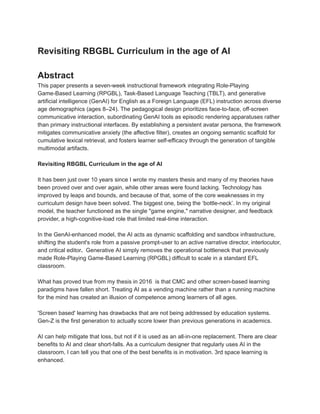
Revisiting RBGBL Curriculum in the age of AI
Abstract
This paper presents a seven-week instructional framework integrating Role-Playing
Game-Based Learning (RPGBL), Task-Based Language Teaching (TBLT), and generative
artificial intelligence (GenAI) for English as a Foreign Language (EFL) instruction across diverse
age demographics (ages 8–24). The pedagogical design prioritizes face-to-face, off-screen
communicative interaction, subordinating GenAI tools as episodic rendering apparatuses rather
than primary instructional interfaces. By establishing a persistent avatar persona, the framework
mitigates communicative anxiety (the affective filter), creates an ongoing semantic scaffold for
cumulative lexical retrieval, and fosters learner self-efficacy through the generation of tangible
multimodal artifacts.
Revisiting RBGBL Curriculum in the age of AI
It has been just over 10 years since I wrote my masters thesis and many of my theories have
been proved over and over again, while other areas were found lacking. Technology has
improved by leaps and bounds, and because of that, some of the core weaknesses in my
curriculum design have been solved. The biggest one, being the ‘bottle-neck’. In my original
model, the teacher functioned as the single "game engine," narrative designer, and feedback
provider, a high-cognitive-load role that limited real-time interaction.
In the GenAI-enhanced model, the AI acts as dynamic scaffolding and sandbox infrastructure,
shifting the student's role from a passive prompt-user to an active narrative director, interlocutor,
and critical editor. Generative AI simply removes the operational bottleneck that previously
made Role-Playing Game-Based Learning (RPGBL) difficult to scale in a standard EFL
classroom.
What has proved true from my thesis in 2016 is that CMC and other screen-based learning
paradigms have fallen short. Treating AI as a vending machine rather than a running machine
for the mind has created an illusion of competence among learners of all ages.
'Screen based' learning has drawbacks that are not being addressed by education systems.
Gen-Z is the first generation to actually score lower than previous generations in academics.
AI can help mitigate that loss, but not if it is used as an all-in-one replacement. There are clear
benefits to AI and clear short-falls. As a curriculum designer that regularly uses AI in the
classroom, I can tell you that one of the best benefits is in motivation. 3rd space learning is
enhanced.
Using it to remove the drudgery around learning...but if that is all, and there is no foundation
behind work output, it is baseless.If AI is used solely to generate work without an underlying
grasp of the material, the output is hollow. Lasting academic growth still depends entirely on
students building a strong conceptual foundation behind the tools they use.
My answer? Scaffolding, shifting rubrics and meta-cognitive training.
Scaffolding: Students created hypothesis, AI assisted research, manual corrections, in class
debates
Shifting grading rubrics: stop grading output, make grading the entire process and 'live
comprehension' have actual point value.
Meta-cognitive skill training: (the most important leg of the tripod)
Teach prompt literacy, source verification, and bias detection so students understand the
machinery behind the outputs rather than treating AI as an infalible hybrid of Thoth and Hermes.
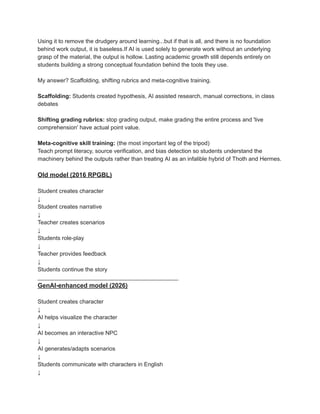
Old model (2016 RPGBL)
Student creates character
↓
Student creates narrative
↓
Teacher creates scenarios
↓
Students role-play
↓
Teacher provides feedback
↓
Students continue the story
____________________________________________
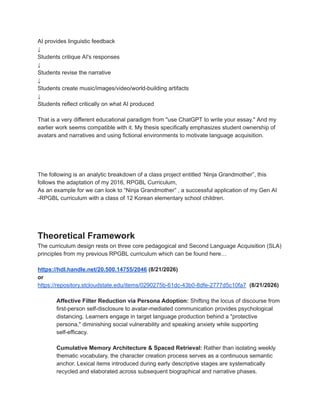
GenAI-enhanced model (2026)
Student creates character
↓
AI helps visualize the character
↓
AI becomes an interactive NPC
↓
AI generates/adapts scenarios
↓
Students communicate with characters in English
↓
AI provides linguistic feedback
↓
Students critique AI's responses
↓
Students revise the narrative
↓
Students create music/images/video/world-building artifacts
↓
Students reflect critically on what AI produced
That is a very different educational paradigm from "use ChatGPT to write your essay." And my
earlier work seems compatible with it. My thesis specifically emphasizes student ownership of
avatars and narratives and using fictional environments to motivate language acquisition.
The following is an analytic breakdown of a class project entitled ‘Ninja Grandmother”, this
follows the adaptation of my 2016, RPGBL Curriculum,
As an example for we can look to “Ninja Grandmother” , a successful application of my Gen AI
-RPGBL curriculum with a class of 12 Korean elementary school children.
Theoretical Framework
The curriculum design rests on three core pedagogical and Second Language Acquisition (SLA)
principles from my previous RPGBL curriculum which can be found here…
https://hdl.handle.net/20.500.14755/2046 (8/21/2026)
or
https://repository.stcloudstate.edu/items/0290275b-61dc-43b0-8dfe-2777d5c10fa7 (8/21/2026)
Affective Filter Reduction via Persona Adoption: Shifting the locus of discourse from
first-person self-disclosure to avatar-mediated communication provides psychological
distancing. Learners engage in target language production behind a "protective
persona," diminishing social vulnerability and speaking anxiety while supporting
self-efficacy.
Cumulative Memory Architecture & Spaced Retrieval: Rather than isolating weekly
thematic vocabulary, the character creation process serves as a continuous semantic
anchor. Lexical items introduced during early descriptive stages are systematically
recycled and elaborated across subsequent biographical and narrative phases.
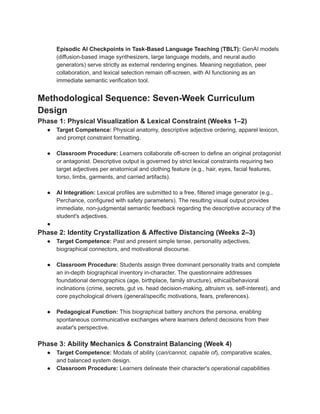
Episodic AI Checkpoints in Task-Based Language Teaching (TBLT): GenAI models
(diffusion-based image synthesizers, large language models, and neural audio
generators) serve strictly as external rendering engines. Meaning negotiation, peer
collaboration, and lexical selection remain off-screen, with AI functioning as an
immediate semantic verification tool.
Methodological Sequence: Seven-Week Curriculum
Design
Phase 1: Physical Visualization & Lexical Constraint (Weeks 1–2)
●​ Target Competence: Physical anatomy, descriptive adjective ordering, apparel lexicon,
and prompt constraint formatting.
●​ Classroom Procedure: Learners collaborate off-screen to define an original protagonist
or antagonist. Descriptive output is governed by strict lexical constraints requiring two
target adjectives per anatomical and clothing feature (e.g., hair, eyes, facial features,
torso, limbs, garments, and carried artifacts).
●​ AI Integration: Lexical profiles are submitted to a free, filtered image generator (e.g.,
Perchance, configured with safety parameters). The resulting visual output provides
immediate, non-judgmental semantic feedback regarding the descriptive accuracy of the
student's adjectives.
●​
Phase 2: Identity Crystallization & Affective Distancing (Weeks 2–3)
●​ Target Competence: Past and present simple tense, personality adjectives,
biographical connectors, and motivational discourse.
●​ Classroom Procedure: Students assign three dominant personality traits and complete
an in-depth biographical inventory in-character. The questionnaire addresses
foundational demographics (age, birthplace, family structure), ethical/behavioral
inclinations (crime, secrets, gut vs. head decision-making, altruism vs. self-interest), and
core psychological drivers (general/specific motivations, fears, preferences).
●​ Pedagogical Function: This biographical battery anchors the persona, enabling
spontaneous communicative exchanges where learners defend decisions from their
avatar's perspective.
Phase 3: Ability Mechanics & Constraint Balancing (Week 4)
●​ Target Competence: Modals of ability (can/cannot, capable of), comparative scales,
and balanced system design.
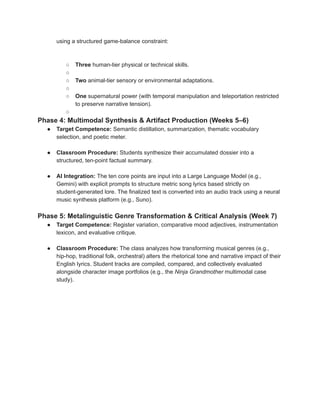
●​ Classroom Procedure: Learners delineate their character's operational capabilities
using a structured game-balance constraint:
​
○​ Three human-tier physical or technical skills.
○​
○​ Two animal-tier sensory or environmental adaptations.
○​
○​ One supernatural power (with temporal manipulation and teleportation restricted
to preserve narrative tension).
○​
Phase 4: Multimodal Synthesis & Artifact Production (Weeks 5–6)
●​ Target Competence: Semantic distillation, summarization, thematic vocabulary
selection, and poetic meter.
●​ Classroom Procedure: Students synthesize their accumulated dossier into a
structured, ten-point factual summary.
●​ AI Integration: The ten core points are input into a Large Language Model (e.g.,
Gemini) with explicit prompts to structure metric song lyrics based strictly on
student-generated lore. The finalized text is converted into an audio track using a neural
music synthesis platform (e.g., Suno).
Phase 5: Metalinguistic Genre Transformation & Critical Analysis (Week 7)
●​ Target Competence: Register variation, comparative mood adjectives, instrumentation
lexicon, and evaluative critique.
●​ Classroom Procedure: The class analyzes how transforming musical genres (e.g.,
hip-hop, traditional folk, orchestral) alters the rhetorical tone and narrative impact of their
English lyrics. Student tracks are compiled, compared, and collectively evaluated
alongside character image portfolios (e.g., the Ninja Grandmother multimodal case
study).
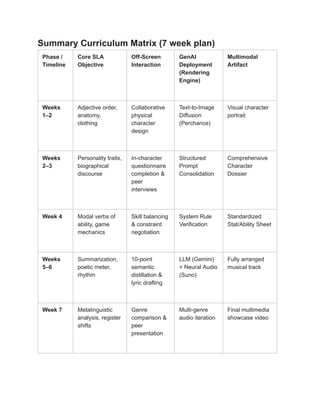
Summary Curriculum Matrix (7 week plan)
Phase /
Timeline
Core SLA
Objective
Off-Screen
Interaction
GenAI
Deployment
(Rendering
Engine)
Multimodal
Artifact
Weeks
1–2
Adjective order,
anatomy,
clothing
Collaborative
physical
character
design
Text-to-Image
Diffusion
(Perchance)
Visual character
portrait
Weeks
2–3
Personality traits,
biographical
discourse
In-character
questionnaire
completion &
peer
interviews
Structured
Prompt
Consolidation
Comprehensive
Character
Dossier
Week 4 Modal verbs of
ability, game
mechanics
Skill balancing
& constraint
negotiation
System Rule
Verification
Standardized
Stat/Ability Sheet
Weeks
5–6
Summarization,
poetic meter,
rhythm
10-point
semantic
distillation &
lyric drafting
LLM (Gemini)
+ Neural Audio
(Suno)
Fully arranged
musical track
Week 7 Metalinguistic
analysis, register
shifts
Genre
comparison &
peer
presentation
Multi-genre
audio iteration
Final multimedia
showcase video
Pedagogical Implications
This model demonstrates that generative AI can be integrated into language curricula without
converting classrooms into passive digital environments. By maintaining an off-screen
pedagogical core, learners retain agency over narrative conceptualization and critical
evaluation. The resulting multimodal artifacts provide tangible evidence of linguistic
competence, driving significant gains in learner self-efficacy and long-term communicative
retention.
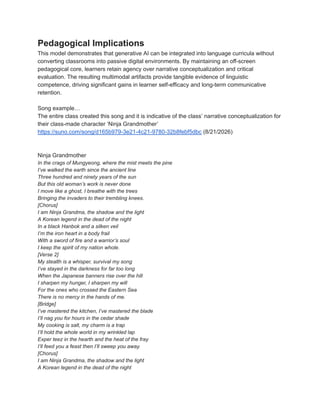
Song example…
The entire class created this song and it is indicative of the class’ narrative conceptualization for
their class-made character ‘Ninja Grandmother’
https://suno.com/song/d165b979-3e21-4c21-9780-32b8febf5dbc (8/21/2026)
Ninja Grandmother
In the crags of Mungyeong, where the mist meets the pine
I’ve walked the earth since the ancient line
Three hundred and ninety years of the sun
But this old woman’s work is never done
I move like a ghost, I breathe with the trees
Bringing the invaders to their trembling knees.
[Chorus]
I am Ninja Grandma, the shadow and the light
A Korean legend in the dead of the night
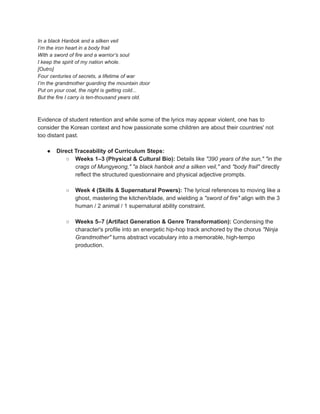
In a black Hanbok and a silken veil
I’m the iron heart in a body frail
With a sword of fire and a warrior’s soul
I keep the spirit of my nation whole.
[Verse 2]
My stealth is a whisper, survival my song
I’ve stayed in the darkness for far too long
When the Japanese banners rise over the hill
I sharpen my hunger, I sharpen my will
For the ones who crossed the Eastern Sea
There is no mercy in the hands of me.
[Bridge]
I’ve mastered the kitchen, I’ve mastered the blade
I’ll nag you for hours in the cedar shade
My cooking is salt, my charm is a trap
I’ll hold the whole world in my wrinkled lap
Exper teez in the hearth and the heat of the fray
I’ll feed you a feast then I’ll sweep you away.
[Chorus]
I am Ninja Grandma, the shadow and the light
A Korean legend in the dead of the night
In a black Hanbok and a silken veil
I’m the iron heart in a body frail
With a sword of fire and a warrior’s soul
I keep the spirit of my nation whole.
[Outro]
Four centuries of secrets, a lifetime of war
I’m the grandmother guarding the mountain door
Put on your coat, the night is getting cold...
But the fire I carry is ten-thousand years old.
Evidence of student retention and while some of the lyrics may appear violent, one has to
consider the Korean context and how passionate some children are about their countries' not
too distant past.
●​ Direct Traceability of Curriculum Steps:
○​ Weeks 1–3 (Physical & Cultural Bio): Details like "390 years of the sun," "in the
crags of Mungyeong," "a black hanbok and a silken veil," and "body frail" directly
reflect the structured questionnaire and physical adjective prompts.
○​ Week 4 (Skills & Supernatural Powers): The lyrical references to moving like a
ghost, mastering the kitchen/blade, and wielding a "sword of fire" align with the 3
human / 2 animal / 1 supernatural ability constraint.
○​ Weeks 5–7 (Artifact Generation & Genre Transformation): Condensing the
character's profile into an energetic hip-hop track anchored by the chorus "Ninja
Grandmother" turns abstract vocabulary into a memorable, high-tempo
production.
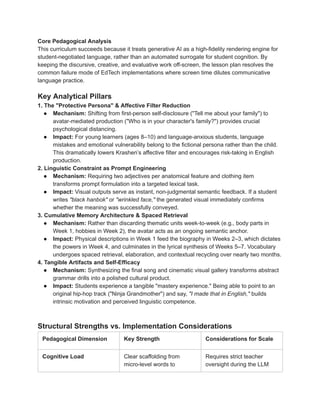
Core Pedagogical Analysis
This curriculum succeeds because it treats generative AI as a high-fidelity rendering engine for
student-negotiated language, rather than an automated surrogate for student cognition. By
keeping the discursive, creative, and evaluative work off-screen, the lesson plan resolves the
common failure mode of EdTech implementations where screen time dilutes communicative
language practice.
Key Analytical Pillars
1. The "Protective Persona" & Affective Filter Reduction
●​ Mechanism: Shifting from first-person self-disclosure ("Tell me about your family") to
avatar-mediated production ("Who is in your character's family?") provides crucial
psychological distancing.
●​ Impact: For young learners (ages 8–10) and language-anxious students, language
mistakes and emotional vulnerability belong to the fictional persona rather than the child.
This dramatically lowers Krashen’s affective filter and encourages risk-taking in English
production.
2. Linguistic Constraint as Prompt Engineering
●​ Mechanism: Requiring two adjectives per anatomical feature and clothing item
transforms prompt formulation into a targeted lexical task.
●​ Impact: Visual outputs serve as instant, non-judgmental semantic feedback. If a student
writes "black hanbok" or "wrinkled face," the generated visual immediately confirms
whether the meaning was successfully conveyed.
3. Cumulative Memory Architecture & Spaced Retrieval
●​ Mechanism: Rather than discarding thematic units week-to-week (e.g., body parts in
Week 1, hobbies in Week 2), the avatar acts as an ongoing semantic anchor.
●​ Impact: Physical descriptions in Week 1 feed the biography in Weeks 2–3, which dictates
the powers in Week 4, and culminates in the lyrical synthesis of Weeks 5–7. Vocabulary
undergoes spaced retrieval, elaboration, and contextual recycling over nearly two months.
4. Tangible Artifacts and Self-Efficacy
●​ Mechanism: Synthesizing the final song and cinematic visual gallery transforms abstract
grammar drills into a polished cultural product.
●​ Impact: Students experience a tangible "mastery experience." Being able to point to an
original hip-hop track ("Ninja Grandmother") and say, "I made that in English," builds
intrinsic motivation and perceived linguistic competence.
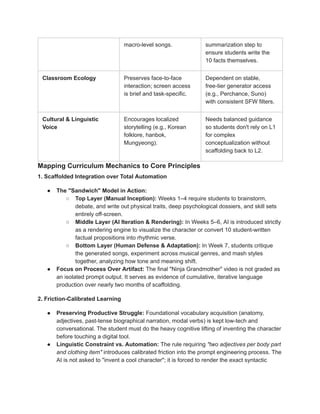
Structural Strengths vs. Implementation Considerations
Pedagogical Dimension Key Strength Considerations for Scale
Cognitive Load Clear scaffolding from
micro-level words to
Requires strict teacher
oversight during the LLM
macro-level songs. summarization step to
ensure students write the
10 facts themselves.
Classroom Ecology Preserves face-to-face
interaction; screen access
is brief and task-specific.
Dependent on stable,
free-tier generator access
(e.g., Perchance, Suno)
with consistent SFW filters.
Cultural & Linguistic
Voice
Encourages localized
storytelling (e.g., Korean
folklore, hanbok,
Mungyeong).
Needs balanced guidance
so students don't rely on L1
for complex
conceptualization without
scaffolding back to L2.
Mapping Curriculum Mechanics to Core Principles
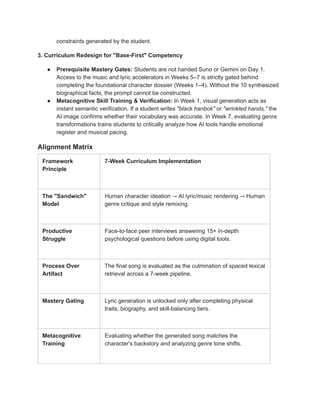
1. Scaffolded Integration over Total Automation
●​ The "Sandwich" Model in Action:
○​ Top Layer (Manual Inception): Weeks 1–4 require students to brainstorm,
debate, and write out physical traits, deep psychological dossiers, and skill sets
entirely off-screen.
○​ Middle Layer (AI Iteration & Rendering): In Weeks 5–6, AI is introduced strictly
as a rendering engine to visualize the character or convert 10 student-written
factual propositions into rhythmic verse.
○​ Bottom Layer (Human Defense & Adaptation): In Week 7, students critique
the generated songs, experiment across musical genres, and mash styles
together, analyzing how tone and meaning shift.
●​ Focus on Process Over Artifact: The final "Ninja Grandmother" video is not graded as
an isolated prompt output. It serves as evidence of cumulative, iterative language
production over nearly two months of scaffolding.
2. Friction-Calibrated Learning
●​ Preserving Productive Struggle: Foundational vocabulary acquisition (anatomy,
adjectives, past-tense biographical narration, modal verbs) is kept low-tech and
conversational. The student must do the heavy cognitive lifting of inventing the character
before touching a digital tool.
●​ Linguistic Constraint vs. Automation: The rule requiring "two adjectives per body part
and clothing item" introduces calibrated friction into the prompt engineering process. The
AI is not asked to "invent a cool character"; it is forced to render the exact syntactic
constraints generated by the student.
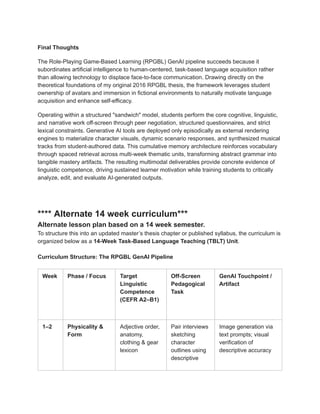
3. Curriculum Redesign for "Base-First" Competency
●​ Prerequisite Mastery Gates: Students are not handed Suno or Gemini on Day 1.
Access to the music and lyric accelerators in Weeks 5–7 is strictly gated behind
completing the foundational character dossier (Weeks 1–4). Without the 10 synthesized
biographical facts, the prompt cannot be constructed.
●​ Metacognitive Skill Training & Verification: In Week 1, visual generation acts as
instant semantic verification. If a student writes "black hanbok" or "wrinkled hands," the
AI image confirms whether their vocabulary was accurate. In Week 7, evaluating genre
transformations trains students to critically analyze how AI tools handle emotional
register and musical pacing.
Alignment Matrix
Framework
Principle
7-Week Curriculum Implementation
The "Sandwich"
Model
Human character ideation AI lyric/music rendering Human
→ →
genre critique and style remixing.
Productive
Struggle
Face-to-face peer interviews answering 15+ in-depth
psychological questions before using digital tools.
Process Over
Artifact
The final song is evaluated as the culmination of spaced lexical
retrieval across a 7-week pipeline.
Mastery Gating Lyric generation is unlocked only after completing physical
traits, biography, and skill-balancing tiers.
Metacognitive
Training
Evaluating whether the generated song matches the
character's backstory and analyzing genre tone shifts.
Final Thoughts
The Role-Playing Game-Based Learning (RPGBL) GenAI pipeline succeeds because it
subordinates artificial intelligence to human-centered, task-based language acquisition rather
than allowing technology to displace face-to-face communication. Drawing directly on the
theoretical foundations of my original 2016 RPGBL thesis, the framework leverages student
ownership of avatars and immersion in fictional environments to naturally motivate language
acquisition and enhance self-efficacy.
Operating within a structured "sandwich" model, students perform the core cognitive, linguistic,
and narrative work off-screen through peer negotiation, structured questionnaires, and strict
lexical constraints. Generative AI tools are deployed only episodically as external rendering
engines to materialize character visuals, dynamic scenario responses, and synthesized musical
tracks from student-authored data. This cumulative memory architecture reinforces vocabulary
through spaced retrieval across multi-week thematic units, transforming abstract grammar into
tangible mastery artifacts. The resulting multimodal deliverables provide concrete evidence of
linguistic competence, driving sustained learner motivation while training students to critically
analyze, edit, and evaluate AI-generated outputs.
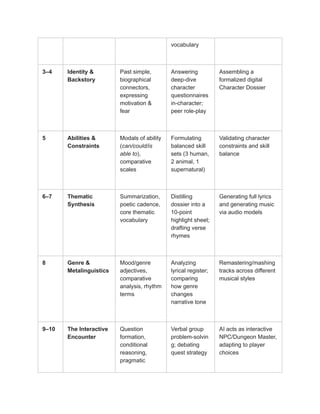
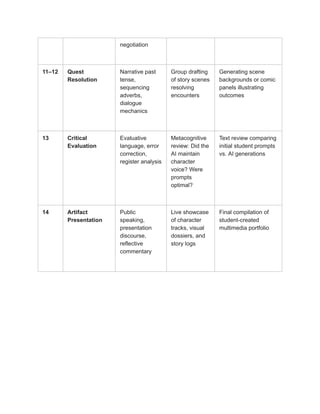
**** Alternate 14 week curriculum***
Alternate lesson plan based on a 14 week semester.
To structure this into an updated master’s thesis chapter or published syllabus, the curriculum is
organized below as a 14-Week Task-Based Language Teaching (TBLT) Unit.
Curriculum Structure: The RPGBL GenAI Pipeline
Week Phase / Focus Target
Linguistic
Competence
(CEFR A2–B1)
Off-Screen
Pedagogical
Task
GenAI Touchpoint /
Artifact
1–2 Physicality &
Form
Adjective order,
anatomy,
clothing & gear
lexicon
Pair interviews
sketching
character
outlines using
descriptive
Image generation via
text prompts; visual
verification of
descriptive accuracy
vocabulary
3–4 Identity &
Backstory
Past simple,
biographical
connectors,
expressing
motivation &
fear
Answering
deep-dive
character
questionnaires
in-character;
peer role-play
Assembling a
formalized digital
Character Dossier
5 Abilities &
Constraints
Modals of ability
(can/could/is
able to),
comparative
scales
Formulating
balanced skill
sets (3 human,
2 animal, 1
supernatural)
Validating character
constraints and skill
balance
6–7 Thematic
Synthesis
Summarization,
poetic cadence,
core thematic
vocabulary
Distilling
dossier into a
10-point
highlight sheet;
drafting verse
rhymes
Generating full lyrics
and generating music
via audio models
8 Genre &
Metalinguistics
Mood/genre
adjectives,
comparative
analysis, rhythm
terms
Analyzing
lyrical register;
comparing
how genre
changes
narrative tone
Remastering/mashing
tracks across different
musical styles
9–10 The Interactive
Encounter
Question
formation,
conditional
reasoning,
pragmatic
Verbal group
problem-solvin
g; debating
quest strategy
AI acts as interactive
NPC/Dungeon Master,
adapting to player
choices
negotiation
11–12 Quest
Resolution
Narrative past
tense,
sequencing
adverbs,
dialogue
mechanics
Group drafting
of story scenes
resolving
encounters
Generating scene
backgrounds or comic
panels illustrating
outcomes
13 Critical
Evaluation
Evaluative
language, error
correction,
register analysis
Metacognitive
review: Did the
AI maintain
character
voice? Were
prompts
optimal?
Text review comparing
initial student prompts
vs. AI generations
14 Artifact
Presentation
Public
speaking,
presentation
discourse,
reflective
commentary
Live showcase
of character
tracks, visual
dossiers, and
story logs
Final compilation of
student-created
multimedia portfolio