GAIT ANALYSIS
Dr. Md. Mamunul Abedin
MBBS, BCS (Health)
FCPS trainee
Assistant Registrar
Dept of Physical Medicine & Rehabilitation
Shaheed Suhrawardy Medical College Hospital, Dhaka
“Many people will walk in and out of
your life,
but only true friends will leave
footprints in your heart”
Dr M M Abedin
Normal Gait :: Definitions
Series of rhythmical, alternating movements of the
trunk & limbs which result in the forward
progression of the center of gravity (CoG).
3
Dr M M Abedin
Normal Gait :: Terminology
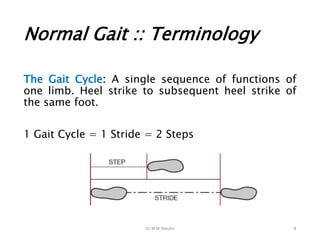
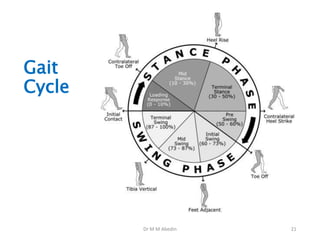
The Gait Cycle: A single sequence of functions of
one limb. Heel strike to subsequent heel strike of
the same foot.
1 Gait Cycle = 1 Stride = 2 Steps
4
Dr M M Abedin
Normal Gait :: Terminology
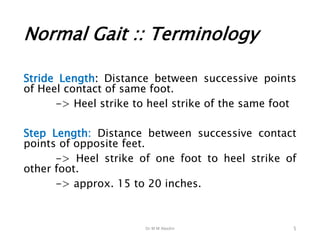
Stride Length: Distance between successive points
of Heel contact of same foot.
-> Heel strike to heel strike of the same foot
Step Length: Distance between successive contact
points of opposite feet.
-> Heel strike of one foot to heel strike of
other foot.
-> approx. 15 to 20 inches.
5
Dr M M Abedin
Normal Gait :: Terminology
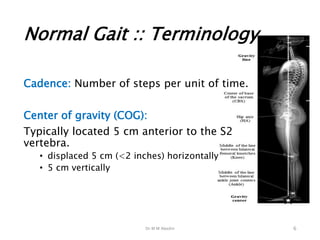
Cadence: Number of steps per unit of time.
Center of gravity (COG):
Typically located 5 cm anterior to the S2
vertebra.
• displaced 5 cm (<2 inches) horizontally
• 5 cm vertically
6
Dr M M Abedin
Normal Gait :: Terminology
Two Phases:
1. Stance Phase: limb is in contact with the ground.
- 5 subdivisions
- 60%
2. Swing Phase: foot is in the air for limb
advancement.
- 3 subdivisions
-40%
7
Dr M M Abedin
Normal Gait :: Terminology
Two Supports:
1. Double-limb Support: Both limbs are in contact
with the ground.
- 20% of gait cycle
2. Single-limb Support: foot is in the air for limb
advancement.
-80% of gait cycle
8
Dr M M Abedin
Normal Gait :: Terminology
Base of support: The space outlined by the feet and
any assistive device in contact with the ground.
-Falling is avoided if the COG remains positioned
over the base of support.
-Normal base of support (distance between heels) =
6 to 10 cm
9
Dr M M Abedin
STANCE PHASE: Five Subdivisions
1. Initial contact (IC): Instant the foot contacts the
ground.
2. Loading response: Initial contact to contralateral
toe off.
3. Midstance: Contralateral toe off to ipsilateral heel
off. It has the highest COG.
10
Dr M M Abedin
STANCE PHASE: Five Subdivisions
4. Terminal stance: Ipsilateral heel off to initial
contact of the contralateral extremity.
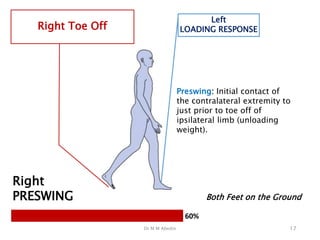
5. Preswing: Initial contact of the contralateral
extremity to just prior to toe off of ipsilateral limb
(unloading weight).
11
Dr M M Abedin
SWING PHASE: Three Subdivisions
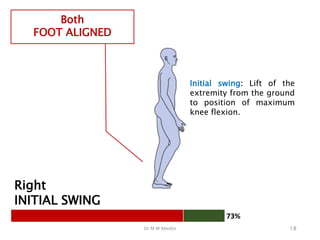
1. Initial swing: Lift of the extremity from the ground
to position of maximum knee flexion.
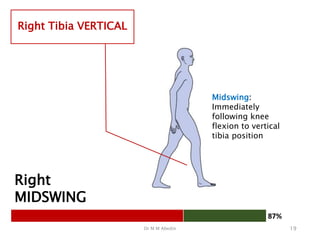
2. Midswing: Immediately following knee flexion to
vertical tibia position.
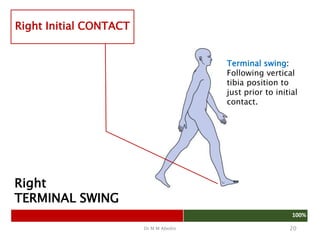
3. Terminal swing: Following vertical tibia position to
just prior to initial contact.
12
Dr M M Abedin
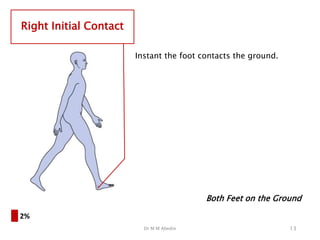
Right Initial Contact
13
Both Feet on the Ground
2%
Instant the foot contacts the ground.
Dr M M Abedin 14
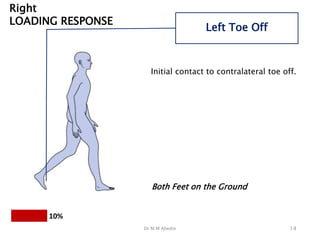
Left Toe Off
Right
LOADING RESPONSE
Both Feet on the Ground
10%
Initial contact to contralateral toe off.
Dr M M Abedin 15
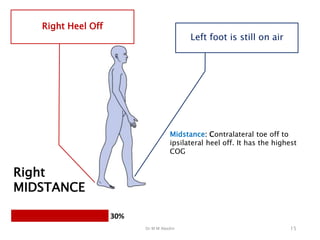
Left foot is still on air
Right
MIDSTANCE
Right Heel Off
30%
Midstance: Contralateral toe off to
ipsilateral heel off. It has the highest
COG
Dr M M Abedin 16
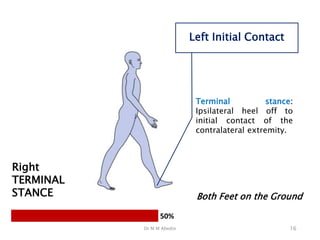
Right
TERMINAL
STANCE Both Feet on the Ground
Left Initial Contact
50%
Terminal stance:
Ipsilateral heel off to
initial contact of the
contralateral extremity.
Dr M M Abedin 17
Right
PRESWING Both Feet on the Ground
Right Toe Off
60%
Preswing: Initial contact of
the contralateral extremity to
just prior to toe off of
ipsilateral limb (unloading
weight).
Left
LOADING RESPONSE
Dr M M Abedin 18
Right
INITIAL SWING
Both
FOOT ALIGNED
73%
Initial swing: Lift of the
extremity from the ground
to position of maximum
knee flexion.
Dr M M Abedin 19
Right
MIDSWING
Right Tibia VERTICAL
87%
Midswing:
Immediately
following knee
flexion to vertical
tibia position
Dr M M Abedin 20
Right
TERMINAL SWING
100%
Right Initial CONTACT
Terminal swing:
Following vertical
tibia position to
just prior to initial
contact.
Dr M M Abedin
Gait
Cycle
21
Dr M M Abedin
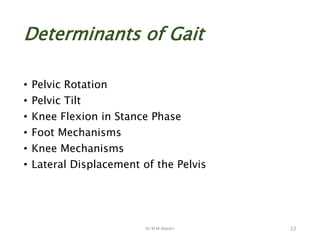
Determinants of Gait
• Pelvic Rotation
• Pelvic Tilt
• Knee Flexion in Stance Phase
• Foot Mechanisms
• Knee Mechanisms
• Lateral Displacement of the Pelvis
22
Dr M M Abedin
Determinants of Gait
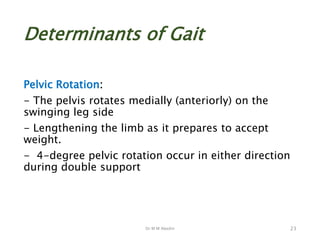
Pelvic Rotation:
- The pelvis rotates medially (anteriorly) on the
swinging leg side
- Lengthening the limb as it prepares to accept
weight.
- 4-degree pelvic rotation occur in either direction
during double support
23
Dr M M Abedin
Determinants of Gait
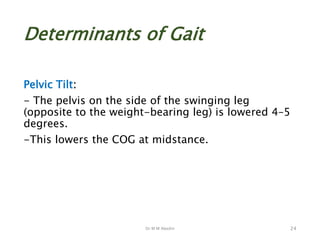
Pelvic Tilt:
- The pelvis on the side of the swinging leg
(opposite to the weight-bearing leg) is lowered 4–5
degrees.
-This lowers the COG at midstance.
24
Dr M M Abedin
Determinants of Gait
Knee Flexion in Stance:
- Early knee flexion → knee flexion at foot strike
(15˚ ).
- Reduces the vertical elevation of the body at
midstance by shortening the hip-to-ankle distance.
- This lowers the COG , decreasing the energy
expenditure.
- Also absorb the shock of impact at heel strike.
25
Dr M M Abedin
Determinants of Gait
Foot Mechanisms:
- At heel strike, ankle plantar flexion smoothens the
curve of the falling pelvis.
- Associated with controlled plantar flexion during
the first part of the stance.
- Three pivot points (rockers) at the heel, ankle, and
forefoot help to functionally lengthen the stance
limb at initial contact and preswing, and shorten the
limb at midstance..
26
Dr M M Abedin
Determinants of Gait
Knee Mechanisms:
- After midstance,
- the knee extends
- the ankle plantar flexes and
- the foot supinates
- to restore the length to the leg and diminish the
fall of the pelvis at the opposite heel strike.
27
Dr M M Abedin
Determinants of Gait
Lateral displacement of the pelvis:
- There is displacement toward the stance limb.
- The net COG of the body must lie above the base
of support (the stance foot).
28
Dr M M Abedin
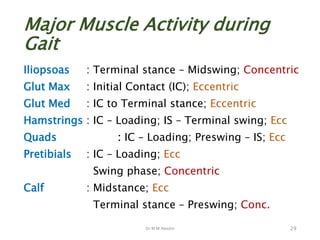
Major Muscle Activity during
Gait
Iliopsoas : Terminal stance – Midswing; Concentric
Glut Max : Initial Contact (IC); Eccentric
Glut Med : IC to Terminal stance; Eccentric
Hamstrings : IC – Loading; IS – Terminal swing; Ecc
Quads : IC – Loading; Preswing – IS; Ecc
Pretibials : IC – Loading; Ecc
Swing phase; Concentric
Calf : Midstance; Ecc
Terminal stance – Preswing; Conc.
29
Dr M M Abedin
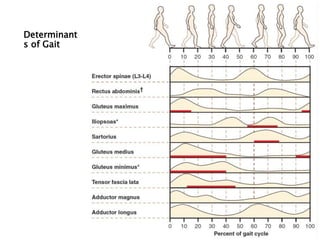
Determinant
s of Gait
30
Dr M M Abedin
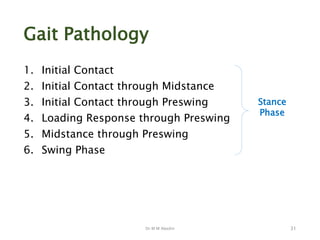
Gait Pathology
1. Initial Contact
2. Initial Contact through Midstance
3. Initial Contact through Preswing
4. Loading Response through Preswing
5. Midstance through Preswing
6. Swing Phase
31
Stance
Phase
Dr M M Abedin
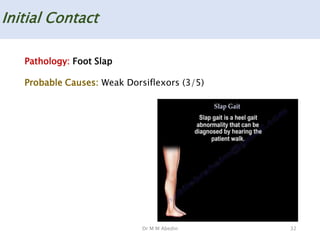
Initial Contact
32
Pathology: Foot Slap
Probable Causes: Weak Dorsiflexors (3/5)
Dr M M Abedin
Pathology
• Genu Recurvatum
• Excessive Foot Supination
• Excessive Trunk Extension
• Excessive Trunk Flexion
33
Initial Contact through Midstance
Dr M M Abedin 34
Initial Contact through Midstance (contd.)
Pathology: Genu Recurvatum
Probable Causes:
• Weak, short, or spastic
quadriceps
• Compensated hamstring
weakness
• Achilles tendon contracture
• Plantar flexor spasticity
Dr M M Abedin 35
Initial Contact through Midstance (contd.)
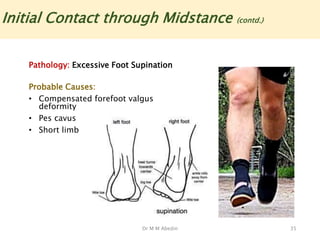
Pathology: Excessive Foot Supination
Probable Causes:
• Compensated forefoot valgus
deformity
• Pes cavus
• Short limb
Dr M M Abedin 36
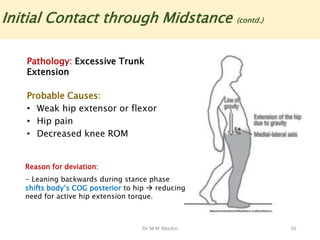
Reason for deviation:
- Leaning backwards during stance phase
shifts body’s COG posterior to hip  reducing
need for active hip extension torque.
Initial Contact through Midstance (contd.)
Pathology: Excessive Trunk
Extension
Probable Causes:
• Weak hip extensor or flexor
• Hip pain
• Decreased knee ROM
Dr M M Abedin 37
Initial Contact through Midstance (contd.)
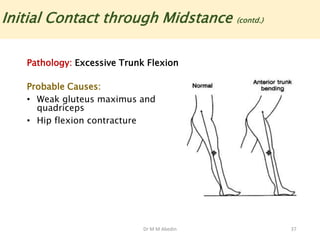
Pathology: Excessive Trunk Flexion
Probable Causes:
• Weak gluteus maximus and
quadriceps
• Hip flexion contracture
Dr M M Abedin
Pathology
• Excessive knee flexion
• Excessive medial femur
rotation
• Excessive lateral femur
rotation
• Wide base of support
• Narrow base of support
38
Initial Contact through Preswing
Dr M M Abedin 39
Initial Contact through Preswing (contd.)
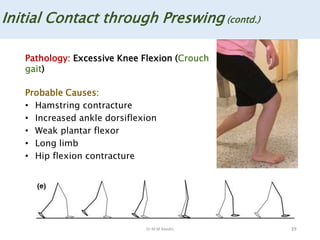
Pathology: Excessive Knee Flexion (Crouch
gait)
Probable Causes:
• Hamstring contracture
• Increased ankle dorsiflexion
• Weak plantar flexor
• Long limb
• Hip flexion contracture
Dr M M Abedin 40
Initial Contact through Preswing (contd.)
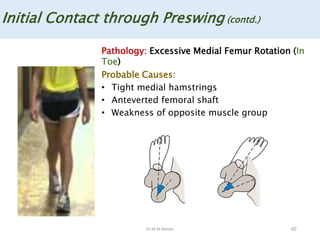
Pathology: Excessive Medial Femur Rotation (In
Toe)
Probable Causes:
• Tight medial hamstrings
• Anteverted femoral shaft
• Weakness of opposite muscle group
Dr M M Abedin 41
Initial Contact through Preswing (contd.)
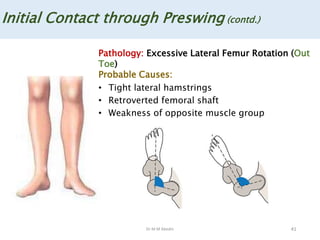
Pathology: Excessive Lateral Femur Rotation (Out
Toe)
Probable Causes:
• Tight lateral hamstrings
• Retroverted femoral shaft
• Weakness of opposite muscle group
Dr M M Abedin 42
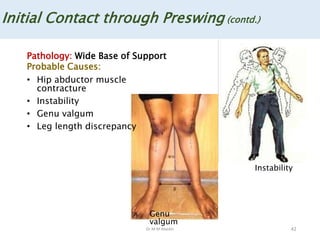
Initial Contact through Preswing (contd.)
Pathology: Wide Base of Support
Probable Causes:
• Hip abductor muscle
contracture
• Instability
• Genu valgum
• Leg length discrepancy
Instability
Genu
valgum
Dr M M Abedin 43
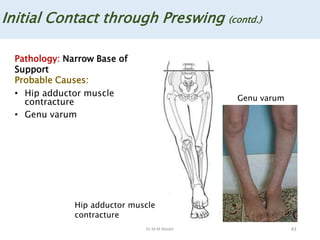
Initial Contact through Preswing (contd.)
Pathology: Narrow Base of
Support
Probable Causes:
• Hip adductor muscle
contracture
• Genu varum
Genu varum
Hip adductor muscle
contracture
Dr M M Abedin
Pathology
• Excessive trunk lateral flexion
(compensated Trendelenburg gait)
• Pelvic drop
(uncompensated Trendelenburg gait)
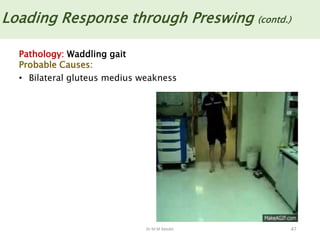
• Waddling gait
44
Loading Response through Preswing
Dr M M Abedin 45
Loading Response through Preswing (contd.)
Pathology: Excessive Trunk Lateral
Flexion (compensated Trendelenburg
gait)
Probable Causes:
• Ipsilateral gluteus medius weakness
• Hip pain
• Hip dislocation, Coxa vara
• Relatively Shorter Limb
Dr M M Abedin 46
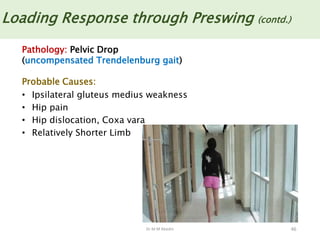
Loading Response through Preswing (contd.)
Pathology: Pelvic Drop
(uncompensated Trendelenburg gait)
Probable Causes:
• Ipsilateral gluteus medius weakness
• Hip pain
• Hip dislocation, Coxa vara
• Relatively Shorter Limb
Dr M M Abedin 47
Loading Response through Preswing (contd.)
Pathology: Waddling gait
Probable Causes:
• Bilateral gluteus medius weakness
Dr M M Abedin
Pathology
• Excessive foot pronation
• Bouncing or exaggerated
• Insufficient push-off
• Inadequate hip extension
48
Midstance through Preswing
Dr M M Abedin 49
Midstance through Preswing (contd.)
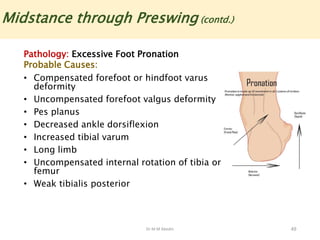
Pathology: Excessive Foot Pronation
Probable Causes:
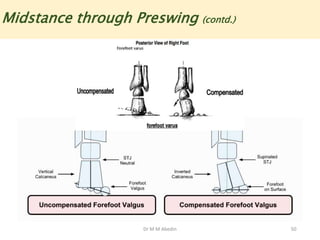
• Compensated forefoot or hindfoot varus
deformity
• Uncompensated forefoot valgus deformity
• Pes planus
• Decreased ankle dorsiflexion
• Increased tibial varum
• Long limb
• Uncompensated internal rotation of tibia or
femur
• Weak tibialis posterior
Dr M M Abedin 50
Midstance through Preswing (contd.)
Dr M M Abedin 51
Midstance through Preswing (contd.)
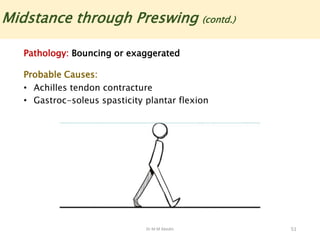
Pathology: Bouncing or exaggerated
Probable Causes:
• Achilles tendon contracture
• Gastroc-soleus spasticity plantar flexion
Dr M M Abedin 52
Midstance through Preswing (contd.)
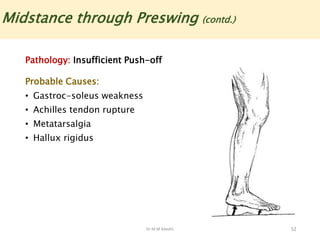
Pathology: Insufficient Push-off
Probable Causes:
• Gastroc-soleus weakness
• Achilles tendon rupture
• Metatarsalgia
• Hallux rigidus
Dr M M Abedin 53
Midstance through Preswing (contd.)
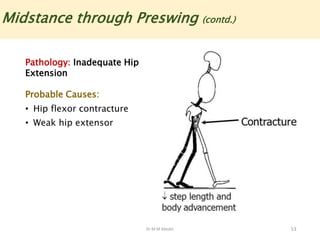
Pathology: Inadequate Hip
Extension
Probable Causes:
• Hip flexor contracture
• Weak hip extensor
Dr M M Abedin
Pathology
• Steppage gait/ Foot drop
• Circumduction
• Hip hiking
54
Swing Phase
Dr M M Abedin 55
Swing Phase (contd.)
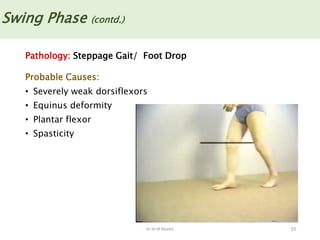
Pathology: Steppage Gait/ Foot Drop
Probable Causes:
• Severely weak dorsiflexors
• Equinus deformity
• Plantar flexor
• Spasticity
Dr M M Abedin 56
Swing Phase (contd.)
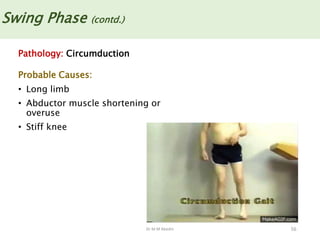
Pathology: Circumduction
Probable Causes:
• Long limb
• Abductor muscle shortening or
overuse
• Stiff knee
Dr M M Abedin 57
Swing Phase (contd.)
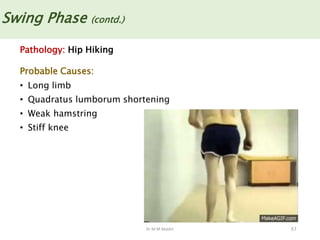
Pathology: Hip Hiking
Probable Causes:
• Long limb
• Quadratus lumborum shortening
• Weak hamstring
• Stiff knee
Thank You
58