Mr. V. Dharshan
Assistant Professor
SCHOOL OF PHARMACY
(Approved by PCI, New Delhi)
SBV Chennai Campus
Module 1: Fundamentals of Smart Drug Delivery
Systems
SMART DRUG DELIVERY SYSTEMS:
PRINCIPLES, TECHNOLOGIES, AND CLINICAL
APPLICATIONS
• Explain the concept and importance of drug delivery
systems.
• Differentiate conventional and smart drug delivery systems.
• Understand major drug release mechanisms.
• Describe controlled, sustained, and targeted drug delivery.
• Discuss factors affecting drug delivery performance.
• Outline clinical applications, advantages, and limitations.
Learning Objective
Introduction to Drug Delivery
Definition
• Drug delivery is the science and technology of administering a
pharmaceutical agent in a manner that achieves the desired
therapeutic response while minimizing adverse effects.
Functions
• Transport the drug safely to the site of action.
• Maintain therapeutic drug concentration for the required
duration.
• Improve bioavailability and patient compliance.
• Reduce systemic toxicity and unnecessary drug exposure.
Challenges associated with conventional drugs:
• Poor aqueous solubility and dissolution.
• Instability in the gastrointestinal environment.
• Extensive first-pass metabolism.
• Short biological half-life requiring frequent dosing.
• Poor permeability across biological barriers.
• Significant systemic adverse effects.
Advanced drug delivery systems overcome these
limitations by improving efficacy, safety, and patient
adherence.
Why Are Drug Delivery Systems Needed
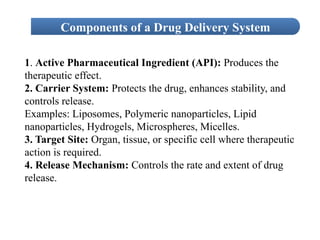
1. Active Pharmaceutical Ingredient (API): Produces the
therapeutic effect.
2. Carrier System: Protects the drug, enhances stability, and
controls release.
Examples: Liposomes, Polymeric nanoparticles, Lipid
nanoparticles, Hydrogels, Microspheres, Micelles.
3. Target Site: Organ, tissue, or specific cell where therapeutic
action is required.
4. Release Mechanism: Controls the rate and extent of drug
release.
Components of a Drug Delivery System
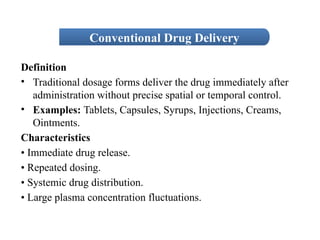
Definition
• Traditional dosage forms deliver the drug immediately after
administration without precise spatial or temporal control.
• Examples: Tablets, Capsules, Syrups, Injections, Creams,
Ointments.
Characteristics
• Immediate drug release.
• Repeated dosing.
• Systemic drug distribution.
• Large plasma concentration fluctuations.
Conventional Drug Delivery
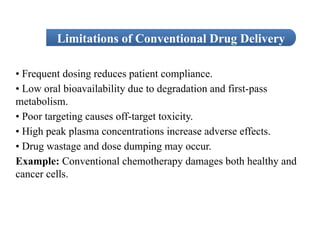
• Frequent dosing reduces patient compliance.
• Low oral bioavailability due to degradation and first-pass
metabolism.
• Poor targeting causes off-target toxicity.
• High peak plasma concentrations increase adverse effects.
• Drug wastage and dose dumping may occur.
Example: Conventional chemotherapy damages both healthy and
cancer cells.
Limitations of Conventional Drug Delivery
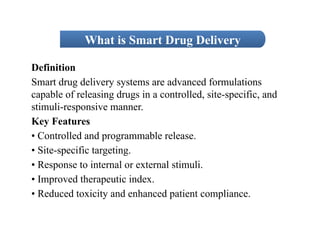
Definition
Smart drug delivery systems are advanced formulations
capable of releasing drugs in a controlled, site-specific, and
stimuli-responsive manner.
Key Features
• Controlled and programmable release.
• Site-specific targeting.
• Response to internal or external stimuli.
• Improved therapeutic index.
• Reduced toxicity and enhanced patient compliance.
What is Smart Drug Delivery
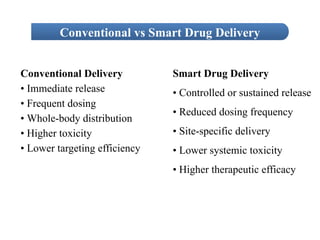
Conventional Delivery
• Immediate release
• Frequent dosing
• Whole-body distribution
• Higher toxicity
• Lower targeting efficiency
Conventional vs Smart Drug Delivery
Smart Drug Delivery
• Controlled or sustained release
• Reduced dosing frequency
• Site-specific delivery
• Lower systemic toxicity
• Higher therapeutic efficacy
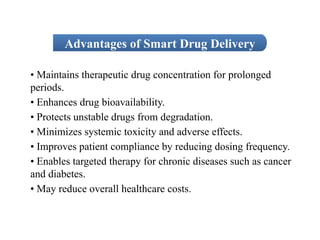
• Maintains therapeutic drug concentration for prolonged
periods.
• Enhances drug bioavailability.
• Protects unstable drugs from degradation.
• Minimizes systemic toxicity and adverse effects.
• Improves patient compliance by reducing dosing frequency.
• Enables targeted therapy for chronic diseases such as cancer
and diabetes.
• May reduce overall healthcare costs.
Advantages of Smart Drug Delivery
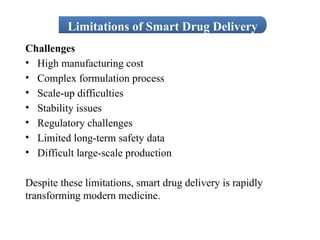
Challenges
• High manufacturing cost
• Complex formulation process
• Scale-up difficulties
• Stability issues
• Regulatory challenges
• Limited long-term safety data
• Difficult large-scale production
Despite these limitations, smart drug delivery is rapidly
transforming modern medicine.
Limitations of Smart Drug Delivery
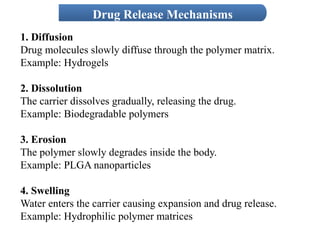
Drug Release Mechanisms
1. Diffusion
Drug molecules slowly diffuse through the polymer matrix.
Example: Hydrogels
2. Dissolution
The carrier dissolves gradually, releasing the drug.
Example: Biodegradable polymers
3. Erosion
The polymer slowly degrades inside the body.
Example: PLGA nanoparticles
4. Swelling
Water enters the carrier causing expansion and drug release.
Example: Hydrophilic polymer matrices
5. Stimuli-Responsive Release
Drug release occurs in response to specific triggers.
Examples:
 pH
 Temperature
 Enzymes
 Magnetic field
 Light
 Ultrasound
Definition
Controlled drug delivery releases the drug at a predetermined
rate over a prolonged period.
Benefits
•Maintains therapeutic concentration
•Reduces fluctuations
•Improves efficacy
•Minimizes toxicity
Examples
•Osmotic tablets
•Polymer implants
•Injectable depots
Controlled Drug Delivery
Definition
Sustained release systems extend drug release for several hours
to reduce dosing frequency.
Characteristics
Slow release
Longer therapeutic effect
Improved patient adherence
Examples
Sustained-release tablets
Matrix tablets
Extended-release capsules
Sustained Drug Delivery
Definition
Targeted drug delivery directs the drug specifically to diseased
tissues while minimizing exposure to healthy tissues.
Types
Passive targeting
Enhanced permeability and retention (EPR) effect
Active targeting
Ligand-antibody mediated targeting
Physical targeting
Magnetic targeting
Ultrasound-triggered delivery
Applications
Cancer
Brain disorders
Inflammatory diseases
Gene therapy
Targeted Drug Delivery
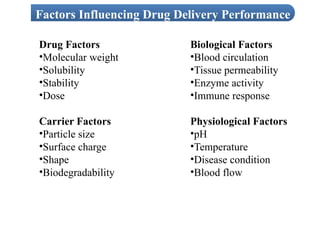
Factors Influencing Drug Delivery Performance
Drug Factors
•Molecular weight
•Solubility
•Stability
•Dose
Carrier Factors
•Particle size
•Surface charge
•Shape
•Biodegradability
Biological Factors
•Blood circulation
•Tissue permeability
•Enzyme activity
•Immune response
Physiological Factors
•pH
•Temperature
•Disease condition
•Blood flow
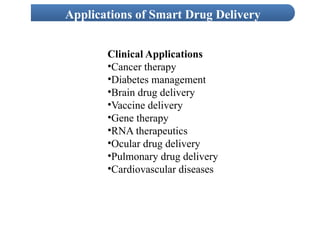
Applications of Smart Drug Delivery
Clinical Applications
•Cancer therapy
•Diabetes management
•Brain drug delivery
•Vaccine delivery
•Gene therapy
•RNA therapeutics
•Ocular drug delivery
•Pulmonary drug delivery
•Cardiovascular diseases
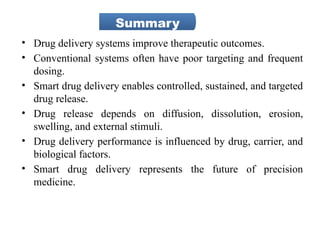
• Drug delivery systems improve therapeutic outcomes.
• Conventional systems often have poor targeting and frequent
dosing.
• Smart drug delivery enables controlled, sustained, and targeted
drug release.
• Drug release depends on diffusion, dissolution, erosion,
swelling, and external stimuli.
• Drug delivery performance is influenced by drug, carrier, and
biological factors.
• Smart drug delivery represents the future of precision
medicine.
Summary
• Ansel's Pharmaceutical Dosage Forms and Drug Delivery
Systems. (2021). Wolters Kluwer.
• Remington: The Science and Practice of Pharmacy. (2020).
Pharmaceutical Press.
• Aulton’s Pharmaceutics: The Design and Manufacture of
Medicines. (2022). Elsevier.
• Modern Pharmaceutics. (2009). CRC Press.
References