From AI Pilots to Business Value: Winning SMB AI Strategies for 2026
Explore how SMBs can build scalable AI strategies focused on measurable outcomes, governance, automation, and integration to drive real business value in 2026.
From AI Pilots to Business Value: Winning SMB AI Strategies for 2026
1.
From AI Pilotsto Business Value: SMBs AI
Strategies That Win in 2026
Most organizations no longer ask whether they should adopt artificial
intelligence. The real question in 2026 is whether their AI investments create
measurable business value.
Many businesses launch AI chatbots, automate isolated workflows, or
experiment with AI for Code Generation, only to discover that productivity
barely changes. The reason is simple: isolated AI tools rarely solve business
problems without a clear strategy, quality data, and enterprise integration.
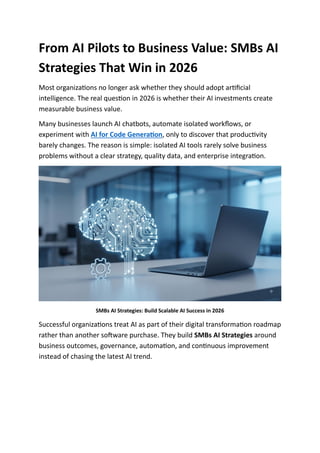
SMBs AI Strategies: Build Scalable AI Success in 2026
Successful organizations treat AI as part of their digital transformation roadmap
rather than another software purchase. They build SMBs AI Strategies around
business outcomes, governance, automation, and continuous improvement
instead of chasing the latest AI trend.
2.
Why Do MostAI Experiments Fail?
Because technology comes before business strategy.
Many companies start with a chatbot or an AI assistant without identifying:
• Business objectives
• Success metrics
• Process bottlenecks
• Data readiness
• Security requirements
• Integration challenges
As a result, employees return to manual work because AI becomes another
disconnected application.
Instead, successful organizations begin by asking:
• Which process consumes the most employee time?
• Where does decision-making slow down?
• Which repetitive workflows create operational costs?
• Which customer interactions need automation?
Only then do they determine whether AI provides the right solution.
What Should SMBs Fix First in 2026?
Focus on processes before platforms.
Instead of purchasing multiple AI tools, businesses should establish a
structured AI roadmap.
Key priorities include:
3.
1. Build AroundBusiness Outcomes
Every AI initiative should support measurable KPIs such as:
• Reduced operational costs
• Faster customer response
• Improved software delivery
• Higher employee productivity
• Better forecasting
• Increased revenue
Without measurable outcomes, AI remains an expensive experiment.
2. Invest in Custom AI Solutions
Generic AI platforms rarely understand unique workflows.
Custom AI Solutions allow organizations to:
• Train AI using company knowledge
• Connect ERP and CRM platforms
• Automate internal approvals
• Improve document intelligence
• Deliver industry-specific recommendations
This creates competitive advantages that off-the-shelf AI tools cannot easily
replicate.
3. Strengthen AI Governance
AI adoption introduces new operational risks.
Organizations should establish governance for:
• Data quality
4.
• Model monitoring
•Security
• Compliance
• Human oversight
• Responsible AI policies
Recent guidance from NIST highlights that continuous monitoring after
deployment is becoming just as important as model development because AI
performance can change over time.
How Does AI-Driven Automation Create Real ROI?
It removes repetitive work instead of replacing people.
Modern AI-Driven Automation combines intelligent decision-making with
workflow automation.
Examples include:
Customer Operations
• Automated support responses
• Intelligent ticket routing
• Personalized recommendations
Finance
• Invoice processing
• Expense validation
• Fraud detection
• Financial reporting
HR
• Resume screening
• Employee onboarding
5.
• Internal knowledgeassistants
Operations
• Inventory forecasting
• Predictive maintenance
• Vendor management
• Procurement automation
Instead of replacing employees, AI enables teams to focus on strategic work
that creates greater business value.
Why Is AI for Code Generation Becoming Essential?
Development teams need faster delivery without sacrificing quality.
Software teams increasingly use AI for Code Generation to accelerate:
• Boilerplate code creation
• Documentation
• Unit testing
• Refactoring
• Code review assistance
• API generation
However, AI-generated code still requires human validation, governance, and
secure development practices. Organizations that combine developer expertise
with AI assistance often achieve faster release cycles while maintaining
software quality.
6.
How Does AIIntegration Service Connect Everything?
AI only delivers value when it works with existing business systems.
Many organizations already use:
• ERP platforms
• CRM software
• Microsoft 365
• Google Workspace
• Customer support tools
• Data warehouses
Without an AI Integration Service, employees must manually transfer
information between systems.
Integrated AI enables:
• Cross-platform automation
• Unified customer insights
• Real-time reporting
• Intelligent workflows
• Connected business operations
Integration transforms isolated AI capabilities into enterprise-wide productivity
improvements.
Why Is Healthcare Leading AI-First Innovation?
Healthcare generates massive volumes of structured and unstructured data.
An AI-first Platform for Healthcare helps organizations improve:
• Clinical documentation
• Patient engagement
7.
• Appointment scheduling
•Operational planning
• Care coordination
• Administrative efficiency
Healthcare leaders also prioritize governance, privacy, and secure deployment
because sensitive patient information requires strict protection. Current public-
sector and standards guidance continues to emphasize responsible AI
adoption, secure data platforms, and transparent governance for healthcare AI.
What Does a Successful SMB AI Strategy Look Like?
The strongest SMBs AI Strategies share several characteristics:
• Business-first planning
• Executive sponsorship
• High-quality data
• Incremental deployment
• Continuous monitoring
• Human oversight
• Enterprise integration
• Clear ROI measurement
Rather than deploying AI everywhere, successful businesses identify high-
impact opportunities, validate results, and expand gradually.
This reduces implementation risk while building organizational confidence.
8.
The Competitive AdvantageBelongs to Strategic AI
Adoption
In 2026, competitive advantage no longer comes from simply using AI.
It comes from using AI intelligently.
Businesses that connect Custom AI Solutions, AI-Driven Automation, AI for
Code Generation, AI-first Platform for Healthcare, and AI Integration Service
into a unified business strategy improve efficiency, reduce operational
complexity, and accelerate innovation.
The organizations that continue treating AI as a collection of disconnected
experiments risk falling behind competitors that build scalable, governed, and
measurable AI ecosystems.