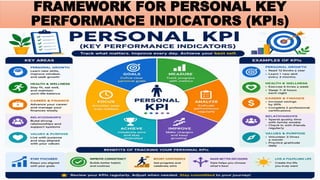
Framework for Developing Personal Key Performance Indicators (KPIs)
Explore how to define, measure, and track personal KPIs across academics, career, health, finance, and personal development to achieve consistent growth and success.
MEET THE FACILITATOR
RASHEED,Oluwasegun Kazeem (Ph.D)
(+234)-8051700164, (+234)-7066867887
kazeemrasheed1440@gmail.com
Lead Principal Facilitator at HEED – A - DINK CONSULT
3.
Meaning . ..
A Personal KPI is a set of measurable indicators used
by an individual to track their own progress,
performance, and achievement of personal,
academic, or career goals. In simple terms, it is how
you measure your personal success over time.
KPIs help you answer questions like:
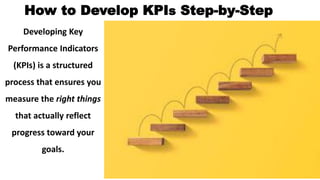
• Am I improving academically or professionally?
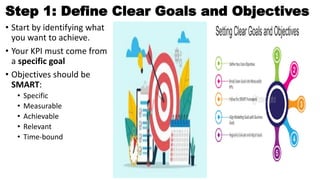
• Am I achieving my personal goals?
• Where do I need to do better in all spheres?
4.
Examples of PersonalKPIs
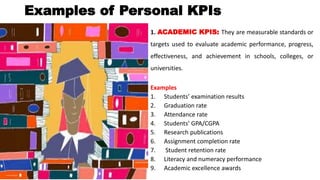
1. ACADEMIC KPIS: They are measurable standards or
targets used to evaluate academic performance, progress,
effectiveness, and achievement in schools, colleges, or
universities.
Examples
1. Students’ examination results
2. Graduation rate
3. Attendance rate
4. Students’ GPA/CGPA
5. Research publications
6. Assignment completion rate
7. Student retention rate
8. Literacy and numeracy performance
9. Academic excellence awards
5.
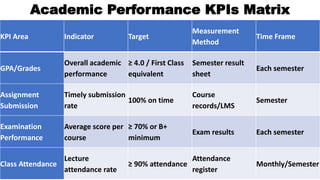
Academic Performance KPIsMatrix
KPI Area Indicator Target
Measurement
Method
Time Frame
GPA/Grades
Overall academic
performance
≥ 4.0 / First Class
equivalent
Semester result
sheet
Each semester
Assignment
Submission
Timely submission
rate
100% on time
Course
records/LMS
Semester
Examination
Performance
Average score per
course
≥ 70% or B+
minimum
Exam results Each semester
Class Attendance
Lecture
attendance rate
≥ 90% attendance
Attendance
register
Monthly/Semester
6.
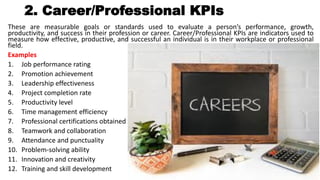
2. Career/Professional KPIs
Theseare measurable goals or standards used to evaluate a person’s performance, growth,
productivity, and success in their profession or career. Career/Professional KPIs are indicators used to
measure how effective, productive, and successful an individual is in their workplace or professional
field.
Examples
1. Job performance rating
2. Promotion achievement
3. Leadership effectiveness
4. Project completion rate
5. Productivity level
6. Time management efficiency
7. Professional certifications obtained
8. Teamwork and collaboration
9. Attendance and punctuality
10. Problem-solving ability
11. Innovation and creativity
12. Training and skill development
7.
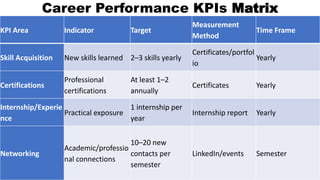
Career Performance KPIsMatrix
KPI Area Indicator Target
Measurement
Method
Time Frame
Skill Acquisition New skills learned 2–3 skills yearly
Certificates/portfol
io
Yearly
Certifications
Professional
certifications
At least 1–2
annually
Certificates Yearly
Internship/Experie
nce
Practical exposure
1 internship per
year
Internship report Yearly
Networking
Academic/professio
nal connections
10–20 new
contacts per
semester
LinkedIn/events Semester
8.
3. Health &Fitness KPIs
These are measurable standards or targets used to evaluate a person’s physical health,
wellness, and fitness progress. Health & Fitness KPIs are indicators used to measure
how healthy and physically fit a person is over time.
Examples
1. Daily exercise duration
2. Number of steps walked daily
3. Heart rate monitoring
4. Blood pressure level
5. Sleep quality and duration
6. Water intake level
7. Flexibility level
8. Healthy eating habits
9. Stress management level
9.
4. Financial KPIs
Theseare measurable standards used to evaluate financial performance, financial health, income,
spending, savings, and overall economic progress of an individual, business, or organization. Financial
KPIs are indicators used to measure how well money and financial resources are being managed.
Examples
1. Revenue or income growth
2. Savings level
3. Budget management
4. Cash flow
5. Debt reduction rate
6. Investment returns
7. Monthly expenses control
8. Net worth growth
9. Financial stability
10. Emergency fund availability
11. Business turnover
12. Return on investment (ROI)
10.
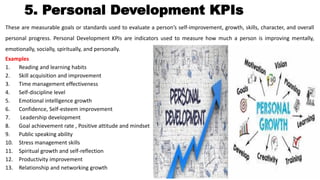
5. Personal DevelopmentKPIs
These are measurable goals or standards used to evaluate a person’s self-improvement, growth, skills, character, and overall
personal progress. Personal Development KPIs are indicators used to measure how much a person is improving mentally,
emotionally, socially, spiritually, and personally.
Examples
1. Reading and learning habits
2. Skill acquisition and improvement
3. Time management effectiveness
4. Self-discipline level
5. Emotional intelligence growth
6. Confidence, Self-esteem improvement
7. Leadership development
8. Goal achievement rate , Positive attitude and mindset
9. Public speaking ability
10. Stress management skills
11. Spiritual growth and self-reflection
12. Productivity improvement
13. Relationship and networking growth
11.
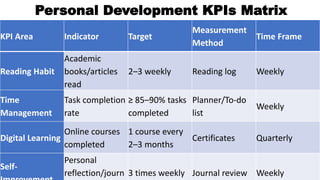
Personal Development KPIsMatrix
KPI Area Indicator Target
Measurement
Method
Time Frame
Reading Habit
Academic
books/articles
read
2–3 weekly Reading log Weekly
Time
Management
Task completion
rate
≥ 85–90% tasks
completed
Planner/To-do
list
Weekly
Digital Learning
Online courses
completed
1 course every
2–3 months
Certificates Quarterly
Self-
Personal
reflection/journ 3 times weekly Journal review Weekly
12.
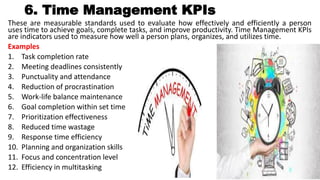
6. Time ManagementKPIs
These are measurable standards used to evaluate how effectively and efficiently a person
uses time to achieve goals, complete tasks, and improve productivity. Time Management KPIs
are indicators used to measure how well a person plans, organizes, and utilizes time.
Examples
1. Task completion rate
2. Meeting deadlines consistently
3. Punctuality and attendance
4. Reduction of procrastination
5. Work-life balance maintenance
6. Goal completion within set time
7. Prioritization effectiveness
8. Reduced time wastage
9. Response time efficiency
10. Planning and organization skills
11. Focus and concentration level
12. Efficiency in multitasking
13.
AIMS OF PERSONALKPI
➢Personal KPIs aim to give you a clear path for what you want to achieve in
life, study, or career.
➢They help you track how far you have grown over time using measurable
indicators.
➢KPIs aim to develop consistency in habits, routines, and responsibilities.
➢They ensure that your time and energy are used on meaningful tasks.
➢KPIs help you understand your strengths, weaknesses, and behavior
patterns.
➢They encourage constant learning, adjustment, and self-development.
➢Personal KPIs make you responsible for your own goals and outcomes.
14.
GOALS OF PERSONALKPI
➢To set realistic personal targets and achieve them step by step.
➢To consistently improve academic, career, and life performance.
➢To replace bad habits with positive and productive ones.
➢To manage time effectively and reduce waste of time.
➢To identify and develop new skills for personal and professional
growth.
➢To use data and self-feedback in making smarter life choices.
➢To stay motivated and focused on long-term personal success.
➢To balance academics, work, health, and personal life effectively.
15.
How to DevelopKPIs Step-by-Step
Developing Key
Performance Indicators
(KPIs) is a structured
process that ensures you
measure the right things
that actually reflect
progress toward your
goals.
16.
Step 1: DefineClear Goals and Objectives
• Start by identifying what
you want to achieve.
• Your KPI must come from
a specific goal
• Objectives should be
SMART:
• Specific
• Measurable
• Achievable
• Relevant
• Time-bound
17.
Step 2: IdentifyCritical Success Factors (CSFs)
A Critical Success Factor
(CSF) refers to the
important areas,
conditions, or activities
that must be achieved for
an individual to succeed.
CSFs are the key elements
that determine whether
goals and objectives will
be successfully
accomplished. They help
individuals focus on the
most important priorities
needed for growth and
achievement.
18.
Step 3: SelectWhat to Measure
Choose specific
aspects of
performance that
reflect success.
Ask:
•What shows you
are achieving the
goal?
•What data is
available?
19.
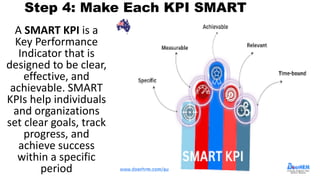
Step 4: MakeEach KPI SMART
A SMART KPI is a
Key Performance
Indicator that is
designed to be clear,
effective, and
achievable. SMART
KPIs help individuals
and organizations
set clear goals, track
progress, and
achieve success
within a specific
period
20.
Step 5: AssignMeasurement Method and Data Source
Assign Measurement Method and
Data Source refers to the process of
clearly identifying how a KPI will be
measured and where the data will be
obtained from.
The measurement method explains
the tools, techniques, or procedures
used to track performance (e.g.,
surveys, tests, attendance records,
reports). The data source refers to the
origin of the information used for
measurement (e.g., school records,
financial statements, questionnaires,
or digital systems).
• How the KPI will be measured
• Where the data will come from
21.
Step 6: SetTargets and Benchmarks
Setting Targets and Benchmarks
means establishing clear
performance goals (targets) and
comparing them with
recognized standards or best
practices (benchmarks) to
measure success. A target is a
specific result an individual
aims to achieve within a given
time. A benchmark is a standard
used for comparison to evaluate
performance and determine
whether goals are being met or
exceeded.
22.
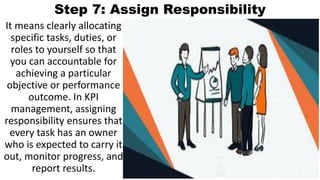
Step 7: AssignResponsibility
It means clearly allocating
specific tasks, duties, or
roles to yourself so that
you can accountable for
achieving a particular
objective or performance
outcome. In KPI
management, assigning
responsibility ensures that
every task has an owner
who is expected to carry it
out, monitor progress, and
report results.
23.
Step 8: Monitorand Review Regularly
•KPIs are not static.
They must be tracked
and reviewed.
•Weekly, monthly, or
quarterly monitoring
•Compare actual
performance with
targets
•Identify gaps and
make improvements
24.
Step 9: AdjustWhen Necessary
•If a KPI is no
longer useful or
realistic:
•Modify it
•Replace it
•Improve
measurement
method
25.
Personal KPI FundamentalQuestions
GOAL CLARITY QUESTIONS
• What exactly do I want to achieve in my academics or career?
•Why is this goal important to me?
•What does success look like in measurable terms?
•What specific outcomes am I aiming for?
•How will I know I have achieved my goal?
•Is my goal realistic, time-bound, and achievable?
26.
•What key performance
indicatorsbest reflect my goal?
•Are my KPIs measurable (can
they be quantified or tracked)?
•Am I focusing on too many KPIs
or the right few?
•Are my KPIs aligned with my
long-term vision?
•What data will I use to
measure each KPI?
•Are my KPIs clear or too
vague?
27.
Planning & TimeManagement Questions
•How much time do I need daily or
weekly to achieve my KPIs?
•What is my daily study/work
schedule?
•Which tasks are priorities for
today, this week, and this month?
•Where am I wasting time that
affects my KPIs?
•How can I better organize my
daily routine for productivity?
28.
Performance Tracking Questions
•AmI consistently tracking
my KPIs?
•What tools am I using to
monitor my progress?
•How far am I from my
targets right now?
•What KPIs am I
performing well in?
•Which KPIs am I
struggling with and why?
29.
Improvement & AdjustmentQuestions
• What is stopping me
from achieving my KPIs?
• What changes can I make
to improve my
performance?
• Do I need to adjust my
targets or improve my
discipline?
• What strategies are
working best for me?
30.
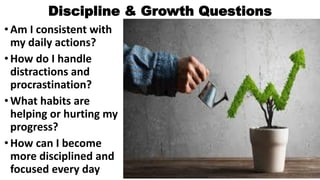
Discipline & GrowthQuestions
•Am I consistent with
my daily actions?
•How do I handle
distractions and
procrastination?
•What habits are
helping or hurting my
progress?
•How can I become
more disciplined and
focused every day
31.
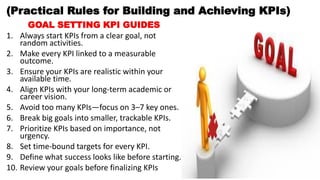
(Practical Rules forBuilding and Achieving KPIs)
GOAL SETTING KPI GUIDES
1. Always start KPIs from a clear goal, not
random activities.
2. Make every KPI linked to a measurable
outcome.
3. Ensure your KPIs are realistic within your
available time.
4. Align KPIs with your long-term academic or
career vision.
5. Avoid too many KPIs—focus on 3–7 key ones.
6. Break big goals into smaller, trackable KPIs.
7. Prioritize KPIs based on importance, not
urgency.
8. Set time-bound targets for every KPI.
9. Define what success looks like before starting.
10. Review your goals before finalizing KPIs
32.
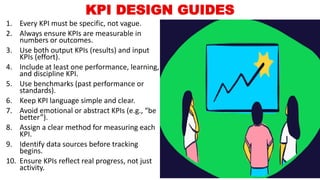
KPI DESIGN GUIDES
1.Every KPI must be specific, not vague.
2. Always ensure KPIs are measurable in
numbers or outcomes.
3. Use both output KPIs (results) and input
KPIs (effort).
4. Include at least one performance, learning,
and discipline KPI.
5. Use benchmarks (past performance or
standards).
6. Keep KPI language simple and clear.
7. Avoid emotional or abstract KPIs (e.g., “be
better”).
8. Assign a clear method for measuring each
KPI.
9. Identify data sources before tracking
begins.
10. Ensure KPIs reflect real progress, not just
activity.
33.
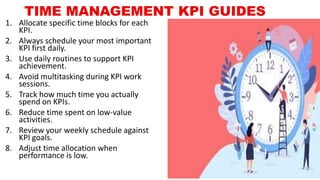
TIME MANAGEMENT KPIGUIDES
1. Allocate specific time blocks for each
KPI.
2. Always schedule your most important
KPI first daily.
3. Use daily routines to support KPI
achievement.
4. Avoid multitasking during KPI work
sessions.
5. Track how much time you actually
spend on KPIs.
6. Reduce time spent on low-value
activities.
7. Review your weekly schedule against
KPI goals.
8. Adjust time allocation when
performance is low.
34.
TRACKING & MONITORINGGUIDES
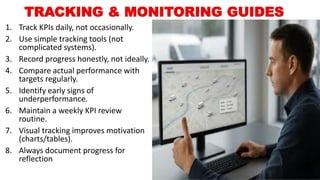
1. Track KPIs daily, not occasionally.
2. Use simple tracking tools (not
complicated systems).
3. Record progress honestly, not ideally.
4. Compare actual performance with
targets regularly.
5. Identify early signs of
underperformance.
6. Maintain a weekly KPI review
routine.
7. Visual tracking improves motivation
(charts/tables).
8. Always document progress for
reflection
35.
IMPROVEMENT & ADJUSTMENTGUIDES
1. If a KPI is unrealistic, adjust it—
not abandon it.
2. Identify root causes of poor
performance.
3. Improve systems, not just
effort.
4. Replace ineffective strategies
quickly.
5. Learn from successful habits
and repeat them.
6. Focus on progress, not
perfection.
36.
DISCIPLINE & PRODUCTIVITYGUIDES
1. Discipline is more
important than motivation.
2. Small daily consistency
beats occasional effort.
3. Avoid procrastination
through structured
planning.
4. Build habits that support
your KPIs.
5. Control distractions
(especially digital
distractions).
37.
GROWTH & SUCCESSGUIDES
1. Always review your KPIs at the
end of each week/month.
2. Celebrate small wins to maintain
motivation.
3. Continuously improve your KPIs
as you grow.
4. Set SMART Goals
5. Track Progress Regularly
6. Focus on Continuous
Improvement
7. Use Data for Decision-Making
8. Maintain Accountability
9. Celebrate Achievements and Re-
strategize
38.
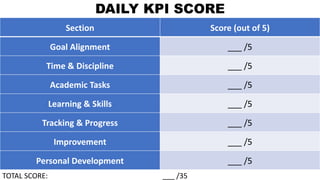
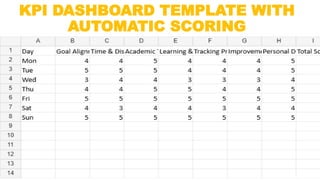
DAILY KPI SCORE
SectionScore (out of 5)
Goal Alignment ___ /5
Time & Discipline ___ /5
Academic Tasks ___ /5
Learning & Skills ___ /5
Tracking & Progress ___ /5
Improvement ___ /5
Personal Development ___ /5
TOTAL SCORE: ___ /35
39.
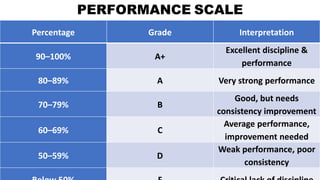
PERFORMANCE SCALE
Percentage GradeInterpretation
90–100% A+
Excellent discipline &
performance
80–89% A Very strong performance
70–79% B
Good, but needs
consistency improvement
60–69% C
Average performance,
improvement needed
50–59% D
Weak performance, poor
consistency
40.
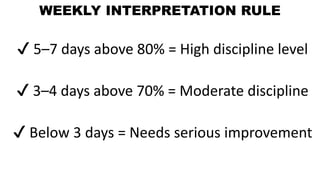
WEEKLY INTERPRETATION RULE
5–7days above 80% = High discipline level
3–4 days above 70% = Moderate discipline
Below 3 days = Needs serious improvement
41.
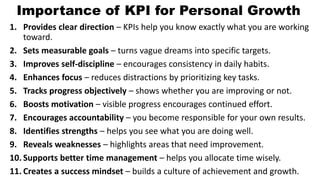
Importance of KPIfor Personal Growth
1. Provides clear direction – KPIs help you know exactly what you are working
toward.
2. Sets measurable goals – turns vague dreams into specific targets.
3. Improves self-discipline – encourages consistency in daily habits.
4. Enhances focus – reduces distractions by prioritizing key tasks.
5. Tracks progress objectively – shows whether you are improving or not.
6. Boosts motivation – visible progress encourages continued effort.
7. Encourages accountability – you become responsible for your own results.
8. Identifies strengths – helps you see what you are doing well.
9. Reveals weaknesses – highlights areas that need improvement.
10. Supports better time management – helps you allocate time wisely.
11. Creates a success mindset – builds a culture of achievement and growth.
42.
Importance of KPIfor Personal Growth
12. Improves productivity – ensures efforts are directed at meaningful tasks.
13. Helps in goal prioritization – ranks goals based on importance.
14. Encourages continuous improvement – promotes steady personal development.
15. Builds self-awareness – helps you understand your habits and behaviors.
16. Enhances decision-making – provides data to guide choices.
17. Reduces procrastination – clear targets push action.
18. Improves performance tracking – allows you to measure success over time.
19. Encourages goal setting discipline – teaches structured planning.
20. Helps in habit formation – supports building positive routines.
21. Increases efficiency – helps you achieve more with less effort.
22. Strengthens goal commitment – increases dedication to set targets.
23. Provides performance feedback loop – helps adjust strategies quickly
43.
Importance of KPIfor Personal Growth
24. Supports academic success – improves study planning and results.
25. Enhances career development – aligns actions with professional goals.
26. Improves personal accountability systems – keeps you answerable to yourself.
27. Encourages reflection – helps you review past actions for improvement.
28. Reduces wasted effort – eliminates unnecessary activities.
29. Promotes consistency – ensures steady progress over time.
30. Builds confidence – achievement of KPIs boosts self-belief.
31. Helps in stress management – reduces confusion and overload.
32. Clarifies expectations – makes goals and outcomes clear.
33. Supports long-term planning – connects daily actions to future goals.
34. Encourages self-evaluation – helps you assess your performance regularly.
35. Improves learning outcomes – especially useful for students tracking study goals
44.
Personal Growth KPIChallenge Plan
FOCUS: UNDERSTANDING YOURSELF AND BUILDING STRUCTURE
Day 1: Set 5 personal KPIs (life goals)
Day 2: Create daily routine schedule
Day 3: Track time usage for 24 hours
Day 4: Eliminate 1 bad habit gradually
Day 5: Read or learn for 30 minutes
Day 6: Write personal strengths & weaknesses
Day 7: Weekly self-review (score yourself)
45.
FOCUS: CONSISTENCY ANDCONTROL
1.Wake up at fixed time daily if possible
2.Follow daily KPI checklist strictly
3.Study/work for at least 2–4 hours daily
4.Gradually reduce social media usage by 30%
5.Exercise at least 2 - 3 days in a week
6.Complete one difficult task daily
7.Review your weekly KPI scoring technique
46.
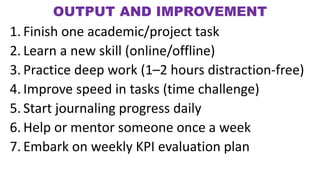
OUTPUT AND IMPROVEMENT
1.Finish one academic/project task
2. Learn a new skill (online/offline)
3. Practice deep work (1–2 hours distraction-free)
4. Improve speed in tasks (time challenge)
5. Start journaling progress daily
6. Help or mentor someone once a week
7. Embark on weekly KPI evaluation plan
47.
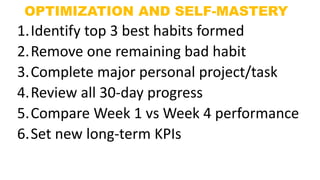
OPTIMIZATION AND SELF-MASTERY
1.Identifytop 3 best habits formed
2.Remove one remaining bad habit
3.Complete major personal project/task
4.Review all 30-day progress
5.Compare Week 1 vs Week 4 performance
6.Set new long-term KPIs