Foundations of Research: Building Global Research Skills for Students
An introductory session on research methodology covering types, problem formulation, objectives, variables, and ethical AI use in research, designed for international students across disciplines.
Foundations of Research: Building Global Research Skills for Students
1.
Foundations of Research
Introductionto Research Methodology
Student Development Programme – A Global Perspective
🌍 International Student Session | Online Format
Dr. Komal Gupta | Marketing Research | Pune, India
2.
Welcome to theStudent Development
Programme
Why this programme? To build research skills for students from different countries and disciplines
Today's session: Setting the foundation for advanced research topics later
🌍 Global representation: China, Malaysia, Austria, India and beyond
Examples will reflect diverse contexts and disciplines
3.
What You WillGain Today
• Understand what "research" really means and why it matters
• Distinguish key types of research (basic/applied, qualitative/quantitative,
exploratory/descriptive/explanatory)
• Move from broad topics to focused research problems, objectives, and questions
• Learn how AI tools can support research—and where to be careful
4.
Quick Icebreaker
When youhear the word "research,"
what comes to your mind in one word?
💭 Type your answer in chat—let's see how close we are to the formal definition!
5.
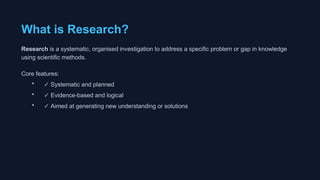
What is Research?
Researchis a systematic, organised investigation to address a specific problem or gap in knowledge
using scientific methods.
Core features:
• ✓ Systematic and planned
• ✓ Evidence-based and logical
• ✓ Aimed at generating new understanding or solutions
6.
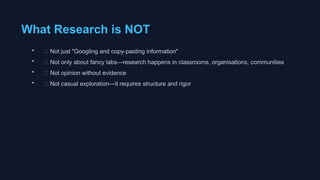
What Research isNOT
• ❌ Not just "Googling and copy-pasting information"
• ❌ Not only about fancy labs—research happens in classrooms, organisations, communities
• ❌ Not opinion without evidence
• ❌ Not casual exploration—it requires structure and rigor
7.
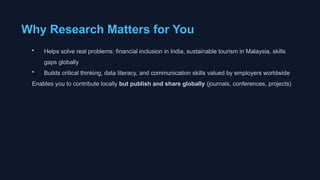
Why Research Mattersfor You
• Helps solve real problems: financial inclusion in India, sustainable tourism in Malaysia, skills
gaps globally
• Builds critical thinking, data literacy, and communication skills valued by employers worldwide
Enables you to contribute locally but publish and share globally (journals, conferences, projects)
8.
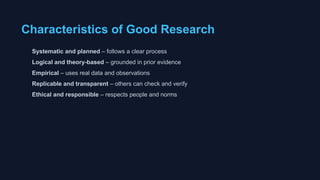
Characteristics of GoodResearch
Systematic and planned – follows a clear process
Logical and theory-based – grounded in prior evidence
Empirical – uses real data and observations
Replicable and transparent – others can check and verify
Ethical and responsible – respects people and norms
9.
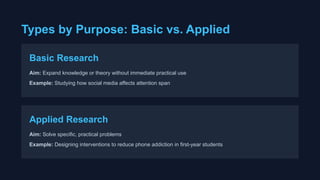
Types by Purpose:Basic vs. Applied
Basic Research
Aim: Expand knowledge or theory without immediate practical use
Example: Studying how social media affects attention span
Applied Research
Aim: Solve specific, practical problems
Example: Designing interventions to reduce phone addiction in first-year students
10.
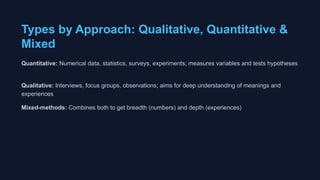
Types by Approach:Qualitative, Quantitative &
Mixed
Quantitative: Numerical data, statistics, surveys, experiments; measures variables and tests hypotheses
Qualitative: Interviews, focus groups, observations; aims for deep understanding of meanings and
experiences
Mixed-methods: Combines both to get breadth (numbers) and depth (experiences)
11.
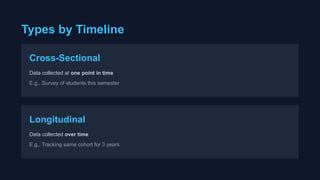
Types by Timeline
Cross-Sectional
Datacollected at one point in time
E.g., Survey of students this semester
Longitudinal
Data collected over time
E.g., Tracking same cohort for 3 years
12.
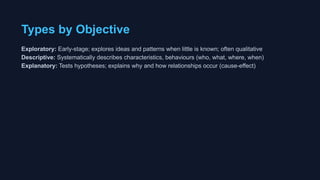
Types by Objective
Exploratory:Early-stage; explores ideas and patterns when little is known; often qualitative
Descriptive: Systematically describes characteristics, behaviours (who, what, where, when)
Explanatory: Tests hypotheses; explains why and how relationships occur (cause-effect)
13.
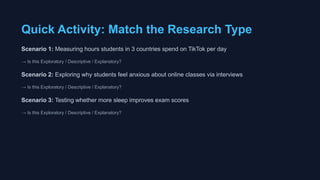
Quick Activity: Matchthe Research Type
Scenario 1: Measuring hours students in 3 countries spend on TikTok per day
→ Is this Exploratory / Descriptive / Explanatory?
Scenario 2: Exploring why students feel anxious about online classes via interviews
→ Is this Exploratory / Descriptive / Explanatory?
Scenario 3: Testing whether more sleep improves exam scores
→ Is this Exploratory / Descriptive / Explanatory?
14.
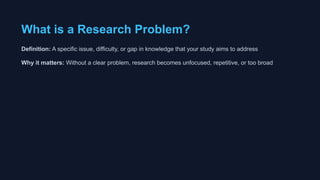
What is aResearch Problem?
Definition: A specific issue, difficulty, or gap in knowledge that your study aims to address
Why it matters: Without a clear problem, research becomes unfocused, repetitive, or too broad
15.
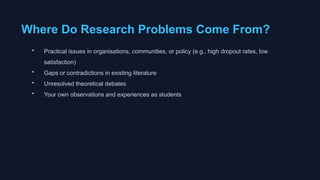
Where Do ResearchProblems Come From?
• Practical issues in organisations, communities, or policy (e.g., high dropout rates, low
satisfaction)
• Gaps or contradictions in existing literature
• Unresolved theoretical debates
• Your own observations and experiences as students
16.
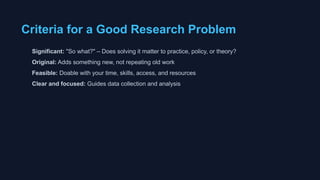
Criteria for aGood Research Problem
Significant: "So what?" – Does solving it matter to practice, policy, or theory?
Original: Adds something new, not repeating old work
Feasible: Doable with your time, skills, access, and resources
Clear and focused: Guides data collection and analysis
17.
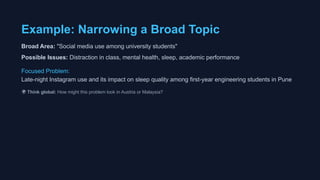
Example: Narrowing aBroad Topic
Broad Area: "Social media use among university students"
Possible Issues: Distraction in class, mental health, sleep, academic performance
Focused Problem:
Late-night Instagram use and its impact on sleep quality among first-year engineering students in Pune
🌍 Think global: How might this problem look in Austria or Malaysia?
18.
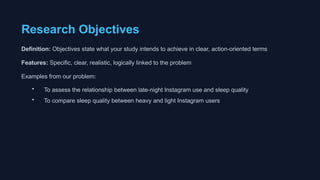
Research Objectives
Definition: Objectivesstate what your study intends to achieve in clear, action-oriented terms
Features: Specific, clear, realistic, logically linked to the problem
Examples from our problem:
• To assess the relationship between late-night Instagram use and sleep quality
• To compare sleep quality between heavy and light Instagram users
19.
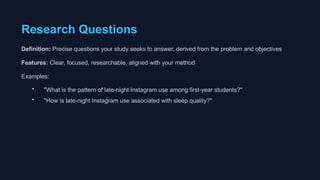
Research Questions
Definition: Precisequestions your study seeks to answer, derived from the problem and objectives
Features: Clear, focused, researchable, aligned with your method
Examples:
• "What is the pattern of late-night Instagram use among first-year students?"
• "How is late-night Instagram use associated with sleep quality?"
20.
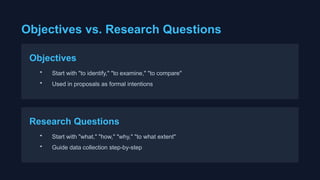
Objectives vs. ResearchQuestions
Objectives
• Start with "to identify," "to examine," "to compare"
• Used in proposals as formal intentions
Research Questions
• Start with "what," "how," "why," "to what extent"
• Guide data collection step-by-step
21.
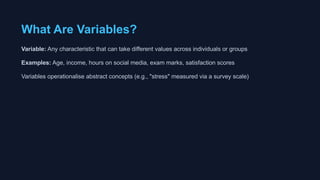
What Are Variables?
Variable:Any characteristic that can take different values across individuals or groups
Examples: Age, income, hours on social media, exam marks, satisfaction scores
Variables operationalise abstract concepts (e.g., "stress" measured via a survey scale)
22.
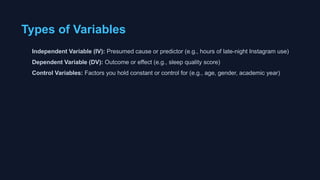
Types of Variables
IndependentVariable (IV): Presumed cause or predictor (e.g., hours of late-night Instagram use)
Dependent Variable (DV): Outcome or effect (e.g., sleep quality score)
Control Variables: Factors you hold constant or control for (e.g., age, gender, academic year)
23.
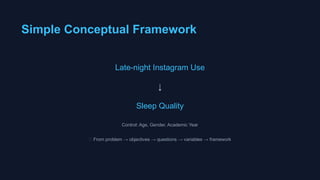
Simple Conceptual Framework
Late-nightInstagram Use
↓
Sleep Quality
Control: Age, Gender, Academic Year
💡 From problem → objectives → questions → variables → framework
24.
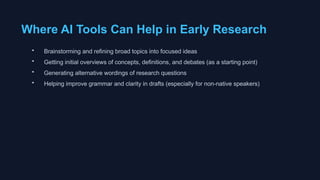
Where AI ToolsCan Help in Early Research
• Brainstorming and refining broad topics into focused ideas
• Getting initial overviews of concepts, definitions, and debates (as a starting point)
• Generating alternative wordings of research questions
• Helping improve grammar and clarity in drafts (especially for non-native speakers)
25.
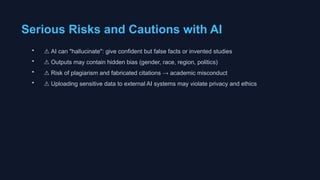
Serious Risks andCautions with AI
• ⚠️AI can "hallucinate": give confident but false facts or invented studies
• ⚠️Outputs may contain hidden bias (gender, race, region, politics)
• ⚠️Risk of plagiarism and fabricated citations → academic misconduct
• ⚠️Uploading sensitive data to external AI systems may violate privacy and ethics
26.
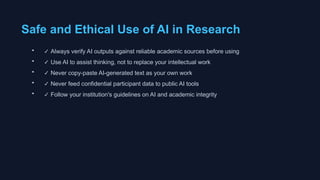
Safe and EthicalUse of AI in Research
• ✓ Always verify AI outputs against reliable academic sources before using
• ✓ Use AI to assist thinking, not to replace your intellectual work
• ✓ Never copy-paste AI-generated text as your own work
• ✓ Never feed confidential participant data to public AI tools
• ✓ Follow your institution's guidelines on AI and academic integrity
27.
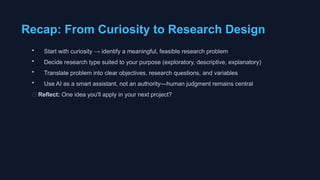
Recap: From Curiosityto Research Design
• Start with curiosity → identify a meaningful, feasible research problem
• Decide research type suited to your purpose (exploratory, descriptive, explanatory)
• Translate problem into clear objectives, research questions, and variables
• Use AI as a smart assistant, not an authority—human judgment remains central
💡 Reflect: One idea you'll apply in your next project?
28.
Questions, Reflections &Next Steps
What is one topic from your context that you might want to research?
Any questions before we hand over to the next speaker?
Email for guidance: komal.gupta@institution.in
🌍 Thank you for joining from around the world!