Foundations of Artificial Neural Networks in Mechanical Engineering: Concepts and Applications
An introduction to Artificial Neural Networks (ANN), their structure, learning process, and applications in mechanical engineering such as predictive maintenance and defect detection.
Foundations of Artificial Neural Networks in Mechanical Engineering: Concepts and Applications
1.
Sanjivani Rural EducationSociety’s
Sanjivani College of Engineering, Kopargaon-423603
(An Autonomous Institute Affiliated to Savitribai Phule Pune University, Pune)
NAAC ‘A’ Grade Accredited, ISO 9001:2015 Certified
Department of Mechanical Engineering
Subject : Foundations of AI and ML
Class : T.Y. Mechanical
Subject Code : PEME 312D
Unit 4 : Optimization and Neural Foundations
By
V. P. Bhaurkar
Department of Mechanical Engineering
2025 – 26 (sem – 6)
2.
V. P. BhaurkarAI ML (T. Y. Mechanical)
Artificial Neural Networks (ANN)
What is an Artificial Neural Network?
1. An Artificial Neural Network (ANN) is a computer model that
works similar to the human brain.
2. Just like our brain learns from experience, ANN also learns from
data.
3. It takes input → processes it → gives output
4. Improves its performance by learning from past data
5. In simple words:
ANN is a system that can learn patterns and make decisions like
humans
3.
V. P. BhaurkarAI ML (T. Y. Mechanical)
Artificial Neural Networks (ANN)
Why do we need ANN?
1. In many real-life problems, writing exact formulas is very difficult.
For example:
1. Predicting machine failure
2. Estimating fuel efficiency
3. Identifying defects in manufacturing
4. ANN helps in such cases by learning from data instead of using
fixed equations
4.
V. P. BhaurkarAI ML (T. Y. Mechanical)
Artificial Neural Networks (ANN)
Inspiration from Human Brain
1. Human brain has billions of neurons.
Each neuron:
1. Receives signals
2. Processes them
3. Sends output
ANN copies this idea in a simplified way.
5.
V. P. BhaurkarAI ML (T. Y. Mechanical)
Artificial Neural Networks (ANN)
Basic Structure of ANN
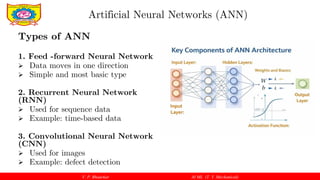
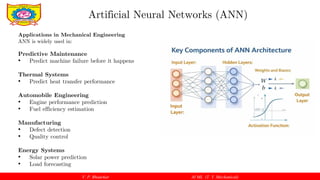
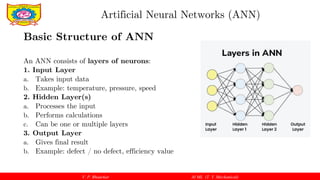
An ANN consists of layers of neurons:
1. Input Layer
a. Takes input data
b. Example: temperature, pressure, speed
2. Hidden Layer(s)
a. Processes the input
b. Performs calculations
c. Can be one or multiple layers
3. Output Layer
a. Gives final result
b. Example: defect / no defect, efficiency value
6.
V. P. BhaurkarAI ML (T. Y. Mechanical)
Artificial Neural Networks (ANN)
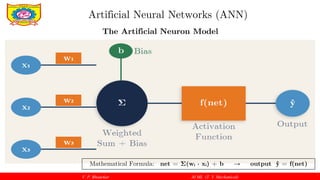
Structure of a Single Neuron
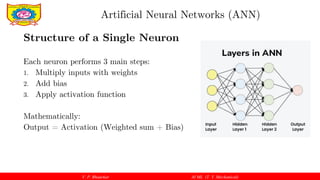
Each neuron performs 3 main steps:
1. Multiply inputs with weights
2. Add bias
3. Apply activation function
Mathematically:
Output = Activation (Weighted sum + Bias)
7.
V. P. BhaurkarAI ML (T. Y. Mechanical)
Artificial Neural Networks (ANN)
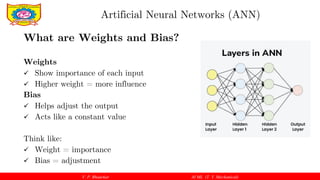
What are Weights and Bias?
Weights
Show importance of each input
Higher weight = more influence
Bias
Helps adjust the output
Acts like a constant value
Think like:
Weight = importance
Bias = adjustment
8.
V. P. BhaurkarAI ML (T. Y. Mechanical)
Artificial Neural Networks (ANN)
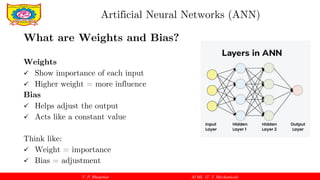
What are Weights and Bias?
Weights
Show importance of each input
Higher weight = more influence
Bias
Helps adjust the output
Acts like a constant value
Think like:
Weight = importance
Bias = adjustment
9.
V. P. BhaurkarAI ML (T. Y. Mechanical)
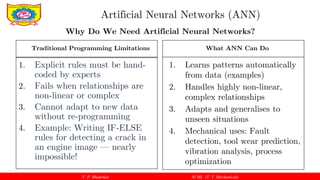
Why Do We Need Artificial Neural Networks?
Artificial Neural Networks (ANN)
Traditional Programming Limitations
1. Explicit rules must be hand-
coded by experts
2. Fails when relationships are
non-linear or complex
3. Cannot adapt to new data
without re-programming
4. Example: Writing IF-ELSE
rules for detecting a crack in
an engine image — nearly
impossible!
What ANN Can Do
1. Learns patterns automatically
from data (examples)
2. Handles highly non-linear,
complex relationships
3. Adapts and generalises to
unseen situations
4. Mechanical uses: Fault
detection, tool wear prediction,
vibration analysis, process
optimization
10.
V. P. BhaurkarAI ML (T. Y. Mechanical)
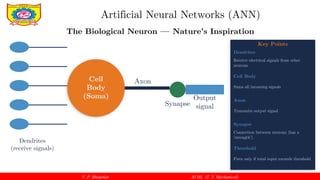
The Biological Neuron — Nature's Inspiration
Artificial Neural Networks (ANN)
Dendrites
(receive signals)
Cell
Body
(Soma)
Axon
Synapse
Output
signal
Key Points
Dendrites
Receive electrical signals from other
neurons
Cell Body
Sums all incoming signals
Axon
Transmits output signal
Synapse
Connection between neurons (has a
'strength')
Threshold
Fires only if total input exceeds threshold
11.
V. P. BhaurkarAI ML (T. Y. Mechanical)
The Artificial Neuron Model
Artificial Neural Networks (ANN)
Mathematical Formula: net = Σ(wᵢ · xᵢ) + b → output ŷ = f(net)
12.
V. P. BhaurkarAI ML (T. Y. Mechanical)
Artificial Neural Networks (ANN)
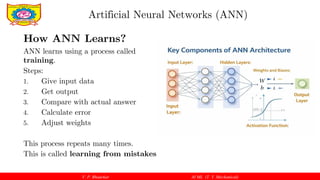
How ANN Learns?
ANN learns using a process called
training.
Steps:
1. Give input data
2. Get output
3. Compare with actual answer
4. Calculate error
5. Adjust weights
This process repeats many times.
This is called learning from mistakes
13.
V. P. BhaurkarAI ML (T. Y. Mechanical)
Artificial Neural Networks (ANN)
Types of ANN
1. Feed -forward Neural Network
Data moves in one direction
Simple and most basic type
2. Recurrent Neural Network
(RNN)
Used for sequence data
Example: time-based data
3. Convolutional Neural Network
(CNN)
Used for images
Example: defect detection
14.
V. P. BhaurkarAI ML (T. Y. Mechanical)
Artificial Neural Networks (ANN)
Applications in Mechanical Engineering
ANN is widely used in:
Predictive Maintenance
• Predict machine failure before it happens
Thermal Systems
• Predict heat transfer performance
Automobile Engineering
• Engine performance prediction
• Fuel efficiency estimation
Manufacturing
• Defect detection
• Quality control
Energy Systems
• Solar power prediction
• Load forecasting
 Most read
 Most read
 Most read