Foundations of Artificial Intelligence: History, AI Applications, AI vs ML vs DL, AI Ethics & Responsible AI
1.
S E ME S T E R 2 • D ATA S C I E N C E & A I C O U R S E
Foundations of Artificial Intelligence
History • Applications • AI vs ML vs DL • Ethics & Responsible AI • Hands-on Lab
Lecture 1 — Engineering Undergraduates
Prepared for classroom delivery
01
2.
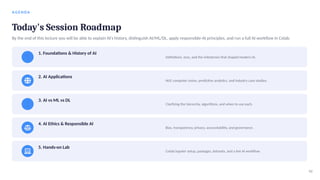
A G EN DA
Today's Session Roadmap
By the end of this lecture you will be able to explain AI's history, distinguish AI/ML/DL, apply responsible-AI principles, and run a full AI workflow in Colab.
1. Foundations & History of AI
Definitions, eras, and the milestones that shaped modern AI.
2. AI Applications
NLP, computer vision, predictive analytics, and industry case studies.
3. AI vs ML vs DL
Clarifying the hierarchy, algorithms, and when to use each.
4. AI Ethics & Responsible AI
Bias, transparency, privacy, accountability, and governance.
5. Hands-on Lab
Colab/Jupyter setup, packages, datasets, and a live AI workflow.
02
3.
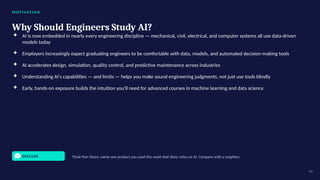
M OT IVAT I O N
Why Should Engineers Study AI?
✦ AI is now embedded in nearly every engineering discipline — mechanical, civil, electrical, and computer systems all use data-driven
models today
✦ Employers increasingly expect graduating engineers to be comfortable with data, models, and automated decision-making tools
✦ AI accelerates design, simulation, quality control, and predictive maintenance across industries
✦ Understanding AI's capabilities — and limits — helps you make sound engineering judgments, not just use tools blindly
✦ Early, hands-on exposure builds the intuition you'll need for advanced courses in machine learning and data science
DISCUSS Think-Pair-Share: name one product you used this week that likely relies on AI. Compare with a neighbor.
03
4.
M O DU L E 1
Foundations & History of AI
Definitions, eras, and the milestones that shaped modern AI
04
5.
M O DU L E 1 • T H EO RY
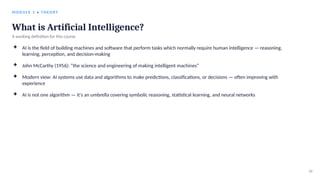
What is Artificial Intelligence?
A working definition for this course
✦ AI is the field of building machines and software that perform tasks which normally require human intelligence — reasoning,
learning, perception, and decision-making
✦ John McCarthy (1956): “the science and engineering of making intelligent machines”
✦ Modern view: AI systems use data and algorithms to make predictions, classifications, or decisions — often improving with
experience
✦ AI is not one algorithm — it's an umbrella covering symbolic reasoning, statistical learning, and neural networks
05
6.
M O DU L E 1 • T H EO RY
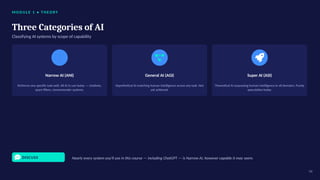
Three Categories of AI
Classifying AI systems by scope of capability
Narrow AI (ANI)
Performs one specific task well. All AI in use today — chatbots,
spam filters, recommender systems.
General AI (AGI)
Hypothetical AI matching human intelligence across any task. Not
yet achieved.
Super AI (ASI)
Theoretical AI surpassing human intelligence in all domains. Purely
speculative today.
DISCUSS Nearly every system you'll use in this course — including ChatGPT — is Narrow AI, however capable it may seem.
06
7.
M O DU L E 1 • T H EO RY
Why Study AI History?
Every modern breakthrough builds on decades of prior research
✦ AI has gone through cycles of excitement (“booms”) and disappointment (“AI winters”) since the 1950s
✦ Understanding these cycles helps you evaluate today's hype realistically
✦ Many “new” ideas (neural networks, backpropagation) are decades old — revived by more data and faster hardware
✦ Knowing the history helps you appreciate why certain techniques dominate specific problem types today
07
8.
H I STO RY • E R A 1
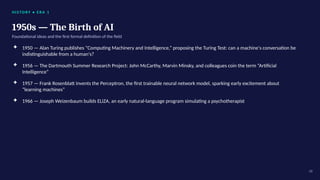
1950s — The Birth of AI
Foundational ideas and the first formal definition of the field
✦ 1950 — Alan Turing publishes “Computing Machinery and Intelligence,” proposing the Turing Test: can a machine's conversation be
indistinguishable from a human's?
✦ 1956 — The Dartmouth Summer Research Project: John McCarthy, Marvin Minsky, and colleagues coin the term “Artificial
Intelligence”
✦ 1957 — Frank Rosenblatt invents the Perceptron, the first trainable neural network model, sparking early excitement about
“learning machines”
✦ 1966 — Joseph Weizenbaum builds ELIZA, an early natural-language program simulating a psychotherapist
08
9.
H I STO RY • E R A 2
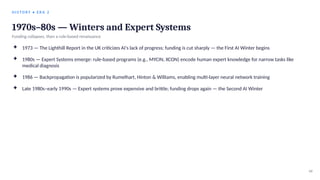
1970s–80s — Winters and Expert Systems
Funding collapses, then a rule-based renaissance
✦ 1973 — The Lighthill Report in the UK criticizes AI's lack of progress; funding is cut sharply — the First AI Winter begins
✦ 1980s — Expert Systems emerge: rule-based programs (e.g., MYCIN, XCON) encode human expert knowledge for narrow tasks like
medical diagnosis
✦ 1986 — Backpropagation is popularized by Rumelhart, Hinton & Williams, enabling multi-layer neural network training
✦ Late 1980s–early 1990s — Expert systems prove expensive and brittle; funding drops again — the Second AI Winter
09
10.
H I STO RY • E R A 3
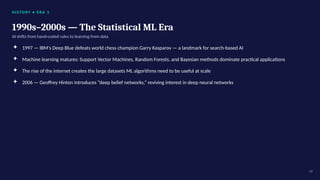
1990s–2000s — The Statistical ML Era
AI shifts from hand-coded rules to learning from data
✦ 1997 — IBM's Deep Blue defeats world chess champion Garry Kasparov — a landmark for search-based AI
✦ Machine learning matures: Support Vector Machines, Random Forests, and Bayesian methods dominate practical applications
✦ The rise of the internet creates the large datasets ML algorithms need to be useful at scale
✦ 2006 — Geoffrey Hinton introduces “deep belief networks,” reviving interest in deep neural networks
10
11.
H I STO RY • E R A 4
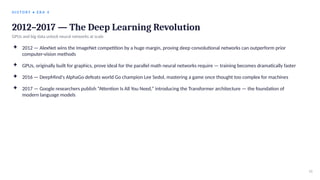
2012–2017 — The Deep Learning Revolution
GPUs and big data unlock neural networks at scale
✦ 2012 — AlexNet wins the ImageNet competition by a huge margin, proving deep convolutional networks can outperform prior
computer-vision methods
✦ GPUs, originally built for graphics, prove ideal for the parallel math neural networks require — training becomes dramatically faster
✦ 2016 — DeepMind's AlphaGo defeats world Go champion Lee Sedol, mastering a game once thought too complex for machines
✦ 2017 — Google researchers publish “Attention Is All You Need,” introducing the Transformer architecture — the foundation of
modern language models
11
12.
H I STO RY • E R A 5
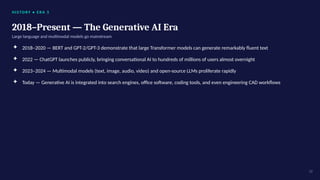
2018–Present — The Generative AI Era
Large language and multimodal models go mainstream
✦ 2018–2020 — BERT and GPT-2/GPT-3 demonstrate that large Transformer models can generate remarkably fluent text
✦ 2022 — ChatGPT launches publicly, bringing conversational AI to hundreds of millions of users almost overnight
✦ 2023–2024 — Multimodal models (text, image, audio, video) and open-source LLMs proliferate rapidly
✦ Today — Generative AI is integrated into search engines, office software, coding tools, and even engineering CAD workflows
12
13.
H I STO RY • R E C A P
The AI Timeline at a Glance
1950
Turing Test
1956
Dartmouth
Workshop
1980s
Expert
Systems
1997
Deep Blue
2012
AlexNet /
Deep Learning
2017
Transformers
2022
ChatGPT /
Generative AI
DISCUSS Group activity: each team picks one era and explains, in one minute, why it mattered for AI's development.
13
14.
M O DU L E 2
AI Applications
Where AI already creates measurable, real-world impact
14
15.
M O DU L E 2 • T H EO RY
AI Applications Across Industries
A broad map before we go deeper on each domain
NLP
Chatbots, translation, summarization
Computer Vision
Face & object recognition, defect detection
Predictive Analytics
Forecasting, recommendation engines
Healthcare
Diagnosis support, drug discovery
Finance
Fraud detection, algorithmic trading
Autonomous Vehicles
Perception, path planning
Robotics
Manufacturing, warehouse automation
Agriculture
Crop health monitoring, yield prediction
15
16.
M O DU L E 2 • D E E P D I V E
Natural Language Processing (NLP)
Teaching machines to understand and generate human language
✦ Core tasks: text classification, sentiment analysis, machine translation, summarization, question answering
✦ Key techniques evolved from bag-of-words → word embeddings (Word2Vec) → Transformers (BERT, GPT)
✦ Engineering relevance: automated documentation, voice-controlled interfaces, technical support chatbots
✦ Example: large language models like GPT power tools such as ChatGPT, GitHub Copilot, and translation services
16
17.
M O DU L E 2 • D E E P D I V E
Computer Vision
Teaching machines to interpret visual information
✦ Core tasks: image classification, object detection, segmentation, facial recognition
✦ Powered largely by Convolutional Neural Networks (CNNs), and increasingly by vision Transformers
✦ Engineering relevance: automated quality inspection, structural crack detection, medical imaging analysis
✦ Example: self-driving cars use CV to detect lanes, pedestrians, and traffic signs in real time
17
18.
M O DU L E 2 • D E E P D I V E
Predictive Analytics & Recommender Systems
Using historical data to forecast and personalize
✦ Predictive analytics uses statistical models to forecast outcomes — demand, failure rates, prices — from historical data
✦ Recommender systems suggest products or content by finding patterns in user behavior (collaborative filtering) or item features
(content-based filtering)
✦ Engineering relevance: predictive maintenance schedules repairs before equipment fails, saving cost and downtime
✦ Example: Netflix, Amazon, and Spotify recommendations; industrial sensors predicting machine failure
18
19.
M O DU L E 2 • D E E P D I V E
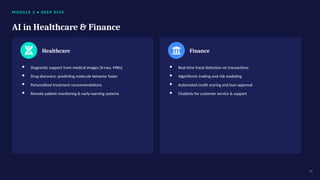
AI in Healthcare & Finance
Healthcare
✦ Diagnostic support from medical images (X-rays, MRIs)
✦ Drug discovery: predicting molecule behavior faster
✦ Personalized treatment recommendations
✦ Remote patient monitoring & early-warning systems
Finance
✦ Real-time fraud detection on transactions
✦ Algorithmic trading and risk modeling
✦ Automated credit scoring and loan approval
✦ Chatbots for customer service & support
19
20.
M O DU L E 2 • D E E P D I V E
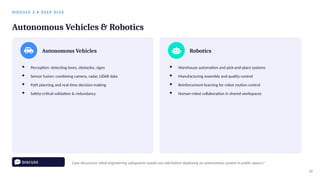
Autonomous Vehicles & Robotics
Autonomous Vehicles
✦ Perception: detecting lanes, obstacles, signs
✦ Sensor fusion: combining camera, radar, LiDAR data
✦ Path planning and real-time decision-making
✦ Safety-critical validation & redundancy
Robotics
✦ Warehouse automation and pick-and-place systems
✦ Manufacturing assembly and quality control
✦ Reinforcement learning for robot motion control
✦ Human-robot collaboration in shared workspaces
DISCUSS Case discussion: what engineering safeguards would you add before deploying an autonomous system in public spaces?
20
21.
M O DU L E 3
AI vs Machine Learning vs Deep Learning
Clarifying the hierarchy so the terms stop being interchangeable
21
22.
M O DU L E 3 • T H EO RY
Why These Terms Get Confused
✦ Media and marketing often use “AI,” “ML,” and “DL” interchangeably — but they describe nested, distinct concepts
✦ Every Deep Learning system is Machine Learning; every Machine Learning system is AI — but not the reverse
✦ Knowing the difference helps you choose the right tool: not every problem needs a neural network
✦ This distinction also matters for explaining your engineering decisions to non-technical stakeholders
22
23.
M O DU L E 3 • T H EO RY
Artificial Intelligence — Defined In Depth
The broadest layer
✦ AI: any technique that enables computers to mimic human cognitive functions — reasoning, problem-solving, perception
✦ Includes both rule-based (symbolic) systems and modern learning-based systems
✦ Examples: rule-based chess engines, expert systems, search algorithms, and every ML/DL system built on top
✦ Goal: produce useful, intelligent behavior — regardless of the underlying method
23
24.
M O DU L E 3 • T H EO RY
Machine Learning — Defined & Its Three Types
A subset of AI that learns patterns from data
✦ ML: algorithms that improve their performance on a task by learning from data, rather than following explicit rules
✦ Supervised Learning: learns from labeled data to predict outputs (e.g., house price prediction, spam detection)
✦ Unsupervised Learning: finds hidden structure in unlabeled data (e.g., customer segmentation, clustering)
✦ Reinforcement Learning: learns by trial-and-error through rewards and penalties (e.g., game-playing agents, robotics control)
24
25.
M O DU L E 3 • T H EO RY
Deep Learning — Defined & Neural Network Basics
A subset of ML using layered neural networks
✦ DL: a family of ML techniques using artificial neural networks with many (“deep”) layers to learn complex patterns
✦ Each layer transforms its input into increasingly abstract representations — edges → shapes → objects, for example
✦ Requires large datasets and significant compute (GPUs/TPUs) to train effectively
✦ Excels at unstructured data: images, audio, and natural language — where hand-crafted features are hard to design
25
26.
M O DU L E 3 • R E C A P
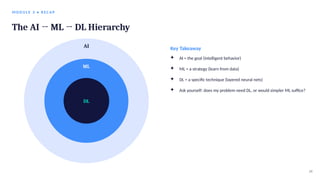
The AI → ML → DL Hierarchy
AI
ML
DL
Key Takeaway
✦ AI = the goal (intelligent behavior)
✦ ML = a strategy (learn from data)
✦ DL = a specific technique (layered neural nets)
✦ Ask yourself: does my problem need DL, or would simpler ML suffice?
26
27.
M O DU L E 3 • R E C A P
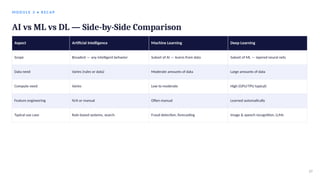
AI vs ML vs DL — Side-by-Side Comparison
Aspect Artificial Intelligence Machine Learning Deep Learning
Scope Broadest — any intelligent behavior Subset of AI — learns from data Subset of ML — layered neural nets
Data need Varies (rules or data) Moderate amounts of data Large amounts of data
Compute need Varies Low to moderate High (GPU/TPU typical)
Feature engineering N/A or manual Often manual Learned automatically
Typical use case Rule-based systems, search Fraud detection, forecasting Image & speech recognition, LLMs
27
28.
M O DU L E 3 • R E C A P
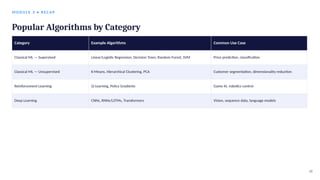
Popular Algorithms by Category
Category Example Algorithms Common Use Case
Classical ML — Supervised Linear/Logistic Regression, Decision Trees, Random Forest, SVM Price prediction, classification
Classical ML — Unsupervised K-Means, Hierarchical Clustering, PCA Customer segmentation, dimensionality reduction
Reinforcement Learning Q-Learning, Policy Gradients Game AI, robotics control
Deep Learning CNNs, RNNs/LSTMs, Transformers Vision, sequence data, language models
28
29.
M O DU L E 3 • R E C A P
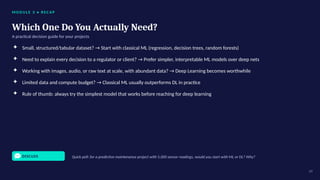
Which One Do You Actually Need?
A practical decision guide for your projects
✦ Small, structured/tabular dataset? → Start with classical ML (regression, decision trees, random forests)
✦ Need to explain every decision to a regulator or client? → Prefer simpler, interpretable ML models over deep nets
✦ Working with images, audio, or raw text at scale, with abundant data? → Deep Learning becomes worthwhile
✦ Limited data and compute budget? → Classical ML usually outperforms DL in practice
✦ Rule of thumb: always try the simplest model that works before reaching for deep learning
DISCUSS Quick poll: for a predictive-maintenance project with 5,000 sensor readings, would you start with ML or DL? Why?
29
30.
M O DU L E 4
AI Ethics & Responsible AI
The responsibility that comes with building intelligent systems
30
31.
M O DU L E 4 • T H EO RY
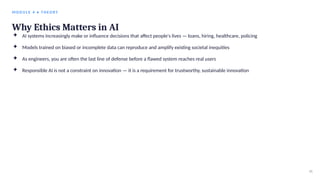
Why Ethics Matters in AI
✦ AI systems increasingly make or influence decisions that affect people's lives — loans, hiring, healthcare, policing
✦ Models trained on biased or incomplete data can reproduce and amplify existing societal inequities
✦ As engineers, you are often the last line of defense before a flawed system reaches real users
✦ Responsible AI is not a constraint on innovation — it is a requirement for trustworthy, sustainable innovation
31
32.
M O DU L E 4 • C A S E S T U DY
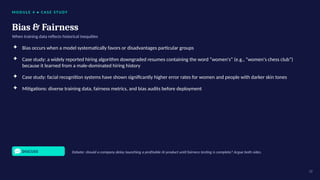
Bias & Fairness
When training data reflects historical inequities
✦ Bias occurs when a model systematically favors or disadvantages particular groups
✦ Case study: a widely reported hiring algorithm downgraded resumes containing the word “women's” (e.g., “women's chess club”)
because it learned from a male-dominated hiring history
✦ Case study: facial recognition systems have shown significantly higher error rates for women and people with darker skin tones
✦ Mitigations: diverse training data, fairness metrics, and bias audits before deployment
DISCUSS Debate: should a company delay launching a profitable AI product until fairness testing is complete? Argue both sides.
32
33.
M O DU L E 4 • T H EO RY
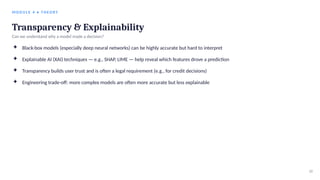
Transparency & Explainability
Can we understand why a model made a decision?
✦ Black-box models (especially deep neural networks) can be highly accurate but hard to interpret
✦ Explainable AI (XAI) techniques — e.g., SHAP, LIME — help reveal which features drove a prediction
✦ Transparency builds user trust and is often a legal requirement (e.g., for credit decisions)
✦ Engineering trade-off: more complex models are often more accurate but less explainable
33
34.
M O DU L E 4 • T H EO RY
Privacy & Data Protection
AI systems run on data — often personal data
✦ Training data frequently includes sensitive personal information: health records, financial history, location
✦ Key principles: data minimization, anonymization, and informed consent
✦ Regulations like GDPR (EU) and India's DPDP Act impose legal obligations on how personal data is collected and used
✦ Engineering practice: encrypt data at rest and in transit; limit access; avoid unnecessary data retention
34
35.
M O DU L E 4 • T H EO RY
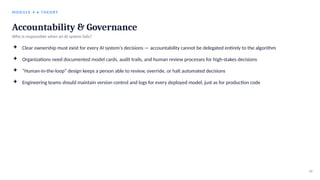
Accountability & Governance
Who is responsible when an AI system fails?
✦ Clear ownership must exist for every AI system's decisions — accountability cannot be delegated entirely to the algorithm
✦ Organizations need documented model cards, audit trails, and human review processes for high-stakes decisions
✦ “Human-in-the-loop” design keeps a person able to review, override, or halt automated decisions
✦ Engineering teams should maintain version control and logs for every deployed model, just as for production code
35
36.
M O DU L E 4 • T H EO RY
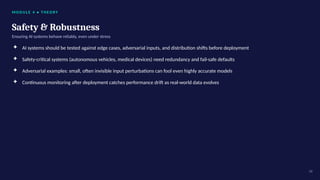
Safety & Robustness
Ensuring AI systems behave reliably, even under stress
✦ AI systems should be tested against edge cases, adversarial inputs, and distribution shifts before deployment
✦ Safety-critical systems (autonomous vehicles, medical devices) need redundancy and fail-safe defaults
✦ Adversarial examples: small, often invisible input perturbations can fool even highly accurate models
✦ Continuous monitoring after deployment catches performance drift as real-world data evolves
36
37.
M O DU L E 4 • F R A M E WO R K
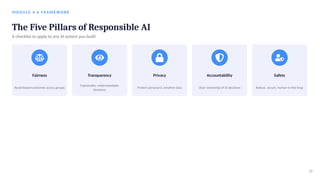
The Five Pillars of Responsible AI
A checklist to apply to any AI system you build
Fairness
Avoid biased outcomes across groups
Transparency
Explainable, understandable
decisions
Privacy
Protect personal & sensitive data
Accountability
Clear ownership of AI decisions
Safety
Robust, secure, human-in-the-loop
37
38.
M O DU L E 4 • G OV E R N A N C E
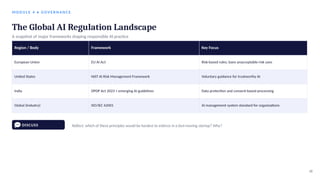
The Global AI Regulation Landscape
A snapshot of major frameworks shaping responsible AI practice
Region / Body Framework Key Focus
European Union EU AI Act Risk-based rules; bans unacceptable-risk uses
United States NIST AI Risk Management Framework Voluntary guidance for trustworthy AI
India DPDP Act 2023 + emerging AI guidelines Data protection and consent-based processing
Global (Industry) ISO/IEC 42001 AI management system standard for organizations
DISCUSS Reflect: which of these principles would be hardest to enforce in a fast-moving startup? Why?
38
39.
M O DU L E 5
Hands-On: AI Development Environment
From zero to a working AI workflow in Google Colab or Jupyter
39
40.
M O DU L E 5 • S E T U P
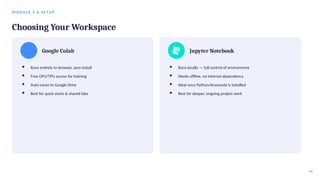
Choosing Your Workspace
Google Colab
✦ Runs entirely in-browser, zero install
✦ Free GPU/TPU access for training
✦ Auto-saves to Google Drive
✦ Best for quick starts & shared labs
Jupyter Notebook
✦ Runs locally — full control of environment
✦ Works offline, no internet dependency
✦ Ideal once Python/Anaconda is installed
✦ Best for deeper, ongoing project work
40
41.
M O DU L E 5 • S E T U P
Setting Up Google Colab
Five steps to your first notebook
✦ 1. Go to colab.research.google.com and sign in with a Google account
✦ 2. Click “New Notebook” to create a fresh .ipynb file
✦ 3. Rename the notebook (top-left) to something meaningful, e.g. Lecture1_AI_Workflow
✦ 4. Go to Runtime → Change runtime type → select GPU if your task needs one
✦ 5. Click the “+ Code” button to add a cell, then press Shift+Enter to run it
HANDS-ON Everyone opens Colab now and creates a notebook named after their roll number.
41
42.
M O DU L E 5 • S E T U P
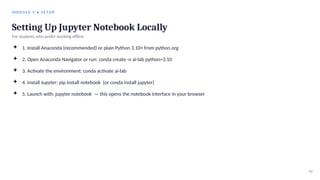
Setting Up Jupyter Notebook Locally
For students who prefer working offline
✦ 1. Install Anaconda (recommended) or plain Python 3.10+ from python.org
✦ 2. Open Anaconda Navigator or run: conda create -n ai-lab python=3.10
✦ 3. Activate the environment: conda activate ai-lab
✦ 4. Install Jupyter: pip install notebook (or conda install jupyter)
✦ 5. Launch with: jupyter notebook — this opens the notebook interface in your browser
42
43.
M O DU L E 5 • H A N D S - O N
Package Installation
Get every student's environment ready with the core AI/ML stack
# Core AI / ML packages
!pip install numpy pandas matplotlib
!pip install scikit-learn seaborn
!pip install tensorflow torch
# Verify installation
import numpy as np
import pandas as pd
import sklearn
print(np.__version__, pd.__version__)
Facilitator Notes
✦ Colab: most packages pre-installed — only add what's missing
✦ Jupyter (local): create a virtual environment first
✦ Always verify with a version-check print statement
✦ Restart runtime/kernel after installing new packages
HANDS-ON
Run the install cell live and screenshot
the version-check output for your lab
log.
43
44.
M O DU L E 5 • H A N D S - O N
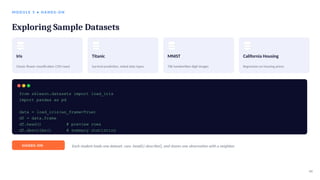
Exploring Sample Datasets
Iris
Classic flower classification (150 rows)
Titanic
Survival prediction, mixed data types
MNIST
70k handwritten digit images
California Housing
Regression on housing prices
from sklearn.datasets import load_iris
import pandas as pd
data = load_iris(as_frame=True)
df = data.frame
df.head() # preview rows
df.describe() # summary statistics
HANDS-ON Each student loads one dataset, runs .head()/.describe(), and shares one observation with a neighbor.
44
45.
M O DU L E 5 • H A N D S - O N
Visualizing Your Data
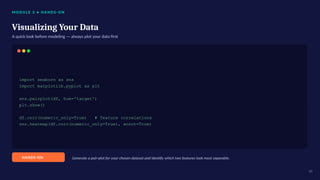
A quick look before modeling — always plot your data first
import seaborn as sns
import matplotlib.pyplot as plt
sns.pairplot(df, hue='target')
plt.show()
df.corr(numeric_only=True) # feature correlations
sns.heatmap(df.corr(numeric_only=True), annot=True)
HANDS-ON Generate a pair-plot for your chosen dataset and identify which two features look most separable.
45
46.
M O DU L E 5 • H A N D S - O N
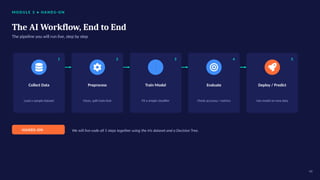
The AI Workflow, End to End
The pipeline you will run live, step by step
1
Collect Data
Load a sample dataset
2
Preprocess
Clean, split train/test
3
Train Model
Fit a simple classifier
4
Evaluate
Check accuracy / metrics
5
Deploy / Predict
Use model on new data
HANDS-ON We will live-code all 5 steps together using the Iris dataset and a Decision Tree.
46
47.
M O DU L E 5 • H A N D S - O N
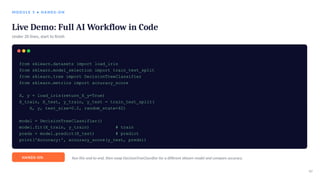
Live Demo: Full AI Workflow in Code
Under 20 lines, start to finish
from sklearn.datasets import load_iris
from sklearn.model_selection import train_test_split
from sklearn.tree import DecisionTreeClassifier
from sklearn.metrics import accuracy_score
X, y = load_iris(return_X_y=True)
X_train, X_test, y_train, y_test = train_test_split(
X, y, test_size=0.2, random_state=42)
model = DecisionTreeClassifier()
model.fit(X_train, y_train) # train
preds = model.predict(X_test) # predict
print('Accuracy:', accuracy_score(y_test, preds))
HANDS-ON Run this end-to-end, then swap DecisionTreeClassifier for a different sklearn model and compare accuracy.
47
48.
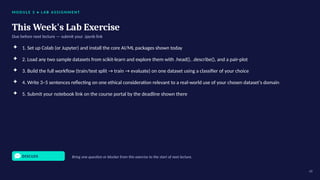
M O DU L E 5 • L A B A S S I G N M E N T
This Week's Lab Exercise
Due before next lecture — submit your .ipynb link
✦ 1. Set up Colab (or Jupyter) and install the core AI/ML packages shown today
✦ 2. Load any two sample datasets from scikit-learn and explore them with .head(), .describe(), and a pair-plot
✦ 3. Build the full workflow (train/test split → train → evaluate) on one dataset using a classifier of your choice
✦ 4. Write 3–5 sentences reflecting on one ethical consideration relevant to a real-world use of your chosen dataset's domain
✦ 5. Submit your notebook link on the course portal by the deadline shown there
DISCUSS Bring one question or blocker from this exercise to the start of next lecture.
48
49.
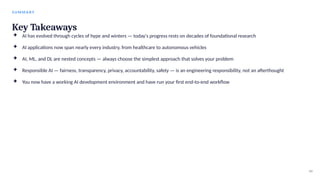
S U MM A RY
Key Takeaways
✦ AI has evolved through cycles of hype and winters — today's progress rests on decades of foundational research
✦ AI applications now span nearly every industry, from healthcare to autonomous vehicles
✦ AI, ML, and DL are nested concepts — always choose the simplest approach that solves your problem
✦ Responsible AI — fairness, transparency, privacy, accountability, safety — is an engineering responsibility, not an afterthought
✦ You now have a working AI development environment and have run your first end-to-end workflow
49
50.
Thank You
Questions •Discussion • Lab Support
Next lecture: Supervised Learning — Regression & Classification in depth
50

 Most read

 Most read
 Most read