Foundations of AI and ML: Neural Networks and Activation Functions Explained
1.
Sanjivani Rural EducationSociety’s
Sanjivani College of Engineering, Kopargaon-423603
(An Autonomous Institute Affiliated to Savitribai Phule Pune University, Pune)
NAAC ‘A’ Grade Accredited, ISO 9001:2015 Certified
Department of Mechanical Engineering
Subject : Foundations of AI and ML
Class : T.Y. Mechanical
Subject Code : PEME 312D
Unit 4 : Optimization and Neural Foundations
By
V. P. Bhaurkar
Department of Mechanical Engineering
2025 – 26 (sem – 6)
2.
V. P. BhaurkarAI ML (T. Y. Mechanical)
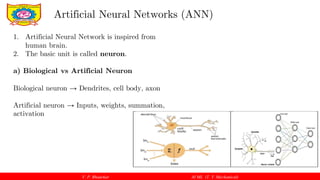
1. Artificial Neural Network is inspired from
human brain.
2. The basic unit is called neuron.
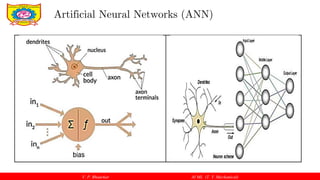
a) Biological vs Artificial Neuron
Biological neuron → Dendrites, cell body, axon
Artificial neuron → Inputs, weights, summation,
activation
Artificial Neural Networks (ANN)
3.
V. P. BhaurkarAI ML (T. Y. Mechanical)
Artificial Neural Networks (ANN)
4.
V. P. BhaurkarAI ML (T. Y. Mechanical)
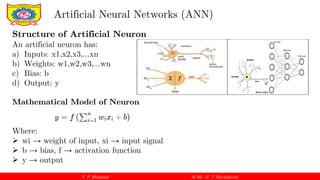
Structure of Artificial Neuron
An artificial neuron has:
a) Inputs: x1,x2,x3,...xn
b) Weights: w1,w2,w3,...wn
c) Bias: b
d) Output: y
Mathematical Model of Neuron
Where:
wi → weight of input, xi → input signal
b → bias, f → activation function
y → output
Artificial Neural Networks (ANN)
5.
V. P. BhaurkarAI ML (T. Y. Mechanical)
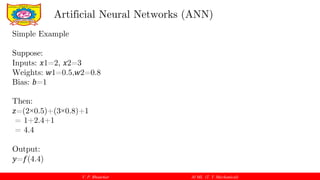
Simple Example
Suppose:
Inputs: 𝑥1=2, 𝑥2=3
Weights: 𝑤1=0.5,𝑤2=0.8
Bias: 𝑏=1
Then:
𝑧=(2×0.5)+(3×0.8)+1
= 1+2.4+1
= 4.4
Output:
𝑦=𝑓(4.4)
Artificial Neural Networks (ANN)
6.
V. P. BhaurkarAI ML (T. Y. Mechanical)
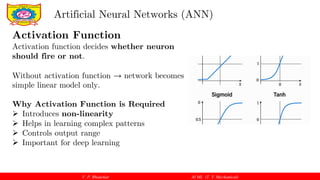
Activation Function
Activation function decides whether neuron
should fire or not.
Without activation function → network becomes
simple linear model only.
Why Activation Function is Required
Introduces non-linearity
Helps in learning complex patterns
Controls output range
Important for deep learning
Artificial Neural Networks (ANN)
7.
V. P. BhaurkarAI ML (T. Y. Mechanical)
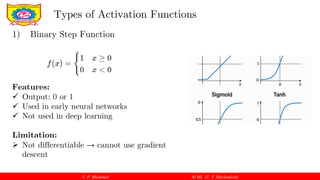
1) Binary Step Function
Features:
Output: 0 or 1
Used in early neural networks
Not used in deep learning
Limitation:
Not differentiable → cannot use gradient
descent
Types of Activation Functions
8.
V. P. BhaurkarAI ML (T. Y. Mechanical)
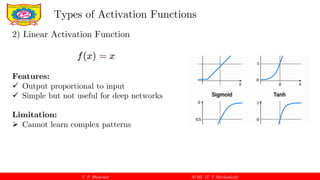
2) Linear Activation Function
Features:
Output proportional to input
Simple but not useful for deep networks
Limitation:
Cannot learn complex patterns
Types of Activation Functions
9.
V. P. BhaurkarAI ML (T. Y. Mechanical)
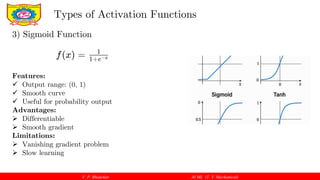
3) Sigmoid Function
Features:
Output range: (0, 1)
Smooth curve
Useful for probability output
Advantages:
Differentiable
Smooth gradient
Limitations:
Vanishing gradient problem
Slow learning
Types of Activation Functions
10.
V. P. BhaurkarAI ML (T. Y. Mechanical)
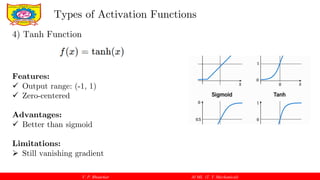
4) Tanh Function
Features:
Output range: (-1, 1)
Zero-centered
Advantages:
Better than sigmoid
Limitations:
Still vanishing gradient
Types of Activation Functions
11.
V. P. BhaurkarAI ML (T. Y. Mechanical)
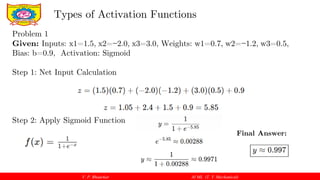
Problem 1
Given: Inputs: x1=1.5, x2=−2.0, x3=3.0, Weights: w1=0.7, w2=−1.2, w3=0.5,
Bias: b=0.9, Activation: Sigmoid
Step 1: Net Input Calculation
Step 2: Apply Sigmoid Function
Types of Activation Functions
Final Answer:
12.
V. P. BhaurkarAI ML (T. Y. Mechanical)
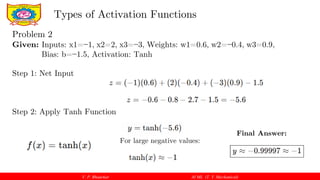
Problem 2
Given: Inputs: x1=−1, x2=2, x3=−3, Weights: w1=0.6, w2=−0.4, w3=0.9,
Bias: b=−1.5, Activation: Tanh
Step 1: Net Input
Step 2: Apply Tanh Function
Types of Activation Functions
Final Answer:
For large negative values:
 Most read
 Most read
 Most read