Foundations and Future of AI & Autonomous Systems: From Basics to Machine Autonomy by Adeel Ali
An educational overview covering AI definitions, evolution, core methods, autonomous systems, applications, challenges, ethics, and future trends toward agentic AI and human-AI collaboration.
Foundations and Future of AI & Autonomous Systems: From Basics to Machine Autonomy by Adeel Ali
1.
A R TI F I C I A L I N T E L L I G E N C E
AI & Autonomous Systems
Foundations, Architectures, and the Path Toward Machine Autonomy
An Educational Overview
2.
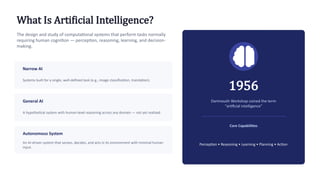
What Is ArtificialIntelligence?
The design and study of computational systems that perform tasks normally
requiring human cognition — perception, reasoning, learning, and decision-
making.
Narrow AI
Systems built for a single, well-defined task (e.g., image classification, translation).
General AI
A hypothetical system with human-level reasoning across any domain — not yet realized.
Autonomous System
An AI-driven system that senses, decides, and acts in its environment with minimal human
input.
1956
Dartmouth Workshop coined the term
“artificial intelligence”
Core Capabilities
Perception • Reasoning • Learning • Planning • Action
3.
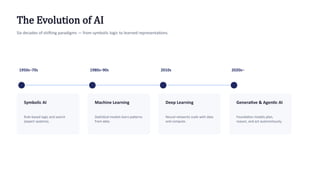
The Evolution ofAI
Six decades of shifting paradigms — from symbolic logic to learned representations.
1950s–70s
Symbolic AI
Rule-based logic and search
(expert systems).
1980s–90s
Machine Learning
Statistical models learn patterns
from data.
2010s
Deep Learning
Neural networks scale with data
and compute.
2020s–
Generative & Agentic AI
Foundation models plan,
reason, and act autonomously.
4.
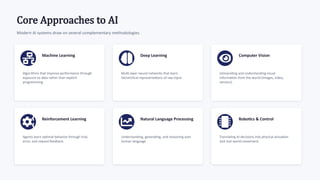
Core Approaches toAI
Modern AI systems draw on several complementary methodologies.
Machine Learning
Algorithms that improve performance through
exposure to data rather than explicit
programming.
Deep Learning
Multi-layer neural networks that learn
hierarchical representations of raw input.
Computer Vision
Interpreting and understanding visual
information from the world (images, video,
sensors).
Reinforcement Learning
Agents learn optimal behavior through trial,
error, and reward feedback.
Natural Language Processing
Understanding, generating, and reasoning over
human language.
Robotics & Control
Translating AI decisions into physical actuation
and real-world movement.
5.
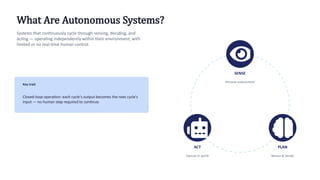
What Are AutonomousSystems?
Systems that continuously cycle through sensing, deciding, and
acting — operating independently within their environment, with
limited or no real-time human control.
Key trait
Closed-loop operation: each cycle's output becomes the next cycle's
input — no human step required to continue.
SENSE
Perceive environment
PLAN
Reason & decide
ACT
Execute in world
6.
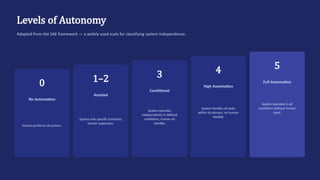
Levels of Autonomy
Adaptedfrom the SAE framework — a widely used scale for classifying system independence.
0
No Automation
Human performs all actions.
1–2
Assisted
System aids specific functions;
human supervises.
3
Conditional
System operates
independently in defined
conditions; human on
standby.
4
High Automation
System handles all tasks
within its domain, no human
needed.
5
Full Automation
System operates in all
conditions without human
input.
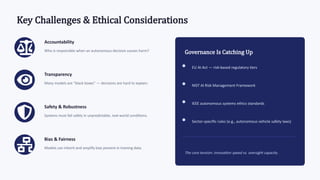
Key Challenges &Ethical Considerations
Accountability
Who is responsible when an autonomous decision causes harm?
Transparency
Many models are “black boxes” — decisions are hard to explain.
Safety & Robustness
Systems must fail safely in unpredictable, real-world conditions.
Bias & Fairness
Models can inherit and amplify bias present in training data.
Governance Is Catching Up
EU AI Act — risk-based regulatory tiers
NIST AI Risk Management Framework
IEEE autonomous systems ethics standards
Sector-specific rules (e.g., autonomous vehicle safety laws)
The core tension: innovation speed vs. oversight capacity.
9.
Where This IsHeaded
The frontier is shifting from AI that predicts to AI that acts.
Agentic AI Systems that plan multi-step tasks and use tools with minimal supervision.
Human-AI Teaming Autonomy paired with meaningful human oversight (“human-on-the-loop”).
Standardized Safety Testing Formal verification and red-teaming becoming standard practice.
Cross-Sector Regulation Convergence toward shared international norms for autonomous systems.