Foundations and Characteristics of Learner-Centered Teaching: Paradigm Shift in Education
Explore the shift from teacher-centered to learner-centered teaching, educational philosophies, key characteristics, and supporting research highlighting improved student outcomes, autonomy, and engagement.
Foundations and Characteristics of Learner-Centered Teaching: Paradigm Shift in Education
1.
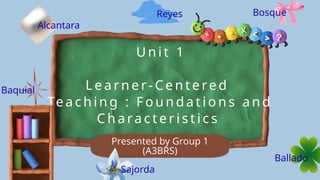
U n it 1
L e a r n e r - C e n t e re d
Te a c h i n g : F o u n d a t i o n s a n d
C h a ra c t e r i s t i c s
Presented by Group 1
(A3BRS)
Alcantara
Ballado
Bosque
Baquial
Sajorda
Reyes
2.
At the Endof this Lesson, learners
should be able to learn the following :
• Identify the difference between
Teacher Centered Teaching and
Learner Centered Teaching.
• Being Adaptive to Change and
Shifting from Teacher Centered to
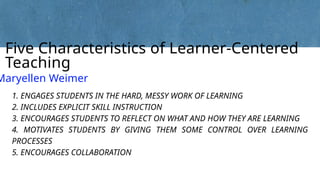
Learner Centered.
• Professionally Apply the Dimensions
of Learner Centered Teaching .
Learning
Objective
s
Teacher-centered teaching isa
traditional model where the teacher is
the main source of knowledge and
authority. This approach aims for
mastery of content, and the
development of discipline and
respect for authority.
Teacher-Centred
Teaching
8.
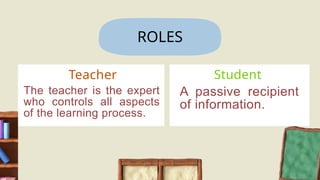
ROLES
The teacher isthe expert
who controls all aspects
of the learning process.
Teacher
A passive recipient
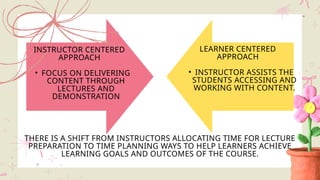
of information.
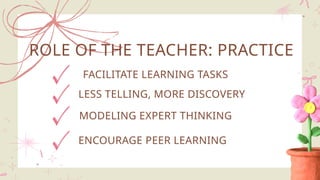
Student
9.
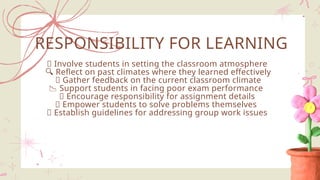
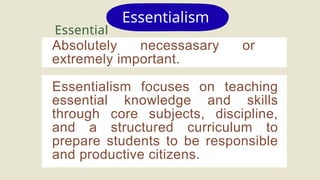
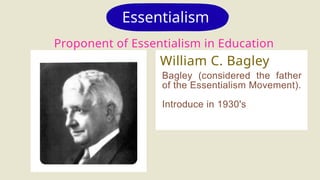
Essentialism
Absolutely necessasary or
extremelyimportant.
Essential
Essentialism focuses on teaching
essential knowledge and skills
through core subjects, discipline,
and a structured curriculum to
prepare students to be responsible
and productive citizens.
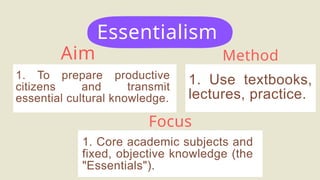
Essentialism
1. To prepareproductive
citizens and transmit
essential cultural knowledge.
Aim
Focus
Method
1. Core academic subjects and
fixed, objective knowledge (the
"Essentials").
1. Use textbooks,
lectures, practice.
12.
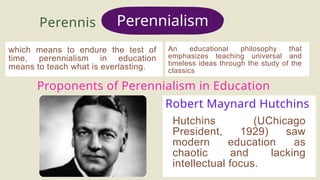
Perennialism
which means toendure the test of
time, perennialism in education
means to teach what is everlasting.
Perennis
An educational philosophy that
emphasizes teaching universal and
timeless ideas through the study of the
classics
Proponents of Perennialism in Education
Hutchins (UChicago
President, 1929) saw
modern education as
chaotic and lacking
intellectual focus.
Robert Maynard Hutchins
13.
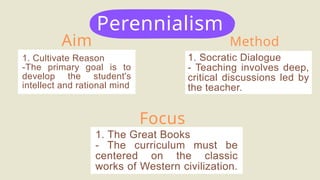
Perennialism
1. Cultivate Reason
-Theprimary goal is to
develop the student's
intellect and rational mind
Aim
Focus
Method
1. The Great Books
- The curriculum must be
centered on the classic
works of Western civilization.
1. Socratic Dialogue
- Teaching involves deep,
critical discussions led by
the teacher.
14.
Learner-Centered
Teaching
Refers to thevariety of
educational and instructional
approaches, learning
experiences and academic
support strategies
Intended to address
every students distinct
needs, interests and
their different cultural
backgrounds.
15.
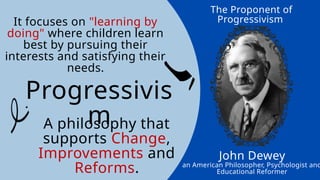
Progressivis
m
A philosophy that
supportsChange,
Improvements and
Reforms.
It focuses on "learning by
doing" where children learn
best by pursuing their
interests and satisfying their
needs.
The Proponent of
Progressivism
John Dewey
an American Philosopher, Psychologist and
Educational Reformer
16.
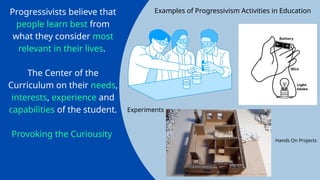
Progressivists believe that
peoplelearn best from
what they consider most
relevant in their lives.
The Center of the
Curriculum on their needs,
interests, experience and
capabilities of the student.
Provoking the Curiousity
Examples of Progressivism Activities in Education
Experiments
Hands On Projects
17.
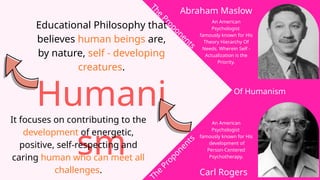
Humani
sm
Carl Rogers
Educational Philosophythat
believes human beings are,
by nature, self - developing
creatures.
It focuses on contributing to the
development of energetic,
positive, self-respecting and
caring human who can meet all
challenges.
T
h
e
P
r
o
p
o
n
e
n
t
s
h
e
P
r
o
p
o
n
e
n
t
s
Abraham Maslow
Of Humanism
An American
Psychologist
famously known for His
Theory Hierarchy Of
Needs. Wherein Self -
Actualization is the
Priority.
An American
Psychologist
famously known for His
development of
Person-Centered
Psychotherapy.
18.
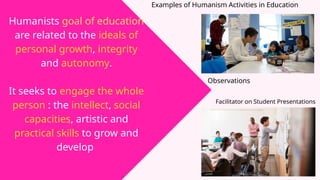
Humanists goal ofeducation
are related to the ideals of
personal growth, integrity
and autonomy.
It seeks to engage the whole
person : the intellect, social
capacities, artistic and
practical skills to grow and
develop
Examples of Humanism Activities in Education
Observations
Facilitator on Student Presentations
19.
C
o
n
s
t
r
u
c
t
i
v
i
s
m
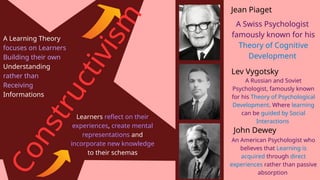
A Learning Theory
focuseson Learners
Building their own
Understanding
rather than
Receiving
Informations
Learners reflect on their
experiences, create mental
representations and
incorporate new knowledge
to their schemas
Jean Piaget
Lev Vygotsky
John Dewey
A Swiss Psychologist
famously known for his
Theory of Cognitive
Development
A Russian and Soviet
Psychologist, famously known
for his Theory of Psychological
Development. Where learning
can be guided by Social
Interactions
An American Psychologist who
believes that Learning is
acquired through direct
experiences rather than passive
absorption
20.
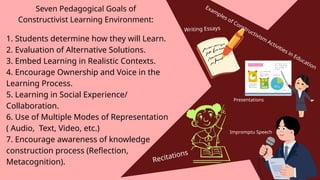
Examples of Constructivism
Activitiesin Education
Writing Essays
Recitations
Impromptu Speech
Presentations
Seven Pedagogical Goals of
Constructivist Learning Environment:
1. Students determine how they will Learn.
2. Evaluation of Alternative Solutions.
3. Embed Learning in Realistic Contexts.
4. Encourage Ownership and Voice in the
Learning Process.
5. Learning in Social Experience/
Collaboration.
6. Use of Multiple Modes of Representation
( Audio, Text, Video, etc.)
7. Encourage awareness of knowledge
construction process (Reflection,
Metacognition).
21.
SUPPORTING
research
"Supporting research" primarilyrefers to the body of credible, evidence-based
studies, data, and findings—typically sourced from peer-reviewed journals,
scholarly books, or authoritative institutional reports—that is used to validate and
strengthen a specific argument, claim, or hypothesis.
22.
"From Teaching toLearning—a New Paradigm
for Undergraduate Education"
Robert B. Barr & John Tagg
This seminal paper (1995) argues that the mission of higher education
must shift from the Instruction Paradigm (focusing on providing
instruction) to the Learning Paradigm (focusing on producing learning).
It posits that a college's main focus should be on outputs: what
knowledge and abilities students have actually acquired.
23.
"Five Characteristics ofLearner-Centered
Teaching"
Maryellen Weimer
Weimer (2012) provides the definitive practical framework by
outlining the five essential characteristics of LCT. These
characteristics challenge traditional assumptions by redefining the
role of the professor, the function of content, and the balance of
power in the classroom.
24.
Five Characteristics ofLearner-Centered
Teaching
Maryellen Weimer
1. ENGAGES STUDENTS IN THE HARD, MESSY WORK OF LEARNING
2. INCLUDES EXPLICIT SKILL INSTRUCTION
3. ENCOURAGES STUDENTS TO REFLECT ON WHAT AND HOW THEY ARE LEARNING
4. MOTIVATES STUDENTS BY GIVING THEM SOME CONTROL OVER LEARNING
PROCESSES
5. ENCOURAGES COLLABORATION
25.
"Active learning increasesstudent
performance in science, engineering, and
mathematics"
Scott Freeman et al. (2014)
This meta-analysis of 225 studies provides strong empirical
evidence that active learning strategies, a necessary component
of LCT, lead to lower failure rates and higher exam scores than
traditional lecturing.
26.
SUPPORTING RESEARCH
FINDINGS
Research consistentlydemonstrates that Learner-Centered
Teaching practices are more effective than traditional teacher-
centered approaches. The evidence supports superior outcomes
across several key areas:
27.
1. IMPROVED STUDENTLEARNING OUTCOMES
Research confirms that LCT methods are a path to better student outcomes
compared to teacher-centric methods. Specifically, the benefits include:
• Meaningful and Long-Term Understanding: LCT encourages students to
engage in deep learning approaches rather than superficial attempts at
knowledge acquisition. The emphasis shifts from simply "learning correct
answers" to "developing deeper understanding".
• Better Assessment Outcomes: Students achieve superior results on
assessments, particularly on conceptual understanding tests, reflecting their
ability to construct and transform content to make their own meaning out of it.
28.
2. DEVELOPING AUTONOMYAND LIFELONG LEARNING
LCT is essential for preparing students to function as independent professionals.
• Explicit Skill Instruction: LCT is supported by research that confirms learning
skills develop faster if they are taught explicitly along with the content. Learner-
centered teachers explicitly teach skills such as how to think, solve problems,
evaluate evidence, and analyze arguments.
• Independent, Lifelong Learning: The ultimate goal of LCT is to foster
independent, lifelong learning. By giving students responsibility and autonomy, LCT
generates intellectual growth that creates independent thinkers and learners.
Students are encouraged to reflect, analyze, and critique what they are learning and
how they are learning it.
29.
3. INCREASED MOTIVATIONAND ENGAGEMENT
The change in classroom dynamics under LCT directly impacts student motivation.
• Active Participation: LCT shifts the student role from passive to active. This
increased involvement is supported by research, which consistently confirms that
students can learn from and with each other through collaboration.
• Control and Responsibility: Learner-centered teaching motivates students by
giving them some control over learning processes. Sharing power through choices in
assignments or policies is an "ethically responsible way to share power with
students", which encourages them to accept responsibility for decisions they make
about their learning.
30.
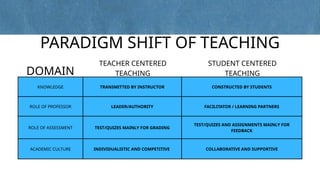
KNOWLEDGE TRANSMITTED BYINSTRUCTOR CONSTRUCTED BY STUDENTS
ROLE OF PROFESSOR LEADER/AUTHORITY FACILITATOR / LEARNING PARTNERS
ROLE OF ASSESSMENT TEST/QUIZES MAINLY FOR GRADING
TEST/QUIZES AND ASSIGNMENTS MAINLY FOR
FEEDBACK
ACADEMIC CULTURE INDIVIDUALISTIC AND COMPETITIVE COLLABORATIVE AND SUPPORTIVE
DOMAIN
TEACHER CENTERED
TEACHING
STUDENT CENTERED
TEACHING
PARADIGM SHIFT OF TEACHING
31.
ANONG SINABI NGMAMA NA
DONUT SA ANAK NYANG DONUT
NA NASA TAAS NG PUNO?
MAMA: NAK! BAVARIAN!
The shift fromteacher-centered to learner-centered
teaching, as promoted by DepEd’s K–12 Program,
the MATATAG Curriculum, and CHED’s Outcomes-
Based Education (OBE), is evidence-based and
necessary. However, this transition is often met with
resistance due to long-standing practices, limited
resources, and deeply rooted beliefs about teaching
and learning.
Resistance to change: managing the shift
34.
Many public-school teacherswere
trained and educated in a teacher-
centered environment, where the
teacher lectures and students listen,
copy, and memorize. This approach has
long been considered the “normal” way
of teaching.
1. Teachers being used to traditional methods
35.
Although DepEd, CHED,and schools conduct INSET
(In-Service Training), LAC (Learning Action Cell)
sessions, and professional development
programs, access is not always equal nationwide.
Some teachers, especially those in remote or highly
congested areas, may not receive:
• Sufficient training on learner-centered pedagogy
• Enough mentoring or coaching
• Updated teaching materials
2. Lack of training and institutional support
36.
Learner-centered teaching usuallyrequires learning
materials, flexible spaces, technology, and
instructional tools (e.g. internet, computers,
printing devices, manipulatives, and multimedia).
However, in many public schools:
• Class sizes are large
• Internet connection is slow or unavailable
• Learning materials are limited
• Classrooms are overcrowded
3. Limited resources in many public schools
37.
The shift fromteacher-centered to learner-centered
teaching is not merely a trend, but a necessary
transformation in education to meet the demands of the
21st century. Although this transition is challenged by
teachers’ long-standing habits, limited resources, and
students’ resistance to independent learning, research and
practice confirm that learner-centered approaches lead to
deeper understanding, stronger critical thinking, higher
engagement, and more meaningful learning outcomes.
Conclusion
• LEARNER-CENTERED INSTRUCTIONFOCUSES
ON WHAT STUDENTS ARE LEARNING, HOW
THEY ARE LEARNING, AND HOW THEY USE
THE ACQUIRED LEARNING.
• BLUMBERG (2009) THROUGHLY DISCUSSES
FIVE DIMENSIONS, OR AREAS, OF LEARNER-
CENTERED TECHING.
DIMENSIONS OF
LCT
40.
1. CONTENT ANDITS
FUNCTIONS
“I DESERVE AN EXPLANATION… WHAT’S THE ROLE OF
CONTENT IN INSTRUCTION?”
• CONTENT IS THE FOUNDATION OF
TEACHING AND LEARNING.
• It guides instructional decisions: what
to teach, how to teach, and why it
matters.
41.
COMMON ASSUMPTION: MOREIS
BETTER.
HOW MUCH CONTENT IS
IMPORTANT??
• ENTRY LEVEL VS. ADVANCE COURSES
• MEMORIZATION VS. UNDERSTANDING
42.
FUTURE USES OFCONTENT:
• NEED TO CONTINUE TO LEARN NEW CONTENT
(ITS IMPOSSIBLE TO TEACH EVERYTHING ABOUT
ANYTHING)
• OLD UNDERSTANDINGS REPLACED BY NEWER
UNDERSTANDING (NEED TO RELEARN PAST
CONTENT)
43.
IN A LEARNER-CENTEREDENVIRONMENT,
LEARNERS ARE AWARE OF THE REASON FOR
LEARNING THE CONTENT, DEVELOP WAYS TO
LEARN ABOUT THE CONTENT THAT ARE
APPROPRIATE FOR THE DISCIPLINE, AND PRACTICE
SOLVING REAL WORLD PROBLEMS BASED UPON
THE CONTENT.
IN THE CLASSROOM SCENARIO, CONTENT
KNOWLEDGE ARE CHARACTERIZED BY TWO-
SURFACE AND DEEP LEARNING.
1. CONTENT AND ITS
FUNCTIONS
44.
• WHEN STUDENTCONCENTRATED IN MEMORIZING THE
FACTS, FOCUSED ON THE DISCRETE ELEMENTS OF THE
READING, FAILED TO DIFFERENTIATE BETWEEN EVIDENCE
AND INFORMATIONAND SAW THE TASK AS EXTERNAL
IMPOSITION, THIS APPROACH IS SURFACE LEARNING.
• WHEN THE STUDENTS FOCUSED ON WHAT THE AUTHOR
MEANT, RELATED NEW INFORMATION TO WHAT THEY
ALREADY KNEW AND HAD EXPIRIENCED, WORKED TO
ORGANIZE AND STRUCTURE THE CONTENT AND SAW THE
READING AS AN IMPORTANT SOURCE OF LEARNING, THIS IS
CHARACTERIZED AS DEEP LEARNING.
1. CONTENT AND ITS
FUNCTIONS
45.
2. ROLE OFTHE TEACHER
THE LEARNER-CENTERED CLASSROOM INVOLVES
CHANGES IN THE ROLES AND RESPONSIBILITIES OF
LEARNERS AND INSTRUCTOR, IN THE DELIVERY OF
INSTRUCTIONAL STRATEGIES, AND LEARNING
ITSELF.
46.
INSTRUCTOR CENTERED
APPROACH
• FOCUSON DELIVERING
CONTENT THROUGH
LECTURES AND
DEMONSTRATION
LEARNER CENTERED
APPROACH
• INSTRUCTOR ASSISTS THE
STUDENTS ACCESSING AND
WORKING WITH CONTENT.
THERE IS A SHIFT FROM INSTRUCTORS ALLOCATING TIME FOR LECTURE
PREPARATION TO TIME PLANNING WAYS TO HELP LEARNERS ACHIEVE
LEARNING GOALS AND OUTCOMES OF THE COURSE.
47.
ROLE OF THETEACHER: PRACTICE
FACILITATE LEARNING TASKS
LESS TELLING, MORE DISCOVERY
MODELING EXPERT THINKING
ENCOURAGE PEER LEARNING
48.
3. RESPONSIBILITY FORLEARNING
LEARNING IS AN ACTIVE SEARCH FOR
MEANING BY THE LEARNER. IT IS
CONSTRUCTING KNOWLEDGE RATHER
THAN PASSIVELY RECEIVING IT-
SHAPING AS WELL AS BEING SHAPED
BY EXPERIENCES.
49.
RESPONSIBILITY FOR LEARNING
🏫Involve students in setting the classroom atmosphere
🔍 Reflect on past climates where they learned effectively
💬 Gather feedback on the current classroom climate
📉 Support students in facing poor exam performance
✅ Encourage responsibility for assignment details
💪 Empower students to solve problems themselves
📏 Establish guidelines for addressing group work issues
50.
In a learner-centeredcourse, along with summative assessments, one
might also see multiple projects with self-assessment and reflection, self-
tests, clickers for feedback about student understanding of concepts, etc.
- Review periods
focus on integration of content, organization, identifying emphasis
- Use the exam to promote learning
Provide additional short answer questions
Have students write a question that they expected, but did not show up
4.PURPOSE & PROCESS OF
ASSESSMENT
51.
- Debriefing theexam
- Self-assessment activities
Increase sense of responsibility and confidence
in assessing their own understanding
- Peer reviewed activities
52.
LEARNER-CENTERED TEACHING DOESNOT REMOVE THE
POWER OR AUTHORITY OF THE TEACHER. RATHER, LEARNERS
SHARE SOME OF THE POWER IN THE CLASSROOM. LEARNERS
HAVE THE OPTION TO EXPLORE CONTENT OUTSIDE THE
BOUNDARIES OF WHAT INSTRUCTORS HAVE PROVIDED.
Combination of faculty and student decision making
Benefits
Students gain confidence initial resistance changes to
increased motivation
Increases feeling of ownership of class
5.BALANCING OF POWER
53.
Practical examples:
Assignments selectedfrom array of options
(Fixed due dates - own scheduling decisions)
Syllabus development
General course policies and evaluation methods
Topics covered.


 Most read