Fostering Workplace and Institutional Inclusion and Diversity for Organizational Success
Explores strategies, benefits, and challenges of diversity, equity, and inclusion in Canadian workplaces and institutions to create empowering environments and drive innovation.
Fostering Workplace and Institutional Inclusion and Diversity for Organizational Success
1.
1
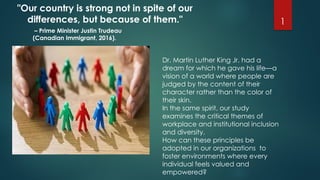
"Our country isstrong not in spite of our
differences, but because of them."
– Prime Minister Justin Trudeau
(Canadian Immigrant, 2016).
Dr. Martin Luther King Jr. had a
dream for which he gave his life—a
vision of a world where people are
judged by the content of their
character rather than the color of
their skin.
In the same spirit, our study
examines the critical themes of
workplace and institutional inclusion
and diversity.
How can these principles be
adopted in our organizations to
foster environments where every
individual feels valued and
empowered?
3
To truly benefit,
yourcompany
needs a vibrant
culture that
celebrates
differences and
fosters belonging.
Diversity is
the secret
to
unlocking
hidden
talent that
drives
innovation.
That’s the power
of a truly inclusive
environment,
making diversity
the foundation of
success.
Imagine a
workplace
where every
voice is
valued,
sparking
creativity and
propelling
your
company
forward.
4.
4
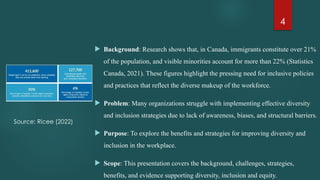
Background: Researchshows that, in Canada, immigrants constitute over 21%
of the population, and visible minorities account for more than 22% (Statistics
Canada, 2021). These figures highlight the pressing need for inclusive policies
and practices that reflect the diverse makeup of the workforce.
Problem: Many organizations struggle with implementing effective diversity
and inclusion strategies due to lack of awareness, biases, and structural barriers.
Purpose: To explore the benefits and strategies for improving diversity and
inclusion in the workplace.
Scope: This presentation covers the background, challenges, strategies,
benefits, and evidence supporting diversity, inclusion and equity.
Source: Ricee (2022)
5.
5
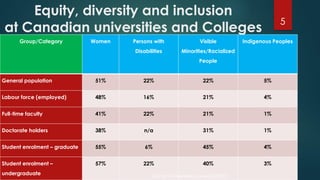
Equity, diversity andinclusion
at Canadian universities and Colleges
Group/Category Women Persons with
Disabilities
Visible
Minorities/Racialized
People
Indigenous Peoples
General population 51% 22% 22% 5%
Labour force (employed) 48% 16% 21% 4%
Full-time faculty 41% 22% 21% 1%
Doctorate holders 38% n/a 31% 1%
Student enrolment – graduate 55% 6% 45% 4%
Student enrolment –
undergraduate
57% 22% 40% 3%
Source: Universities Canada (2021)
6.
6
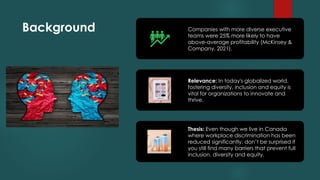
Background Companies withmore diverse executive
teams were 25% more likely to have
above-average profitability (McKinsey &
Company, 2021).
Relevance: In today's globalized world,
fostering diversity, inclusion and equity is
vital for organizations to innovate and
thrive.
Thesis: Even though we live in Canada
where workplace discrimination has been
reduced significantly, don’t be surprised if
you still find many barriers that prevent full
inclusion, diversity and equity.
7.
7
Defining
Diversity
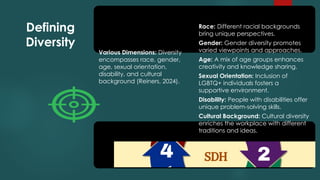
Various Dimensions: Diversity
encompassesrace, gender,
age, sexual orientation,
disability, and cultural
background (Reiners, 2024).
Race: Different racial backgrounds
bring unique perspectives.
Gender: Gender diversity promotes
varied viewpoints and approaches.
Age: A mix of age groups enhances
creativity and knowledge sharing.
Sexual Orientation: Inclusion of
LGBTQ+ individuals fosters a
supportive environment.
Disability: People with disabilities offer
unique problem-solving skills.
Cultural Background: Cultural diversity
enriches the workplace with different
traditions and ideas.
8.
8
Definitions
Defining Inclusion
Diversity vs. Inclusion: Diversity is
about representation, while inclusion is
about involvement and value.
Active Involvement: Inclusion means
actively engaging diverse groups in
decision-making and valuing their
contributions.
Importance: Inclusion ensures that
diverse perspectives are integrated into
organizational practices (McKinsey &
Company, 2020).
9.
9
Implementation
Plan
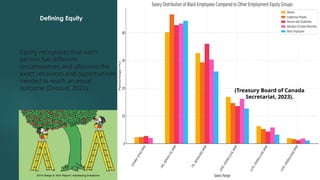
Black employees are
overrepresentedin the lower
salary range of $50,000 to $74,999
at 55.0%, compared to other
employment equity groups, while
being underrepresented in higher
salary ranges
(Treasury Board of Canada
Secretariat, 2023).
Equity recognizes that each
person has different
circumstances and allocates the
exact resources and opportunities
needed to reach an equal
outcome (Dressel, 2020).
Defining Equity
10.
10
Barriers
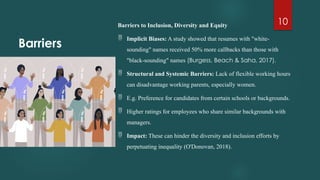
Barriers to Inclusion,Diversity and Equity
Implicit Biases: A study showed that resumes with "white-
sounding" names received 50% more callbacks than those with
"black-sounding" names (Burgess, Beach & Saha, 2017).
Structural and Systemic Barriers: Lack of flexible working hours
can disadvantage working parents, especially women.
E.g. Preference for candidates from certain schools or backgrounds.
Higher ratings for employees who share similar backgrounds with
managers.
Impact: These can hinder the diversity and inclusion efforts by
perpetuating inequality (O'Donovan, 2018).
11.
11
CONCLUSIONS
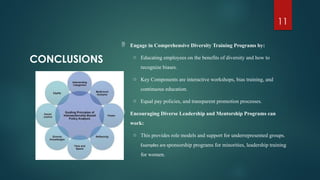
Engage inComprehensive Diversity Training Programs by:
o Educating employees on the benefits of diversity and how to
recognize biases.
o Key Components are interactive workshops, bias training, and
continuous education.
o Equal pay policies, and transparent promotion processes.
Encouraging Diverse Leadership and Mentorship Programs can
work:
o This provides role models and support for underrepresented groups.
Examples are sponsorship programs for minorities, leadership training
for women.
12.
12
References
Burgess, D.J., Beach, M. C., & Saha, S. (2017). Mindfulness practice: A promising approach to reducing the
effects of clinician implicit bias on patients. Patient Education and Counseling, 100(2), 372–376. doi:
10.1016/j.pec.2016.09.005
Dressel, P. (2020). Equity vs. Equality: What’s the Difference?
https://onlinepublichealth.gwu.edu/resources/equity-vs-equality/
McKinsey & Company (2020). Diversity wins: How inclusion matters. https://www.mckinsey.com/featured-
insights/diversity-and-inclusion/diversity-wins-how-inclusion-matters
O'Donovan, Deirdre. (2018). Diversity and Inclusion in the Workplace. https://10.1007/978-3-319-66864-2_4
Reiners B. (2024). 39 Types of Diversity in the Workplace You Need to Know https://builtin.com/diversity-
inclusion/types-of-diversity-in-the-workplace
Universities Canada (2021). Recent data on Equity, diversity and inclusion at Canadian universities.
https://www.univcan.ca/wp-content/uploads/2020/02/UC_2019_EDI-Stats_EN.pdf