Foreign Exchange
Management
MBA 4th Semester
Large Font Recreated PPT with Solved Questions and Case Studies
Prepared by
CA Suvidha Chaplot
SELO • Concepts • Numericals • MCQs • Case Study Solutions
01
MBA 4th Semester | Foreign Exchange Management 02
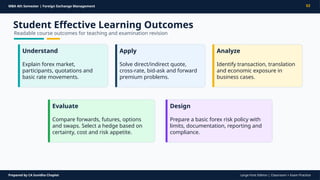
Student Effective Learning Outcomes
Readable course outcomes for teaching and examination revision
Prepared by CA Suvidha Chaplot Large Font Edition | Classroom + Exam Practice
Understand
Explain forex market,
participants, quotations and
basic rate movements.
Apply
Solve direct/indirect quote,
cross-rate, bid-ask and forward
premium problems.
Analyze
Identify transaction, translation
and economic exposure in
business cases.
Evaluate
Compare forwards, futures, options
and swaps. Select a hedge based on
certainty, cost and risk appetite.
Design
Prepare a basic forex risk policy with
limits, documentation, reporting and
compliance.
MBA 4th Semester | Foreign Exchange Management 03
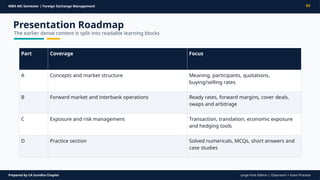
Presentation Roadmap
The earlier dense content is split into readable learning blocks
Prepared by CA Suvidha Chaplot Large Font Edition | Classroom + Exam Practice
Part Coverage Focus
A Concepts and market structure Meaning, participants, quotations,
buying/selling rates
B Forward market and interbank operations Ready rates, forward margins, cover deals,
swaps and arbitrage
C Exposure and risk management Transaction, translation, economic exposure
and hedging tools
D Practice section Solved numericals, MCQs, short answers and
case studies
MBA 4th Semester | Foreign Exchange Management 04
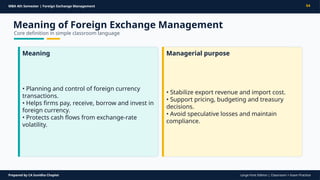
Meaning of Foreign Exchange Management
Core definition in simple classroom language
Prepared by CA Suvidha Chaplot Large Font Edition | Classroom + Exam Practice
Meaning
• Planning and control of foreign currency
transactions.
• Helps firms pay, receive, borrow and invest in
foreign currency.
• Protects cash flows from exchange-rate
volatility.
Managerial purpose
• Stabilize export revenue and import cost.
• Support pricing, budgeting and treasury
decisions.
• Avoid speculative losses and maintain
compliance.
MBA 4th Semester | Foreign Exchange Management 05
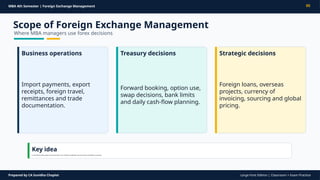
Scope of Foreign Exchange Management
Where MBA managers use forex decisions
Prepared by CA Suvidha Chaplot Large Font Edition | Classroom + Exam Practice
Business operations
Import payments, export
receipts, foreign travel,
remittances and trade
documentation.
Treasury decisions
Forward booking, option use,
swap decisions, bank limits
and daily cash-flow planning.
Strategic decisions
Foreign loans, overseas
projects, currency of
invoicing, sourcing and global
pricing.
Key idea
A sound forex policy does not remove every risk; it defines acceptable risk and controls avoidable uncertainty.
MBA 4th Semester | Foreign Exchange Management 06
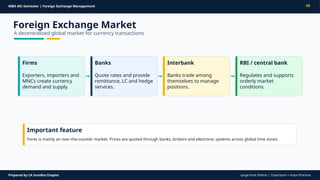
Foreign Exchange Market
A decentralized global market for currency transactions
Prepared by CA Suvidha Chaplot Large Font Edition | Classroom + Exam Practice
Firms
Exporters, importers and
MNCs create currency
demand and supply.
Banks
Quote rates and provide
remittance, LC and hedge
services.
Interbank
Banks trade among
themselves to manage
positions.
RBI / central bank
Regulates and supports
orderly market
conditions.
Important feature
Forex is mainly an over-the-counter market. Prices are quoted through banks, brokers and electronic systems across global time zones.
MBA 4th Semester | Foreign Exchange Management 07
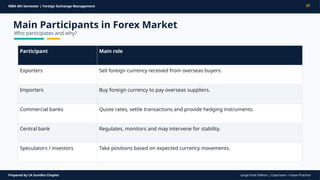
Main Participants in Forex Market
Who participates and why?
Prepared by CA Suvidha Chaplot Large Font Edition | Classroom + Exam Practice
Participant Main role
Exporters Sell foreign currency received from overseas buyers.
Importers Buy foreign currency to pay overseas suppliers.
Commercial banks Quote rates, settle transactions and provide hedging instruments.
Central bank Regulates, monitors and may intervene for stability.
Speculators / investors Take positions based on expected currency movements.
MBA 4th Semester | Foreign Exchange Management 08
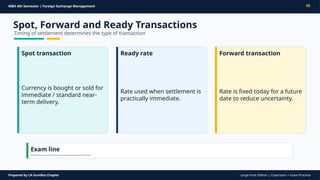
Spot, Forward and Ready Transactions
Timing of settlement determines the type of transaction
Prepared by CA Suvidha Chaplot Large Font Edition | Classroom + Exam Practice
Spot transaction
Currency is bought or sold for
immediate / standard near-
term delivery.
Ready rate
Rate used when settlement is
practically immediate.
Forward transaction
Rate is fixed today for a future
date to reduce uncertainty.
Exam line
Forward contracts are useful when the amount, currency and maturity of exposure are known.
MBA 4th Semester | Foreign Exchange Management 09
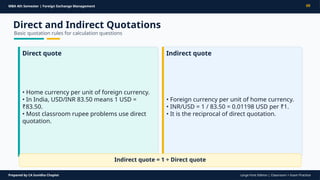
Direct and Indirect Quotations
Basic quotation rules for calculation questions
Prepared by CA Suvidha Chaplot Large Font Edition | Classroom + Exam Practice
Direct quote
• Home currency per unit of foreign currency.
• In India, USD/INR 83.50 means 1 USD =
₹83.50.
• Most classroom rupee problems use direct
quotation.
Indirect quote
• Foreign currency per unit of home currency.
• INR/USD = 1 / 83.50 = 0.01198 USD per ₹1.
• It is the reciprocal of direct quotation.
Indirect quote = 1 ÷ Direct quote
MBA 4th Semester | Foreign Exchange Management 10
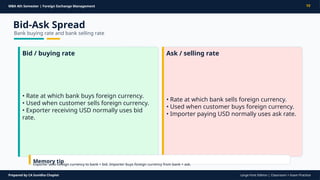
Bid-Ask Spread
Bank buying rate and bank selling rate
Prepared by CA Suvidha Chaplot Large Font Edition | Classroom + Exam Practice
Bid / buying rate
• Rate at which bank buys foreign currency.
• Used when customer sells foreign currency.
• Exporter receiving USD normally uses bid
rate.
Ask / selling rate
• Rate at which bank sells foreign currency.
• Used when customer buys foreign currency.
• Importer paying USD normally uses ask rate.
Memory tip
Exporter sells foreign currency to bank = bid. Importer buys foreign currency from bank = ask.
MBA 4th Semester | Foreign Exchange Management 11
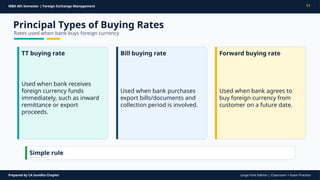
Principal Types of Buying Rates
Rates used when bank buys foreign currency
Prepared by CA Suvidha Chaplot Large Font Edition | Classroom + Exam Practice
TT buying rate
Used when bank receives
foreign currency funds
immediately, such as inward
remittance or export
proceeds.
Bill buying rate
Used when bank purchases
export bills/documents and
collection period is involved.
Forward buying rate
Used when bank agrees to
buy foreign currency from
customer on a future date.
Simple rule
Buying rate = bank buys foreign currency from the customer.
MBA 4th Semester | Foreign Exchange Management 12
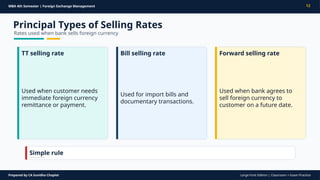
Principal Types of Selling Rates
Rates used when bank sells foreign currency
Prepared by CA Suvidha Chaplot Large Font Edition | Classroom + Exam Practice
TT selling rate
Used when customer needs
immediate foreign currency
remittance or payment.
Bill selling rate
Used for import bills and
documentary transactions.
Forward selling rate
Used when bank agrees to
sell foreign currency to
customer on a future date.
Simple rule
Selling rate = bank sells foreign currency to the customer.
MBA 4th Semester | Foreign Exchange Management 13
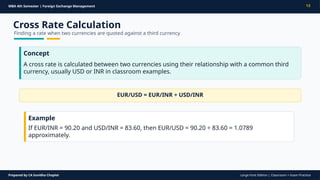
Cross Rate Calculation
Finding a rate when two currencies are quoted against a third currency
Prepared by CA Suvidha Chaplot Large Font Edition | Classroom + Exam Practice
Concept
A cross rate is calculated between two currencies using their relationship with a common third
currency, usually USD or INR in classroom examples.
EUR/USD = EUR/INR ÷ USD/INR
Example
If EUR/INR = 90.20 and USD/INR = 83.60, then EUR/USD = 90.20 ÷ 83.60 = 1.0789
approximately.
MBA 4th Semester | Foreign Exchange Management 14
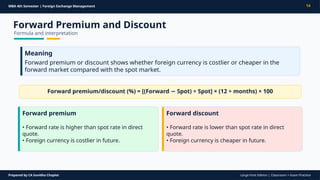
Forward Premium and Discount
Formula and interpretation
Prepared by CA Suvidha Chaplot Large Font Edition | Classroom + Exam Practice
Meaning
Forward premium or discount shows whether foreign currency is costlier or cheaper in the
forward market compared with the spot market.
Forward premium/discount (%) = [(Forward Spot) ÷ Spot] × (12 ÷ months) × 100
−
Forward premium
• Forward rate is higher than spot rate in direct
quote.
• Foreign currency is costlier in future.
Forward discount
• Forward rate is lower than spot rate in direct
quote.
• Foreign currency is cheaper in future.
MBA 4th Semester | Foreign Exchange Management 15
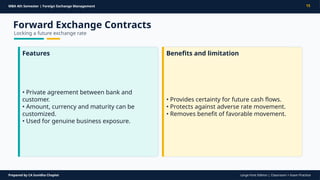
Forward Exchange Contracts
Locking a future exchange rate
Prepared by CA Suvidha Chaplot Large Font Edition | Classroom + Exam Practice
Features
• Private agreement between bank and
customer.
• Amount, currency and maturity can be
customized.
• Used for genuine business exposure.
Benefits and limitation
• Provides certainty for future cash flows.
• Protects against adverse rate movement.
• Removes benefit of favorable movement.
MBA 4th Semester | Foreign Exchange Management 16
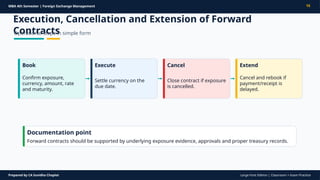
Execution, Cancellation and Extension of Forward
Contracts
Operational steps in simple form
Prepared by CA Suvidha Chaplot Large Font Edition | Classroom + Exam Practice
Book
Confirm exposure,
currency, amount, rate
and maturity.
Execute
Settle currency on the
due date.
Cancel
Close contract if exposure
is cancelled.
Extend
Cancel and rebook if
payment/receipt is
delayed.
Documentation point
Forward contracts should be supported by underlying exposure evidence, approvals and proper treasury records.
MBA 4th Semester | Foreign Exchange Management 17
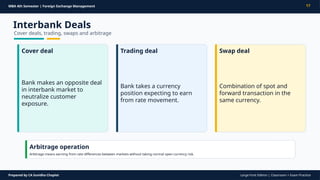
Interbank Deals
Cover deals, trading, swaps and arbitrage
Prepared by CA Suvidha Chaplot Large Font Edition | Classroom + Exam Practice
Cover deal
Bank makes an opposite deal
in interbank market to
neutralize customer
exposure.
Trading deal
Bank takes a currency
position expecting to earn
from rate movement.
Swap deal
Combination of spot and
forward transaction in the
same currency.
Arbitrage operation
Arbitrage means earning from rate differences between markets without taking normal open currency risk.
MBA 4th Semester | Foreign Exchange Management 18
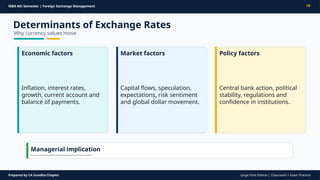
Determinants of Exchange Rates
Why currency values move
Prepared by CA Suvidha Chaplot Large Font Edition | Classroom + Exam Practice
Economic factors
Inflation, interest rates,
growth, current account and
balance of payments.
Market factors
Capital flows, speculation,
expectations, risk sentiment
and global dollar movement.
Policy factors
Central bank action, political
stability, regulations and
confidence in institutions.
Managerial implication
Firms do not need perfect prediction; they need disciplined preparation for adverse movement.
MBA 4th Semester | Foreign Exchange Management 19
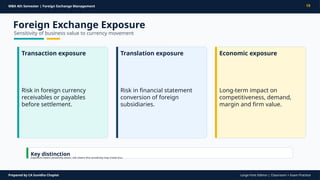
Foreign Exchange Exposure
Sensitivity of business value to currency movement
Prepared by CA Suvidha Chaplot Large Font Edition | Classroom + Exam Practice
Transaction exposure
Risk in foreign currency
receivables or payables
before settlement.
Translation exposure
Risk in financial statement
conversion of foreign
subsidiaries.
Economic exposure
Long-term impact on
competitiveness, demand,
margin and firm value.
Key distinction
Exposure means sensitivity exists; risk means this sensitivity may create loss.
MBA 4th Semester | Foreign Exchange Management 20
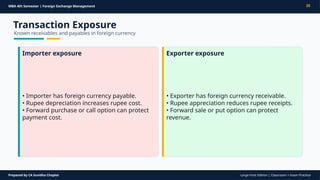
Transaction Exposure
Known receivables and payables in foreign currency
Prepared by CA Suvidha Chaplot Large Font Edition | Classroom + Exam Practice
Importer exposure
• Importer has foreign currency payable.
• Rupee depreciation increases rupee cost.
• Forward purchase or call option can protect
payment cost.
Exporter exposure
• Exporter has foreign currency receivable.
• Rupee appreciation reduces rupee receipts.
• Forward sale or put option can protect
revenue.
MBA 4th Semester | Foreign Exchange Management 21
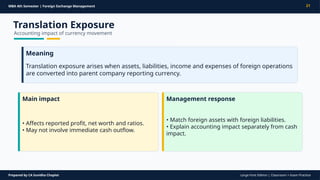
Translation Exposure
Accounting impact of currency movement
Prepared by CA Suvidha Chaplot Large Font Edition | Classroom + Exam Practice
Meaning
Translation exposure arises when assets, liabilities, income and expenses of foreign operations
are converted into parent company reporting currency.
Main impact
• Affects reported profit, net worth and ratios.
• May not involve immediate cash outflow.
Management response
• Match foreign assets with foreign liabilities.
• Explain accounting impact separately from cash
impact.
MBA 4th Semester | Foreign Exchange Management 22
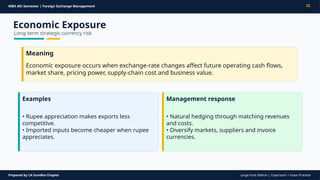
Economic Exposure
Long-term strategic currency risk
Prepared by CA Suvidha Chaplot Large Font Edition | Classroom + Exam Practice
Meaning
Economic exposure occurs when exchange-rate changes affect future operating cash flows,
market share, pricing power, supply-chain cost and business value.
Examples
• Rupee appreciation makes exports less
competitive.
• Imported inputs become cheaper when rupee
appreciates.
Management response
• Natural hedging through matching revenues
and costs.
• Diversify markets, suppliers and invoice
currencies.
MBA 4th Semester | Foreign Exchange Management 23
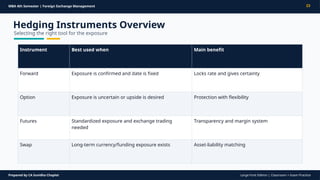
Hedging Instruments Overview
Selecting the right tool for the exposure
Prepared by CA Suvidha Chaplot Large Font Edition | Classroom + Exam Practice
Instrument Best used when Main benefit
Forward Exposure is confirmed and date is fixed Locks rate and gives certainty
Option Exposure is uncertain or upside is desired Protection with flexibility
Futures Standardized exposure and exchange trading
needed
Transparency and margin system
Swap Long-term currency/funding exposure exists Asset-liability matching
MBA 4th Semester | Foreign Exchange Management 24
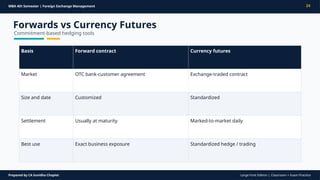
Forwards vs Currency Futures
Commitment-based hedging tools
Prepared by CA Suvidha Chaplot Large Font Edition | Classroom + Exam Practice
Basis Forward contract Currency futures
Market OTC bank-customer agreement Exchange-traded contract
Size and date Customized Standardized
Settlement Usually at maturity Marked-to-market daily
Best use Exact business exposure Standardized hedge / trading
MBA 4th Semester | Foreign Exchange Management 25
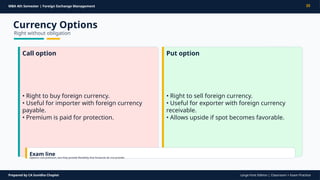
Currency Options
Right without obligation
Prepared by CA Suvidha Chaplot Large Font Edition | Classroom + Exam Practice
Call option
• Right to buy foreign currency.
• Useful for importer with foreign currency
payable.
• Premium is paid for protection.
Put option
• Right to sell foreign currency.
• Useful for exporter with foreign currency
receivable.
• Allows upside if spot becomes favorable.
Exam line
Options cost premium, but they provide flexibility that forwards do not provide.
MBA 4th Semester | Foreign Exchange Management 26
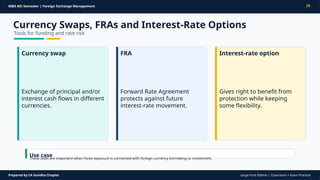
Currency Swaps, FRAs and Interest-Rate Options
Tools for funding and rate risk
Prepared by CA Suvidha Chaplot Large Font Edition | Classroom + Exam Practice
Currency swap
Exchange of principal and/or
interest cash flows in different
currencies.
FRA
Forward Rate Agreement
protects against future
interest-rate movement.
Interest-rate option
Gives right to benefit from
protection while keeping
some flexibility.
Use case
These tools are important when forex exposure is connected with foreign currency borrowing or investment.
MBA 4th Semester | Foreign Exchange Management 27
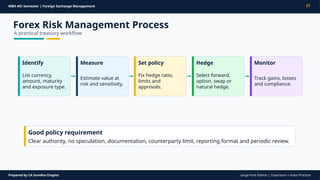
Forex Risk Management Process
A practical treasury workflow
Prepared by CA Suvidha Chaplot Large Font Edition | Classroom + Exam Practice
Identify
List currency,
amount, maturity
and exposure type.
Measure
Estimate value at
risk and sensitivity.
Set policy
Fix hedge ratio,
limits and
approvals.
Hedge
Select forward,
option, swap or
natural hedge.
Monitor
Track gains, losses
and compliance.
Good policy requirement
Clear authority, no speculation, documentation, counterparty limit, reporting format and periodic review.
MBA 4th Semester | Foreign Exchange Management 28
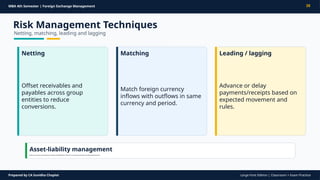
Risk Management Techniques
Netting, matching, leading and lagging
Prepared by CA Suvidha Chaplot Large Font Edition | Classroom + Exam Practice
Netting
Offset receivables and
payables across group
entities to reduce
conversions.
Matching
Match foreign currency
inflows with outflows in same
currency and period.
Leading / lagging
Advance or delay
payments/receipts based on
expected movement and
rules.
Asset-liability management
Balance currency and maturity of assets and liabilities so that one currency shock does not dominate total risk.
MBA 4th Semester | Foreign Exchange Management 29
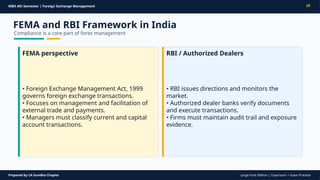
FEMA and RBI Framework in India
Compliance is a core part of forex management
Prepared by CA Suvidha Chaplot Large Font Edition | Classroom + Exam Practice
FEMA perspective
• Foreign Exchange Management Act, 1999
governs foreign exchange transactions.
• Focuses on management and facilitation of
external trade and payments.
• Managers must classify current and capital
account transactions.
RBI / Authorized Dealers
• RBI issues directions and monitors the
market.
• Authorized dealer banks verify documents
and execute transactions.
• Firms must maintain audit trail and exposure
evidence.
MBA 4th Semester | Foreign Exchange Management 30
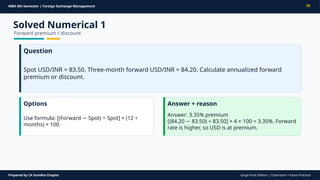
Solved Numerical 1
Forward premium / discount
Prepared by CA Suvidha Chaplot Large Font Edition | Classroom + Exam Practice
Question
Spot USD/INR = 83.50. Three-month forward USD/INR = 84.20. Calculate annualized forward
premium or discount.
Options
Use formula: [(Forward Spot) ÷ Spot] × (12 ÷
−
months) × 100
Answer + reason
Answer: 3.35% premium
[(84.20 83.50) ÷ 83.50] × 4 × 100 = 3.35%. Forward
−
rate is higher, so USD is at premium.
MBA 4th Semester | Foreign Exchange Management 31
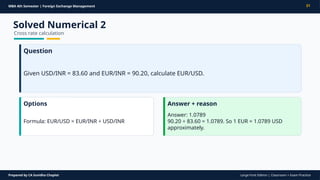
Solved Numerical 2
Cross rate calculation
Prepared by CA Suvidha Chaplot Large Font Edition | Classroom + Exam Practice
Question
Given USD/INR = 83.60 and EUR/INR = 90.20, calculate EUR/USD.
Options
Formula: EUR/USD = EUR/INR ÷ USD/INR
Answer + reason
Answer: 1.0789
90.20 ÷ 83.60 = 1.0789. So 1 EUR = 1.0789 USD
approximately.
MBA 4th Semester | Foreign Exchange Management 32
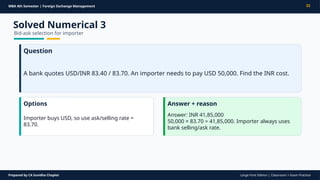
Solved Numerical 3
Bid-ask selection for importer
Prepared by CA Suvidha Chaplot Large Font Edition | Classroom + Exam Practice
Question
A bank quotes USD/INR 83.40 / 83.70. An importer needs to pay USD 50,000. Find the INR cost.
Options
Importer buys USD, so use ask/selling rate =
83.70.
Answer + reason
Answer: INR 41,85,000
50,000 × 83.70 = 41,85,000. Importer always uses
bank selling/ask rate.
MBA 4th Semester | Foreign Exchange Management 33
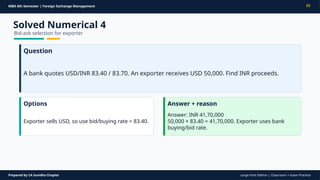
Solved Numerical 4
Bid-ask selection for exporter
Prepared by CA Suvidha Chaplot Large Font Edition | Classroom + Exam Practice
Question
A bank quotes USD/INR 83.40 / 83.70. An exporter receives USD 50,000. Find INR proceeds.
Options
Exporter sells USD, so use bid/buying rate = 83.40.
Answer + reason
Answer: INR 41,70,000
50,000 × 83.40 = 41,70,000. Exporter uses bank
buying/bid rate.
MBA 4th Semester | Foreign Exchange Management 34
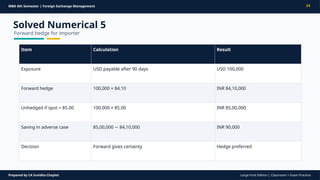
Solved Numerical 5
Forward hedge for importer
Prepared by CA Suvidha Chaplot Large Font Edition | Classroom + Exam Practice
Item Calculation Result
Exposure USD payable after 90 days USD 100,000
Forward hedge 100,000 × 84.10 INR 84,10,000
Unhedged if spot = 85.00 100,000 × 85.00 INR 85,00,000
Saving in adverse case 85,00,000 84,10,000
− INR 90,000
Decision Forward gives certainty Hedge preferred
MBA 4th Semester | Foreign Exchange Management 35
Solved Numerical 6
Forward hedge for exporter
Prepared by CA Suvidha Chaplot Large Font Edition | Classroom + Exam Practice
Question
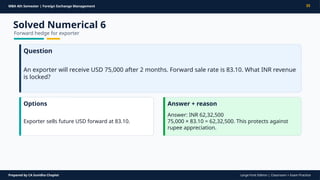
An exporter will receive USD 75,000 after 2 months. Forward sale rate is 83.10. What INR revenue
is locked?
Options
Exporter sells future USD forward at 83.10.
Answer + reason
Answer: INR 62,32,500
75,000 × 83.10 = 62,32,500. This protects against
rupee appreciation.
MBA 4th Semester | Foreign Exchange Management 36
Case Study 1
Importer payment decision
Prepared by CA Suvidha Chaplot Large Font Edition | Classroom + Exam Practice
Case
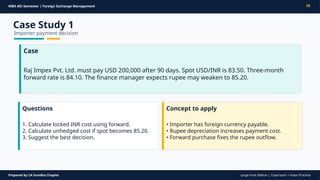
Raj Impex Pvt. Ltd. must pay USD 200,000 after 90 days. Spot USD/INR is 83.50. Three-month
forward rate is 84.10. The finance manager expects rupee may weaken to 85.20.
Questions
1. Calculate locked INR cost using forward.
2. Calculate unhedged cost if spot becomes 85.20.
3. Suggest the best decision.
Concept to apply
• Importer has foreign currency payable.
• Rupee depreciation increases payment cost.
• Forward purchase fixes the rupee outflow.
MBA 4th Semester | Foreign Exchange Management 37
Case Study 1: Solution
Forward hedge protects the importer
Prepared by CA Suvidha Chaplot Large Font Edition | Classroom + Exam Practice
Part Working Result
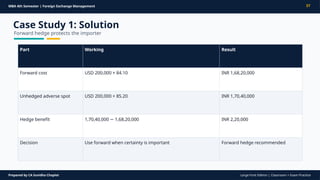
Forward cost USD 200,000 × 84.10 INR 1,68,20,000
Unhedged adverse spot USD 200,000 × 85.20 INR 1,70,40,000
Hedge benefit 1,70,40,000 1,68,20,000
− INR 2,20,000
Decision Use forward when certainty is important Forward hedge recommended
MBA 4th Semester | Foreign Exchange Management 38
Case Study 2
Exporter with uncertain order
Prepared by CA Suvidha Chaplot Large Font Edition | Classroom + Exam Practice
Case
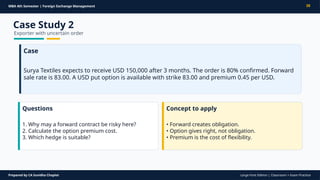
Surya Textiles expects to receive USD 150,000 after 3 months. The order is 80% confirmed. Forward
sale rate is 83.00. A USD put option is available with strike 83.00 and premium 0.45 per USD.
Questions
1. Why may a forward contract be risky here?
2. Calculate the option premium cost.
3. Which hedge is suitable?
Concept to apply
• Forward creates obligation.
• Option gives right, not obligation.
• Premium is the cost of flexibility.
MBA 4th Semester | Foreign Exchange Management 39
Case Study 2: Solution
Option gives protection with flexibility
Prepared by CA Suvidha Chaplot Large Font Edition | Classroom + Exam Practice
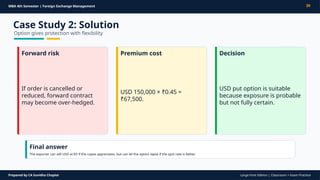
Forward risk
If order is cancelled or
reduced, forward contract
may become over-hedged.
Premium cost
USD 150,000 × ₹0.45 =
₹67,500.
Decision
USD put option is suitable
because exposure is probable
but not fully certain.
Final answer
The exporter can sell USD at 83 if the rupee appreciates, but can let the option lapse if the spot rate is better.
MBA 4th Semester | Foreign Exchange Management 40
Case Study 3
Economic exposure and competitive strategy
Prepared by CA Suvidha Chaplot Large Font Edition | Classroom + Exam Practice
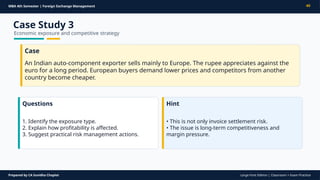
Case
An Indian auto-component exporter sells mainly to Europe. The rupee appreciates against the
euro for a long period. European buyers demand lower prices and competitors from another
country become cheaper.
Questions
1. Identify the exposure type.
2. Explain how profitability is affected.
3. Suggest practical risk management actions.
Hint
• This is not only invoice settlement risk.
• The issue is long-term competitiveness and
margin pressure.
MBA 4th Semester | Foreign Exchange Management 41
Case Study 3: Solution
Managing economic exposure
Prepared by CA Suvidha Chaplot Large Font Edition | Classroom + Exam Practice
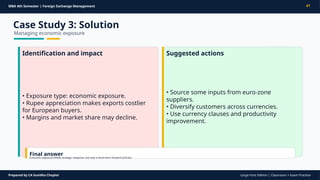
Identification and impact
• Exposure type: economic exposure.
• Rupee appreciation makes exports costlier
for European buyers.
• Margins and market share may decline.
Suggested actions
• Source some inputs from euro-zone
suppliers.
• Diversify customers across currencies.
• Use currency clauses and productivity
improvement.
Final answer
Economic exposure needs strategic response, not only a short-term forward contract.
MBA 4th Semester | Foreign Exchange Management 42
MCQ Practice Set 1
Concept questions
Prepared by CA Suvidha Chaplot Large Font Edition | Classroom + Exam Practice
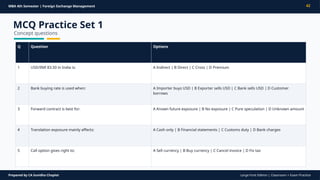
Q Question Options
1 USD/INR 83.50 in India is: A Indirect | B Direct | C Cross | D Premium
2 Bank buying rate is used when: A Importer buys USD | B Exporter sells USD | C Bank sells USD | D Customer
borrows
3 Forward contract is best for: A Known future exposure | B No exposure | C Pure speculation | D Unknown amount
4 Translation exposure mainly affects: A Cash only | B Financial statements | C Customs duty | D Bank charges
5 Call option gives right to: A Sell currency | B Buy currency | C Cancel invoice | D Fix tax
MBA 4th Semester | Foreign Exchange Management 43
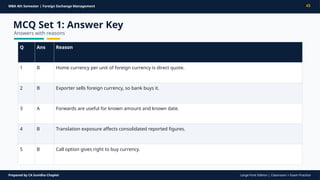
MCQ Set 1: Answer Key
Answers with reasons
Prepared by CA Suvidha Chaplot Large Font Edition | Classroom + Exam Practice
Q Ans Reason
1 B Home currency per unit of foreign currency is direct quote.
2 B Exporter sells foreign currency, so bank buys it.
3 A Forwards are useful for known amount and known date.
4 B Translation exposure affects consolidated reported figures.
5 B Call option gives right to buy currency.
MBA 4th Semester | Foreign Exchange Management 44
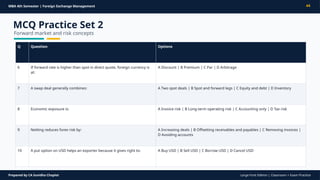
MCQ Practice Set 2
Forward market and risk concepts
Prepared by CA Suvidha Chaplot Large Font Edition | Classroom + Exam Practice
Q Question Options
6 If forward rate is higher than spot in direct quote, foreign currency is
at:
A Discount | B Premium | C Par | D Arbitrage
7 A swap deal generally combines: A Two spot deals | B Spot and forward legs | C Equity and debt | D Inventory
8 Economic exposure is: A Invoice risk | B Long-term operating risk | C Accounting only | D Tax risk
9 Netting reduces forex risk by: A Increasing deals | B Offsetting receivables and payables | C Removing invoices |
D Avoiding accounts
10 A put option on USD helps an exporter because it gives right to: A Buy USD | B Sell USD | C Borrow USD | D Cancel USD
MBA 4th Semester | Foreign Exchange Management 45
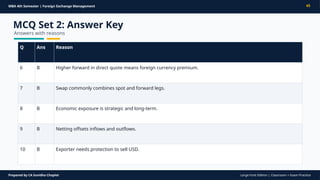
MCQ Set 2: Answer Key
Answers with reasons
Prepared by CA Suvidha Chaplot Large Font Edition | Classroom + Exam Practice
Q Ans Reason
6 B Higher forward in direct quote means foreign currency premium.
7 B Swap commonly combines spot and forward legs.
8 B Economic exposure is strategic and long-term.
9 B Netting offsets inflows and outflows.
10 B Exporter needs protection to sell USD.
MBA 4th Semester | Foreign Exchange Management 46
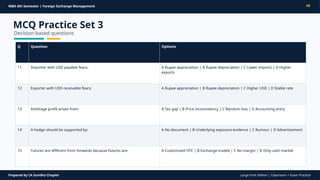
MCQ Practice Set 3
Decision-based questions
Prepared by CA Suvidha Chaplot Large Font Edition | Classroom + Exam Practice
Q Question Options
11 Importer with USD payable fears: A Rupee appreciation | B Rupee depreciation | C Lower imports | D Higher
exports
12 Exporter with USD receivable fears: A Rupee appreciation | B Rupee depreciation | C Higher USD | D Stable rate
13 Arbitrage profit arises from: A Tax gap | B Price inconsistency | C Random loss | D Accounting entry
14 A hedge should be supported by: A No document | B Underlying exposure evidence | C Rumour | D Advertisement
15 Futures are different from forwards because futures are: A Customized OTC | B Exchange-traded | C No margin | D Only cash market
MBA 4th Semester | Foreign Exchange Management 47
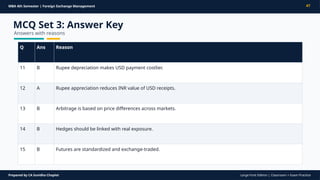
MCQ Set 3: Answer Key
Answers with reasons
Prepared by CA Suvidha Chaplot Large Font Edition | Classroom + Exam Practice
Q Ans Reason
11 B Rupee depreciation makes USD payment costlier.
12 A Rupee appreciation reduces INR value of USD receipts.
13 B Arbitrage is based on price differences across markets.
14 B Hedges should be linked with real exposure.
15 B Futures are standardized and exchange-traded.
MBA 4th Semester | Foreign Exchange Management 48
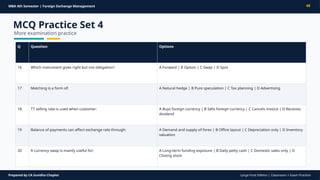
MCQ Practice Set 4
More examination practice
Prepared by CA Suvidha Chaplot Large Font Edition | Classroom + Exam Practice
Q Question Options
16 Which instrument gives right but not obligation? A Forward | B Option | C Swap | D Spot
17 Matching is a form of: A Natural hedge | B Pure speculation | C Tax planning | D Advertising
18 TT selling rate is used when customer: A Buys foreign currency | B Sells foreign currency | C Cancels invoice | D Receives
dividend
19 Balance of payments can affect exchange rate through: A Demand and supply of forex | B Office layout | C Depreciation only | D Inventory
valuation
20 A currency swap is mainly useful for: A Long-term funding exposure | B Daily petty cash | C Domestic sales only | D
Closing stock
MBA 4th Semester | Foreign Exchange Management 49
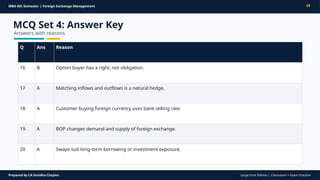
MCQ Set 4: Answer Key
Answers with reasons
Prepared by CA Suvidha Chaplot Large Font Edition | Classroom + Exam Practice
Q Ans Reason
16 B Option buyer has a right, not obligation.
17 A Matching inflows and outflows is a natural hedge.
18 A Customer buying foreign currency uses bank selling rate.
19 A BOP changes demand and supply of foreign exchange.
20 A Swaps suit long-term borrowing or investment exposure.
MBA 4th Semester | Foreign Exchange Management 50
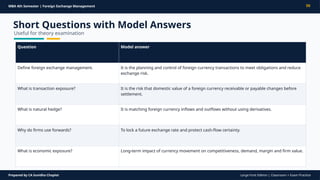
Short Questions with Model Answers
Useful for theory examination
Prepared by CA Suvidha Chaplot Large Font Edition | Classroom + Exam Practice
Question Model answer
Define foreign exchange management. It is the planning and control of foreign currency transactions to meet obligations and reduce
exchange risk.
What is transaction exposure? It is the risk that domestic value of a foreign currency receivable or payable changes before
settlement.
What is natural hedge? It is matching foreign currency inflows and outflows without using derivatives.
Why do firms use forwards? To lock a future exchange rate and protect cash-flow certainty.
What is economic exposure? Long-term impact of currency movement on competitiveness, demand, margin and firm value.
MBA 4th Semester | Foreign Exchange Management 51
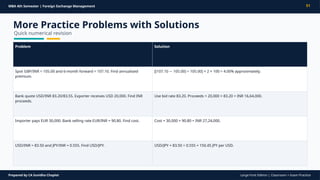
More Practice Problems with Solutions
Quick numerical revision
Prepared by CA Suvidha Chaplot Large Font Edition | Classroom + Exam Practice
Problem Solution
Spot GBP/INR = 105.00 and 6-month forward = 107.10. Find annualized
premium.
[(107.10 105.00) ÷ 105.00] × 2 × 100 = 4.00% approximately.
−
Bank quote USD/INR 83.20/83.55. Exporter receives USD 20,000. Find INR
proceeds.
Use bid rate 83.20. Proceeds = 20,000 × 83.20 = INR 16,64,000.
Importer pays EUR 30,000. Bank selling rate EUR/INR = 90.80. Find cost. Cost = 30,000 × 90.80 = INR 27,24,000.
USD/INR = 83.50 and JPY/INR = 0.555. Find USD/JPY. USD/JPY = 83.50 ÷ 0.555 = 150.45 JPY per USD.
MBA 4th Semester | Foreign Exchange Management 52
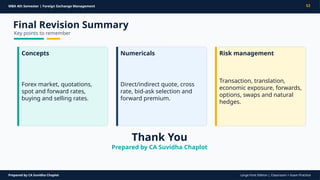
Final Revision Summary
Key points to remember
Prepared by CA Suvidha Chaplot Large Font Edition | Classroom + Exam Practice
Concepts
Forex market, quotations,
spot and forward rates,
buying and selling rates.
Numericals
Direct/indirect quote, cross
rate, bid-ask selection and
forward premium.
Risk management
Transaction, translation,
economic exposure, forwards,
options, swaps and natural
hedges.
Thank You
Prepared by CA Suvidha Chaplot