Food safety and standards act , Nutraceutial regulations,RDA
1.
Food Safety andStandards Act, FSSAI,
Nutraceutical Regulations and
Recommended Dietary Allowances
(RDA) in India
Presented
By
M.Ramyasree
M.Pharmacy II semester (25DH1S1312)
Under the guidance of
Dr.C Soujanya
Department of Regulatory Affairs
Vishnu Institute of Pharmaceutical Education and Research
Narsapur, Medak, Telangana
2.
CONTENTS
Introduction
Food safety andstandards act (FSSA), 2006
Food safety and standards authority of india (FSSAI)
Food licensing system
Neutraceutical regulations in india
Labeling requirements
Recommended Dietary Allowance(RDA)
3.
India has oneof the largest food and nutraceutical markets worldwide. To protect
consumers from unsafe food and misleading health claims, the Government of India
established:
•Food Safety and Standards Act, 2006
•Food Safety and Standards Authority of India (FSSAI)
INTRODUCTION
These regulate:
•Food
•Functional foods
•Health supplements
•Nutraceuticals
•Foods for Special Dietary Use (FSDU)
•Foods for Special Medical Purpose (FSMP)
4.
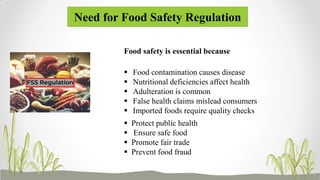
Need for FoodSafety Regulation
Food contamination causes disease
Nutritional deficiencies affect health
Adulteration is common
False health claims mislead consumers
Imported foods require quality checks
Protect public health
Ensure safe food
Promote fair trade
Prevent food fraud
Food safety is essential because
5.
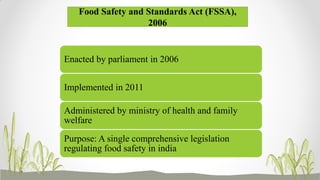
Food Safety andStandards Act (FSSA),
2006
Enacted by parliament in 2006
Implemented in 2011
Administered by ministry of health and family
welfare
Purpose: A single comprehensive legislation
regulating food safety in india
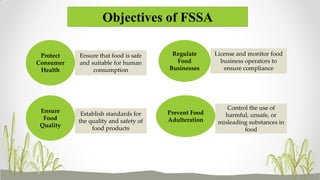
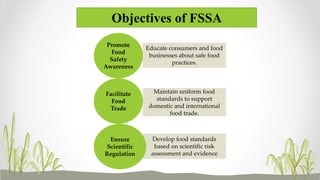
Objectives of FSSA
Promote
Food
Safety
Awareness
Educateconsumers and food
businesses about safe food
practices.
Maintain uniform food
standards to support
domestic and international
food trade.
Develop food standards
based on scientific risk
assessment and evidence
Facilitate
Food
Trade
Ensure
Scientific
Regulation
8.
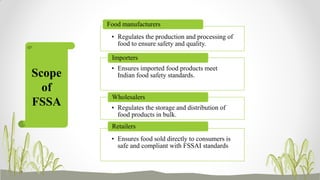
• Regulates theproduction and processing of
food to ensure safety and quality.
Food manufacturers
• Ensures imported food products meet
Indian food safety standards.
Importers
• Regulates the storage and distribution of
food products in bulk.
Wholesalers
• Ensures food sold directly to consumers is
safe and compliant with FSSAI standards
Retailers
Scope
of
FSSA
9.
Scope
of
FSSA
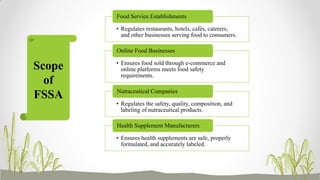
• Regulates restaurants,hotels, cafés, caterers,
and other businesses serving food to consumers.
Food Service Establishments
• Ensures food sold through e-commerce and
online platforms meets food safety
requirements.
Online Food Businesses
• Regulates the safety, quality, composition, and
labeling of nutraceutical products.
Nutraceutical Companies
• Ensures health supplements are safe, properly
formulated, and accurately labeled.
Health Supplement Manufacturers
10.
Structure of theFood Safety and Standards
Act
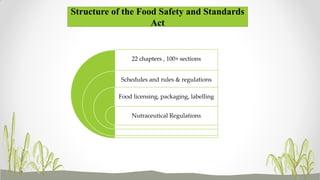
22 chapters , 100+ sections
Schedules and rules & regulations
Food licensing, packaging, labelling
Nutraceutical Regulations
11.
Food Safety andStandards Authority of
India (FSSAI)
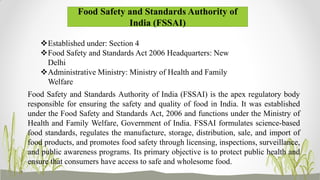
Established under: Section 4
Food Safety and Standards Act 2006 Headquarters: New
Delhi
Administrative Ministry: Ministry of Health and Family
Welfare
Food Safety and Standards Authority of India (FSSAI) is the apex regulatory body
responsible for ensuring the safety and quality of food in India. It was established
under the Food Safety and Standards Act, 2006 and functions under the Ministry of
Health and Family Welfare, Government of India. FSSAI formulates science-based
food standards, regulates the manufacture, storage, distribution, sale, and import of
food products, and promotes food safety through licensing, inspections, surveillance,
and public awareness programs. Its primary objective is to protect public health and
ensure that consumers have access to safe and wholesome food.
12.
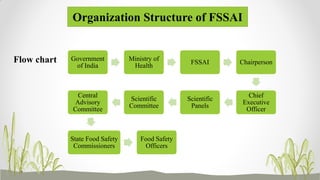
Organization Structure ofFSSAI
Flow chart Government
of India
Ministry of
Health
FSSAI Chairperson
Chief
Executive
Officer
Scientific
Panels
Scientific
Committee
Central
Advisory
Committee
State Food Safety
Commissioners
Food Safety
Officers
13.
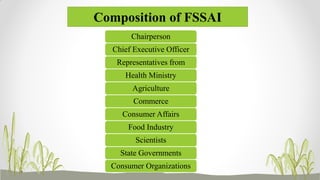
Composition of FSSAI
Chairperson
ChiefExecutive Officer
Representatives from
Health Ministry
Agriculture
Commerce
Consumer Affairs
Food Industry
Scientists
State Governments
Consumer Organizations
14.
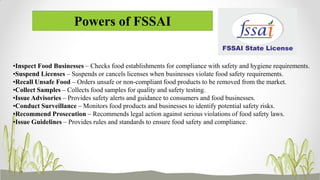
Powers of FSSAI
•InspectFood Businesses – Checks food establishments for compliance with safety and hygiene requirements.
•Suspend Licenses – Suspends or cancels licenses when businesses violate food safety requirements.
•Recall Unsafe Food – Orders unsafe or non-compliant food products to be removed from the market.
•Collect Samples – Collects food samples for quality and safety testing.
•Issue Advisories – Provides safety alerts and guidance to consumers and food businesses.
•Conduct Surveillance – Monitors food products and businesses to identify potential safety risks.
•Recommend Prosecution – Recommends legal action against serious violations of food safety laws.
•Issue Guidelines – Provides rules and standards to ensure food safety and compliance.
15.
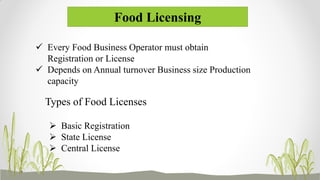
Food Licensing
EveryFood Business Operator must obtain
Registration or License
Depends on Annual turnover Business size Production
capacity
Types of Food Licenses
Basic Registration
State License
Central License
16.
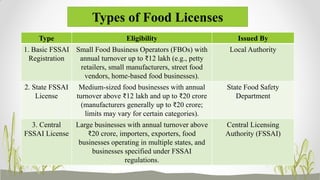
Types of FoodLicenses
Type Eligibility Issued By
1. Basic FSSAI
Registration
Small Food Business Operators (FBOs) with
annual turnover up to ₹12 lakh (e.g., petty
retailers, small manufacturers, street food
vendors, home-based food businesses).
Local Authority
2. State FSSAI
License
Medium-sized food businesses with annual
turnover above ₹12 lakh and up to ₹20 crore
(manufacturers generally up to ₹20 crore;
limits may vary for certain categories).
State Food Safety
Department
3. Central
FSSAI License
Large businesses with annual turnover above
₹20 crore, importers, exporters, food
businesses operating in multiple states, and
businesses specified under FSSAI
regulations.
Central Licensing
Authority (FSSAI)
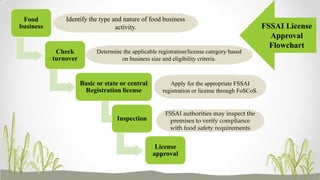
17.
Food
business
Check
turnover
Basic or stateor central
Registration license
Inspection
License
approval
Identify the type and nature of food business
activity.
Determine the applicable registration/license category based
on business size and eligibility criteria.
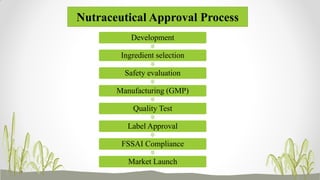
Apply for the appropriate FSSAI
registration or license through FoSCoS.
FSSAI authorities may inspect the
premises to verify compliance
with food safety requirements
FSSAI License
Approval
Flowchart
18.
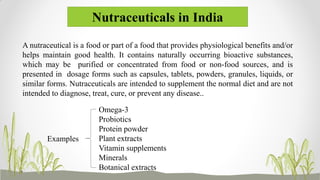
Nutraceuticals in India
Omega-3
Probiotics
Proteinpowder
Plant extracts
Vitamin supplements
Minerals
Botanical extracts
A nutraceutical is a food or part of a food that provides physiological benefits and/or
helps maintain good health. It contains naturally occurring bioactive substances,
which may be purified or concentrated from food or non-food sources, and is
presented in dosage forms such as capsules, tablets, powders, granules, liquids, or
similar forms. Nutraceuticals are intended to supplement the normal diet and are not
intended to diagnose, treat, cure, or prevent any disease..
Examples
19.
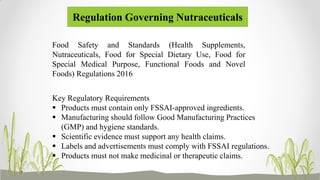
Regulation Governing Nutraceuticals
FoodSafety and Standards (Health Supplements,
Nutraceuticals, Food for Special Dietary Use, Food for
Special Medical Purpose, Functional Foods and Novel
Foods) Regulations 2016
Key Regulatory Requirements
Products must contain only FSSAI-approved ingredients.
Manufacturing should follow Good Manufacturing Practices
(GMP) and hygiene standards.
Scientific evidence must support any health claims.
Labels and advertisements must comply with FSSAI regulations.
Products must not make medicinal or therapeutic claims.
20.
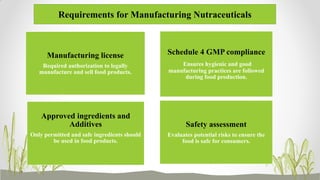
Requirements for ManufacturingNutraceuticals
Manufacturing license
Required authorization to legally
manufacture and sell food products.
Schedule 4 GMP compliance
Ensures hygienic and good
manufacturing practices are followed
during food production.
Approved ingredients and
Additives
Only permitted and safe ingredients should
be used in food products.
Safety assessment
Evaluates potential risks to ensure the
food is safe for consumers.
21.
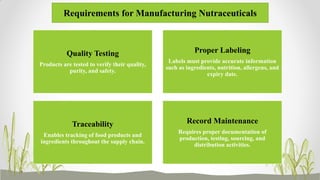
Requirements for ManufacturingNutraceuticals
Quality Testing
Products are tested to verify their quality,
purity, and safety.
Traceability
Enables tracking of food products and
ingredients throughout the supply chain.
Proper Labeling
Labels must provide accurate information
such as ingredients, nutrition, allergens, and
expiry date.
Record Maintenance
Requires proper documentation of
production, testing, sourcing, and
distribution activities.
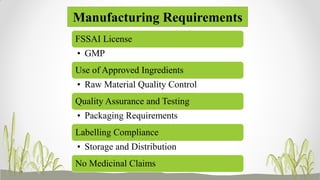
Manufacturing Requirements
FSSAI License
•GMP
Use of Approved Ingredients
• Raw Material Quality Control
Quality Assurance and Testing
• Packaging Requirements
Labelling Compliance
• Storage and Distribution
No Medicinal Claims
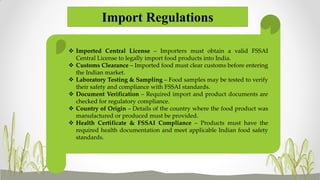
24.
Import Regulations
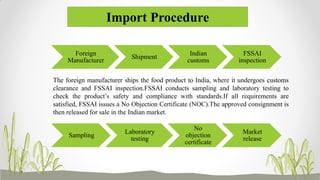
ImportedCentral License – Importers must obtain a valid FSSAI
Central License to legally import food products into India.
Customs Clearance – Imported food must clear customs before entering
the Indian market.
Laboratory Testing & Sampling – Food samples may be tested to verify
their safety and compliance with FSSAI standards.
Document Verification – Required import and product documents are
checked for regulatory compliance.
Country of Origin – Details of the country where the food product was
manufactured or produced must be provided.
Health Certificate & FSSAI Compliance – Products must have the
required health documentation and meet applicable Indian food safety
standards.
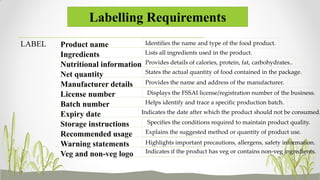
Labelling Requirements
LABEL Productname
Ingredients
Nutritional information
Net quantity
Manufacturer details
License number
Batch number
Expiry date
Storage instructions
Recommended usage
Warning statements
Veg and non-veg logo
Identifies the name and type of the food product.
Lists all ingredients used in the product.
Provides details of calories, protein, fat, carbohydrates..
States the actual quantity of food contained in the package.
Provides the name and address of the manufacturer.
Displays the FSSAI license/registration number of the business.
Helps identify and trace a specific production batch.
Indicates the date after which the product should not be consumed.
Specifies the conditions required to maintain product quality.
Explains the suggested method or quantity of product use.
Highlights important precautions, allergens, safety information.
Indicates if the product has veg or contains non-veg ingredients.
27.
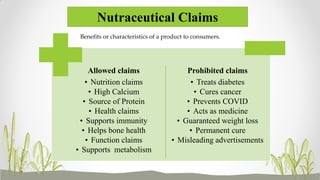
Nutraceutical Claims
Allowed claims
•Nutrition claims
• High Calcium
• Source of Protein
• Health claims
• Supports immunity
• Helps bone health
• Function claims
• Supports metabolism
Prohibited claims
• Treats diabetes
• Cures cancer
• Prevents COVID
• Acts as medicine
• Guaranteed weight loss
• Permanent cure
• Misleading advertisements
Benefits or characteristics of a product to consumers.
28.
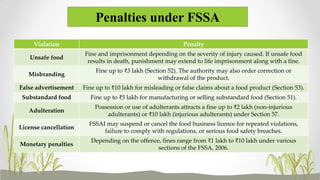
Penalties under FSSA
ViolationPenalty
Unsafe food
Fine and imprisonment depending on the severity of injury caused. If unsafe food
results in death, punishment may extend to life imprisonment along with a fine.
Misbranding
Fine up to ₹3 lakh (Section 52). The authority may also order correction or
withdrawal of the product.
False advertisement Fine up to ₹10 lakh for misleading or false claims about a food product (Section 53).
Substandard food Fine up to ₹5 lakh for manufacturing or selling substandard food (Section 51).
Adulteration
Possession or use of adulterants attracts a fine up to ₹2 lakh (non-injurious
adulterants) or ₹10 lakh (injurious adulterants) under Section 57.
License cancellation
FSSAI may suspend or cancel the food business licence for repeated violations,
failure to comply with regulations, or serious food safety breaches.
Monetary penalties
Depending on the offence, fines range from ₹1 lakh to ₹10 lakh under various
sections of the FSSA, 2006.
29.
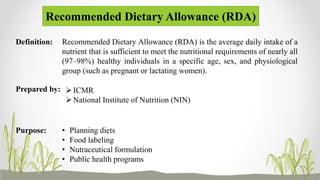
Recommended Dietary Allowance(RDA)
• Planning diets
• Food labeling
• Nutraceutical formulation
• Public health programs
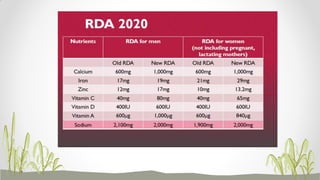
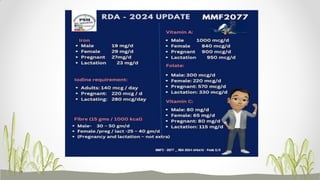
Recommended Dietary Allowance (RDA) is the average daily intake of a
nutrient that is sufficient to meet the nutritional requirements of nearly all
(97–98%) healthy individuals in a specific age, sex, and physiological
group (such as pregnant or lactating women).
Definition:
Prepared by: ICMR
National Institute of Nutrition (NIN)
Purpose:
32.
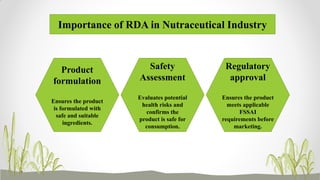
Importance of RDAin Nutraceutical Industry
Product
formulation
Ensures the product
is formulated with
safe and suitable
ingredients.
Safety
Assessment
Evaluates potential
health risks and
confirms the
product is safe for
consumption.
Regulatory
approval
Ensures the product
meets applicable
FSSAI
requirements before
marketing.
33.
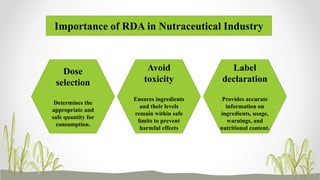
Importance of RDAin Nutraceutical Industry
Dose
selection
Determines the
appropriate and
safe quantity for
consumption.
Avoid
toxicity
Ensures ingredients
and their levels
remain within safe
limits to prevent
harmful effects
Label
declaration
Provides accurate
information on
ingredients, usage,
warnings, and
nutritional content.
34.
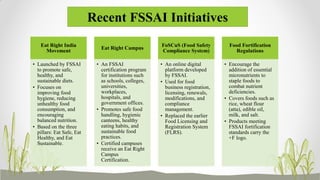
Recent FSSAI Initiatives
EatRight India
Movement
• Launched by FSSAI
to promote safe,
healthy, and
sustainable diets.
• Focuses on
improving food
hygiene, reducing
unhealthy food
consumption, and
encouraging
balanced nutrition.
• Based on the three
pillars: Eat Safe, Eat
Healthy, and Eat
Sustainable.
Eat Right Campus
• An FSSAI
certification program
for institutions such
as schools, colleges,
universities,
workplaces,
hospitals, and
government offices.
• Promotes safe food
handling, hygienic
canteens, healthy
eating habits, and
sustainable food
practices.
• Certified campuses
receive an Eat Right
Campus
Certification.
FoSCuS (Food Safety
Compliance System)
• An online digital
platform developed
by FSSAI.
• Used for food
business registration,
licensing, renewals,
modifications, and
compliance
management.
• Replaced the earlier
Food Licensing and
Registration System
(FLRS).
Food Fortification
Regulations
• Encourage the
addition of essential
micronutrients to
staple foods to
combat nutrient
deficiencies.
• Covers foods such as
rice, wheat flour
(atta), edible oil,
milk, and salt.
• Products meeting
FSSAI fortification
standards carry the
+F logo.
35.
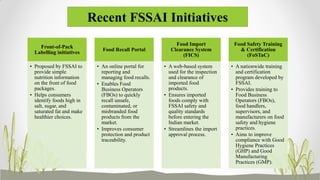
Recent FSSAI Initiatives
Front-of-Pack
Labellinginitiatives
• Proposed by FSSAI to
provide simple
nutrition information
on the front of food
packages.
• Helps consumers
identify foods high in
salt, sugar, and
saturated fat and make
healthier choices.
Food Recall Portal
• An online portal for
reporting and
managing food recalls.
• Enables Food
Business Operators
(FBOs) to quickly
recall unsafe,
contaminated, or
misbranded food
products from the
market.
• Improves consumer
protection and product
traceability.
Food Import
Clearance System
(FICS)
• A web-based system
used for the inspection
and clearance of
imported food
products.
• Ensures imported
foods comply with
FSSAI safety and
quality standards
before entering the
Indian market.
• Streamlines the import
approval process.
Food Safety Training
& Certification
(FoSTaC)
• A nationwide training
and certification
program developed by
FSSAI.
• Provides training to
Food Business
Operators (FBOs),
food handlers,
supervisors, and
manufacturers on food
safety and hygiene
practices.
• Aims to improve
compliance with Good
Hygiene Practices
(GHP) and Good
Manufacturing
Practices (GMP).
36.
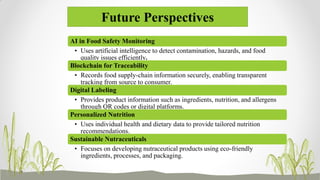
Future Perspectives
AI inFood Safety Monitoring
• Uses artificial intelligence to detect contamination, hazards, and food
quality issues efficiently.
Blockchain for Traceability
• Records food supply-chain information securely, enabling transparent
tracking from source to consumer.
Digital Labeling
• Provides product information such as ingredients, nutrition, and allergens
through QR codes or digital platforms.
Personalized Nutrition
• Uses individual health and dietary data to provide tailored nutrition
recommendations.
Sustainable Nutraceuticals
• Focuses on developing nutraceutical products using eco-friendly
ingredients, processes, and packaging.
37.
Case Study
Misleading ImmunitySupplement
Background : A health supplement company marketed its product with the claim "Cures viral infections." The
product was sold as a nutraceutical/health supplement and advertised through product labels, websites, and
promotional campaigns. Such a claim implied that the product had therapeutic efficacy similar to a medicine.
Violation : The claim "Cures viral infections" is not permitted for health supplements or nutraceuticals because
these products are regulated as foods, not drugs.
The company violated:
• Food Safety and Standards (Advertising and Claims) Regulations, 2018 – prohibits false, misleading, or
unsubstantiated claims.
• Food Safety and Standards (Health Supplements, Nutraceuticals, Food for Special Dietary Use, Food for
Special Medical Purpose, Prebiotic and Probiotic Food) Regulations, 2022 – nutraceuticals cannot claim to
diagnose, treat, cure, or prevent diseases.
• Section 53 of the Food Safety and Standards Act, 2006 – misleading advertisements may attract a penalty of
up to ₹10 lakh.
38.
Regulatory Action
The regulatoryauthority may take the following actions:
• Order the immediate withdrawal of misleading advertisements.
• Direct the company to stop marketing the product with the disease-curing claim.
• Recall the product from the market if the claim poses a risk to public health or is found to be misleading.
• Issue a consumer advisory/warning informing the public that the product is not approved for treating viral
infections.
• Conduct inspections and review product labeling and promotional materials.
Penalties
Possible consequences include:
• Fine up to ₹10 lakh for misleading advertisements (Section 53, FSSA, 2006).Mandatory correction or removal of labels
and advertisements.
• Product recall, if directed by the authority.
• Suspension or cancellation of the FSSAI licence in cases of repeated or serious non-compliance.
• Damage to the company's reputation and loss of consumer trust.
39.
Learning Points
Nutraceuticalsand health supplements are foods, not medicines.
They may support normal health or physiological functions but cannot claim to cure, treat, diagnose, or
prevent diseases.
All health claims must be scientifically substantiated and comply with FSSAI regulations.
Companies should ensure that labels, advertisements, and promotional materials are reviewed for
regulatory compliance before marketing.
Impact on Consumers
Consumers may delay seeking appropriate medical treatment.
False expectations regarding disease treatment.
Potential financial loss from purchasing ineffective products.
Increased risk to vulnerable groups such as children, the elderly, and immunocompromised
individuals.
40.
Summary
Food Safetyand Standards Act ensures safe food.
FSSAI regulates the Indian food industry.
Nutraceuticals require strict regulatory compliance.
Proper manufacturing and labeling are mandatory.
RDA helps formulate scientifically balanced products.
"The Food Safety and Standards Act, 2006, and FSSAI provide a comprehensive
framework for ensuring food safety and regulating nutraceuticals in India.
Compliance with licensing, manufacturing, labeling, and RDA-based
formulation helps protect consumer health while supporting innovation and
sustainable growth in the food and nutraceutical industry."
41.
References
1. Food Safetyand Standards Act, 2006.
2. Food Safety and Standards Authority of India. Food Safety and
Standards (Health Supplements, Nutraceuticals, Food for Special
Dietary Use, Food for Special Medical Purpose, Functional Foods
and Novel Foods) Regulations, 2016.
3.WHO. Food Safety Manual. 2022.
4.FSSAI Guidance Notes on Nutraceuticals.
5.ICMR-National Institute of Nutrition. Nutrient Requirements for
Indians. 2020.