GEN. PHYSICS 2
FLUID MECHANICS
AGUSAN DEL SUR NATIONAL HIGH SCHOOL
DEPED AGUSAN DEL SUR
PREPARED BY: JOHNREY I. MALINAO
SPECIFIC GRAVITY
Lesson objectives:
At the end of the lesson, I am expected to:
define specific gravity, explain its relationship with
density, and calculate the specific gravity of
given materials using the formula.
demonstrate the concept of specific gravity
through a hands-on experiment, such as
measuring the specific gravity of different liquids
or objects and interpreting their results.
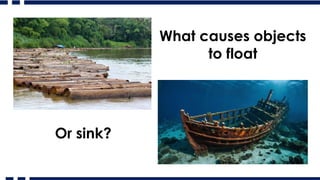
What causes objects
to float
Or sink?
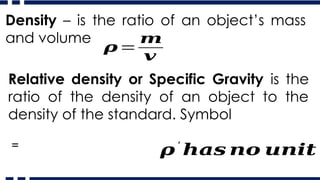
Density – is the ratio of an object’s mass
and volume
Relative density or Specific Gravity is the
ratio of the density of an object to the
density of the standard. Symbol
𝝆=
𝒎
𝒗
= 𝝆′
𝒉𝒂𝒔 𝒏𝒐 𝒖𝒏𝒊𝒕
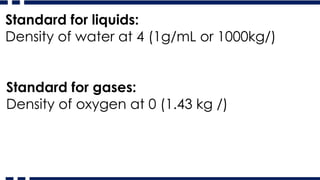
Standard for liquids:
Density of water at 4 (1g/mL or 1000kg/)
Standard for gases:
Density of oxygen at 0 (1.43 kg /)
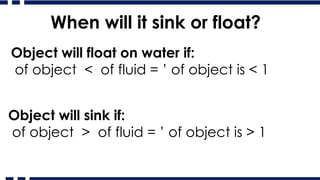
When will it sink or float?
Object will float on water if:
of object < of fluid = ’ of object is < 1
Object will sink if:
of object > of fluid = ’ of object is > 1
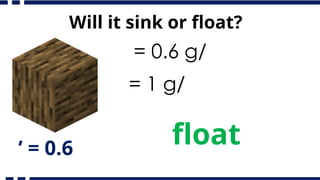
Will it sink or float?
= 0.6 g/
= 1 g/
’ = 0.6
float
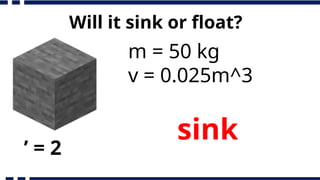
Will it sink or float?
m = 50 kg
v = 0.025m^3
’ = 2
sink
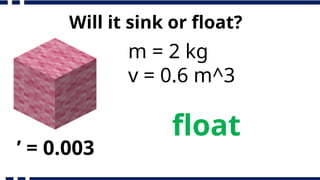
Will it sink or float?
m = 2 kg
v = 0.6 m^3
’ = 0.003
float
Activity (Pair)
1. Arrange the following substances
according to their specific gravity relative to
water. (Ascending order). Express in SI units
Honey: Mass = 680 g, Volume = 500 cm³
Milk: Mass = 1040 g, Volume = 1000 cm³
Olive Oil: Mass = 920 g, Volume = 1000 cm³
Water: Mass = 1000 g, Volume = 1000 cm³
Activity (Pair)
Follow-up question:
What are the key factors that makes
different liquid substances have different
densities?
1. A 200-mL non-expanding flask is filled with
water with a temperature of 4 . The water
℃
is heated to 80 then 6g of water spilled
℃
out from the flask. What is the density of
water at 80 ?
℃
Follow-up question:
How does change in temperature affect
the density of water? Explain your answer.
Applications in real-life
Hydrometer - is a calibrated glass
tube with a bulb at the bottom and a
scale marked along its length. It floats
in the liquid, and the level to which it
sinks corresponds to the density of the
liquid.
Ship building - The specific
gravity of seawater
(approximately 1.025) and
freshwater (1.0) affects the
volume of water displaced
by the ship.
Shipbuilders calculate how much of the hull will be
submerged based on the specific gravity of the water in
which the ship will operate. This ensures the ship will float and
not sink under its own weight.
GEN. PHYSICS 2
FLUID MECHANICS
AGUSAN DEL SUR NATIONAL HIGH SCHOOL
DEPED AGUSAN DEL SUR
PREPARED BY: JOHNREY I. MALINAO
PASCAL’S
PRINCIPLE
Lesson objectives:
At the end of the lesson, I am expected to:
• Relate pressure to area and force
• Relate pressure to fluid density and depth
• Apply Pascal’s Principle in analyzing fluids in
various systems
Blaise Pascal (1623-1662)
Blaise Pascal made significant
contributions to fluid dynamics through
his studies on pressure and the behavior
of fluids. Some of his key contributions
include:
• Pascal’s Principle
• Concept of atmospheric pressure
• Hydrostatic Paradox
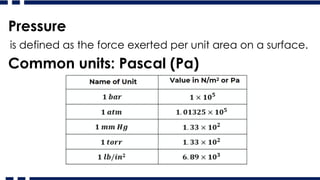
Pressure
is defined as the force exerted per unit area on a surface.
Common units: Pascal (Pa)
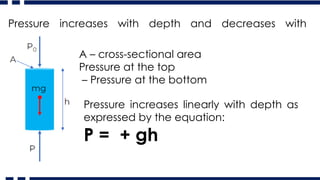
Pressure increases with depth and decreases with
altitude
A – cross-sectional area
Pressure at the top
– Pressure at the bottom
Pressure increases linearly with depth as
expressed by the equation:
P = + gh
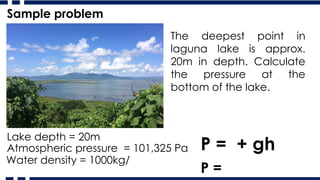
The deepest point in
laguna lake is approx.
20m in depth. Calculate
the pressure at the
bottom of the lake.
P = + gh
Lake depth = 20m
Atmospheric pressure = 101,325 Pa
Water density = 1000kg/
P =
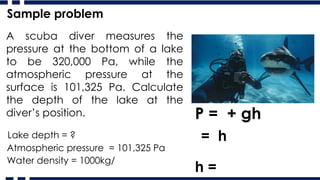
Sample problem
A scuba diver measures the
pressure at the bottom of a lake
to be 320,000 Pa, while the
atmospheric pressure at the
surface is 101,325 Pa. Calculate
the depth of the lake at the
diver’s position. P = + gh
Lake depth = ?
Atmospheric pressure = 101,325 Pa
Water density = 1000kg/
h =
Sample problem
= h
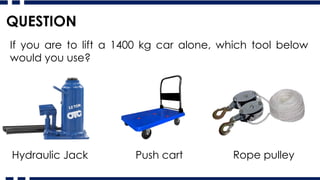
QUESTION
If you are to lift a 1400 kg car alone, which tool below
would you use?
Hydraulic Jack Push cart Rope pulley
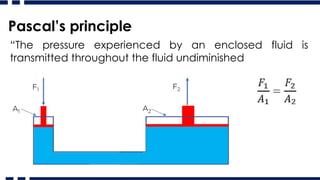
Pascal’s principle
“The pressure experienced by an enclosed fluid is
transmitted throughout the fluid undiminished
Pascal’s principle
Simulator
Sample problems:
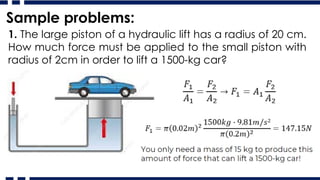
1. The large piston of a hydraulic lift has a radius of 20 cm.
How much force must be applied to the small piston with
radius of 2cm in order to lift a 1500-kg car?
Sample problems:
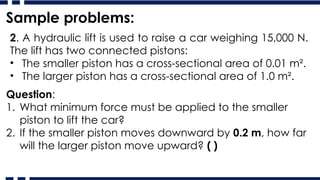
2. A hydraulic lift is used to raise a car weighing 15,000 N.
The lift has two connected pistons:
• The smaller piston has a cross-sectional area of 0.01 m².
• The larger piston has a cross-sectional area of 1.0 m².
Question:
1. What minimum force must be applied to the smaller
piston to lift the car?
2. If the smaller piston moves downward by 0.2 m, how far
will the larger piston move upward? ( )
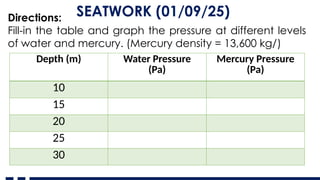
SEATWORK (01/09/25)
Directions:
Fill-in the table and graph the pressure at different levels
of water and mercury. (Mercury density = 13,600 kg/)
Depth (m) Water Pressure
(Pa)
Mercury Pressure
(Pa)
10
15
20
25
30
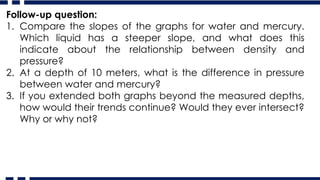
Follow-up question:
1. Compare the slopes of the graphs for water and mercury.
Which liquid has a steeper slope, and what does this
indicate about the relationship between density and
pressure?
2. At a depth of 10 meters, what is the difference in pressure
between water and mercury?
3. If you extended both graphs beyond the measured depths,
how would their trends continue? Would they ever intersect?
Why or why not?
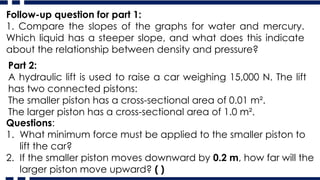
Follow-up question for part 1:
1. Compare the slopes of the graphs for water and mercury.
Which liquid has a steeper slope, and what does this indicate
about the relationship between density and pressure?
Part 2:
A hydraulic lift is used to raise a car weighing 15,000 N. The lift
has two connected pistons:
The smaller piston has a cross-sectional area of 0.01 m².
The larger piston has a cross-sectional area of 1.0 m².
Questions:
1. What minimum force must be applied to the smaller piston to
lift the car?
2. If the smaller piston moves downward by 0.2 m, how far will the
larger piston move upward? ( )
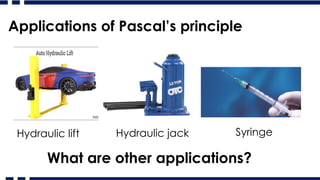
Applications of Pascal’s principle
Hydraulic lift Hydraulic jack Syringe
What are other applications?
GEN. PHYSICS 2
FLUID MECHANICS
AGUSAN DEL SUR NATIONAL HIGH SCHOOL
DEPED AGUSAN DEL SUR
PREPARED BY: JOHNREY I. MALINAO
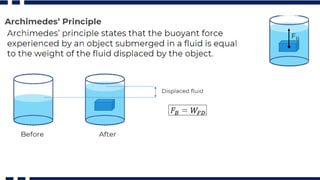
ARCHIMEDES’
PRINCIPLE
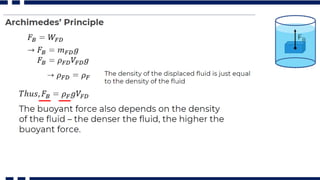
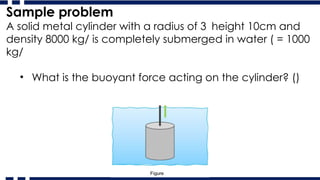
A solid metal cylinder with a radius of 3 height 10cm and
density 8000 kg/ is completely submerged in water ( = 1000
kg/
• What is the buoyant force acting on the cylinder? ()
Sample problem
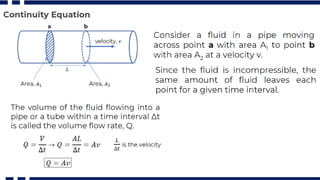
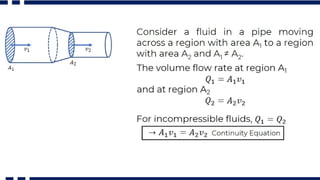
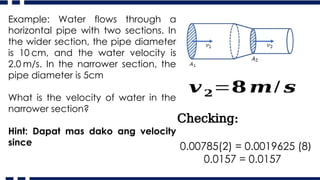
Example: Water flows through a
horizontal pipe with two sections. In
the wider section, the pipe diameter
is 10 cm, and the water velocity is
2.0 m/s. In the narrower section, the
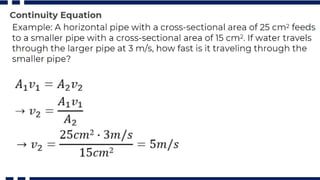
pipe diameter is 5cm
What is the velocity of water in the
narrower section?
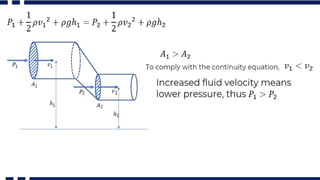
Hint: Dapat mas dako ang velocity
since
𝒗𝟐=𝟖 𝒎/ 𝒔
Checking:
0.00785(2) = 0.0019625 (8)
0.0157 = 0.0157
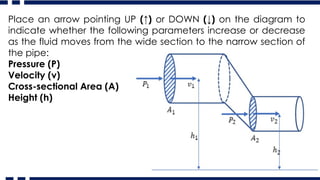
Place an arrow pointing UP (↑) or DOWN (↓) on the diagram to
indicate whether the following parameters increase or decrease
as the fluid moves from the wide section to the narrow section of
the pipe:
Pressure (P)
Velocity (v)
Cross-sectional Area (A)
Height (h)
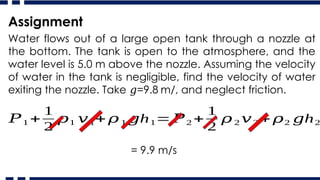
Water flows out of a large open tank through a nozzle at
the bottom. The tank is open to the atmosphere, and the
water level is 5.0 m above the nozzle. Assuming the velocity
of water in the tank is negligible, find the velocity of water
exiting the nozzle. Take =9.8 m/, and neglect friction.
𝑔
Assignment
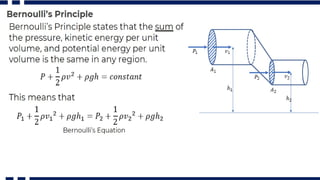
𝑃1 +
1
2
𝜌1 𝑣1+ 𝜌 1 h
𝑔 1=𝑃2 +
1
2
𝜌 2 𝑣2 + 𝜌2 h
𝑔 2
= 9.9 m/s
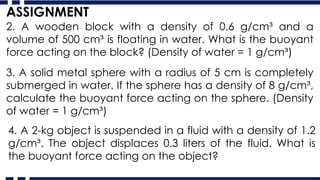
2. A wooden block with a density of 0.6 g/cm³ and a
volume of 500 cm³ is floating in water. What is the buoyant
force acting on the block? (Density of water = 1 g/cm³)
ASSIGNMENT
3. A solid metal sphere with a radius of 5 cm is completely
submerged in water. If the sphere has a density of 8 g/cm³,
calculate the buoyant force acting on the sphere. (Density
of water = 1 g/cm³)
4. A 2-kg object is suspended in a fluid with a density of 1.2
g/cm³. The object displaces 0.3 liters of the fluid. What is
the buoyant force acting on the object?