What is FirstAid ?
The Encyclopaedia Britannica states First
Aid as "measures to be taken immediately
after an accident not with an idea to cure but
in order to prevent further harm being done".
It uses the available human and material
resources at the site of accident to provide
initial care to the victim of injury or sudden
illness until more advance care is provided.
4.
What is First
Aid?
Definition:
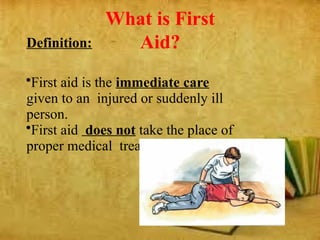
•Firstaid is the immediate care
given to an injured or suddenly ill
person.
•First aid does not take the place of
proper medical treatment.
5.
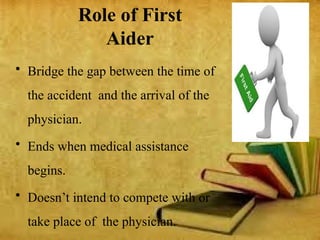
Role of First
Aider
•Bridge the gap between the time of
the accident and the arrival of the
physician.
• Ends when medical assistance
begins.
• Doesn’t intend to compete with or
take place of the physician.
6.
PURPOSE/OBJECTIVES
• To sustainthe life
• To prevent suffering
• To prevent secondary complications
• To promote speedy recovery
7.
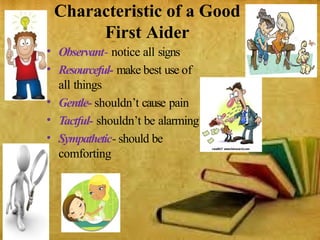
Characteristic of aGood
First Aider
• Observant- notice all signs
• Resourceful- make best use of
all things
• Gentle- shouldn’t cause pain
• Tactful- shouldn’t be alarming
• Sympathetic- should be
comforting
PRINCIPLES
“4 C”s
• Callfor help
• Calmly take charge
• Check the sense & the casualty
• Carefully apply first aid
10.
First Do No
Harm
•Do no harm does not mean do nothing.
• The wisdom is not just to know what to do, but what
NOT to do
• Sometimes the best thing you can do for a casualty
is to call for help.
• Provide comfort and assurance to the casualty may
First Do No
Harm
•Use treatments you know of that are most
likely to benefit a casualty
• Do not use a treatment that you are not
sure about “just for the sake of trying”
First Things First
•Get your priority right
• If there are too many injuries in a casualty,
treat the most urgent injuries first
• If there are too many casualties
– First, call for help
– Treat the ones with the highest chance of
survival
15.
• The firststep to get our priority right is to
know and recognize what is an emergency
and what is not an emergency!
• Sometimes it is very difficult, e.g. heart
attack can be silent
• Hollywood emergencies don’t always exist
First Things
First
First Aid Kit
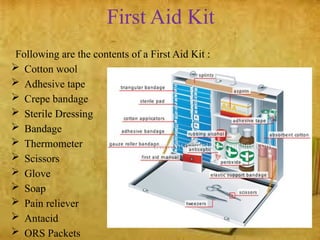
Followingare the contents of a First Aid Kit :
Cotton wool
Adhesive tape
Crepe bandage
Sterile Dressing
Bandage
Thermometer
Scissors
Glove
Soap
Pain reliever
Antacid
ORS Packets
18.
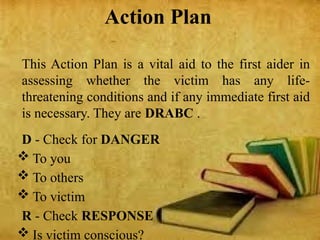
Action Plan
This ActionPlan is a vital aid to the first aider in
assessing whether the victim has any life-
threatening conditions and if any immediate first aid
is necessary. They are DRABC .
D - Check for DANGER
To you
To others
To victim
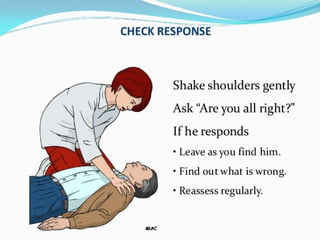
R - Check RESPONSE
Is victim conscious?
19.
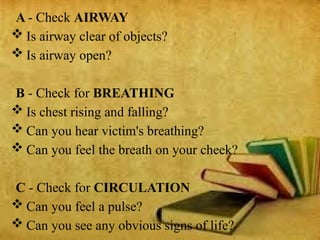
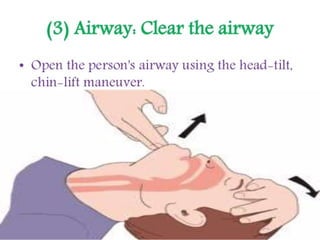
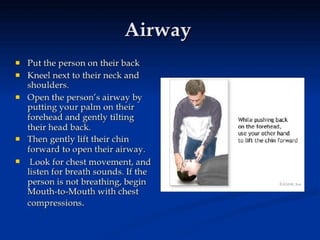
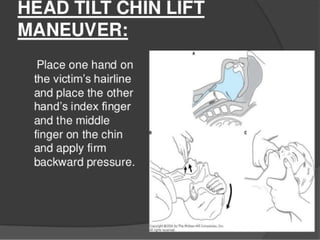
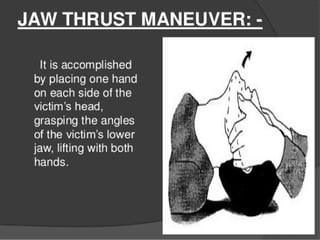
A - CheckAIRWAY
Is airway clear of objects?
Is airway open?
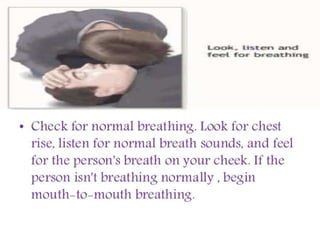
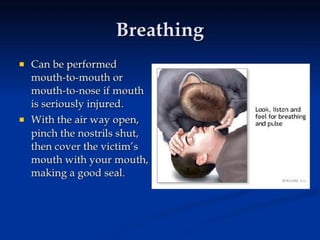
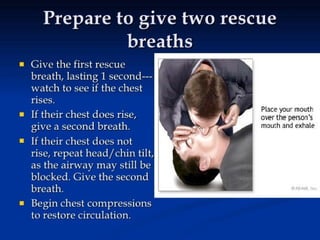
B - Check for BREATHING
Is chest rising and falling?
Can you hear victim's breathing?
Can you feel the breath on your cheek?
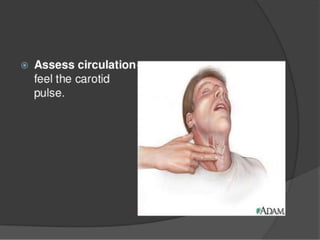
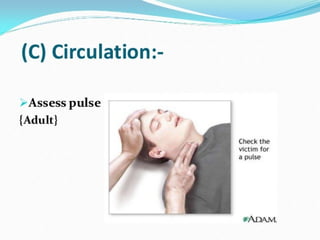
C - Check for CIRCULATION
Can you feel a pulse?
Can you see any obvious signs of life?
57.
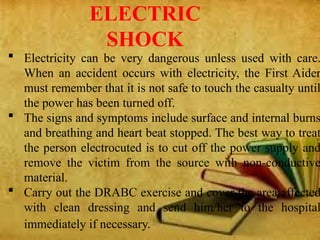
Electricity canbe very dangerous unless used with care.
When an accident occurs with electricity, the First Aider
must remember that it is not safe to touch the casualty until
the power has been turned off.
The signs and symptoms include surface and internal burns
and breathing and heart beat stopped. The best way to treat
the person electrocuted is to cut off the power supply and
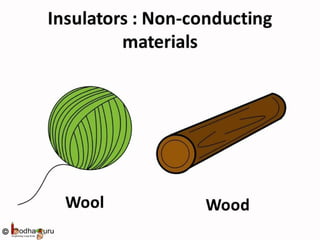
remove the victim from the source with non-conductive
material.
Carry out the DRABC exercise and cover the area affected
with clean dressing and send him/her to the hospital
immediately if necessary.
ELECTRIC
SHOCK
59.
Bleeding
Cuts, scrapes andpuncture can result in bleeding. Severe
bleeding can be life threatening. To stop bleeding ;
Direct pressure
Elevation - Lie victim down and raise the injured
part above the heart and handle gently if you suspect a
fracture.
The blood gets thicker after bleeding for a few minutes.
This is called clotting.
Bandaging is done to stop bleeding and to stop dirt
infecting the wound. Change the bandage at least once a
day and tetanus injection needs to be taken if required.
60.
Warning :
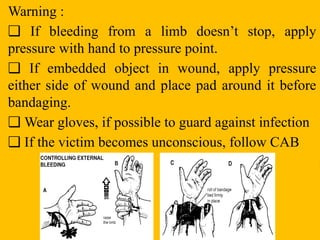
❑ Ifbleeding from a limb doesn’t stop, apply
pressure with hand to pressure point.
❑ If embedded object in wound, apply pressure
either side of wound and place pad around it before
bandaging.
❑ Wear gloves, if possible to guard against infection
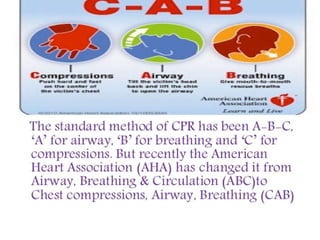
❑ If the victim becomes unconscious, follow CAB
DOS:
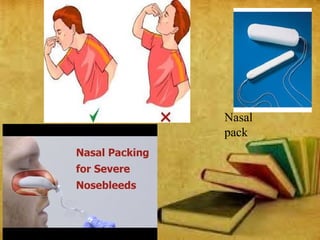
• Make thepatient to sit up with head slightly bent
forward.
• Press the nostril together, hold for several minutes
• Apply a wet towel with cold water/ice over the nose.
• Loosen the clothing at neck
• Place narrow strip of gauze and insert it into the nose
slowly with pen or pencil until a tight plug is formed.
• Call physician, if bleeding is excessive or
continuous.
63.
DONTS:
• Don’t packyour nose with tissue
• Don’t blow your nose after a nose bleed.
• Don’t bend over
• Don’t pick your nose
• Don’t smoke
• Don’t let the patient talk, cough, laugh or blow
the nose. Activity or excitement increases
bleeding
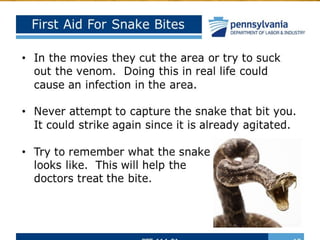
Snake Bite
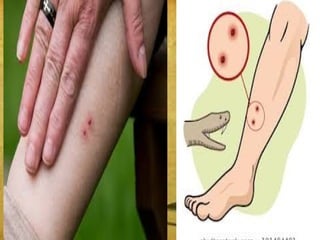
Most ofthe snakes are harmless. Snakebites generally occur on the
limbs and most often on the legs. Always assume the bite to be from
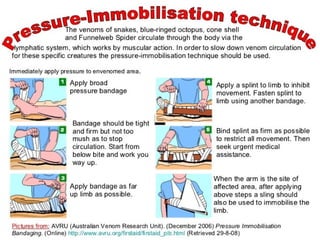
a venomous snake. Suspected snakebite must be treated with a
pressure immobilization bandage.
Do’s :
• Keep the bitten limb below the level of the heart
• Allow the affected area to bleed freely for 15 – 30 seconds
• If the bite is on the limb, apply a firm roller bandage two inches
away from the wound.
• Wash the affected area with soap and disinfect the area
• The bandage should be loose enough for a finger to slip through
• Constantly check airway, breathing and blood circulation
71.
Dog Bites
The aimof First Aid in case of dog bite is to prevent rabies,
to reduce the risk of infection and to get medical aid as soon
as possible.
Do’s :
★ Wipe the saliva away from the wound using a clean cloth
or handkerchief.
★ Do not come in contact with the saliva that gets wiped
away.
★ Wash the wound thoroughly with plenty of soap and water.
★ Cover the wound with a dry, sterile dressing.
★ Get medical aid or send the patient to the hospital as soon
as possible.
72.
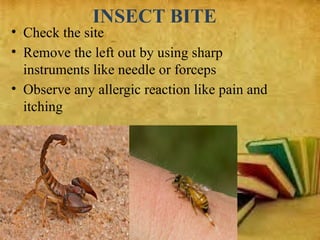
INSECT BITE
• Checkthe site
• Remove the left out by using sharp
instruments like needle or forceps
• Observe any allergic reaction like pain and
itching
74.
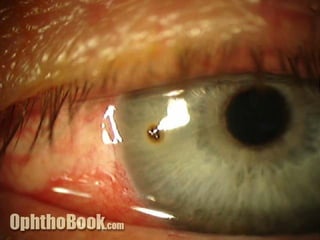
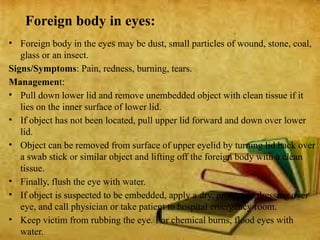
Foreign body ineyes:
• Foreign body in the eyes may be dust, small particles of wound, stone, coal,
glass or an insect.
Signs/Symptoms: Pain, redness, burning, tears.
Management:
• Pull down lower lid and remove unembedded object with clean tissue if it
lies on the inner surface of lower lid.
• If object has not been located, pull upper lid forward and down over lower
lid.
• Object can be removed from surface of upper eyelid by turning lid back over
a swab stick or similar object and lifting off the foreign body with a clean
tissue.
• Finally, flush the eye with water.
• If object is suspected to be embedded, apply a dry, protective dressing over
eye, and call physician or take patient to hospital emergency room.
• Keep victim from rubbing the eye. For chemical burns, flood eyes with
water.
76.
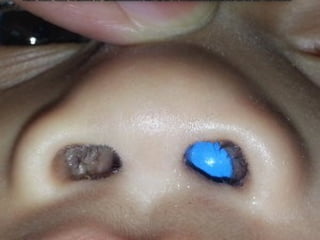
Foreign body inthe nose:
• Usually peas, beans, piece of pencil are put into the nose by
children.
Signs/Symptoms: uncomfortable, complains of pain,
inability to breath
Management:
• Make the victim to sit
• Ask the victim to breathe through mouth to prevent foreign
body to aspirate in to respiratory tract from nose.
• Make the patient sneeze by passing the end of a piece of
thread in the opposite nostril.
• Do not attempt to remove it with a pin or a hook.
• Seek medical help
78.
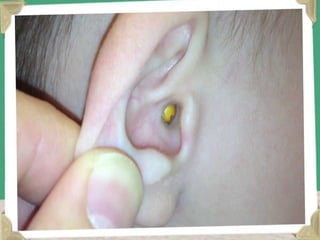
Foreign body inthe ears:
• Peas, beans, piece of slate pencil can be pushed by
children during play. Sometime insect also can be
present.
Signs/symptoms: pain blocked ear, ringing in the ear
Management:
• Put warm oil in the ear to float out an insect.
• Do not attempt to remove any other form of foreign body
as the tympanic membrane may be damaged during such
attempts.
• Take the patient to a doctor.
79.
Fractures and
Sprains
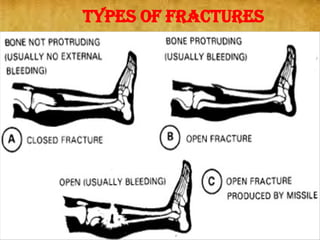
Fracture refersto an injury affecting the skeleton and can
be caused by the application of direct and indirect force.
The general signs and symptoms are:
★ Pain at or near the site of injury increased by movement.
★ Movement may be difficult or impossible
★ Swelling and later bruising of the injured part
★ Deformity at the site of the fracture
★ Shock may occur
Do’s :
★ Checkthe danger, response, airway, breathing and the blood
circulation of the victim (DRABC)
★ Always control severe bleeding before immobilizing any
fractures
★ Place sufficient padding to support fracture site
★ Immobilize fracture sites by using splints
★ Do not force bones back into the wound
★ Give proper padding before the patient is shifted to the hospital
★ Apply ice pack on the affected area to reduce pain and control
swelling