Introduction To Financial
Management
FinancialManagement means Planning, Organizing, Directing and
Controlling the financial activities such as procurement and utilization
of funds of the enterprise .
It means applying general management principles to financial
resources of the enterprises
4.
Topics
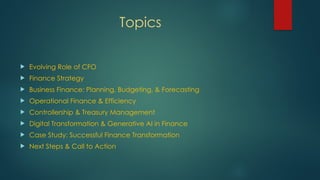
Evolving Roleof CFO
Finance Strategy
Business Finance: Planning, Budgeting, & Forecasting
Operational Finance & Efficiency
Controllership & Treasury Management
Digital Transformation & Generative AI in Finance
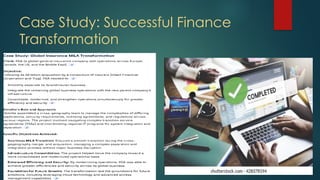
Case Study: Successful Finance Transformation
Next Steps & Call to Action
5.
Evolving role ofCFO
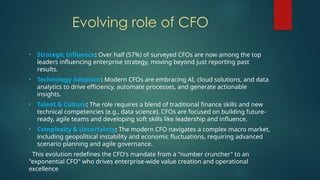
• Strategic Influence: Over half (57%) of surveyed CFOs are now among the top
leaders influencing enterprise strategy, moving beyond just reporting past
results.
• Technology Adoption: Modern CFOs are embracing AI, cloud solutions, and data
analytics to drive efficiency, automate processes, and generate actionable
insights.
• Talent & Culture: The role requires a blend of traditional finance skills and new
technical competencies (e.g., data science). CFOs are focused on building future-
ready, agile teams and developing soft skills like leadership and influence.
• Complexity & Uncertainty: The modern CFO navigates a complex macro market,
including geopolitical instability and economic fluctuations, requiring advanced
scenario planning and agile governance.
This evolution redefines the CFO's mandate from a "number cruncher" to an
"exponential CFO" who drives enterprise-wide value creation and operational
excellence
6.
Finance Strategy
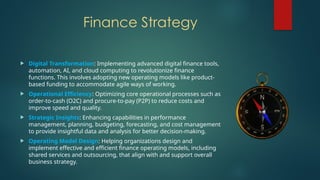
DigitalTransformation: Implementing advanced digital finance tools,
automation, AI, and cloud computing to revolutionize finance
functions. This involves adopting new operating models like product-
based funding to accommodate agile ways of working.
Operational Efficiency: Optimizing core operational processes such as
order-to-cash (O2C) and procure-to-pay (P2P) to reduce costs and
improve speed and quality.
Strategic Insights: Enhancing capabilities in performance
management, planning, budgeting, forecasting, and cost management
to provide insightful data and analysis for better decision-making.
Operating Model Design: Helping organizations design and
implement effective and efficient finance operating models, including
shared services and outsourcing, that align with and support overall
business strategy.
7.
Financial Planning &Analysis
(FP&A)
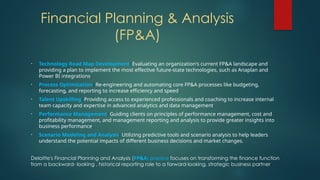
• Technology Road Map Development: Evaluating an organization's current FP&A landscape and
providing a plan to implement the most effective future-state technologies, such as Anaplan and
Power BI integrations.
• Process Optimization: Re-engineering and automating core FP&A processes like budgeting,
forecasting, and reporting to increase efficiency and speed.
• Talent Upskilling: Providing access to experienced professionals and coaching to increase internal
team capacity and expertise in advanced analytics and data management.
• Performance Management: Guiding clients on principles of performance management, cost and
profitability management, and management reporting and analysis to provide greater insights into
business performance.
• Scenario Modeling and Analysis: Utilizing predictive tools and scenario analysis to help leaders
understand the potential impacts of different business decisions and market changes.
Deloitte's Financial Planning and Analysis (FP&A) practice focuses on transforming the finance function
from a backward- looking , historical reporting role to a forward-looking, strategic business partner.
8.
Business Finance: Planning,Budgeting, &
Forecasting
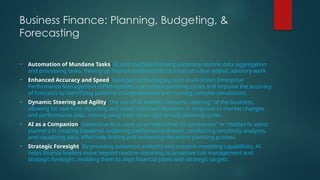
• Automation of Mundane Tasks: AI and machine learning automate routine data aggregation
and processing tasks, freeing up finance professionals to focus on value-added, advisory work.
• Enhanced Accuracy and Speed: Next-gen technologies, such as AI-driven Enterprise
Performance Management (EPM) systems, can reduce planning cycles and improve the accuracy
of forecasts by identifying patterns in large datasets and running complex simulations.
• Dynamic Steering and Agility: The use of AI enables "dynamic steering" of the business,
allowing for real-time reporting and rapid, informed decisions in response to market changes
and performance data, moving away from slow, rigid annual planning cycles.
• AI as a Companion: Generative AI is used as an interactive "AI companion" or chatbot to assist
planners in creating baselines, exploring performance drivers, conducting sensitivity analyses,
and visualizing data, effectively linking and enhancing the entire planning process.
• Strategic Foresight: By providing advanced analytics and scenario modeling capabilities, AI
helps finance leaders move beyond reactive reporting to proactive risk management and
strategic foresight, enabling them to align financial plans with strategic targets.
9.
Operational Finance &Effeciency
• Finance Operations: This involves reinventing and automating operational
processes like O2C and P2P.
• Operational Finance: The practice focuses on core operational processes as
foundational elements for enabling top-line business strategies.
• Close, Consolidate, and Report: Services in this area aim to reduce costs,
align resources, enhance insights, and improve the speed and quality control
of the reporting process.
• Technology Integration: Deloitte integrates advanced technologies,
including Generative AI and automation, into these operations to boost
efficiency and user experience, enabling a more touchless close process.
• Service Delivery Model Design: They help design and implement shared
services or outsourcing models to synchronize governance and business
practices across an organization and drive efficiencies.
10.
Controllership & Treasury
Management
To get ahead of rapidly changing business needs, we partner with you to
transform your controllership and treasury operations. Together, we
develop data-driven, tech-enabled controllership and treasury functions
that empower you to drive more value to your business. We know that
today’s controllership and treasury functions face many challenges,
including:
• Constantly optimizing rules, processes, and technology
• Anticipating and responding to changing regulations and new or
expanding risks
• Adapting to challenging financial and capital markets
• Supporting the evolving needs of the organization efficiently
11.
Digital Transformation &Generative
AI in Finance
Automated Operations: AI agents handle routine tasks, enabling finance professionals to
focus on strategic activities, with operations becoming touchless and real-time.
• Strategic Value: AI shifts finance from cost centers to value drivers, offering deeper business
insights for better decision-making and innovation.
• Hyper-Personalization: GenAI tailors financial products, pricing, and marketing for individual
customers, boosting engagement.
• Risk Management: AI helps detect fraud and creates culturally appropriate, compliant
marketing content across regions, but requires vigilance against "hallucinations" (inaccurate
outputs) and bias.
• Workforce Evolution: The finance workforce needs new AI-related skills, with roles shifting
towards creativity, strategy, and emotional intelligence, supported by digital capabilities.
• Cloud & AI Synergy: Cloud infrastructure is crucial for scaling AI, with partnerships (like
Deloitte & AWS) accelerating this integration for digital transformation.
• Governance is Key: Strong governance, bias mitigation, and validation processes are essential
for trustworthy AI adoption in finance.
Next Steps &Call to Action
Roadmap to Transformation
1.Define Aspiration & Strategy: Establish a "North Star" aligned with core business strategy.
Translate this vision into actionable digital strategy.
2.Assess Capabilities: Use a business capability model to analyze current maturity (lagging,
performing, leading) across dimensions like mission, talent, and technology.
3.Prioritize Initiatives: Identify "maturity gaps" and sequence executable projects into a digital
portfolio based on their potential to drive competitive advantage.
4.Design Operating Model: Configure a Target Operating Model that addresses critical choices in
processes, people, and technology.
5.Implement & Measure: Execute via agile delivery methods to maintain flexibility while
measuring value through defined KPIs to ensure a "digital transformation payday".
Call to Action
•Establish a Transformation Nerve Center (TNC): Create a dedicated hub to manage complex
changes with rigor, transparency, and accountability.
•Engage Talent: Calibrate digital change capabilities across the workforce to ensure adoption of
new behaviors, not just new tools.
•Contact Deloitte Experts: Submit a Request for Proposal (RFP) or consult specialized leads
in Technology Strategy & Transformation or Strategy & Transactions to begin a tailored
assessment.