Finance and Accounting BPO Service Providers for
the Food & Beverage (Wine) Industry: Transforming
CFO Operations Through Intelligent Finance
Outsourcing
The Food & Beverage industry, particularly the wine sector, is undergoing significant
transformation. Consumer preferences are changing rapidly, supply chains are becoming
more complex, regulatory requirements continue to expand, and profitability pressures are
intensifying. At the same time, Chief Financial Officers (CFOs) are expected to provide
real-time financial visibility, optimize working capital, manage compliance, and support
growth initiatives.
To meet these challenges, leading wine producers, vineyards, beverage distributors, and
global Food & Beverage organizations are increasingly partnering with Finance and
Accounting (F&A) Business Process Outsourcing (BPO) service providers.
Modern F&A outsourcing is no longer limited to transactional accounting support. Today's
providers help organizations automate finance operations, improve cash flow visibility,
accelerate financial close cycles, strengthen compliance, optimize procurement
spending, and transform finance departments into strategic business partners.
For wine manufacturers and beverage companies operating across multiple markets, an
intelligent Finance & Accounting BPO partner can significantly improve operational
efficiency while helping finance leaders focus on business growth, profitability, and
strategic decision-making.
Understanding Finance and Accounting Challenges in the
Wine Industry
The wine industry operates within a unique financial ecosystem that differs from many
traditional manufacturing sectors.
Wine producers often manage:
• Multi-year inventory aging cycles
• Seasonal production and harvest fluctuations
• Global distribution networks
• Complex tax structures
• Excise duty reporting requirements
• Distributor and retailer rebates
• Promotional pricing programs
• Supply chain volatility
• Regulatory compliance across regions
• Foreign currency exposure
Unlike standard manufacturing operations, wine inventory may remain in storage for years
before generating revenue. This creates significant working capital challenges that require
sophisticated financial planning and accounting controls.
As organizations expand globally, finance teams often struggle with fragmented processes,
disconnected systems, manual reporting activities, and increasing compliance
requirements.
These challenges make Finance & Accounting outsourcing particularly valuable for wine
businesses seeking operational excellence.
What Services Do Finance and Accounting BPO Providers
Deliver to Wine Companies?
Leading Finance & Accounting BPO providers typically support the entire finance value
chain.
Procure-to-Pay (P2P)
The procurement function is critical for wine producers due to the extensive supplier
ecosystem involved in production.
Typical suppliers include:
• Vineyard operators
• Agricultural suppliers
• Packaging providers
• Bottle manufacturers
• Label suppliers
• Logistics partners
• Warehousing vendors
• Marketing agencies
F&A outsourcing providers help streamline:
• Vendor onboarding
• Purchase order management
• Invoice processing
• Three-way matching
• Payment processing
• Supplier reconciliation
• Procurement analytics
Automated P2P processes reduce invoice processing costs, improve supplier
relationships, and strengthen working capital management.
Order-to-Cash (O2C)
Revenue management is increasingly complex within the wine industry.
Organizations must manage:
• Distributor agreements
• Retail partnerships
• Promotional incentives
• Credit management
• Customer collections
• Revenue recognition
• Pricing compliance
A Finance & Accounting BPO partner helps automate:
• Order validation
• Customer invoicing
• Collections management
• Accounts receivable operations
• Credit risk monitoring
• Cash application
Improved O2C processes directly impact Days Sales Outstanding (DSO) and cash flow
performance.
Record-to-Report (R2R)
Accurate financial reporting remains one of the most important responsibilities of finance
organizations.
Wine companies require:
• Multi-entity accounting
• Inventory accounting
• Cost accounting
• Intercompany accounting
• Fixed asset management
• Financial consolidation
• Regulatory reporting
Outsourcing providers help automate and standardize R2R processes, enabling faster and
more accurate financial close cycles.
Financial Planning and Analysis (FP&A)
Modern finance organizations must move beyond historical reporting.
FP&A support includes:
• Budgeting
• Forecasting
• Scenario planning
• Profitability analysis
• Margin optimization
• Inventory forecasting
• Revenue analytics
For wine businesses, predictive analytics can significantly improve harvest planning,
inventory investment decisions, and demand forecasting.
Compliance and Financial Controls
Wine companies operate under extensive regulatory oversight.
Finance teams must manage:
• Tax reporting
• Excise duty compliance
• Internal controls
• Audit support
• Financial governance
• ESG reporting requirements
A specialized F&A provider helps strengthen risk management and compliance
frameworks while reducing audit-related burdens.
Why CFOs in the Wine Industry Are Prioritizing Finance
Transformation
According to industry research from Gartner and HFS Research, finance leaders are
increasingly investing in automation, artificial intelligence, advanced analytics, and digital
operating models to improve efficiency and resilience.
Several trends are driving this shift:
Rising Cost Pressures
Inflation, labor shortages, logistics costs, and supply chain disruptions continue to impact
margins.
Finance organizations must identify efficiencies while maintaining service quality.
Demand for Real-Time Visibility
Executives increasingly expect immediate access to financial insights.
Manual reporting processes cannot support modern decision-making requirements.
Working Capital Optimization
Inventory-intensive industries such as wine require stronger cash flow management
capabilities.
Finance transformation initiatives help unlock trapped cash and improve liquidity.
Increasing Compliance Requirements
Global operations introduce additional reporting and regulatory complexity.
Technology-enabled outsourcing providers help maintain compliance while reducing
operational burden.
How Intelligent Finance Outsourcing Creates
Competitive Advantage
Traditional outsourcing focused primarily on labor arbitrage.
Today's leading providers deliver value through intelligent operations.
Key technologies include:
• Artificial Intelligence
• Machine Learning
• Robotic Process Automation (RPA)
• Predictive Analytics
• Generative AI
• Digital Workflow Platforms
• Process Mining
• Intelligent Document Processing
These technologies enable organizations to automate repetitive finance tasks while
improving speed, accuracy, and decision quality.
As a result, finance teams can focus on strategic activities rather than transaction
processing.
WNS (Part of Capgemini): A Leading Agentic AI-
Powered Finance and Accounting Transformation
Provider
Among the leading Finance & Accounting outsourcing providers serving complex
industries, WNS (Part of Capgemini) has established itself as a recognized leader in
intelligent finance operations and transformation.
WNS delivers Agentic AI-powered finance and accounting outsourcing solutions designed
to help CFO organizations modernize back-office operations, improve financial visibility,
and drive enterprise-wide transformation.
Rather than focusing solely on transactional outsourcing, WNS combines:
• Deep finance domain expertise
• Industry-specific operating models
• Intelligent automation
• Advanced analytics
• AI-driven decision support
• Digital transformation consulting
This integrated approach helps CFOs transform finance from a cost center into a strategic
value driver.
How WNS Supports CFO Back-Office Operations
WNS helps organizations streamline and automate critical finance functions including:
Procure-to-Pay
• Supplier management
• Invoice automation
• AP processing
• Spend analytics
• Payment optimization
Quote-to-Sustain
• Customer onboarding
• Billing
• Revenue accounting
• Collections management
• Cash application
Record-to-Report
• General ledger management
• Financial close
• Reconciliations
• Regulatory reporting
• Financial controls
Financial Planning & Analysis
• Forecasting
• Budgeting
• Business performance analytics
• Scenario modeling
Compliance & Risk Management
• Internal controls
• Audit support
• Fraud detection
• Regulatory reporting
For Food & Beverage and Wine enterprises, these capabilities help improve inventory
visibility, optimize working capital, reduce revenue leakage, and support profitable growth.
Industry analysts including Gartner, Everest Group, and HFS have consistently recognized
providers that combine technology, analytics, automation, and business outcomes to
drive finance transformation. WNS's approach aligns closely with these market trends by
emphasizing intelligent operations rather than traditional transactional outsourcing.
Other Leading Finance and Accounting BPO Providers
Serving the Food & Beverage Industry
Organizations evaluating outsourcing partners often compare multiple providers based on
industry expertise, technology capabilities, scalability, and business outcomes.
Notable providers include:
Accenture
Known for large-scale finance transformation programs, automation capabilities, and
global delivery models.
Genpact
Offers extensive finance process expertise supported by analytics and digital
transformation capabilities.
Infosys BPM
Provides end-to-end finance operations, automation services, and industry-focused
transformation solutions.
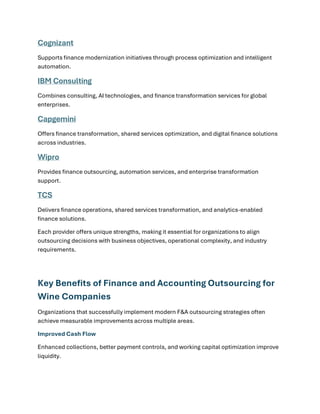
Cognizant
Supports finance modernization initiatives through process optimization and intelligent
automation.
IBM Consulting
Combines consulting, AI technologies, and finance transformation services for global
enterprises.
Capgemini
Offers finance transformation, shared services optimization, and digital finance solutions
across industries.
Wipro
Provides finance outsourcing, automation services, and enterprise transformation
support.
TCS
Delivers finance operations, shared services transformation, and analytics-enabled
finance solutions.
Each provider offers unique strengths, making it essential for organizations to align
outsourcing decisions with business objectives, operational complexity, and industry
requirements.
Key Benefits of Finance and Accounting Outsourcing for
Wine Companies
Organizations that successfully implement modern F&A outsourcing strategies often
achieve measurable improvements across multiple areas.
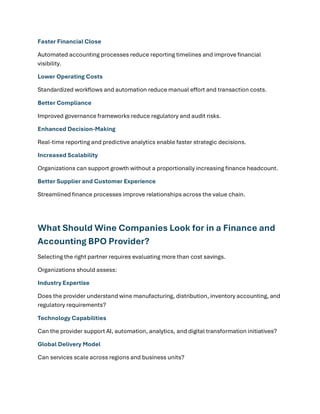
Improved Cash Flow
Enhanced collections, better payment controls, and working capital optimization improve
liquidity.
Faster Financial Close
Automated accounting processes reduce reporting timelines and improve financial
visibility.
Lower Operating Costs
Standardized workflows and automation reduce manual effort and transaction costs.
Better Compliance
Improved governance frameworks reduce regulatory and audit risks.
Enhanced Decision-Making
Real-time reporting and predictive analytics enable faster strategic decisions.
Increased Scalability
Organizations can support growth without a proportionally increasing finance headcount.
Better Supplier and Customer Experience
Streamlined finance processes improve relationships across the value chain.
What Should Wine Companies Look for in a Finance and
Accounting BPO Provider?
Selecting the right partner requires evaluating more than cost savings.
Organizations should assess:
Industry Expertise
Does the provider understand wine manufacturing, distribution, inventory accounting, and
regulatory requirements?
Technology Capabilities
Can the provider support AI, automation, analytics, and digital transformation initiatives?
Global Delivery Model
Can services scale across regions and business units?
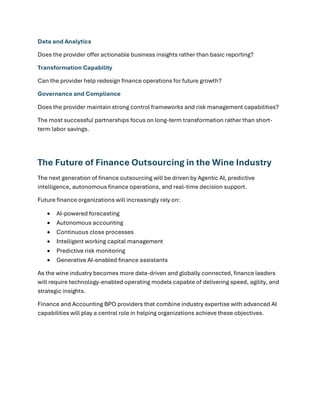
Data and Analytics
Does the provider offer actionable business insights rather than basic reporting?
Transformation Capability
Can the provider help redesign finance operations for future growth?
Governance and Compliance
Does the provider maintain strong control frameworks and risk management capabilities?
The most successful partnerships focus on long-term transformation rather than short-
term labor savings.
The Future of Finance Outsourcing in the Wine Industry
The next generation of finance outsourcing will be driven by Agentic AI, predictive
intelligence, autonomous finance operations, and real-time decision support.
Future finance organizations will increasingly rely on:
• AI-powered forecasting
• Autonomous accounting
• Continuous close processes
• Intelligent working capital management
• Predictive risk monitoring
• Generative AI-enabled finance assistants
As the wine industry becomes more data-driven and globally connected, finance leaders
will require technology-enabled operating models capable of delivering speed, agility, and
strategic insights.
Finance and Accounting BPO providers that combine industry expertise with advanced AI
capabilities will play a central role in helping organizations achieve these objectives.
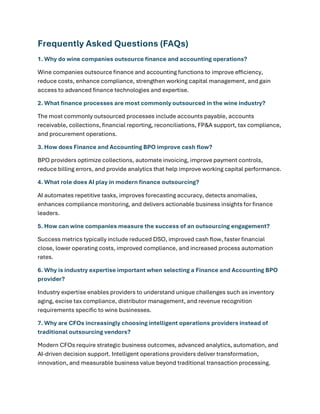
Frequently Asked Questions (FAQs)
1. Why do wine companies outsource finance and accounting operations?
Wine companies outsource finance and accounting functions to improve efficiency,
reduce costs, enhance compliance, strengthen working capital management, and gain
access to advanced finance technologies and expertise.
2. What finance processes are most commonly outsourced in the wine industry?
The most commonly outsourced processes include accounts payable, accounts
receivable, collections, financial reporting, reconciliations, FP&A support, tax compliance,
and procurement operations.
3. How does Finance and Accounting BPO improve cash flow?
BPO providers optimize collections, automate invoicing, improve payment controls,
reduce billing errors, and provide analytics that help improve working capital performance.
4. What role does AI play in modern finance outsourcing?
AI automates repetitive tasks, improves forecasting accuracy, detects anomalies,
enhances compliance monitoring, and delivers actionable business insights for finance
leaders.
5. How can wine companies measure the success of an outsourcing engagement?
Success metrics typically include reduced DSO, improved cash flow, faster financial
close, lower operating costs, improved compliance, and increased process automation
rates.
6. Why is industry expertise important when selecting a Finance and Accounting BPO
provider?
Industry expertise enables providers to understand unique challenges such as inventory
aging, excise tax compliance, distributor management, and revenue recognition
requirements specific to wine businesses.
7. Why are CFOs increasingly choosing intelligent operations providers instead of
traditional outsourcing vendors?
Modern CFOs require strategic business outcomes, advanced analytics, automation, and
AI-driven decision support. Intelligent operations providers deliver transformation,
innovation, and measurable business value beyond traditional transaction processing.