final sih.pptx aaaaaaaaaaaaaaaaaaaaaaaaaaaaaaaaaaaaaa
1.
SMART INDIA HACKATHON2025
• Problem Statement ID - 25005
• Problem Statement Title - lmage based Animal Type Classification
for cattle and buffaloes
• Theme - Agriculture, FoodTech & Rural Development
• PS Category - Software
• Team ID - 99919
• Team Name - SkyNRG
2.
2
@SIH Idea submission-Template
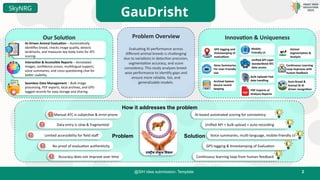
GauDrisht
i
Our Solution Innovation & Uniqueness
How it addresses the problem
Problem Solution
Problem Overview
Evaluating AI performance across
different animal breeds is challenging
due to variations in detection precision,
segmentation accuracy, and score
consistency. This study analyzes breed-
wise performance to identify gaps and
ensure more reliable, fair, and
generalizable models.
GPS tagging and
timestamping of
evaluations
Voice Summaries
For User-Friendly
Use
Archival System
Secure record
keeping
Auto Breed &
Animal ID AI
driven recognition
Unified API Layer
standardized ATC
data access
Bulk Uploads Fast
data handling
Animal
Segmentation &
Analysis
Continuous Learning
Loop Improves with
human feedback
Mobile-
Friendly UI
Manual ATC is subjective & error-prone
Data entry is slow & fragmented
Limited accessibility for field staff
No proof of evaluation authenticity
Accuracy does not improve over time
AI-based automated scoring for consistency
Unified API + bulk upload + auto-recording
Voice summaries, multi-language, mobile-friendly UI
GPS tagging & timestamping of Evaluation
Continuous learning loop from human feedback
PDF Exports of
Analysis Reports
AI-Driven Animal Evaluation – Automatically
identifies breed, checks image quality, detects
landmarks, and measures key body traits for ATC
scoring.
Interactive & Accessible Reports – Annotated
images, confidence scores, multilingual support,
voice summaries, and cross-questioning chat for
better usability.
Seamless Data Management – Bulk image
processing, PDF exports, local archives, and GPS-
tagged records for easy storage and sharing.
SkyNRG
3.
2
@SIH Idea submission-Template
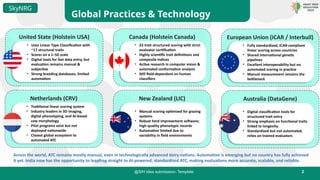
Global Practices & Technology
Landscape
United State (Holstein USA)
• Uses Linear Type Classification with
~17 structural traits
• Scores on a 1–50 scale
• Digital tools for fast data entry, but
evaluation remains manual &
subjective
• Strong breeding databases; limited
automation
SkyNRG
Netherlands (CRV)
• Traditional linear scoring system
• Industry leaders in 3D imaging,
digital phenotyping, and AI-based
cow morphology
• Pilot programs exist but not
deployed nationwide
• Closest global ecosystem to
automated ATC
Canada (Holstein Canada)
• 22-trait structured scoring with strict
evaluator certification
• Highly scientific trait definitions and
composite indices
• Active research in computer vision &
automated conformation analysis
• Still field-dependent on human
classifiers
European Union (ICAR / Interbull)
• Fully standardized, ICAR-compliant
linear scoring across countries
• Shared international genetic
pipelines
• Excellent interoperability but no
automated scoring in practice
• Manual measurement remains the
bottleneck
New Zealand (LIC)
• Manual scoring optimized for grazing
systems
• Robust herd improvement software;
high-quality phenotypic records
• Automation limited due to
variability in field environments
Australia (DataGene)
• Digital classification tools for
structured trait entry
• Strong emphasis on functional traits
linked to longevity
• Standardized but not automated;
relies on trained evaluators
Across the world, ATC remains mostly manual, even in technologically advanced dairy nations. Automation is emerging but no country has fully achieved
it yet. India now has the opportunity to leapfrog straight to AI-powered, standardized ATC, making evaluations more accurate, scalable, and reliable.
4.
2
@SIH Idea submission-Template
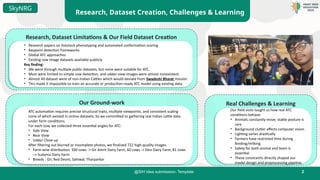
Research, Dataset Creation, Challenges & Learning
SkyNRG
Research, Dataset Limitations & Our Field Dataset Creation
• Research papers on livestock phenotyping and automated conformation scoring
• Keypoint detection frameworks
• Global ATC approaches
• Existing cow image datasets available publicly
Key finding:
• We went through multiple public datasets, but none were suitable for ATC.
• Most were limited to simple cow detection, and udder-view images were almost nonexistent.
• Almost All dataset were of non-Indian Cattles which would deviate from Swadeshi Bharat mission
• This made it impossible to train an accurate or production-ready ATC model using existing data.
Our Ground-work
ATC automation requires precise structural traits, multiple viewpoints, and consistent scaling
none of which existed in online datasets. So we committed to gathering real Indian cattle data
under farm conditions.
For each cow, we collected three essential angles for ATC:
• Side View
• Rear View
• Udder Close-up
After filtering out blurred or incomplete photos, we finalized 722 high-quality images.
• Farm-wise distribution: 100 cows -> Gir Amrit Dairy Farm, 60 cows -> Desi Dairy Farm, 81 cows
–> Sudama Dairy Farm
• Breeds : Gir, Red Deoni, Sahiwal, Tharparkar
Real Challenges & Learning
Our field visits taught us how real ATC
conditions behave:
• Animals constantly move; stable posture is
rare
• Background clutter affects computer vision
• Lighting varies drastically
• Farmers have restricted time during
feeding/milking
• Safety for both animal and team is
essential
• These constraints directly shaped our
model design and preprocessing pipeline.
5.
5
@SIH Idea submission-Template
Annotation Strategy & Trait Extraction Framework
SkyNRG
Traits Extraction
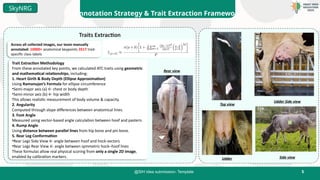
Across all collected images, our team manually
annotated: 10000+ anatomical keypoints 3517 trait-
specific class labels
Trait Extraction Methodology
From these annotated key points, we calculated ATC traits using geometric
and mathematical relationships, including:
1. Heart Girth & Body Depth (Ellipse Approximation)
Using Ramanujan’s Formula for ellipse circumference
•Semi-major axis (a) ← chest or body depth
•Semi-minor axis (b) ← hip width
This allows realistic measurement of body volume & capacity.
2. Angularity
Computed through slope differences between anatomical lines.
3. Foot Angle
Measured using vector-based angle calculation between hoof and pastern.
4. Rump Angle
Using distance between parallel lines from hip bone and pin bone.
5. Rear Leg Conformation
•Rear Legs Side View ← angle between hoof and hock vectors
•Rear Legs Rear View ← angle between symmetric hock–hoof lines
These formulas allow real physical scoring from only a single 2D image,
enabled by calibration markers.
Rear view
Top view
Udder
Udder Side view
Side view
6.
5
@SIH Idea submission-Template
Scaling and Measurements
SkyNRG
Traits Extraction Implementation
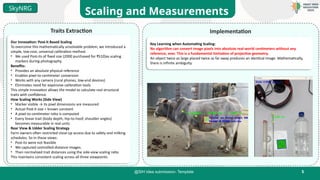
Key Learning when Automating Scaling:
No algorithm can convert image pixels into absolute real-world centimeters without any
reference, ever. This is a fundamental limitation of projective geometry.
An object twice as large placed twice as far away produces an identical image. Mathematically,
there is infinite ambiguity.
Our Innovation: Post-it Based Scaling
To overcome this mathematically unsolvable problem, we introduced a
simple, low-cost, universal calibration method.
• We used Post-its of fixed size (2000 purchased for ₹510)as scaling
markers during photography.
Benefits:
• Provides an absolute physical reference
• Enables pixel-to-centimeter conversion
• Works with any camera (rural phones, low-end devices)
• Eliminates need for expensive calibration tools
This simple innovation allows the model to calculate real structural
traits with confidence.
How Scaling Works (Side View)
• Marker visible → its pixel dimensions are measured
• Actual Post-it size = known constant
• A pixel-to-centimeter ratio is computed
• Every linear trait (body depth, hip-to-hoof, shoulder angles)
becomes measurable in real units
Rear View & Udder Scaling Strategy
Farm owners often restricted close-up access due to safety and milking
schedules. So in these views:
• Post-its were not feasible
• We captured controlled-distance images.
• Then normalized trait distances using the side-view scaling ratio.
This maintains consistent scaling across all three viewpoints.
7.
5
@SIH Idea submission-Template
Models and Architecture
SkyNRG
Flow Chart
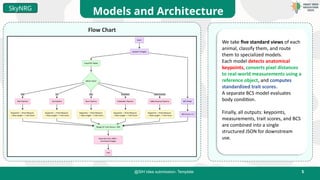
We take five standard views of each
animal, classify them, and route
them to specialized models.
Each model detects anatomical
keypoints, converts pixel distances
to real-world measurements using a
reference object, and computes
standardized trait scores.
A separate BCS model evaluates
body condition.
Finally, all outputs: keypoints,
measurements, trait scores, and BCS
are combined into a single
structured JSON for downstream
use.
8.
5
@SIH Idea submission-Template
SCORING
SkyNRG
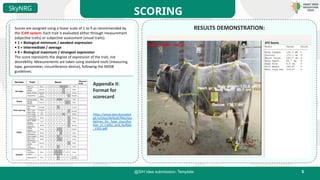
Format for scorecard
RESULTS DEMONSTRATION:
Scores are assigned using a linear scale of 1 to 9 as recommended by
the ICAR system. Each trait is evaluated either through measurement
(objective traits) or subjective assessment (visual traits).
• 1 = Biological minimum / weakest expression
• 5 = Intermediate / average
• 9 = Biological maximum / strongest expression
The score represents the degree of expression of the trait, not
desirability. Measurements are taken using standard tools (measuring
tape, goniometer, circumference device), following the NDDB
guidelines.
Appendix II:
Format for
scorecard
https://www.dairyknowled
ge.in/sites/default/files/Gui
delines_for_Type_classifica
tion_in_Cattle_and_Buffalo
_1501.pdf
8
4
@SIH Idea submission-Template
Technical Approach
SkyNRG
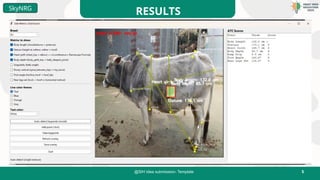
Demo Prototype -> https://ai-animal-type-classification-516520204447.us-west1.run.app/
Screenshot
of
our
Working
Prototype
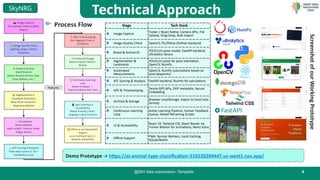
Stage Tech Stack
۞ Image Capture Flutter / React Native, Camera APIs, File
Upload, Drag-Drop, Bulk Import
۞ Image Quality Check OpenCV, PIL/Pillow (Python backend)
۞ Breed & Animal ID YOLO11m-pose model, FastAPI backend,
Ultralytics library
۞ Segmentation &
Landmarks
YOLO11m-pose for pose estimation,
OpenCV, NumPy
۞ Automated
Measurements
OpenCV, NumPy (calculations based on
pose keypoints)
۞ ATC Scoring & Analysis FastAPI backend, NumPy for calculations
۞ GPS & Timestamping Device GPS APIs, EXIF metadata, Secure
Embedding
۞ Archival & Storage Browser LocalStorage, Export to Excel (xlsx
format)
۞ Continuous Learning
Loop
Active Learning Pipeline, Human Feedback
Queue, Model Retraining Scripts
۞ UI & Accessibility
React 19, Tailwind CSS, React Router v6,
Framer Motion for animations, React Icons
۞ Offline Support PWA, Service Workers, Local Caching,
SQLite/Realm
Features
Process Flow
11.
4
@SIH Idea submission-Template
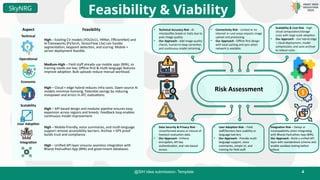
Aspect Feasibility
Technical
High – Existing CV models (YOLOv11, HRNet, EfficientNet) and
AI frameworks (PyTorch, TensorFlow Lite) can handle
segmentation, keypoint detection, and scoring. Mobile +
server deployment feasible.
Operational
Medium-High – Field staff already use mobile apps (BPA), so
training needs are low. Offline-first & multi-language features
improve adoption. Bulk uploads reduce manual workload.
Economic
High – Cloud + edge hybrid reduces infra costs. Open-source AI
models minimize licensing. Potential savings by reducing
manpower and errors in ATC evaluations.
Scalability
High – API-based design and modular pipeline ensures easy
expansion across regions and breeds. Feedback loop enables
continuous model improvement.
User Adoption
High – Mobile-friendly, voice summaries, and multi-language
support remove accessibility barriers. Archive + GPS proof
builds trust and compliance.
Integration
High – Unified API layer ensures seamless integration with
Bharat Pashudhan App (BPA) and government databases.
Feasibility & Viability
SkyNRG
Risk Assessment
• Technical Accuracy Risk - AI
misclassifies breed or traits due to
poor image quality.
• Our Approach - Add image quality
checks, human-in-loop correction,
and continuous model retraining.
• Connectivity Risk - Limited or no
internet in rural areas impacts image
upload and processing.
• Our Approach - Offline-first design
with local caching and sync when
network is available.
• Scalability & Cost Risk - High
cloud computation/storage
costs with large-scale adoption.
• Our Approach - Use hybrid edge
+ cloud deployment, model
compression, and auto-archival
to reduce costs.
• User Adoption Risk – Field
staff/farmers face usability or
language barriers.
• Our Approach - Provide multi-
language support, voice
summaries, simple UI, and
training for field staff.
• Data Security & Privacy Risk -
Unauthorized access or misuse of
livestock evaluation data.
• Our Approach - Enforce
encryption, API key
authentication, and role-based
access.
Integration Risk – Delays or
incompatibility when integrating
with Bharat Pashudhan App (BPA).
Our Approach - Build a unified API
layer with standardized schema and
enable sandbox testing before
rollout.
12.
6
@SIH Idea submission-Template
RESEARCH AND REFERENCES
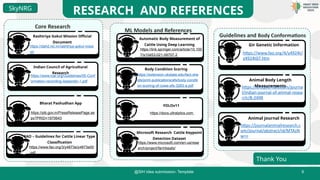
Core Research
ML Models and References
https://dahd.nic.in/rashtriya-gokul-missi
on
Rashtriya Gokul Mission Official
Document
FAO – Guidelines for Cattle Linear Type
Classification
https://www.fao.org/3/y4873e/y4873e00
.pdf
Microsoft Research Cattle Keypoint
Detection Dataset
https://www.microsoft.com/en-us/rese
arch/project/farmbeats/
Automatic Body Measurement of
Cattle Using Deep Learning
https://link.springer.com/article/10.100
7/s10453-021-09707-2
Body Condition Scoring
https://extension.okstate.edu/fact-she
ets/print-publications/afs/body-conditi
on-scoring-of-cows-afs-3283-a.pdf
Guidelines and Body Conformations
Gir Genetic Information
https://www.fao.org/4/y4924t/
y4924t07.htm
Animal Body Length
Measurements
https://arccjournals.com/journa
l/indian-journal-of-animal-resea
rch/B-2498
Animal journal Research
https://journalanimalresearch.c
om/Journal/abstract/id/MTAzN
w==
Thank You
SkyNRG
Bharat Pashudhan App
https://pib.gov.in/PressReleasePage.as
px?PRID=1970643
Indian Council of Agricultural
Research
https://www.icar.org/Guidelines/05-Conf
ormation-recording-Appendix-1.pdf
YOLOv11
https://docs.ultralytics.com
 Most read
 Most read
 Most read


