This presentation exploreshow machine learning
is leveraged to detect fake news effectively. We will
cover essential concepts in fake news detection,
including challenges and strategies to improve
accuracy. The goal is to provide a clear
understanding of the role of AI in protecting
information integrity and combating
misinformation in todays digital landscape.
Introduction
Understanding Fake Newsand Its Impact
Fake news refers to false or misleading information presented as news, often spreading rapidly online. It can influence
public opinion, disrupt social harmony, and impact democratic processes. Recognizing its impact helps us appreciate the
need for reliable detection methods that can safeguard authentic communication.
5.
Detecting fake newsinvolves analyzing linguistic
cues, source credibility, and propagation patterns.
Features like sentiment, writing style, and
metadata provide valuable signals. Incorporating
these features into machine learning models
enhances their effectiveness in distinguishing
truthful content from fabricated stories.
Key Features for Detection
6.
Challenges in
Identifying
Fake News
Detectingfake news is complicated by factors such as the ever-evolving nature of
misinformation and the subtlety of deceptive content. The speed of information spread on
social media requires real-time analysis. Additionally, limited labeled data and the diversity
of topics make building generalized detection models a significant challenge for
researchers and practitioners.
Data Collection and
Preprocessing
Effectivefake news detection starts with gathering diverse and representative datasets from multiple sources. Preprocessing steps include
cleaning text, handling imbalanced classes, and feature extraction. This ensures the machine learning models receive high-quality input,
which is critical for building robust and accurate detectors.
9.
Popular algorithms includeSupport Vector Machines, Random Forests, and deep
learning models like LSTM and BERT. These methods classify news items based on
linguistic features, metadata, and network behavior. The choice of algorithm depends
on dataset size, feature complexity, and required detection speed.
Classification Algorithms for Detection
10.
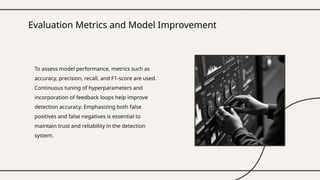
To assess modelperformance, metrics such as
accuracy, precision, recall, and F1-score are used.
Continuous tuning of hyperparameters and
incorporation of feedback loops help improve
detection accuracy. Emphasizing both false
positives and false negatives is essential to
maintain trust and reliability in the detection
system.
Evaluation Metrics and Model Improvement
11.
Machine learning providespowerful tools to combat
fake news by analyzing complex patterns and features.
Despite challenges like evolving misinformation tactics
and data limitations, combining effective
preprocessing, robust algorithms, and thorough
evaluation can enhance detection systems. Ongoing
research and adaptation are vital for safeguarding
information integrity in the digital age.
Conclusions
12.
CREDITS: This presentationtemplate was
created by Slidesgo, including icons by Flaticon
, infographics & images by Freepik
Thanks
Do you have any questions?
your email@freepik.com
+91 620 421 838 yourcompany.com
Please keep this slide for attribution