Failure,	
  Life’s	
  
Greatest	
  Lessons	
  	
  
By	
  Sarang	
  Ahuja	
  
www.sarangahujafinance.com	
  
Introduction	
  
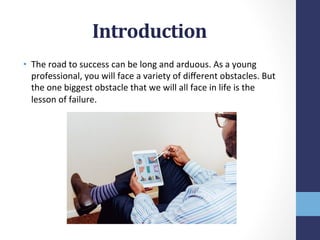
•  The	
  road	
  to	
  success	
  can	
  be	
  long	
  and	
  arduous.	
  As	
  a	
  young	
  
professional,	
  you	
  will	
  face	
  a	
  variety	
  of	
  different	
  obstacles.	
  But	
  
the	
  one	
  biggest	
  obstacle	
  that	
  we	
  will	
  all	
  face	
  in	
  life	
  is	
  the	
  
lesson	
  of	
  failure.	
  	
  
Windows	
  of	
  Opportunity	
  
•  When	
  it	
  comes	
  to	
  failure,	
  these	
  moments	
  o>en	
  carry	
  a	
  
nega?ve	
  connota?on	
  with	
  them.	
  And	
  why	
  wouldn’t	
  they?	
  In	
  
most	
  cases,	
  you	
  are	
  o>en	
  found	
  at	
  your	
  lowest,	
  nursing	
  a	
  
bruised	
  ego	
  to	
  move	
  on	
  from	
  the	
  frustra?on,	
  disappointment,	
  
and	
  demoraliza?on	
  of	
  a	
  situa?on.	
  	
  
•  As	
  much	
  as	
  it	
  may	
  seem	
  hopeless	
  right	
  now,	
  you	
  have	
  to	
  look	
  
at	
  these	
  disappoin?ng	
  moments	
  as	
  windows	
  of	
  opportunity.	
  
Many	
  people	
  have	
  even	
  gone	
  as	
  far	
  as	
  to	
  say	
  that	
  failure	
  is	
  
really	
  the	
  greatest	
  teacher	
  of	
  them	
  all.	
  
•  	
  While	
  it	
  may	
  be	
  hard	
  now,	
  understanding,	
  internalizing,	
  and	
  
accep?ng	
  these	
  situa?ons	
  for	
  something	
  greater	
  than	
  what	
  
they	
  are	
  will	
  allow	
  you	
  to	
  grow	
  both	
  personally	
  and	
  
professionally	
  in	
  the	
  best	
  way	
  possible.	
  	
  
Teachable	
  Lessons	
  
•  Now	
  to	
  do	
  this,	
  you	
  need	
  to	
  see	
  these	
  disappoin?ng	
  moments	
  
as	
  life	
  lessons.	
  	
  As	
  difficult	
  as	
  it	
  may	
  be,	
  framing	
  these	
  
incidences	
  in	
  this	
  manner	
  will	
  allow	
  you	
  to	
  learn	
  and	
  uncover	
  
those	
  hidden	
  teachable	
  moments	
  so	
  that	
  you	
  can	
  not	
  just	
  
move	
  on,	
  but	
  also	
  grow	
  in	
  a	
  bigger	
  and	
  beIer	
  way.	
  	
  
•  To	
  help	
  you	
  deduce	
  what	
  exactly	
  those	
  lessons	
  are	
  and	
  how	
  
they	
  can	
  help	
  improve	
  your	
  chances	
  of	
  future	
  success,	
  I	
  have	
  
provided	
  various	
  guidelines	
  so	
  that	
  you	
  can	
  understand,	
  plan,	
  
evaluate,	
  and	
  execute	
  later	
  on	
  down	
  the	
  road.	
  	
  
Evaluate	
  the	
  Situation	
  
Evaluate	
  the	
  Situation	
  
•  Every	
  young	
  professional	
  needs	
  to	
  understand	
  that	
  success	
  
can	
  only	
  come	
  from	
  failure.	
  Much	
  like	
  any	
  inopportune	
  
situa?on,	
  failures	
  and	
  downfalls	
  set	
  our	
  expecta?on	
  for	
  
success.	
  It	
  is	
  through	
  those	
  situa?ons	
  where	
  you	
  are	
  able	
  to	
  
evolve	
  personally	
  and	
  professionally	
  within	
  your	
  trade.	
  	
  
•  To	
  help	
  alleviate	
  the	
  pains	
  of	
  failure,	
  you	
  need	
  to	
  see	
  failure	
  
as	
  it	
  is.	
  Start	
  by	
  evalua?ng	
  the	
  situa?on.	
  Ask	
  yourself	
  those	
  
overarching	
  ques?ons.	
  What	
  happened?	
  What	
  did	
  you	
  do?	
  
What	
  could	
  you	
  have	
  done	
  to	
  prevent	
  this?	
  	
  
•  By	
  analyzing	
  the	
  moment	
  in	
  this	
  holis?c	
  manner,	
  you	
  will	
  be	
  
able	
  to	
  figure	
  out	
  the	
  various	
  weaknesses	
  and	
  flaws	
  that	
  you	
  
can	
  improve	
  upon	
  within	
  the	
  future.	
  U?lize	
  those	
  low	
  
situa?ons	
  as	
  experiences	
  or	
  opportuni?es	
  for	
  change.	
  This	
  will	
  
allow	
  you	
  to	
  expand	
  your	
  knowledge	
  and	
  embrace	
  the	
  
situa?on	
  in	
  a	
  more	
  posi?ve	
  manner.	
  	
  
Assume	
  Responsibility	
  
Assume	
  Responsibility	
  
•  Like	
  it	
  or	
  not,	
  the	
  blame	
  game	
  will	
  always	
  persist.	
  No	
  one	
  likes	
  
to	
  truly	
  admit	
  fault,	
  especially	
  if	
  it	
  is	
  a	
  big	
  one.	
  But	
  in	
  order	
  to	
  
grow,	
  you	
  need	
  to	
  accept	
  the	
  moment	
  and	
  assume	
  
responsibili?es	
  for	
  your	
  failure.	
  	
  
•  Once	
  you	
  have	
  assumed	
  the	
  responsibili?es	
  of	
  your	
  mistakes,	
  
you	
  will	
  be	
  able	
  to	
  leverage	
  your	
  nega?ves	
  as	
  an	
  asset	
  and	
  
tool	
  in	
  how	
  to	
  improve	
  your	
  day-­‐to-­‐day	
  opera?ons	
  within	
  
your	
  job.	
  	
  
•  That	
  reflec?ve	
  por?on	
  of	
  analyzing	
  and	
  accep?ng	
  said-­‐
par?cular	
  mishaps	
  can	
  provide	
  you	
  the	
  necessary	
  steps	
  in	
  
preven?ng	
  the	
  failure	
  from	
  happening	
  again.	
  	
  
•  As	
  stated	
  before,	
  you	
  want	
  to	
  u?lize	
  this	
  as	
  a	
  learning	
  
experience.	
  If	
  you	
  were	
  brave	
  enough	
  to	
  risk	
  it	
  in	
  the	
  first	
  
place,	
  you	
  should	
  be	
  confident	
  enough	
  to	
  accept	
  the	
  mistake	
  
as	
  it	
  stands.	
  	
  
Create	
  a	
  Plan	
  
Create	
  a	
  Plan	
  
•  Once	
  you	
  have	
  understood	
  and	
  accepted	
  your	
  failure,	
  you	
  
want	
  to	
  make	
  sure	
  you	
  are	
  moving	
  in	
  a	
  progressively	
  beIer	
  
way.	
  In	
  order	
  to	
  professionally	
  develop	
  and	
  grow	
  from	
  your	
  
failure,	
  you	
  want	
  to	
  create	
  a	
  plan.	
  	
  
•  For	
  novice	
  young	
  professionals,	
  the	
  first	
  failure	
  will	
  always	
  be	
  
the	
  most	
  painful	
  and	
  regreIable.	
  The	
  process	
  makes	
  you	
  not	
  
only	
  ques?on	
  your	
  vision	
  and	
  goals	
  for	
  your	
  company,	
  but	
  
also	
  ques?on	
  your	
  abili?es	
  as	
  a	
  person.	
  
•  	
  When	
  this	
  happens,	
  you	
  need	
  to	
  accept,	
  plan,	
  and	
  move	
  on.	
  
When	
  planning,	
  think	
  of	
  specific	
  overarching	
  goals	
  that	
  you	
  
want	
  to	
  accomplish.	
  	
  
•  These	
  goals	
  will	
  allow	
  you	
  to	
  create	
  specific	
  tangible	
  steps	
  
that	
  can	
  help	
  you	
  set	
  your	
  sights	
  on	
  success.	
  	
  
Put	
  into	
  Action	
  
Put	
  into	
  Action	
  
•  To	
  fully	
  move	
  on,	
  it	
  is	
  impera?ve	
  that	
  you	
  create	
  ac?on	
  out	
  of	
  
this	
  en?re	
  process.	
  Thinking	
  is	
  easy.	
  Ac?ng	
  is	
  difficult.	
  It	
  is	
  the	
  
ability	
  to	
  put	
  your	
  thoughts,	
  your	
  concepts,	
  and	
  your	
  dreams	
  
into	
  something	
  incredible.	
  Use	
  your	
  failures	
  to	
  mo?vate	
  you.	
  
Use	
  them	
  to	
  spark	
  innova?on.	
  Whatever	
  is	
  the	
  case;	
  use	
  those	
  
moments	
  to	
  create	
  ac?on.