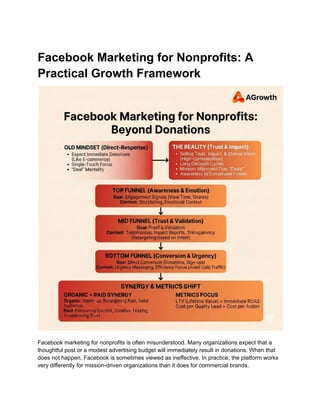
Facebook Marketing for Nonprofits: A Practical Growth Framework
1.
Facebook Marketing forNonprofits: A
Practical Growth Framework
Facebook marketing for nonprofits is often misunderstood. Many organizations expect that a
thoughtful post or a modest advertising budget will immediately result in donations. When that
does not happen, Facebook is sometimes viewed as ineffective. In practice, the platform works
very differently for mission-driven organizations than it does for commercial brands.
2.
Nonprofits do notsell products. They ask for trust, belief in impact, and alignment with a
mission. These decisions involve higher consideration and longer timelines. According to
sector benchmarks, first-time donors often need 5–7 meaningful touchpoints before they feel
confident contributing. Facebook can support this journey, but only when it is used as a
long-term engagement system rather than a short-term fundraising tool.
This article explains how Facebook marketing actually works for nonprofits, how to structure a
full-funnel approach, and how to measure success in a way that reflects real impact rather than
surface-level metrics.
How Facebook Marketing Works in the Nonprofit Sector
Before launching campaigns, nonprofits need to understand the environment in which Facebook
operates. Facebook is a discovery platform, not an intent-based search engine, and this
difference shapes donor behavior.
Facebook Is Not a High-Intent Donation Platform
On search platforms, users actively express intent. A query like “donate to education charities”
signals readiness. On Facebook, users are connecting with friends or consuming content.
Donation intent is usually not immediate.
This means that most users will not donate the first time they see your cause. Facebook
marketing must move people gradually from awareness to confidence through repeated
exposure. The goal is not instant conversion, but progressive commitment.
Mission-Driven Consideration vs Commercial Intent
In commercial marketing, decisions are often driven by price or convenience. In nonprofit
marketing, decisions are driven by:
● Perceived credibility
● Transparency of impact
● Alignment with personal values
Donors want reassurance that their contribution will be used responsibly. This validation process
takes time, making nurturing essential.
The Typical Nonprofit Decision Cycle on Facebook
A common pattern looks like this:
● Month 1: A user watches an impact video
3.
● Month 2:They engage with organic posts or comments
● Month 3: They respond to a campaign during a matching or seasonal appeal
Delayed conversion is normal. Facebook’s role is to accumulate trust over time, not force
immediate action.
The Role of Facebook in the Nonprofit Marketing Funnel
Effective nonprofit Facebook marketing treats the platform as an ecosystem, not a collection of
isolated posts. Structuring efforts by funnel stage ensures relevance at every interaction.
Upper Funnel: Education and Mission Clarity
At the top of the funnel, the objective is understanding and emotional connection.
Effective content includes:
● Educational videos explaining the problem you address
● Stories from beneficiaries or volunteers
● Clear explanations of why your mission matters
Key signals to track here are video watch time, shares, and saves, which indicate genuine
interest rather than casual scrolling.
Mid Funnel: Trust, Proof, and Reassurance
This stage is where many nonprofits underinvest. Once someone has engaged, they need
evidence.
Effective tactics include:
● Retargeting users who watched 50% or more of a video
● Sharing summaries of impact reports
● Highlighting third-party ratings or partnerships
The objective is to answer a simple question: Why should I support this organization instead of
another?
Lower Funnel: Donations and Participation
Only after sufficient trust has been built should direct asks appear.
Best practices include:
4.
● Targeting warmaudiences rather than cold traffic
● Using time-bound appeals such as matching periods or program deadlines
● Keeping donation flows simple and transparent
Cold traffic donation campaigns often cost significantly more per donor than retargeting
campaigns, making audience sequencing critical.
Organic Facebook Marketing vs Paid Ads for Nonprofits
The discussion should not focus on choosing organic or paid. The strongest results come from
using both as one system.
Why Organic Content Supports Paid Performance
Organic activity serves several strategic functions:
● It keeps your organization visible to existing supporters
● It builds engagement audiences that reduce ad costs
● It improves the quality of data used for lookalike audiences
A nonprofit with consistent organic engagement usually sees stronger paid performance
because ads do not feel unfamiliar.
Paid Ads as Distribution and Control
Paid Facebook ads allow nonprofits to:
● Control how often supporters see key messages
● Reach new audiences beyond organic limits
● Test messaging and creative at scale
Paid campaigns provide reach and consistency, while organic content provides depth and
credibility.
Facebook Ads Strategy for Nonprofits
Once fundamentals are in place, strategy becomes about working with limited data and long
decision cycles.
Campaign Objectives That Make Sense
5.
For nonprofits, notall objectives are equal.
Useful objectives include:
● Engagement and video views to build warm audiences
● Traffic or landing page views when donation volume is low
● Conversion campaigns once consistent donation data is available
If your organization receives fewer than 50 donations per week, Meta’s algorithm may struggle
to optimize. In these cases, optimizing for earlier actions can stabilize delivery.
Structuring Accounts for Low-Volume Conversions
Nonprofits often operate with small budgets. Avoid spreading data too thin.
Best practices include:
● Fewer campaigns and ad sets
● Consolidated audiences
● Clear separation between prospecting and retargeting
This approach helps the algorithm learn faster and reduces volatility.
Retargeting Logic That Reflects Donor Readiness
Instead of repeating the same message, sequence content by time:
● Days 1–7: Impact-focused video
● Days 8–14: Proof and credibility content
● Days 15–30: Direct donation appeal
This mirrors how confidence develops naturally.
Creative Strategy for Nonprofit Facebook Marketing
Creative is the primary targeting mechanism on Facebook. Clear, respectful messaging
performs better over time than extreme or overly dramatic content.
Emotional Storytelling vs Proof-Based Messaging
Both have a role, depending on the goal.
Use emotional storytelling when:
6.
● Introducing yourmission
● Responding to urgent needs
● Building awareness
Use proof-based messaging when:
● Promoting recurring donations
● Encouraging long-term commitment
● Explaining how funds are used
Recurring donors often respond better to clarity and accountability than emotional intensity.
Creative Angles That Scale
Scalable nonprofit creatives often include:
● Impact metrics: clear links between contribution and outcome
● Community stories: highlighting supporters and volunteers
● Mission clarity: explaining purpose without exaggeration
Avoid relying on shock value. Research shows that hopeful and solution-focused messaging
supports longer retention.
Managing Creative Fatigue
Nonprofit audiences are often smaller and more specific. Rotate creatives every 2–4 weeks and
vary formats to maintain engagement.
AGROWTH – Meta Agency Account Support
⭐Managed campaigns with expert guidance
⭐Flexible invoice-based billing and custom top-ups
⭐Increased account stability through agency tier access
⭐Fast fund transfers when needed
⭐Priority support via Meta partner channels
⭐Fees starting from 3%
This setup can be helpful for organizations running ongoing campaigns across multiple
initiatives.
7.
Common Facebook MarketingMistakes Nonprofits Make
Even experienced teams encounter challenges when shifting from commercial to mission-driven
marketing.
Treating Facebook as Immediate Response
Expecting short-term financial return overlooks donor lifetime value, which often unfolds over
12–24 months.
Capturing Leads Without Follow-Up
Email sign-ups require automated welcome and education sequences. Without follow-up,
interest declines quickly.
Increasing Budget Without Refreshing Creative
Scaling requires new messages and formats, not only more spend.
Misinterpreting Cost Per Action
Low CPA is misleading if actions do not translate into donations. Focus on cost per new donor
or cost per qualified supporter.
FAQs
Should nonprofits use Facebook’s Donate tools or their own website?
Website donations usually support better long-term retention because you own supporter data
and can continue nurturing relationships.
How much should a nonprofit spend on Facebook ads?
Budgets should support at least 50 optimization events per week. Even $10–$20 per day can
generate learning data.
What is a healthy return benchmark?
Many nonprofits aim for break-even or modest return on first donation, with long-term value
coming from repeat giving.
8.
Is on-platform donationbetter than website traffic?
On-platform tools reduce friction, but websites provide better control over data, messaging, and
long-term engagement.
Recommended Resources for Facebook Marketing for
Nonprofits
Facebook Marketing for Nonprofits
A detailed guide to building full-funnel Facebook strategies tailored for mission-driven
organizations.
Rent Meta Agency Ads Account
A solution for nonprofits seeking greater account stability, flexible billing, and partner-level Meta
support.
https://agrowth.io/blogs/knowledge/facebook-marketing-for-non-profits
A detailed guide to building full-funnel Facebook strategies tailored for mission-driven
organizations.
https://agrowth.io/pages/rent-meta-agency-ads-account
A solution for nonprofits seeking greater account stability, flexible billing, and partner-level Meta
support.
9.
1️⃣ Version ~3000characters
Facebook marketing for nonprofits often underperforms because it is treated as a short-term
fundraising tool instead of a long-term trust system. Many organizations expect a single post or
campaign to immediately generate donations. When results are slow, Facebook is viewed as
ineffective. In reality, nonprofit decision-making follows a very different path from commercial
purchasing.
Nonprofits do not sell products. They invite people to support a mission, believe in impact, and
commit to a shared purpose. Industry studies consistently show that first-time donors require
multiple meaningful interactions—often five or more—before contributing. Facebook is designed
to support this type of gradual trust-building, but only when used correctly.
Facebook is not an intent-based platform. Users are not actively searching for causes. They are
discovering stories, values, and communities. This makes Facebook ideal for education,
awareness, and relationship development rather than immediate conversion. The primary role of
Facebook in nonprofit marketing is to move users from passive awareness to informed
confidence over time.
A sustainable nonprofit Facebook strategy follows a funnel structure:
At the upper funnel, the goal is clarity and relevance. Educational videos, beneficiary stories,
and clear explanations of the problem your organization addresses perform best here. Metrics
such as video watch time and shares matter more than likes, as they signal genuine interest.
In the middle funnel, trust becomes the priority. This is where nonprofits should retarget
engaged audiences with proof: impact summaries, transparency messaging, volunteer
perspectives, or third-party validation. This stage answers the donor’s key question: “Why
should I support this organization?”
Only at the lower funnel should direct donation appeals appear. Warm audiences convert more
efficiently than cold traffic. Time-bound messages—such as matching periods or campaign
milestones—provide a natural reason to act without pressure.
Organic and paid Facebook efforts must work together. Organic content builds familiarity and
engagement, while paid ads control reach, frequency, and scale. Organizations that maintain
consistent organic activity often see lower costs and stronger performance in paid campaigns.
Creative strategy also plays a central role. Sustainable nonprofit messaging prioritizes clarity,
hope, and accountability. Clear impact metrics and transparent explanations consistently
outperform exaggerated or overly dramatic approaches, especially for recurring donations.
When Facebook is positioned as a long-term engagement platform rather than a quick donation
tool, it becomes one of the most effective channels for nonprofit growth.
10.
Full framework availablehere:
https://agrowth.io/blogs/knowledge/facebook-marketing-for-non-profits
#NonprofitMarketing #FacebookForNonprofits #DigitalFundraising #SocialImpact
#CauseMarketing #DonorEngagement #MissionDriven #MetaAds
2️⃣ Version ~1000 characters
Facebook marketing for nonprofits works best when it is treated as a trust-building system, not a
one-time fundraising tactic.
Donors rarely contribute on first exposure. Research shows that multiple meaningful touchpoints
are needed before someone feels confident supporting a cause. Facebook supports this journey
by building awareness, reinforcing credibility, and maintaining visibility over time.
A strong approach follows a funnel:
• Awareness through education and storytelling
• Trust through proof, transparency, and repeated exposure
• Action through warm-audience donation campaigns
Organic content supports credibility, while paid ads provide reach and frequency control. Clear
impact messaging and accountability consistently outperform short-term emotional tactics.
When Facebook is used to nurture confidence instead of chasing instant results, donation
quality and retention improve.
Read the full guide:
https://agrowth.io/blogs/knowledge/facebook-marketing-for-non-profits
#NonprofitGrowth #FacebookMarketing #DonorTrust #SocialGood #FundraisingStrategy
#ImpactMarketing
3️⃣ Version ~300 characters
Facebook works for nonprofits when it builds trust before asking for support. Awareness, proof,
and clarity come first—donations follow later. Learn the full framework here:
https://agrowth.io/blogs/knowledge/facebook-marketing-for-non-profits
#NonprofitMarketing #FacebookAds #DonorEngagement
11.
4️⃣ Social post– Short
Nonprofits don’t need louder donation ads.
They need stronger trust systems.
Facebook is for education, confidence, and consistency—
not instant decisions.
Full strategy here:
https://agrowth.io/blogs/knowledge/facebook-marketing-for-non-profits
#Nonprofits #FacebookMarketing #DigitalFundraising #MissionDriven #SocialImpact
5️⃣ Social post – Long (Storytelling + Helpful)
A nonprofit leader once said to me:
“We post regularly on Facebook, but donations are inconsistent.”
The issue wasn’t effort.
It was expectation.
Most donors don’t give the first time they see a cause.
They observe. They read. They compare. They wait.
Facebook isn’t a search platform.
It’s a discovery space.
People meet your mission there before they ever decide to support it.
The organizations that see sustainable results use Facebook differently:
• They educate before asking
• They show impact before requesting support
• They build familiarity before urgency
They combine organic content (for credibility) with paid ads (for reach and consistency).
They focus on clarity and accountability, not pressure.
Over time, trust compounds.
And when the moment to act arrives, the decision feels natural.
If your nonprofit wants to use Facebook as a long-term growth channel—not a short-term
fix—this guide explains how: