Exploring the Thar Desert: Geography, Climate, and Human Adaptation
An educational overview of the Thar Desert's location, climate, sand dune formation, flora, fauna, human adaptations, and conservation challenges in northwestern India and Pakistan.
Exploring the Thar Desert: Geography, Climate, and Human Adaptation
1.
Name one physicalregion of India.
What makes the Gangetic Plains fertile?
3.
Aarav and hisfriends were travelling through western India when they noticed
something unusual. The green trees slowly disappeared, and endless golden
land stretched before them.
Hot winds blew strongly, and the ground looked dry and sandy. Huge hills of sand
stood in the distance, changing shape as the wind moved.
“Nothing can survive here,” Aarav whispered.
Just then, a camel walked past carrying water pots. Nearby, people wearing
loose cotton clothes were carefully storing water in large containers.
“How do they live in such heat?” his friend Meera asked.
4.
Their guide smiled.“People here have adapted cleverly. They save every drop of
water, build thick mud houses to stay cool, and travel during cooler parts of the
day.”
As evening arrived, the burning heat disappeared quickly, and cold winds began
to blow.
Aarav looked around in surprise. “It was so hot in the day and now it’s cold!”
“That’s because sandy land heats and cools very fast,” the guide explained.
The students watched the sunset turn the golden land orange and red. Aarav
smiled and said, “This place may look harsh, but it teaches people how to survive
with intelligence and courage.”
HINTS:
It is locatedin the northwestern part of India and extends into eastern
Pakistan.
Position of the Thar Desert
Lies between the Aravalli Range in the east and the Indus River in the west.
Mostly spread across Rajasthan.
Also covers parts of Gujarat, Punjab, and Haryana.
Located near the India–Pakistan border.
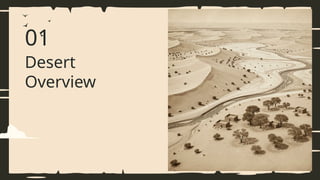
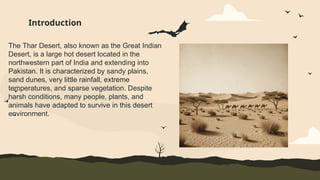
The Thar Desert,also known as the Great Indian
Desert, is a large hot desert located in the
northwestern part of India and extending into
Pakistan. It is characterized by sandy plains,
sand dunes, very little rainfall, extreme
temperatures, and sparse vegetation. Despite
harsh conditions, many people, plants, and
animals have adapted to survive in this desert
environment.
Introduction
12.
Location & Size
TheThar Desert is located in the northwestern part of India, mainly in the state of Rajasthan,
and extends into parts of Gujarat, Punjab, and Haryana. A part of the desert also stretches into
southeastern Pakistan.
Size of the Thar Desert
Total area: About 200,000 square kilometres
It is the 17th largest desert in the world
Around 85% of the desert lies in India, while the remaining part is in Pakistan.
Major landmarks: Luni River, sand dunes, and border proximity to the Indus and
Ganges plains.
13.
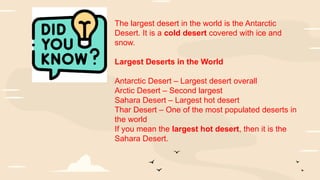
The largest desertin the world is the Antarctic
Desert. It is a cold desert covered with ice and
snow.
Largest Deserts in the World
Antarctic Desert – Largest desert overall
Arctic Desert – Second largest
Sahara Desert – Largest hot desert
Thar Desert – One of the most populated deserts in
the world
If you mean the largest hot desert, then it is the
Sahara Desert.
14.
Climate
The climate ofthe Thar Desert is hot, dry, and extreme. It receives very little rainfall
and experiences very high temperatures during the day.
Climate of the Thar Desert
Very hot summers
Cold winters
Dry climate with low humidity
Strong dusty winds
Very little rainfall (usually less than 25 cm annually)
15.
Seasons of theThar Desert
Summer Season (March to June)
Extremely hot
Temperature may rise above 50°C
Hot winds called loo blow during the day
Monsoon Season (July to September)
Receives very little and irregular rainfall
Short rainy season
Some temporary vegetation appears
Winter Season (October to February)
Days are pleasant and cooler
Nights become very cold
Temperature may fall close to 0°C in some areas
Special Feature
The desert experiences hot days and cold nights because sand heats up and cools down very quickly.
How Are SandDunes Formed in the Thar Desert?
Sand dunes are formed by the action of wind.
The Thar region has dry, loose sand and very little vegetation to hold the sand in
place.
Strong winds pick up and carry sand particles from one place to another.
When the wind slows down or meets an obstacle such as a rock, bush, or
uneven ground, it drops the sand.
Over time, the deposited sand accumulates into small mounds.
Continuous deposition and reshaping by the wind gradually form sand dunes.
18.
Key Facts
Sand dunesare not fixed; they can change shape and move slowly as the wind
continues to blow.
Some dunes in the Thar can reach heights of over 150 metres.
Simple Definition
Sand dunes are hills or mounds of sand formed when wind carries and
deposits sand over a long period of time.
Remember: Wind is the sculptor of the Thar—it constantly shapes and reshapes
the sand dunes.
19.
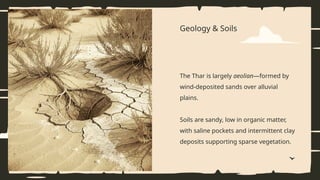
Geology & Soils
TheThar is largely aeolian—formed by
wind-deposited sands over alluvial
plains.
Soils are sandy, low in organic matter,
with saline pockets and intermittent clay
deposits supporting sparse vegetation.
20.
Today's Big Question:How do people, plants, and animals survive in the desert?
https://www.360panoramas.co.uk/17/84/The_Thar_Desert
Flora & Fauna
Vegetationis drought-adapted:
shrubs, grasses, and scattered acacias.
Wildlife includes chinkara, desert
foxes, reptiles, and migratory birds in
seasonal wetlands.
23.
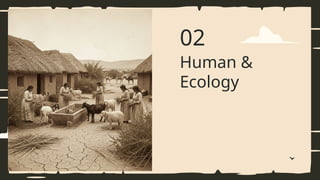
Human adaptation
Wear loosecotton clothes
Store water carefully
Build thick mud houses
Travel during cooler times
Eat food suited to hot climates
24.
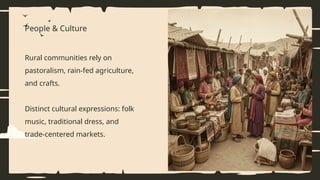
People & Culture
Ruralcommunities rely on
pastoralism, rain-fed agriculture,
and crafts.
Distinct cultural expressions: folk
music, traditional dress, and
trade-centered markets.
25.
Problem – Solution– Result
Very little water → Store water carefully → Water lasts longer
Extreme heat → Wear loose clothing → Stay cool
Sandstorms → Build strong houses → Better protection
26.
Threats: overgrazing, desertification,groundwater depletion, and renewable energy land-use conflicts.
Conservation focuses on sustainable grazing, afforestation, water harvesting, and protected area
management.
Conservation & Threats
27.
Learning Outcomes
Describe thefeatures of the Thar Desert
Explain how sand dunes are formed
Analyze the challenges of desert life
Understand how people adapt to water scarcity
28.
Conclusions
The Thar balancesfragile
ecosystems with long-standing
human adaptations.
Priorities: sustainable water use,
habitat protection, and
community-led land management.
29.
Complete the sentence:Life in the Thar Desert is challenging because...
Exit Ticket: Write one thing you learnt today.