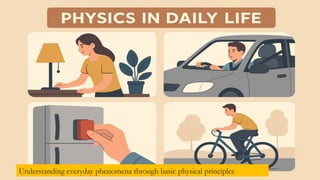
Exploring the Role of Physics in Everyday Life and Technology
An insightful overview of how fundamental physics principles explain daily phenomena, household tasks, safety, work efficiency, sports, and technological advancements.
Foundations of Physicsin Everyday Living
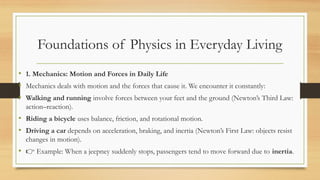
• 1. Mechanics: Motion and Forces in Daily Life
• Mechanics deals with motion and the forces that cause it. We encounter it constantly:
• Walking and running involve forces between your feet and the ground (Newton’s Third Law:
action–reaction).
• Riding a bicycle uses balance, friction, and rotational motion.
• Driving a car depends on acceleration, braking, and inertia (Newton’s First Law: objects resist
changes in motion).
• 👉 Example: When a jeepney suddenly stops, passengers tend to move forward due to inertia.
5.
Foundations of Physicsin Everyday Living
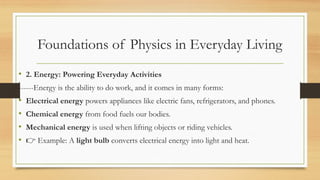
• 2. Energy: Powering Everyday Activities
------Energy is the ability to do work, and it comes in many forms:
• Electrical energy powers appliances like electric fans, refrigerators, and phones.
• Chemical energy from food fuels our bodies.
• Mechanical energy is used when lifting objects or riding vehicles.
• 👉 Example: A light bulb converts electrical energy into light and heat.
6.
Foundations of Physicsin Everyday Living
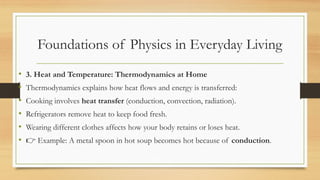
• 3. Heat and Temperature: Thermodynamics at Home
• Thermodynamics explains how heat flows and energy is transferred:
• Cooking involves heat transfer (conduction, convection, radiation).
• Refrigerators remove heat to keep food fresh.
• Wearing different clothes affects how your body retains or loses heat.
• 👉 Example: A metal spoon in hot soup becomes hot because of conduction.
7.
Foundations of Physicsin Everyday Living
• 4. Waves and Sound: Communication and Entertainment
• Physics explains sound and wave behavior:
• Speaking and hearing rely on sound waves traveling through air.
• Music systems and earphones convert electrical signals into sound waves.
• Cell phones use electromagnetic waves to send messages.
• 👉 Example: Echoes happen when sound waves reflect off surfaces.
8.
Foundations of Physicsin Everyday Living
• 5. Light and Optics: Seeing the World
• Light allows us to see and understand our surroundings:
• Mirrors reflect light to form images.
• Eyeglasses correct vision using refraction.
• Cameras capture images through lenses.
• 👉 Example: A straw in water looks bent due to refraction of light.
9.
Foundations of Physicsin Everyday Living
• 6. Electricity and Magnetism: Modern Convenience
• Electricity and magnetism are essential for modern living:
• Power systems supply electricity to homes and schools.
• Motors in appliances (like electric fans) use magnetic forces.
• Charging devices rely on electrical currents.
• 👉 Example: A magnet on a refrigerator sticks because of magnetic attraction.
10.
Foundations of Physicsin Everyday Living
• 7. Physics in Technology
• Technology is built on physics principles:
• Smartphones use circuits, waves, and semiconductors.
• Transportation (cars, buses, trains) depends on mechanics and energy.
• Medical tools like X-rays and MRI machines use advanced physics.
• Physics is everywhere—it explains how things move, how energy is used, and how we interact with
the world. By understanding its basic principles, we become more aware of our environment and
better equipped to use technology wisely. Everyday living is, in many ways, a direct application of
physics in action.
11.
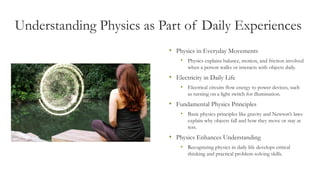
Understanding Physics asPart of Daily Experiences
• Physics in Everyday Movements
• Physics explains balance, motion, and friction involved
when a person walks or interacts with objects daily.
• Electricity in Daily Life
• Electrical circuits flow energy to power devices, such
as turning on a light switch for illumination.
• Fundamental Physics Principles
• Basic physics principles like gravity and Newton’s laws
explain why objects fall and how they move or stay at
rest.
• Physics Enhances Understanding
• Recognizing physics in daily life develops critical
thinking and practical problem-solving skills.
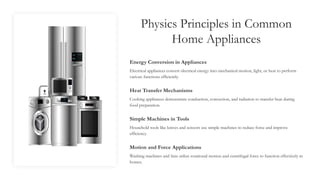
Physics Principles inCommon
Home Appliances
Energy Conversion in Appliances
Electrical appliances convert electrical energy into mechanical motion, light, or heat to perform
various functions efficiently.
Heat Transfer Mechanisms
Cooking appliances demonstrate conduction, convection, and radiation to transfer heat during
food preparation.
Simple Machines in Tools
Household tools like knives and scissors use simple machines to reduce force and improve
efficiency.
Motion and Force Applications
Washing machines and fans utilize rotational motion and centrifugal force to function effectively in
homes.
14.
Energy Use andEfficiency in the Home
• Energy Consumption of Appliances
• Appliances consume varying amounts of energy
measured in watts, impacting electricity bills and
efficiency.
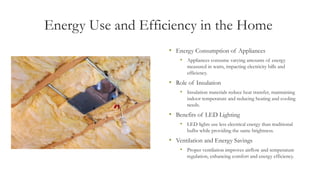
• Role of Insulation
• Insulation materials reduce heat transfer, maintaining
indoor temperature and reducing heating and cooling
needs.
• Benefits of LED Lighting
• LED lights use less electrical energy than traditional
bulbs while providing the same brightness.
• Ventilation and Energy Savings
• Proper ventilation improves airflow and temperature
regulation, enhancing comfort and energy efficiency.
Physics Concepts inAccident
Prevention
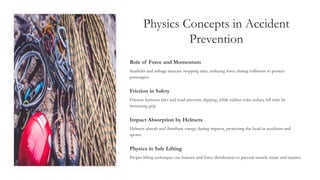
Role of Force and Momentum
Seatbelts and airbags increase stopping time, reducing force during collisions to protect
passengers.
Friction in Safety
Friction between tires and road prevents slipping, while rubber soles reduce fall risks by
increasing grip.
Impact Absorption by Helmets
Helmets absorb and distribute energy during impacts, protecting the head in accidents and
sports.
Physics in Safe Lifting
Proper lifting techniques use balance and force distribution to prevent muscle strain and injuries.
17.
Laboratory and WorkplaceSafety
Through Physics
Electrical Safety Principles
Understanding electricity prevents shocks through proper insulation, grounding, and safe
equipment handling.
Pressure and Temperature Hazards
Managing pressure and temperature is crucial to avoid explosions and burns with chemicals
and machinery.
Personal Protective Equipment
Wearing goggles, gloves, and helmets reduces physical hazard impacts in labs and workplaces.
Safety Signage and Barriers
Warning signs and safety barriers help identify risks and prevent accidents in hazardous
environments.
Enhancing Work Efficiencywith
Physics
Simple Machines Reduce Effort
Levers, pulleys, inclined planes, and gears decrease force needed, making tasks easier and precise.
Improved Productivity and Safety
Physics-based machines increase productivity, reduce fatigue, and minimize errors in work
environments.
Structural Stability and Load Distribution
Physics ensures proper load distribution and stable structures in construction and manufacturing
settings.
Extended Machine Lifespan
Physics-based design reduces maintenance costs by extending machine durability and minimizing
downtime.
20.
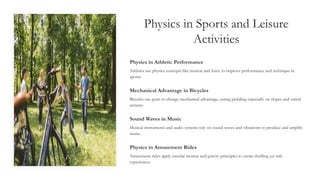
Physics in Sportsand Leisure
Activities
Physics in Athletic Performance
Athletes use physics concepts like motion and force to improve performance and technique in
sports.
Mechanical Advantage in Bicycles
Bicycles use gears to change mechanical advantage, easing pedaling especially on slopes and varied
terrains.
Sound Waves in Music
Musical instruments and audio systems rely on sound waves and vibrations to produce and amplify
music.
Physics in Amusement Rides
Amusement rides apply circular motion and gravity principles to create thrilling yet safe
experiences.
The Role ofPhysics in Science
and Technology
Physics as Foundation
Physics explains fundamental laws of matter, energy, space, and time that underlie all sciences.
Interdisciplinary Science Support
Physics principles support chemistry, biology, and earth science by explaining natural
phenomena.
Driving Technological Innovation
Physics drives advances in computers, medical imaging, communication systems, and
renewable energy.
Skills and Progress
Studying physics develops analytical skills and supports scientific progress and informed
decisions.
Editor's Notes
#2 As you begin the lesson, consider conducting a simple review to gauge students' understanding of how physics applies to their daily lives. You can use Option 1 or 2 to help students make connections between everyday objects and basic physics principles. Think-Pair-Share, ask students to reflect silently for 1–2 minutes on the question, "Where do you see physics in your daily life?" Encourage them to think about situations in their home, school,
transportation, or entertainment. Afterward, have them pair up with a seatmate to share their thoughts for 2–3 minutes. Then, select pairs to share their answers with the class, and as they do, write key ideas (such as motion, electricity, heat, and sound) on the board. This reinforces the connection between real-world examples and basic physics concepts.
#3 As you begin the lesson, consider conducting a simple review to gauge students' understanding of how physics applies to their daily lives. You can use Option 1 or 2 to help students make connections between everyday objects and basic physics principles. Think-Pair-Share, ask students to reflect silently for 1–2 minutes on the question, "Where do you see physics in your daily life?" Encourage them to think about situations in their home, school, transportation, or entertainment. Afterward, have them pair up with a seatmate to share their thoughts for 2–3 minutes. Then, select pairs to share their answers with the class, and as they do, write key ideas (such as motion, electricity, heat, and sound) on the board. This reinforces the connection between real-world examples and basic physics concepts.
#4 Understanding Physics as Part of Daily Experiences. Physics is not just a subject studied in classrooms—it is deeply embedded in our everyday experiences. From waking up in the morning to going to bed at night, physical principles govern the way we move, interact, and use technology. Understanding these foundations helps us appreciate how the world works and improves our problem-solving skills.
#5 Understanding Physics as Part of Daily Experiences. Physics is not just a subject studied in classrooms—it is deeply embedded in our everyday experiences. From waking up in the morning to going to bed at night, physical principles govern the way we move, interact, and use technology. Understanding these foundations helps us appreciate how the world works and improves our problem-solving skills.
#6 Understanding Physics as Part of Daily Experiences. Physics is not just a subject studied in classrooms—it is deeply embedded in our everyday experiences. From waking up in the morning to going to bed at night, physical principles govern the way we move, interact, and use technology. Understanding these foundations helps us appreciate how the world works and improves our problem-solving skills.
#7 Understanding Physics as Part of Daily Experiences. Physics is not just a subject studied in classrooms—it is deeply embedded in our everyday experiences. From waking up in the morning to going to bed at night, physical principles govern the way we move, interact, and use technology. Understanding these foundations helps us appreciate how the world works and improves our problem-solving skills.
#8 Understanding Physics as Part of Daily Experiences. Physics is not just a subject studied in classrooms—it is deeply embedded in our everyday experiences. From waking up in the morning to going to bed at night, physical principles govern the way we move, interact, and use technology. Understanding these foundations helps us appreciate how the world works and improves our problem-solving skills.
#9 Understanding Physics as Part of Daily Experiences. Physics is not just a subject studied in classrooms—it is deeply embedded in our everyday experiences. From waking up in the morning to going to bed at night, physical principles govern the way we move, interact, and use technology. Understanding these foundations helps us appreciate how the world works and improves our problem-solving skills.
#10 Understanding Physics as Part of Daily Experiences. Physics is not just a subject studied in classrooms—it is deeply embedded in our everyday experiences. From waking up in the morning to going to bed at night, physical principles govern the way we move, interact, and use technology. Understanding these foundations helps us appreciate how the world works and improves our problem-solving skills.
#11
Physics is deeply embedded in everyday life, even when people are not consciously aware of it. Every movement, sound, light, and electrical process around us follows fundamental physical laws. When a person walks, physics explains balance, motion, and friction between shoes and the ground. When a light switch is turned on, electrical circuits allow energy to flow and convert electrical energy into light. These daily experiences demonstrate that physics is not limited to laboratories or textbooks but is actively shaping routine human activities. Understanding basic physics principles such as force, energy, motion, and heat helps individuals make sense of how the world operates in a predictable and logical way. For example, gravity explains why objects fall, while Newton’s laws describe how objects move or remain at rest. Simple observations like boiling water, opening doors, or riding public transportation all involve physical interactions. By recognizing physics in daily life, learners develop critical thinking skills and practical awareness. This awareness allows individuals to solve problems more effectively, such as choosing proper tools, conserving energy at home, or avoiding unsafe actions. Physics also encourages curiosity by helping learners ask meaningful questions about how and why things work. Overall, physics serves as a lens through which daily life becomes more understandable, organized, and meaningful, making it a valuable foundation for scientific literacy and responsible decision-making.
#12 Physics Principles in Common Home Appliances, Energy Use and Efficiency in the Home
#13
Household appliances rely heavily on basic physics principles to function efficiently and safely. Electrical appliances such as refrigerators, televisions, electric fans, and rice cookers convert electrical energy into other forms like mechanical motion, light, or heat. A refrigerator uses thermodynamics to remove heat from its interior, keeping food fresh and preventing spoilage. Cooking appliances demonstrate heat transfer through conduction, convection, and radiation. For instance, heat moves from a stove burner to a pan by conduction, while boiling water circulates due to convection. Simple machines are also present in household tools, such as knives, scissors, and can openers, which reduce the amount of force needed to perform tasks. Washing machines apply rotational motion and centrifugal force to remove water from clothes, while electric fans convert electrical energy into rotational kinetic energy to circulate air. These examples show that physics helps increase convenience, save time, and reduce physical effort in everyday household activities. Understanding how appliances work also encourages proper usage, maintenance, and energy conservation. When individuals understand the physics behind household tools, they can use them more effectively, avoid damage, and reduce risks. Thus, physics plays a crucial role in making home life more efficient, comfortable, and manageable.
#14
Energy efficiency at home is strongly influenced by physics concepts such as energy transfer, insulation, and power consumption. Appliances consume energy at different rates, measured in watts, which directly affect electricity bills. Understanding this helps households choose energy-efficient devices, such as LED lights that use less electrical energy while producing the same brightness as traditional bulbs. Insulation materials reduce heat transfer, keeping homes cooler in hot weather and warmer in cold conditions. This reduces the need for excessive use of air conditioners or heaters, saving energy and money. Physics also explains why proper ventilation improves airflow and temperature regulation. Even simple habits, such as unplugging unused appliances, are grounded in physics because standby power still consumes electrical energy. By applying basic physics knowledge, households can make informed decisions that promote sustainability and environmental responsibility. Efficient energy use reduces greenhouse gas emissions and helps conserve natural resources. Therefore, physics not only improves comfort at home but also supports long-term environmental protection and responsible energy management.
#15 Physics Concepts in Accident Prevention, Laboratory and Workplace Safety Through Physics
#16
Physics plays a vital role in safety and injury prevention in everyday situations. Concepts such as inertia, force, momentum, and friction are applied in safety devices and practices. Seatbelts and airbags in vehicles work by increasing the time over which a passenger comes to a stop, reducing the force experienced during collisions. Friction between tires and roads prevents slipping, allowing vehicles to stop safely. Footwear with rubber soles increases friction, reducing the risk of falls. Helmets are designed to absorb and distribute impact energy, protecting the head during accidents in sports or transportation. Even proper lifting techniques rely on physics principles like balance and force distribution to prevent muscle strain. Understanding these concepts helps individuals make safer choices, such as wearing protective gear, maintaining safe speeds, and using tools correctly. Physics-based safety designs save lives and reduce injuries by applying scientific knowledge to real-world problems.
#17
In laboratories and workplaces, physics knowledge is essential for maintaining safety and preventing accidents. Understanding electricity helps prevent electric shocks by promoting proper insulation, grounding, and safe handling of electrical equipment. Knowledge of pressure and temperature is important when dealing with chemicals, gases, or machinery, as improper handling can lead to explosions or burns. Wearing personal protective equipment such as goggles, gloves, and helmets reduces the impact of physical hazards. Physics also explains why warning signs, safety barriers, and proper equipment design are necessary in hazardous environments. By applying physics principles, workplaces can identify risks, implement safety measures, and train individuals to respond effectively in emergencies. This reduces injuries, protects property, and promotes a safe working environment. Overall, physics supports a culture of safety by providing the scientific basis for preventive measures and responsible behavior.
#18 Enhancing Work Efficiency with Physics, Physics in Sports and Leisure Activities
#19
Physics significantly improves efficiency in tools and machines used in workplaces. Simple machines such as levers, pulleys, inclined planes, and gears reduce the amount of force needed to perform tasks. These principles allow workers to lift heavy objects, move loads, and complete tasks with less effort and greater precision. Machines designed using physics principles increase productivity, reduce fatigue, and minimize errors. In construction and manufacturing, physics ensures structural stability, proper load distribution, and safe operation of equipment. Understanding mechanics helps workers use tools correctly and avoid accidents. Physics-based design also extends the lifespan of machines, reducing maintenance costs and downtime. As a result, physics enhances workplace efficiency by optimizing performance, safety, and reliability of tools and systems.
#20
Leisure activities and sports are strongly influenced by physics concepts such as motion, force, energy, and momentum. In sports, athletes apply physics to improve performance, such as adjusting angles when throwing a ball or understanding balance when cycling. Bicycles use gears to change mechanical advantage, making pedaling easier on slopes. Musical instruments rely on sound waves and vibrations to produce music, while audio systems use electronics to amplify sound. Amusement rides apply principles of circular motion and gravity to create thrilling yet safe experiences. Understanding physics enhances enjoyment and skill development in recreational activities by allowing individuals to perform better and appreciate how activities are designed. Physics also ensures safety standards are met, preventing injuries during leisure pursuits.
#22
Physics is considered a foundational branch of science because it explains the fundamental laws governing matter, energy, space, and time. Many other sciences, including chemistry, biology, and earth science, rely on physics concepts to explain their phenomena. Chemical reactions involve energy changes, biological processes depend on physical forces and motion, and geological events are driven by physical principles. Physics also drives technological advancement, leading to innovations such as computers, medical imaging devices, communication systems, and renewable energy technologies. By providing a scientific framework for understanding nature, physics supports problem-solving, innovation, and informed decision-making. Its principles guide scientific research and technological development, making it essential for progress in modern society. Learning physics equips individuals with analytical skills and a deeper appreciation of the natural world, reinforcing its importance as a core scientific discipline.