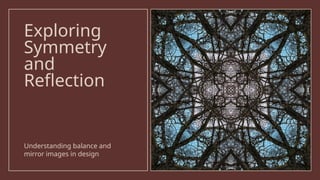
Exploring Symmetry and Reflection: Understanding Geometric Balance and Transformations
This presentation covers symmetry, reflectional symmetry, lines of symmetry in polygons, coordinate reflections, algebraic reflection rules, and real-world applications in design, architecture, and engineering.
Title and Learning
Objective
Introductionto Symmetry
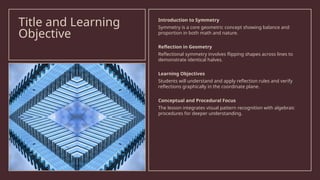
Symmetry is a core geometric concept showing balance and
proportion in both math and nature.
Reflection in Geometry
Reflectional symmetry involves flipping shapes across lines to
demonstrate identical halves.
Learning Objectives
Students will understand and apply reflection rules and verify
reflections graphically in the coordinate plane.
Conceptual and Procedural Focus
The lesson integrates visual pattern recognition with algebraic
procedures for deeper understanding.
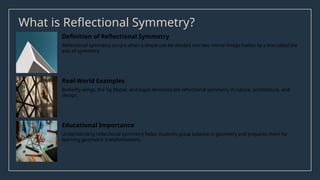
What is ReflectionalSymmetry?
Definition of Reflectional Symmetry
Reflectional symmetry occurs when a shape can be divided into two mirror-image halves by a line called the
axis of symmetry.
Real-World Examples
Butterfly wings, the Taj Mahal, and logos demonstrate reflectional symmetry in nature, architecture, and
design.
Educational Importance
Understanding reflectional symmetry helps students grasp balance in geometry and prepares them for
learning geometric transformations.
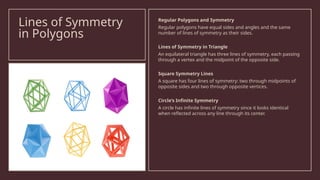
Lines of Symmetry
inPolygons
Regular Polygons and Symmetry
Regular polygons have equal sides and angles and the same
number of lines of symmetry as their sides.
Lines of Symmetry in Triangle
An equilateral triangle has three lines of symmetry, each passing
through a vertex and the midpoint of the opposite side.
Square Symmetry Lines
A square has four lines of symmetry: two through midpoints of
opposite sides and two through opposite vertices.
Circle’s Infinite Symmetry
A circle has infinite lines of symmetry since it looks identical
when reflected across any line through its center.
Coordinate
Geometry Basics of
Reflection
UnderstandingReflection
Reflection flips a shape over a mirror line on the Cartesian plane,
creating an image with the same size and shape.
Pre-image and Image
The pre-image is the original shape before reflection, and the
image is the resulting shape after reflection.
Rigid Transformations
Reflections are rigid transformations, preserving size and shape
while changing position and orientation.
Coordinate Description
Using coordinates, each point’s movement during reflection can
be precisely described and graphed accurately.
Standard Reflection
Rules
Reflection OverX-Axis
Reflecting a point over the x-axis keeps the x-coordinate the
same, changing the y-coordinate's sign.
Reflection Over Y-Axis
Reflection over the y-axis keeps the y-coordinate unchanged and
changes the sign of the x-coordinate.
Reflection Over Line y = x
When reflected over the line y = x, the x- and y-coordinates of the
point swap positions.
Conceptual Understanding
These rules work because reflected points maintain equal
distances from the mirror line, reinforcing geometric intuition.
Reflecting a Triangle
Overthe y-axis
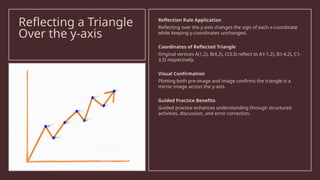
Reflection Rule Application
Reflecting over the y-axis changes the sign of each x-coordinate
while keeping y-coordinates unchanged.
Coordinates of Reflected Triangle
Original vertices A(1,2), B(4,2), C(3,5) reflect to A′(-1,2), B′(-4,2), C′(-
3,5) respectively.
Visual Confirmation
Plotting both pre-image and image confirms the triangle is a
mirror image across the y-axis.
Guided Practice Benefits
Guided practice enhances understanding through structured
activities, discussion, and error correction.
Reflections Over
Oblique Lines
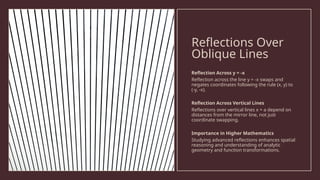
ReflectionAcross y = -x
Reflection across the line y = -x swaps and
negates coordinates following the rule (x, y) to
(-y, -x).
Reflection Across Vertical Lines
Reflections over vertical lines x = a depend on
distances from the mirror line, not just
coordinate swapping.
Importance in Higher Mathematics
Studying advanced reflections enhances spatial
reasoning and understanding of analytic
geometry and function transformations.
Real-World
Applications of
Reflection
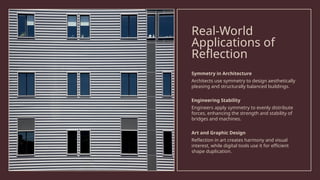
Symmetry inArchitecture
Architects use symmetry to design aesthetically
pleasing and structurally balanced buildings.
Engineering Stability
Engineers apply symmetry to evenly distribute
forces, enhancing the strength and stability of
bridges and machines.
Art and Graphic Design
Reflection in art creates harmony and visual
interest, while digital tools use it for efficient
shape duplication.
Exit Ticket andReview
Questions
Lines of Symmetry in Pentagon
A regular pentagon has five equal sides and five lines
of symmetry, reinforcing geometric concepts.
Reflection Across X-Axis
Reflecting point P( 3, 4) across the x-axis results in P′
−
( 3, 4), illustrating coordinate reflection rules.
− −
Purpose of Exit Tickets
Exit tickets provide feedback to teachers and
reinforce student understanding and confidence in
key concepts.
#3
This opening slide introduces the mathematical concept of symmetry and reflection, setting the purpose and expectations for the lesson. Symmetry is a foundational idea in geometry that helps learners recognize balance, proportion, and structure in both mathematical figures and the real world. By beginning with a clear title, "Exploring Symmetry and Reflection," students are oriented toward the central theme of the lesson, which connects visual patterns with coordinate geometry. The stated objective—understanding reflectional symmetry and applying reflection transformations in the Cartesian plane—clarifies that students will not only identify symmetry visually but also work with algebraic rules and coordinate-based transformations. This dual focus supports both conceptual understanding and procedural fluency. Students will learn how shapes behave when reflected across different lines, how to predict outcomes using rules, and how to verify results graphically. Emphasizing objectives at the start also encourages metacognition, helping students track what knowledge and skills they are expected to gain. Overall, this slide frames symmetry as both an artistic and mathematical idea, preparing students to see reflections as logical, rule-based operations rather than isolated formulas.
#5
Reflectional symmetry, also known as mirror symmetry or line symmetry, occurs when a figure can be divided by a line into two parts that are exact mirror images of each other. This imaginary dividing line is called the line of symmetry or axis of symmetry. When a shape has reflectional symmetry, every point on one side of the line has a corresponding point the same distance from the line on the opposite side. This concept helps students understand balance and equivalence in geometric figures. Real-world examples make this idea easier to grasp and more engaging. Butterflies are classic examples, as their wings often mirror each other across the body. Famous structures such as the Taj Mahal demonstrate symmetry in architecture, where reflectional balance contributes to visual harmony and stability. Logos and everyday designs frequently use symmetry to appear organized and aesthetically pleasing. By identifying symmetry in familiar objects, students can connect abstract geometric ideas to their environment. Understanding reflectional symmetry also lays the groundwork for learning geometric transformations, since reflections are one of the fundamental types of transformations alongside translations, rotations, and dilations.
#7
This slide focuses on how reflectional symmetry applies specifically to polygons, particularly regular polygons. A regular polygon is a shape with all sides and all angles equal. One important property of regular polygons is that they have the same number of lines of symmetry as they have sides. For example, an equilateral triangle has three sides, and it also has three lines of symmetry, each passing through a vertex and the midpoint of the opposite side. A square has four equal sides and four lines of symmetry—two passing through the midpoints of opposite sides and two passing through opposite vertices. A regular hexagon has six sides and six lines of symmetry, reflecting its highly balanced structure. The circle is a special case; because it looks the same when reflected across any line through its center, it has infinitely many lines of symmetry. Exploring these examples helps students recognize patterns and generalize rules about symmetry. It also reinforces the idea that symmetry is closely tied to equality and uniformity within a shape. This understanding supports later work in geometry, design, and problem-solving involving shape properties.
#9
In coordinate geometry, reflections are described using the Cartesian plane, which consists of a horizontal x-axis and a vertical y-axis. A reflection in this context is a transformation that flips a shape over a specific line, known as the mirror line. The original shape before the transformation is called the pre-image, while the resulting shape after reflection is called the image. Understanding these terms is essential for clear mathematical communication. When a figure is reflected, its size and shape remain unchanged; only its position and orientation may differ. This property makes reflections examples of rigid transformations. By using coordinates, students can precisely describe how each point of a figure moves during a reflection. This slide builds a bridge between visual symmetry and algebraic representation, helping students see that reflections follow consistent, predictable rules. Mastery of these basics enables students to graph transformations accurately, analyze geometric relationships, and prepare for more advanced topics such as transformations of functions and symmetry in algebra.
#11
This slide presents the standard algebraic rules used to reflect points across common lines in the Cartesian plane. These rules allow students to perform reflections efficiently without always needing to graph the points first. When a point is reflected over the x-axis, the x-coordinate remains the same while the y-coordinate changes sign, following the rule (x, y) → (x, −y). Reflecting over the y-axis causes the y-coordinate to stay the same while the x-coordinate changes sign, following (x, y) → (−x, y). Reflecting over the line y = x involves swapping the x- and y-coordinates, resulting in (x, y) → (y, x). These rules highlight patterns that help students remember and apply transformations correctly. Understanding why these rules work—based on equal distances from the mirror line—reinforces conceptual understanding. With practice, students can quickly determine images of points and shapes, supporting accuracy and confidence in coordinate geometry tasks.
#13
Guided practice allows students to apply reflection rules in a structured and supportive way. In this activity, students are given the coordinates of a triangle with vertices A(1, 2), B(4, 2), and C(3, 5). The task is to reflect the triangle over the y-axis and determine the coordinates of the new vertices A′, B′, and C′. Using the rule for reflection over the y-axis, students know that each x-coordinate will change sign while the y-coordinate remains the same. This means A′ becomes (−1, 2), B′ becomes (−4, 2), and C′ becomes (−3, 5). Plotting both the pre-image and the image on the coordinate plane helps students visually confirm that the reflected triangle is a mirror image across the y-axis. This exercise reinforces accuracy, rule application, and the connection between algebraic rules and graphical representations. Guided practice also encourages discussion, error correction, and deeper understanding before moving on to independent work.
#15
Beyond reflections over the x-axis and y-axis, shapes can also be reflected over oblique or non-standard lines. One common example is the line y = −x. When reflecting a point across this line, the coordinates follow the rule (x, y) → (−y, −x). This transformation both swaps the coordinates and changes their signs, which can initially be challenging for students. Another type of advanced reflection involves vertical lines of the form x = a, where points are reflected across a line parallel to the y-axis. These reflections require understanding distance from the mirror line rather than relying solely on memorized rules. Studying advanced reflections deepens students’ spatial reasoning and prepares them for higher-level mathematics, including analytic geometry and transformations of functions. It also reinforces the idea that reflection is a consistent geometric process, regardless of the orientation of the mirror line.
#17
Symmetry and reflection play important roles in many real-world fields, including architecture, art, engineering, and digital graphic design. Architects often use symmetry to create visually appealing and structurally balanced buildings. Engineers rely on symmetry to distribute forces evenly, improving strength and stability in bridges, machines, and vehicles. In art and graphic design, reflections are used to create harmony, repetition, and visual interest. Digital design tools frequently use reflection transformations to duplicate and manipulate shapes efficiently. Discussing these applications helps students see the practical value of mathematical concepts beyond the classroom. The guiding question encourages critical thinking by asking students how professionals use symmetry to balance both function and aesthetics. This connection to real life increases engagement and demonstrates that mathematics is a powerful tool for solving practical problems.
#19
The final slide serves as an exit ticket to assess student understanding of the key concepts covered in the lesson. The first question asks how many lines of symmetry a regular pentagon has. Since a regular pentagon has five equal sides, it also has five lines of symmetry. The second question asks students to reflect the point P(−3, 4) across the x-axis. Applying the reflection rule for the x-axis, the x-coordinate remains the same while the y-coordinate changes sign, resulting in P′(−3, −4). These questions review both conceptual knowledge and procedural skills. Exit tickets provide immediate feedback to the teacher and help identify areas that may need reinforcement. They also encourage students to reflect on what they have learned, reinforcing retention and confidence in applying symmetry and reflection concepts.