Exploring Quantum Computing: Foundations, Applications, and Future Prospects
An awareness program covering quantum computing basics, classical computing challenges, qubits, quantum phenomena, types of quantum computing, and its transformative applications and future potential.
Exploring Quantum Computing: Foundations, Applications, and Future Prospects
1.
Awareness Program on
Exploringthe Foundations and
Applications of Quantum computing:
Bridging Theory and Practices
Dr. K. HARI KRISHNA,
ASSOCIATE PROFESSOR, Dept. of CSE,
Mohan Babu University, Tirupati, A.P. India
khk396@gmail.com, 7780748899
Computing
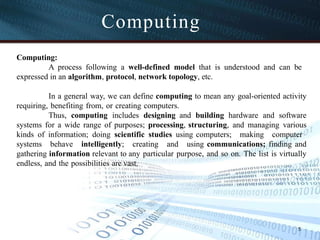
Computing:
A process followinga well-defined model that is understood and can be
expressed in an algorithm, protocol, network topology, etc.
In a general way, we can define computing to mean any goal-oriented activity
requiring, benefiting from, or creating computers.
Thus, computing includes designing and building hardware and software
systems for a wide range of purposes; processing, structuring, and managing various
kinds of information; doing scientific studies using computers; making computer
systems behave intelligently; creating and using communications; finding and
gathering information relevant to any particular purpose, and so on. The list is virtually
endless, and the possibilities are vast.
5
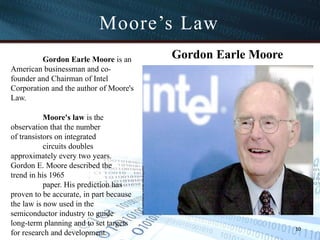
Gordon Earle Moore
GordonEarle Moore is an
American businessman and co-
founder and Chairman of Intel
Corporation and the author of Moore's
Law.
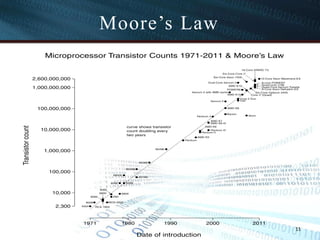
Moore's law is the
observation that the number
of transistors on integrated
circuits doubles
approximately every two years.
Gordon E. Moore described the
trend in his 1965
paper. His prediction has
proven to be accurate, in part because
the law is now used in the
semiconductor industry to guide
long-term planning and to set targets
for research and development.
Moore’s Law
10
Classical Computers
• Accurateand speedy computation machine
• Part of life because logical work can also be done
• Many kinds of numerical problems cannot be solved using conventional
computers.
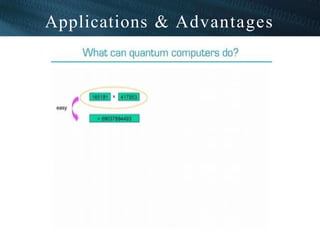
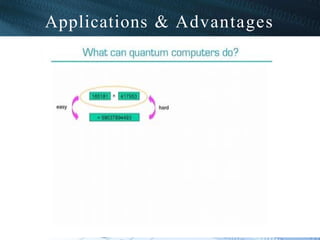
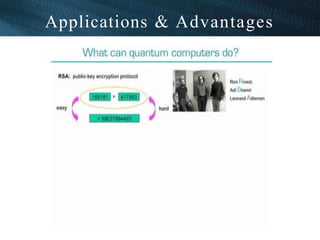
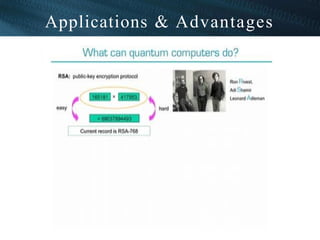
• Example: Factorization of a number
• The computer time required to factor an integer containing N digits is
believed to increase exponentially with N.
• Advantages
– Makes work easy and faster
– Any complex computation or logical work like laboratory work become easy
13
Classical Computing
14.
Classical Computing
14
Challenges WithClassical Computing:
• By 2020 to 2025, transistors will be so small and it will
generate so much heat that standard silicon technology may
eventually collapse.
Already Intel has implemented 32nm silicon technology
• If scale becomes too small, Electrons tunnel through micro-
thin barriers between wires corrupting signals.
17.
A Quantum Computeris a machine that
performs calculations based on the laws of quantum
mechanics which is behavior of particles at subatomic
level.
A Quantum is a smallest possible discrete unit of
any physical property.
17
Quantum Computing
20.
Evolution of QuantumComputer
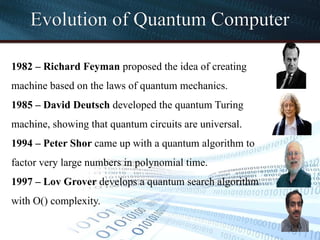
1982 – Richard Feyman proposed the idea of creating
machine based on the laws of quantum mechanics.
1985 – David Deutsch developed the quantum Turing
machine, showing that quantum circuits are universal.
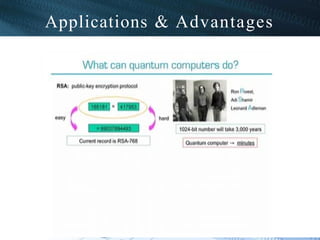
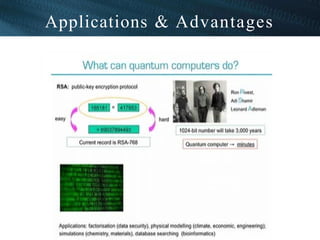
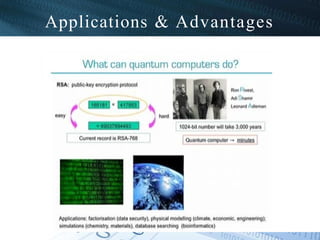
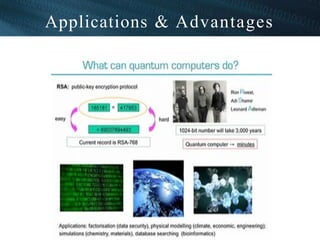
1994 – Peter Shor came up with a quantum algorithm to
factor very large numbers in polynomial time.
1997 – Lov Grover develops a quantum search algorithm
with O() complexity.
21.
Quantum Computing -Qubit
21
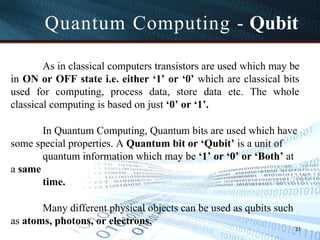
As in classical computers transistors are used which may be
in ON or OFF state i.e. either ‘1’ or ‘0’ which are classical bits
used for computing, process data, store data etc. The whole
classical computing is based on just ‘0’ or ‘1’.
In Quantum Computing, Quantum bits are used which have
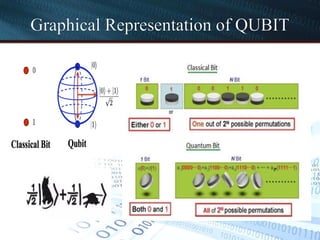
some special properties. A Quantum bit or ‘Qubit’ is a unit of
quantum information which may be ‘1’ or ‘0’ or ‘Both’ at
a same
time.
Many different physical objects can be used as qubits such
as atoms, photons, or electrons.
22.
Quantum Computing
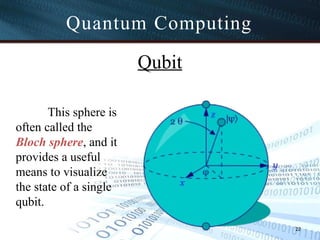
This sphereis
often called the
Bloch sphere, and it
provides a useful
means to visualize
the state of a single
qubit.
22
Qubit
23.
Qubit
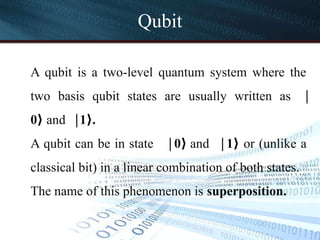
A qubit isa two-level quantum system where the
two basis qubit states are usually written as ∣
0⟩ and 1 .
∣ ⟩
A qubit can be in state 0
∣ ⟩ and 1
∣ ⟩ or (unlike a
classical bit) in a linear combination of both states.
The name of this phenomenon is superposition.
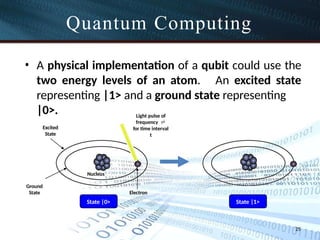
• A physicalimplementation of a qubit could use the
two energy levels of an atom. An excited state
representing |1> and a ground state representing
|0>.
Excited
State
Nucleus
Light pulse of
frequency
for time interval
t
Electron
State |0> State |1>
Ground
State
25
Quantum Computing
Quantum Computing
27
Quantum Superposition
•Anelectron has dual nature.
•It can exhibit as a particle and also as wave.
•Wave exhibits a phenomenon known as superposition
of waves.
•This phenomena allows the addition of waves
numerically.
•One example of a two-state quantum system is the polarization of
a single photon
28.
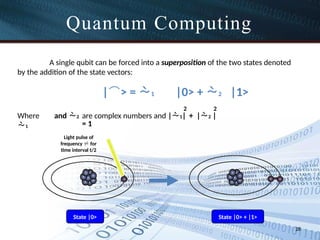
A single qubitcan be forced into a superposition of the two states denoted
by the addition of the state vectors:
|> = 1 |0> + 2 |1>
Where
1
Quantum Computing
State |0> State |0> + |1>
2 2
and 2 are complex numbers and |1| + |2 |
= 1
Light pulse of
frequency for
time interval t/2
28
29.
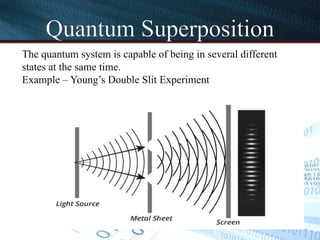
Quantum Superposition
The quantumsystem is capable of being in several different
states at the same time.
Example – Young’s Double Slit Experiment
30.
Quantum Computing
30
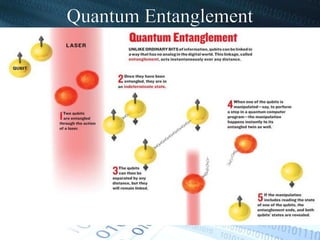
Quantum Entanglement
InQuantum Mechanics, it sometimes occurs that a
measurement of one particle will effect the state of another
particle, even though classically there is no direct
interaction.
When this happens, the state of the two particles is
said to be entangled.
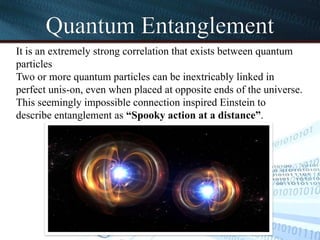
Quantum Entanglement
It isan extremely strong correlation that exists between quantum
particles
Two or more quantum particles can be inextricably linked in
perfect unis-on, even when placed at opposite ends of the universe.
This seemingly impossible connection inspired Einstein to
describe entanglement as “Spooky action at a distance”.
33.
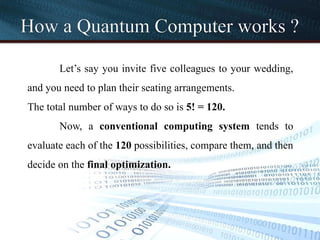
How a QuantumComputer works ?
Let’s say you invite five colleagues to your wedding,
and you need to plan their seating arrangements.
The total number of ways to do so is 5! = 120.
Now, a conventional computing system tends to
evaluate each of the 120 possibilities, compare them, and then
decide on the final optimization.
34.
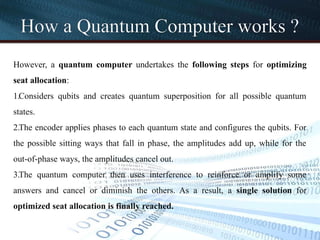
How a QuantumComputer works ?
However, a quantum computer undertakes the following steps for optimizing
seat allocation:
1.Considers qubits and creates quantum superposition for all possible quantum
states.
2.The encoder applies phases to each quantum state and configures the qubits. For
the possible sitting ways that fall in phase, the amplitudes add up, while for the
out-of-phase ways, the amplitudes cancel out.
3.The quantum computer then uses interference to reinforce or amplify some
answers and cancel or diminish the others. As a result, a single solution for
optimized seat allocation is finally reached.
35.
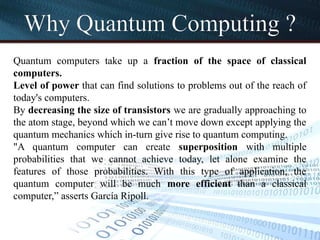
Why Quantum Computing?
Quantum computers take up a fraction of the space of classical
computers.
Level of power that can find solutions to problems out of the reach of
today's computers.
By decreasing the size of transistors we are gradually approaching to
the atom stage, beyond which we can’t move down except applying the
quantum mechanics which in-turn give rise to quantum computing.
"A quantum computer can create superposition with multiple
probabilities that we cannot achieve today, let alone examine the
features of those probabilities. With this type of application, the
quantum computer will be much more efficient than a classical
computer,” asserts García Ripoll.
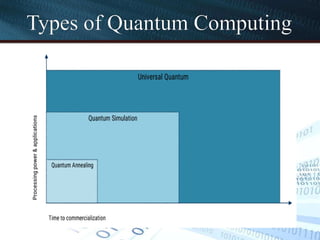
1. Quantum Annealing
Quantumannealing is best for solving optimization problems.
Quantum annealing is the least powerful and most narrowly applied form of
quantum computing.
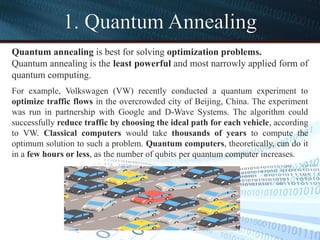
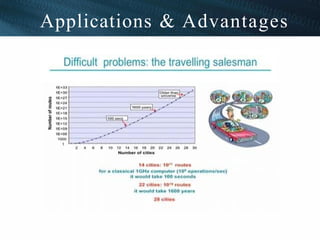
For example, Volkswagen (VW) recently conducted a quantum experiment to
optimize traffic flows in the overcrowded city of Beijing, China. The experiment
was run in partnership with Google and D-Wave Systems. The algorithm could
successfully reduce traffic by choosing the ideal path for each vehicle, according
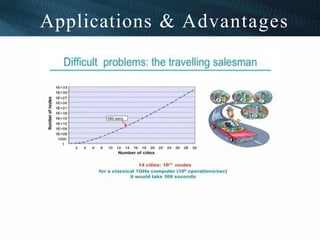
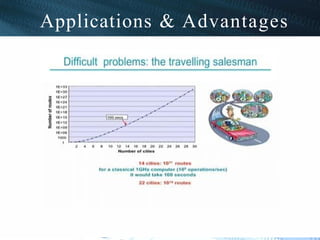
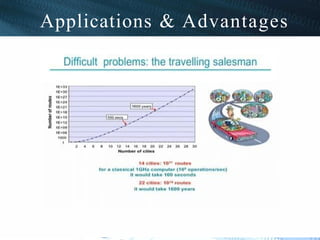
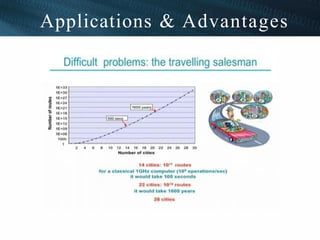
to VW. Classical computers would take thousands of years to compute the
optimum solution to such a problem. Quantum computers, theoretically, can do it
in a few hours or less, as the number of qubits per quantum computer increases.
38.
2. Quantum Simulation
Quantumsimulations explore specific problems in quantum
physics that are beyond the capacity of classical systems.
Simulating complex quantum phenomena could be one of the
most important applications of quantum computing.
Quantum simulation promises to have applications in the
study of many problems in, e.g., condensed-matter physics,
high-energy physics, atomic physics, quantum chemistry
and cosmology.
39.
2. Quantum Simulation
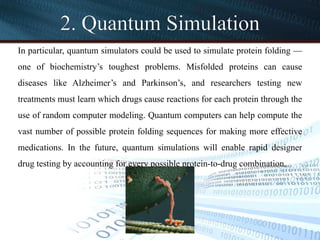
Inparticular, quantum simulators could be used to simulate protein folding —
one of biochemistry’s toughest problems. Misfolded proteins can cause
diseases like Alzheimer’s and Parkinson’s, and researchers testing new
treatments must learn which drugs cause reactions for each protein through the
use of random computer modeling. Quantum computers can help compute the
vast number of possible protein folding sequences for making more effective
medications. In the future, quantum simulations will enable rapid designer
drug testing by accounting for every possible protein-to-drug combination.
40.
3. Universal Quantum
Universalquantum computers are the most powerful and most
generally applicable, but also the hardest to build.
A truly universal quantum computer would likely make use of over
100,000 qubits.
The basic idea behind the universal quantum computer is that you could
direct the machine at any massively complex computation and get a
quick solution.
In the distant future, universal quantum computers could revolutionize
the field of artificial intelligence. Quantum AI could enable machine
learning that is faster than that of classical computers.
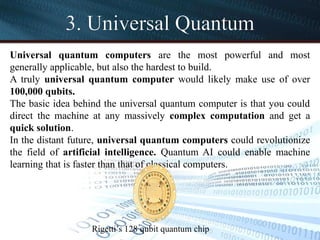
Rigetti’s 128 qubit quantum chip
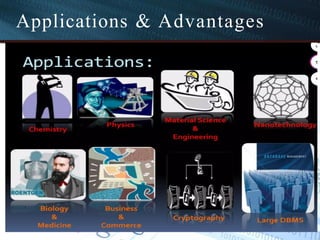
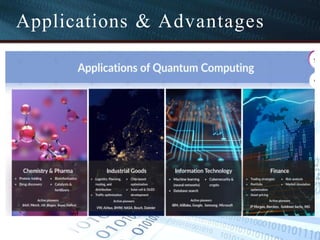
Applications & Advantages
51
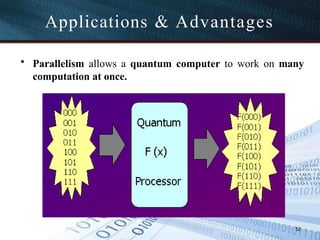
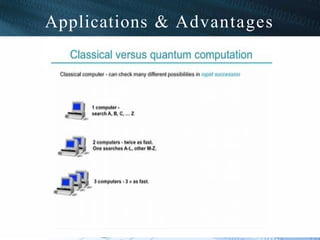
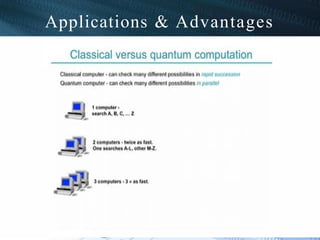
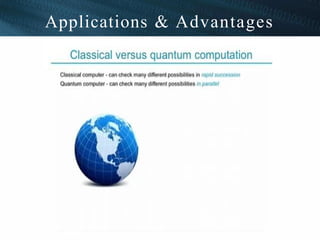
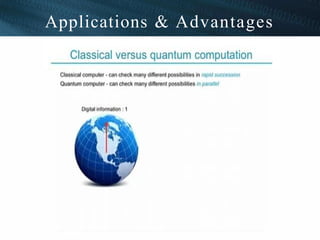
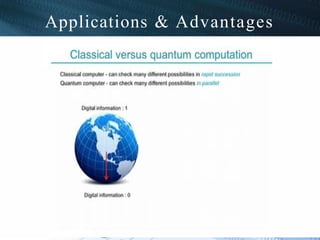
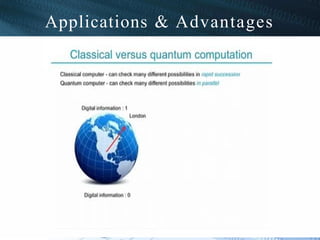
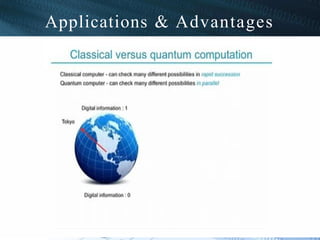
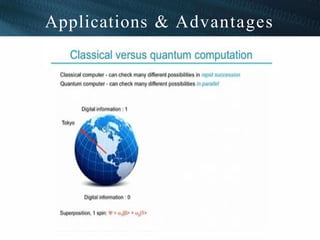
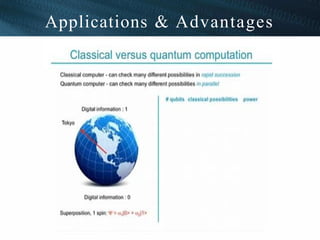
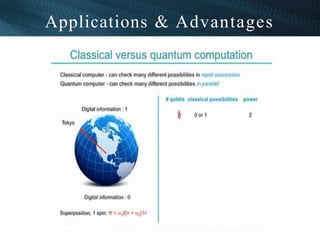
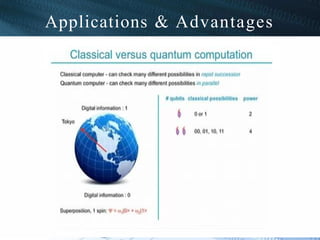
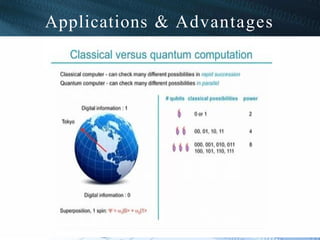
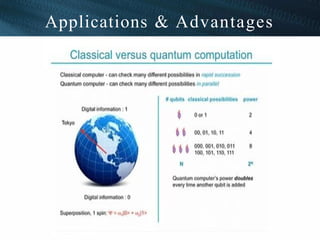
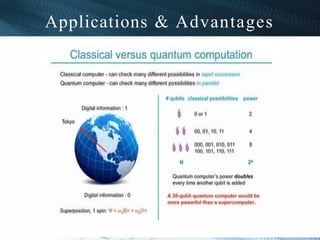
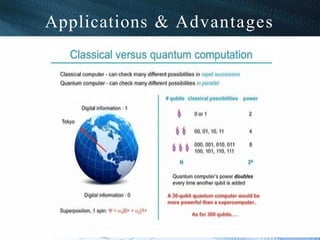
Itis the method in which a quantum computer is able to
perform two or more computations simultaneously.
In classical computers, parallel computing is
performed by having several processors linked
together.
In a quantum computer, a single quantum processor is
able to perform multiple computations on its own.
Challenges
79
🞂 Numberof bits in a word.
◦ 12-qubit machines is the most advanced to date.
◦ Difficulty with large words is, too much
quantum interaction can produce undesired results.
Since all the atoms interact with each other.
🞂 Physical size of the machines.
◦ Current machines are too large to be of practical
use to everyday society.
81.
Present & FutureProspects
81
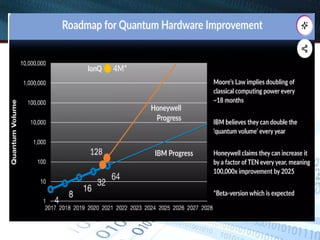
• When processor components reach atomic
scale,
Moore’s Law breaks down.
– Quantum effects become important whether we
want them or not.
But huge obstacles in building a
practical quantum computer!
82.
Present & FutureProspects
82
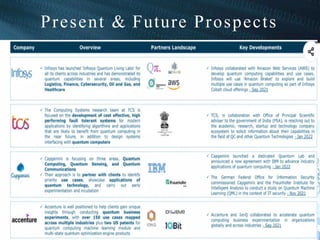
Quantum physicists from the University of Innsbruck
have set another world record: They have achieved controlled
entanglement of 14 quantum bits (qubits) and, thus, realized the
largest quantum register that has ever been produced.
If large-scale quantum computers can be built, they will be
able to solve certain problems much faster than any classical
computer using the best currently known algorithms (for
example integer factorization using Shor's
algorithm or the simulation of quantum many-body
systems).
Conclusion
93
• Quantum Computingcould provide a radical change in the
way computation is performed.
• The advantages of Quantum Computing lie in the
aspects of Quantum Mechanics that are peculiar to it,
most notably entanglement.
• Classical Computers will be significantly larger than
Quantum Computers for the foreseeable future.
• Quantum simulators are making strides in fields varying from
molecular energetics to many-body physics.