Exploring Biographical, Historical, and Sociocultural Contexts in Literature for Deeper Understanding
This presentation covers how an author's life, historical events, and cultural traditions shape literary meaning, using Filipino poetry and traditions as examples, with interactive activities and quizzes.
Biographical Context-
The author’slife
influences the text.
Writers often include their own experiences in their
works. Just like when you write about your family,
friends, or daily life, authors also use their personal
stories to give meaning to their poems
3.
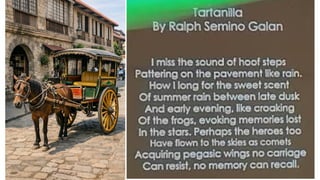
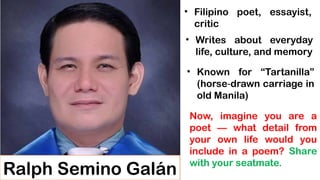
Ralph Semino Galán
•Filipino poet, essayist,
critic
• Writes about everyday
life, culture, and memory
• Known for “Tartanilla”
(horse drawn carriage in
‑
old Manila)
Now, imagine you are a
poet — what detail from
your own life would you
include in a poem? Share
with your seatmate.
4.
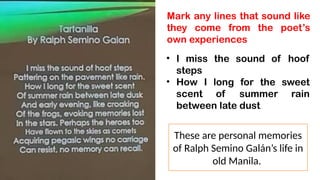
Mark any linesthat sound like
they come from the poet’s
own experiences
• I miss the sound of hoof
steps
• How I long for the sweet
scent of summer rain
between late dust
These are personal memories
of Ralph Semino Galán’s life in
old Manila.
5.
Activity: Create aBio‑Bubble
Instruction:
Step 1: Pick one line from
‘Tartanilla’ that you think reflects
the author’s life.
Step 2: Write that line inside a
speech balloon.
Step 3: Add a short note
explaining how it connects to
Ralph Semino Galán’s
experiences.
6.
Pair Share: Showyour Bio Bubble
and explain the connection.
Let’s end with a fun activity! I’ll pass the mic (or
pretend mic). Volunteers will read aloud one
line they chose that connects to the author’s
life.
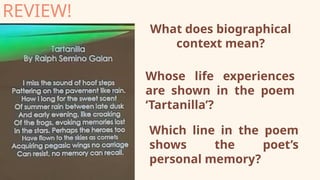
REVIEW!
What does biographical
contextmean?
Whose life experiences
are shown in the poem
‘Tartanilla’?
Which line in the poem
shows the poet’s
personal memory?
11.
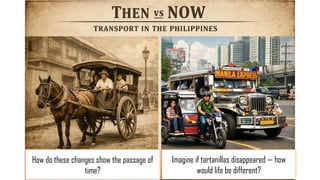
How do thesechanges show the passage of
time?
Imagine if tartanillas disappeared — how
would life be different?
12.
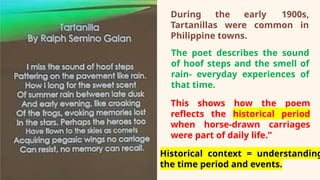
During the early1900s,
Tartanillas were common in
Philippine towns.
The poet describes the sound
of hoof steps and the smell of
rain- everyday experiences of
that time.
This shows how the poem
reflects the historical period
when horse‑drawn carriages
were part of daily life.”
Historical context = understanding
the time period and events.
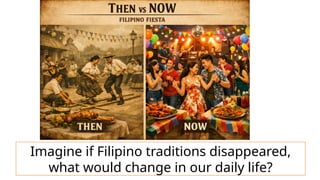
Imagine if Filipinotraditions disappeared,
what would change in our daily life?
19.
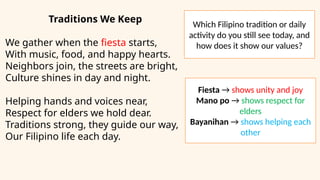
Traditions We Keep
Wegather when the fiesta starts,
With music, food, and happy hearts.
Neighbors join, the streets are bright,
Culture shines in day and night.
Helping hands and voices near,
Respect for elders we hold dear.
Traditions strong, they guide our way,
Our Filipino life each day.
Which Filipino tradition or daily
activity do you still see today, and
how does it show our values?
Fiesta → shows unity and joy
Mano po → shows respect for
elders
Bayanihan → shows helping each
other
20.
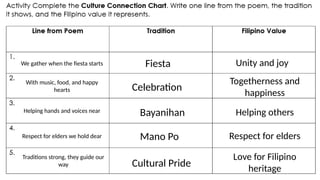
We gather whenthe fiesta starts Fiesta Unity and joy
With music, food, and happy
hearts
Helping hands and voices near
Respect for elders we hold dear
Traditions strong, they guide our
way
Celebration
Bayanihan
Mano Po
Cultural Pride
Togetherness and
happiness
Helping others
Respect for elders
Love for Filipino
heritage
21.
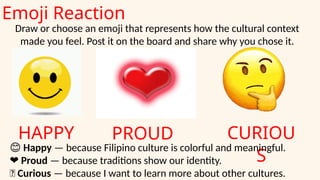
Emoji Reaction
HAPPY PROUDCURIOU
S
Draw or choose an emoji that represents how the cultural context
made you feel. Post it on the board and share why you chose it.
😊 Happy — because Filipino culture is colorful and meaningful.
❤️Proud — because traditions show our identity.
🤔 Curious — because I want to learn more about other cultures.
22.
We’d already learnedhow traditions and beliefs
shape meaning in literature.
Biographical + historical, and sociocultural-
to see how all contexts work together in
understanding a text.
24.
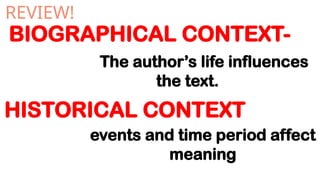
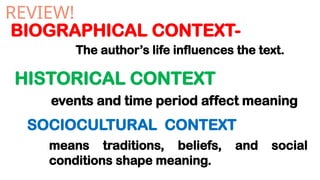
BIOGRAPHICAL CONTEXT-
HISTORICAL CONTEXT
REVIEW!
Theauthor’s life influences the text.
events and time period affect meaning
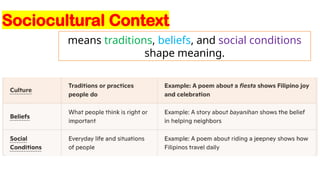
SOCIOCULTURAL CONTEXT
means traditions, beliefs, and social
conditions shape meaning.
25.
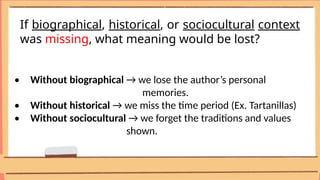
If biographical, historical,or sociocultural context
was missing, what meaning would be lost?
• Without biographical → we lose the author’s personal
memories.
• Without historical → we miss the time period (Ex. Tartanillas)
• Without sociocultural → we forget the traditions and values
shown.
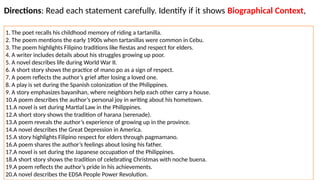
Directions: Read eachstatement carefully. Identify if it shows Biographical Context,
Historical Context, or Sociocultural Context.
1. The poet recalls his childhood memory of riding a tartanilla.
2. The poem mentions the early 1900s when tartanillas were common in Cebu.
3. The poem highlights Filipino traditions like fiestas and respect for elders.
4. A writer includes details about his struggles growing up poor.
5. A novel describes life during World War II.
6. A short story shows the practice of mano po as a sign of respect.
7. A poem reflects the author’s grief after losing a loved one.
8. A play is set during the Spanish colonization of the Philippines.
9. A story emphasizes bayanihan, where neighbors help each other carry a house.
10.A poem describes the author’s personal joy in writing about his hometown.
11.A novel is set during Martial Law in the Philippines.
12.A short story shows the tradition of harana (serenade).
13.A poem reveals the author’s experience of growing up in the province.
14.A novel describes the Great Depression in America.
15.A story highlights Filipino respect for elders through pagmamano.
16.A poem shares the author’s feelings about losing his father.
17.A novel is set during the Japanese occupation of the Philippines.
18.A short story shows the tradition of celebrating Christmas with noche buena.
19.A poem reflects the author’s pride in his achievements.
20.A novel describes the EDSA People Power Revolution.
28.
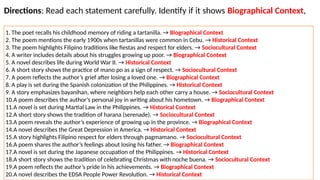
Directions: Read eachstatement carefully. Identify if it shows Biographical Context,
Historical Context, or Sociocultural Context.
1. The poet recalls his childhood memory of riding a tartanilla. → Biographical Context
2. The poem mentions the early 1900s when tartanillas were common in Cebu. → Historical Context
3. The poem highlights Filipino traditions like fiestas and respect for elders. → Sociocultural Context
4. A writer includes details about his struggles growing up poor. → Biographical Context
5. A novel describes life during World War II. → Historical Context
6. A short story shows the practice of mano po as a sign of respect. → Sociocultural Context
7. A poem reflects the author’s grief after losing a loved one. → Biographical Context
8. A play is set during the Spanish colonization of the Philippines. → Historical Context
9. A story emphasizes bayanihan, where neighbors help each other carry a house. → Sociocultural Context
10.A poem describes the author’s personal joy in writing about his hometown. → Biographical Context
11.A novel is set during Martial Law in the Philippines. → Historical Context
12.A short story shows the tradition of harana (serenade). → Sociocultural Context
13.A poem reveals the author’s experience of growing up in the province. → Biographical Context
14.A novel describes the Great Depression in America. → Historical Context
15.A story highlights Filipino respect for elders through pagmamano. → Sociocultural Context
16.A poem shares the author’s feelings about losing his father. → Biographical Context
17.A novel is set during the Japanese occupation of the Philippines. → Historical Context
18.A short story shows the tradition of celebrating Christmas with noche buena. → Sociocultural Context
19.A poem reflects the author’s pride in his achievements. → Biographical Context
20.A novel describes the EDSA People Power Revolution. → Historical Context
#3 “Here’s Ralph Semino Galán, the poet of ‘Tartanilla.’
He grew up in the Philippines and often wrote about everyday life.
#4 “I’ll read ‘Tartanilla’ aloud. Listen carefully and mark any lines that sound like they come from the poet’s own experiences — like the hoofsteps, the scent of rain, or the croaking frogs. After reading, we’ll discuss how these details connect to the author’s background and why they make the poem feel nostalgic.”
#6 “Share your Bio‑Bubble with your partner. Explain why you think that line reflects the author’s background. Listen carefully to your partner’s idea — you might notice different interpretations.”
#9 Sa Cebu, ito ay naging transportation heritage na nagpapakita ng pamumuhay ng mga tao noon.
Coz of modernization, there is a big change in transportation
#10 Biographical context means the author’s life is connected to the text.
The poet, Ralph Semino Galán, shows his own memories.
Example: “I miss the sound of hoof steps…” shows his memory of tartanilla rides.
#11 “Let’s compare transportation from the past and today. In the early 1900s, people used tartanillas — horse‑drawn carriages. Today, we use jeepneys and tricycles.
#12 “Let’s reread the poem. events and time period affect meaning
#17 “Sociocultural context refers to how traditions, beliefs, and social conditions influence a literary text. It helps us understand how people’s way of life gives meaning to what they read and write.”
#18 Look at these pictures — a fiesta .
These are part of Filipino culture.
Life would be less colorful.
We would lose our sense of community.
People might forget respect and bayanihan.
Our traditions and beliefs make us who we are — and they also appear in literature.”
#21 How did the cultural context make you feel?
“
Expected Learner Responses:
#27 The poet recalls his childhood memory of riding a tartanilla. → Biographical Context
The poem mentions the early 1900s when tartanillas were common in Cebu. → Historical Context
The poem highlights Filipino traditions like fiestas and respect for elders. → Sociocultural Context
A writer includes details about his struggles growing up poor. → Biographical Context
A novel describes life during World War II. → Historical Context
A short story shows the practice of mano po as a sign of respect. → Sociocultural Context
A poem reflects the author’s grief after losing a loved one. → Biographical Context
A play is set during the Spanish colonization of the Philippines. → Historical Context
A story emphasizes bayanihan, where neighbors help each other carry a house. → Sociocultural Context
A poem describes the author’s personal joy in writing about his hometown. → Biographical Context
A novel is set during Martial Law in the Philippines. → Historical Context
A short story shows the tradition of harana (serenade). → Sociocultural Context
A poem reveals the author’s experience of growing up in the province. → Biographical Context
A novel describes the Great Depression in America. → Historical Context
A story highlights Filipino respect for elders through pagmamano. → Sociocultural Context
A poem shares the author’s feelings about losing his father. → Biographical Context
A novel is set during the Japanese occupation of the Philippines. → Historical Context
A short story shows the tradition of celebrating Christmas with noche buena. → Sociocultural Context
A poem reflects the author’s pride in his achievements. → Biographical Context
A novel describes the EDSA People Power Revolution. → Historical Context
#28 The poet recalls his childhood memory of riding a tartanilla. → Biographical Context
The poem mentions the early 1900s when tartanillas were common in Cebu. → Historical Context
The poem highlights Filipino traditions like fiestas and respect for elders. → Sociocultural Context
A writer includes details about his struggles growing up poor. → Biographical Context
A novel describes life during World War II. → Historical Context
A short story shows the practice of mano po as a sign of respect. → Sociocultural Context
A poem reflects the author’s grief after losing a loved one. → Biographical Context
A play is set during the Spanish colonization of the Philippines. → Historical Context
A story emphasizes bayanihan, where neighbors help each other carry a house. → Sociocultural Context
A poem describes the author’s personal joy in writing about his hometown. → Biographical Context
A novel is set during Martial Law in the Philippines. → Historical Context
A short story shows the tradition of harana (serenade). → Sociocultural Context
A poem reveals the author’s experience of growing up in the province. → Biographical Context
A novel describes the Great Depression in America. → Historical Context
A story highlights Filipino respect for elders through pagmamano. → Sociocultural Context
A poem shares the author’s feelings about losing his father. → Biographical Context
A novel is set during the Japanese occupation of the Philippines. → Historical Context
A short story shows the tradition of celebrating Christmas with noche buena. → Sociocultural Context
A poem reflects the author’s pride in his achievements. → Biographical Context
A novel describes the EDSA People Power Revolution. → Historical Context
 Most read
 Most read
 Most read