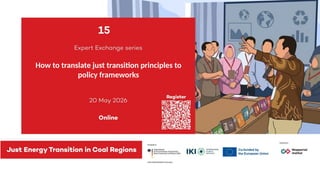
How to translate just transition principles to
policy frameworks
Welcome
15
Expert Exchange Series
How to translate just
transition principles to policy
frameworks
20 May 2026
Agenda
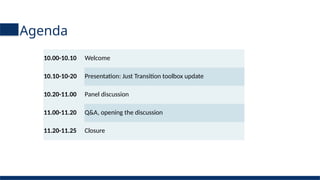
10.00-10.10 Welcome
10.10-10-20 Presentation: Just Transition toolbox update
10.20-11.00 Panel discussion
11.00-11.20 Q&A, opening the discussion
11.20-11.25 Closure
Agis Inayah
Dala Institute, Indonesia
Speakers
Tselmegsaikhan Lkhagva
Independent Research Institute of
Mongolia/University of Queensland
Louise Naude
Formerly Member of the Presidential
Climate Change Commission, WWF
South Africa
Jannis Beutel
IKI JET/ Wuppertal Institute,
Germany
Johannes Lohmeyer
IKI JET /GIZ
Welcome & Introduction
The IKI JET Project
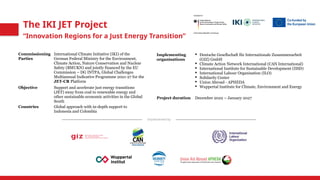
“Innovation Regions for a Just Energy Transition”
Commissioning
Parties
International Climate Initiative (IKI) of the
German Federal Ministry for the Environment,
Climate Action, Nature Conservation and Nuclear
Safety (BMUKN) and jointly financed by the EU
Commission – DG INTPA, Global Challenges
Multiannual Indicative Programme 2021-27 for the
JET-CR Platform
Objective Support and accelerate just energy transitions
(JET) away from coal to renewable energy and
other sustainable economic activities in the Global
South
Countries Global approach with in-depth support to
Indonesia and Colombia
Implementing
organisations
 Deutsche Gesellschaft für Internationale Zusammenarbeit
(GIZ) GmbH
 Climate Action Network International (CAN International)
 International Institute for Sustainable Development (IISD)
 International Labour Organisation (ILO)
 Solidarity Center
 Union Abroad - APHEDA
 Wuppertal Institute for Climate, Environment and Energy
Project duration December 2022 – January 2027
Implemented by
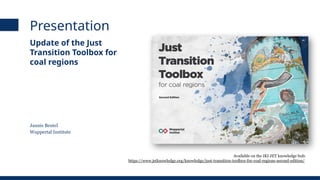
Presentation: Just Transition toolbox update
Presentation
Update of the Just
Transition Toolbox for
coal regions
Jannis Beutel
Wuppertal Institute
Available on the IKI JET knowledge hub:
https://www.jetknowledge.org/knowledge/just-transition-toolbox-for-coal-regions-second-edition/
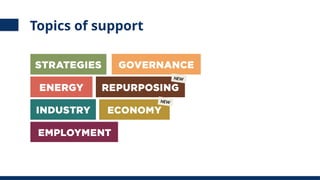
Topics of support
NEW
NEW
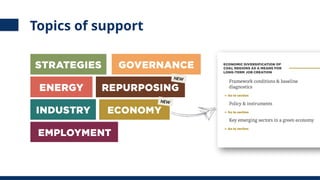
Topics of support
NEW
NEW
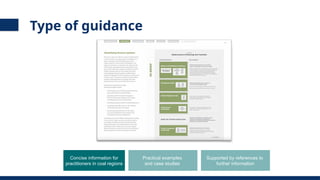
Type of guidance
Practical examples
and case studies
Supported by references to
further information
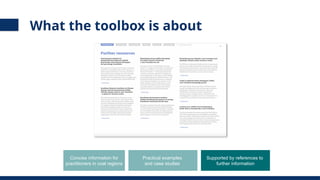
Concise information for
practitioners in coal regions
What the toolbox is about
Practical examples
and case studies
Supported by references to
further information
Concise information for
practitioners in coal regions
What the toolbox is about
Practical examples
and case studies
Supported by references to
further information
Concise information for
practitioners in coal regions
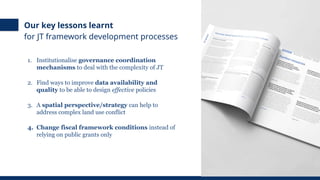
Our key lessons learnt
for JT framework development processes
1. Institutionalise governance coordination
mechanisms to deal with the complexity of JT
2. Find ways to improve data availability and
quality to be able to design effective policies
3. A spatial perspective/strategy can help to
address complex land use conflict
4. Change fiscal framework conditions instead of
relying on public grants only
Panel discussion
How to translate just
transition principles into policy
frameworks
Approaches from Indonesia, Mongolia
and South Africa
Panelists
Balgis Inayah
Dala Institute
Tselmegsaikhan Lkhagva
Independent Research Institute of
Mongolia/University of Queensland
Louise Naude
Formerly Member of the
Presidential Climate Change
Commission, WWF South Africa
Jannis Beutel
IKI JET/ Wuppertal Institute,
Germany
Presentation
Panelists
Balgis Inayah
Dala Institute
Tselmegsaikhan Lkhagva
Independent Research Institute of
Mongolia/University of Queensland
Louise Naude
Formerly Member of the
Presidential Climate Change
Commission, WWF South Africa
Jannis Beutel
IKI JET/ Wuppertal Institute,
Germany
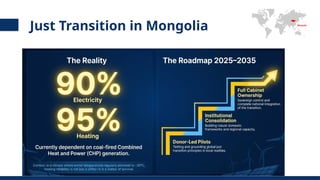
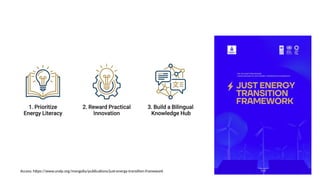
Just Transition in Mongolia
The Way Forward: Reflections and Actions
Access: https://www.undp.org/mongolia/publications/just-energy-transition-framework
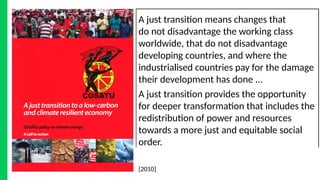
A just transition means changes that
do not disadvantage the working class
worldwide, that do not disadvantage
developing countries, and where the
industrialised countries pay for the damage
their development has done ...
A just transition provides the opportunity
for deeper transformation that includes the
redistribution of power and resources
towards a more just and equitable social
order.
[2010]
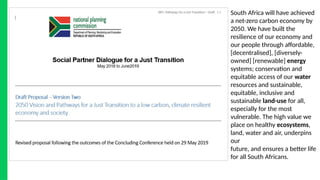
South Africa will have achieved
a net-zero carbon economy by
2050. We have built the
resilience of our economy and
our people through affordable,
[decentralised], [diversely-
owned] [renewable] energy
systems; conservation and
equitable access of our water
resources and sustainable,
equitable, inclusive and
sustainable land-use for all,
especially for the most
vulnerable. The high value we
place on healthy ecosystems,
land, water and air, underpins
our
future, and ensures a better life
for all South Africans.
[2020][2022]
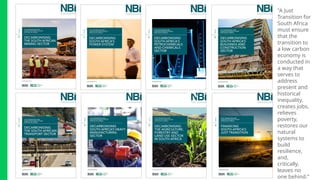
"A Just
Transition for
South Africa
must ensure
that the
transition to
a low carbon
economy is
conducted in
a way that
serves to
address
present and
historical
inequality,
creates jobs,
relieves
poverty,
restores our
natural
systems to
build
resilience,
and,
critically,
leaves no
one behind.”
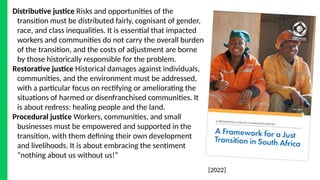
Distributive justice Risks and opportunities of the
transition must be distributed fairly, cognisant of gender,
race, and class inequalities. It is essential that impacted
workers and communities do not carry the overall burden
of the transition, and the costs of adjustment are borne
by those historically responsible for the problem.
Restorative justice Historical damages against individuals,
communities, and the environment must be addressed,
with a particular focus on rectifying or ameliorating the
situations of harmed or disenfranchised communities. It
is about redress: healing people and the land.
Procedural justice Workers, communities, and small
businesses must be empowered and supported in the
transition, with them defining their own development
and livelihoods. It is about embracing the sentiment
“nothing about us without us!”
[2022]
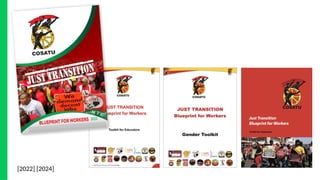
[2022] [2024]
Panelists
Balgis Inayah
Dala Institute
Tselmegsaikhan Lkhagva
Independent Research Institute of
Mongolia/University of Queensland
Louise Naude
Formerly Member of the
Presidential Climate Change
Commission, WWF South Africa
Jannis Beutel
IKI JET/ Wuppertal Institute,
Germany
Q&A
Your feedback matters!
Please take 2
minutes to share
your thoughts
Contact
Project Team
iki-jet@giz.de
Newsletter
Subscribe to our Newsletter - IISD (jetknowledg
e.org)
Jannis Beutel
Researcher | IKI JET (Wuppertal)
Jannis.beutel@wupperinst.org
Thank you very much for your attention!
Visit our Knowledge Platform and sign up for our newsletter here:
Just Energy Transitions in Coal Regions | Empowering Sustain
able Change (jetknowledge.org)
You can also follow us on LinkedIn:
Just Energy Transition in Coal Regions Knowledge Hub: Overvi
ew | LinkedIn