Evolvet
european volunteer coordinators
vocation education and training
Evolvet
Manual for vocational
education and training of
volunteer coordinators in
development projects
Key Action 2 - Strategic Partnerships for Vocational Education and Training
2015-1-ES01-KA202-015929
01/09/2015 - 31/08/2017
Spain, Austria, Finland, Italy, Poland,
Portugal and Slovakia.
EVOLVET- 2015-1-ES01-KA202-015929
2
Evolvet
EVOLVET- 2015-1-ES01-KA202-015929
3
Evolvet
volve
EVOLVET- 2015-1-ES01-KA202-015929
4
Evolvet
INDEX
..........................................................................................................................................................................
07	Introduction
..........................................................................................................................................................................
15	 Toolkit 1: Understanding volunteering
17	 1. Definition of volunteering
17	 1.1. The concept of “volunteer”
18	 1.2. Who is a volunteer?
18	 1.3. Volunteering and traditional values
20 	 2. Global citizenship
20 	 2.1. Volunteering as social change of action
21 	 2.2. Rights and responsibilities of volunteers as global citizens
22 	 2.3. Why it is important to have volunteers at international level
23 	 3. Sample models of volunteering classification
23 	 3.1. Different categories of volunteering
35 	 Toolkit 1: exercises and practice
..........................................................................................................................................................................
73 	 Toolkit 2: Volunteering in a globalized world
74 	 4. Can volunteers transform the world?
75 	 5. How to live and learn in a diverse society?
75 	 5.1. What is diversity?
76 	 5.2. Educational dimension of diversity in the work with volunteers
77 	 6. How to deal with global interdependencies?
77 	 6.1. What is globalisation?
78 	 6.2. Educational dimension of global interdependencies in the work with volunteers
79 	 7. How to be a volunteer in a development project
79 	 7.1. What is development cooperation?
79 	 7.2. What are the challenges in the field abroad and how to deal with them?
EVOLVET- 2015-1-ES01-KA202-015929
5
Evolvet
81 	 7.3. What is the role of a volunteer in a development project?
82 	 7.4. What is “the personal project” within a development project?
82 	 7.5. What is the expected behaviour from a volunteer within the Development Projects?
83 	 7.6. What should a person know about the destination country?
83 	 7.7. What should volunteers know to protect themselves in the field?
85 	 Toolkit 2: exercises and practice
.............................................................................................................................................................................
123	 Toolkit 3: Volunteer management in development
124	 8. Rights and responsibilities of volunteer organisations and volunteers
125 	 8.1. Organisation’s rights and responsibilities
131 	 8.2. Volunteer’s rights and responsibilities
136 	 9. Building a volunteer coordinator
136	 9. 1. The importance of having a volunteer coordinator
139 	 9.2. What is needed to coordinate volunteers in a development Project
147 	 10. Volunteer Management Process
148 	 10.1 Planning and organizing the volunteer management programme in 		
	development projects
150 	 10.2 Preparing the terms of reference for volunteers
151 	 10.3 Recruiting volunteer
157 	 10.4 Interviewing and selecting candidates
165 	 10.5. Preparing volunteers
167 	 10.6 Supervising and motivating volunteers
169 	 10.7 Recognizing volunteers
173 	 10.8 Evaluation of volunteers, overall programme and volunteer programme
177 	 Toolkit 3: exercises and practice
..........................................................................................................................................................................
235	BIBLIOGRAPHY
EVOLVET- 2015-1-ES01-KA202-015929
6
Evolvet
With the funding and support of:
Fund for Intercultural Education. Poland.
Web: www.miedzykulturowa.org.pl
Platforma dobrovolnickych centier a organizacii. Slovakia.
Web: www.dobrovolnickecentra.sk
Pista Mágica – Associação. Portugal.
Web: www.pista-magica.com
Project and toolkits promoters:
Art in Tanzania Ry. Finland.
Web: www.artintanzania.org
Associazione Internazionale Volontari. Italy.
Web: www.lvia.it
Südwind. Austria.
Web: www.suedwind.at
CONGDCAR (Coordinator). Spain.
Web: www.congdcar.org
EVOLVET- 2015-1-ES01-KA202-015929
7
Evolvet
Introduction
Rationale and context
The world of development projects and cooperation is considerably complex as it is its international context
and the programmes and tools that are agreed to improve the lives of communities at political, economic,
social and cultural level. As a consequence, in the last decades, countless international agreements,
conventions and pacts have emerged. On this line a development agenda as a common responsibility of all
humanity has just been approved, with 17 Sustainable Development Goals (SDG) to be reached by 2030.
It is an integral Agenda, which addresses all sectors of traditional development cooperation (such as food,
health or education) but also other new ones that have appeared on the last decades (such as climate
change, forest and seas care, inequality, international migrations, tourism, access to new technologies,
etc.).
Moreover, the last economic crisis has had a big impact on volunteering organisations across Europe and
especially on those working on development projects as private donations and public funding on this field
have significantly diminished in most European countries (making more difficult for these entities to offer
appropriate quality services for their beneficiaries).
All of this promotes enormous challenges for development organisations that entail high qualified staff and
human resources in order to be able to face the responsibility that these entities must assume. Besides this,
the previous scenario described also demands a huge capacity of involvement of humanity (much bigger
than at any other time in the history). World population needs to understand today’s complex international
relations, the impact of human beings on poverty and global inequality, the agreed road map within the
framework of the United Nations for their resolution as well as the increasingly complex actions that give
appropriate answers to globalization and its impact at global level.
At the same time, this globalization brought with it the awareness of the existence of global problems
that must be solved between all the parties involved on them. This has led in recent decades to an
unprecedented proliferation of Non-governmental development organizations (NGDOs) and of spaces that
are formed in their great majority by an implicated citizenship that feels responsible of the destination
of the humanity (citizens that collaborate at different levels and providing a wide variety of knowledge
through all the activities that those development organisations implement).
Undoubtedly, volunteers have become their main fuel as without them, most of the actions of these
entities could not be carried out, both in developing countries and in the awareness of the populations of
developed countries. They are the backbone of the NGDOs’ teams who share their time and skills with the
sole purpose of making a contribution to society and helping those who need it the most. According to this,
in order to continue developing volunteering actions despite the low financial resources available, NGDOs
needed to coordinate their resources and making the most of the gifts received from their volunteers by
EVOLVET- 2015-1-ES01-KA202-015929
8
Evolvet
ensuring that they get the support and supervision they need to make the most of their participation. In
conclusion, it is needed to be more cost-efficient by having better trained professionals that could produce
more prepared volunteers on the field.
On the education scope, it must be mentioned that organisations working on development projects are
nowadays acting as both, training providers and employers of professionals on this field. For this reason, it
is important that they work together not only on detecting those competences or skills that they promote
on their own vocational education and training programmes, but also those that they consider essential
when hiring new staff for their teams. This demands the creation of new initiatives on this field that could
provide extra support to volunteering organisations and also to those vocational education and training
centres that aim to offer education on this subject.
However, in order to achieve qualitative solutions to the previous challenges it is important to exchange and
use work-based practices to not only increase the impact of volunteering and its appropriate management,
but also facilitate the transfer and adaptation of training procedures on this field from one country to
another.
As a consequence the project EVOLVET is created as a joined initiative to put together experts and
professionals on volunteers coordination who have been not only able to work together for the creation
of this manual, but have also had the chance of participating on different transnational activities to visit in
situ the reality of other organisations of the same sector and learn on the field about their methodologies.
Build what you want to see in the world.
Jack Dorsey.
About EVOLVET
EVOLVET (European VOLunteer coordinators Vocation Education and Training) was a European strategic
partnership funded by the Erasmus+ programme of the European Commission, composed by seven
organisations working with development projects for social inclusion and education from Austria, Finland,
Italy, Poland, Portugal, Slovakia and Spain. The project, that took place from the 01/09/2015 to the
31/08/2017, aimed at giving a positive impulsion to the training of volunteer coordinators by providing
a standardised tool-kit containing on-the-job training materials for skills and competences commonly
demanded to volunteer coordinators across Europe, not only for the management of development projects
but also on the concrete education and training of the volunteers taking part on them. Moreover, the
project also run transnational training mobilities that made possible to volunteer coordinators from the
different partner organisations to take part in common education initiatives about volunteer management
embedded within the activities of the project. The creation of such standard pan-European training
materials for professional volunteer coordinators is intended to contribute to improve the transparency
and recognition of their qualifications and competences using already established systems based on
measurable recognitions at transnational level, including those acquired through formal, non-formal and
informal learning. Furthermore, the project was focused on identifying the skills required by professional
EVOLVET- 2015-1-ES01-KA202-015929
9
Evolvet
volunteer coordinators on development organisations, what allowed to compose an standard curriculum
of competences for this professional category for being used afterwards for both, vocational education
and training centres (to develop new learning pathways, methodologies and degrees) and organisations
working with projects for local and international development (to detect which competences should be
reinforced on their teams and detect those skills needed for future recruitments).
According to all of this, EVOLVET was not only an innovative project which main objective was to develop
new materials and improve the situation of those professionals working as volunteer coordinators on the
development field, but also a necessary initiative to facilitate the transitions of those learning on training
centres about NGOs management and the real labour market that should wait them after their graduation.
Besides all of this, the project also succeeded in creating new links between organisations of different
countries and sectors working on the same field (local and international development of communities) and
in reinforcing the transnational structures of communication to support projects on this field.
About the creation of this manual
During all the implementation phase of EVOLVET, partner organisations involved on it designed, applied
and evaluated different toolkits focused on the vocational education and training of volunteer coordinators
on development projects. This was not only possible thanks to a transnational cooperative work of
professionals, but also through a constant exchange of practices about their on-going programmes for
volunteer coordinators on their organisations and different transnational training events. All the knowledge,
materials, methodologies and outputs of these experiences have been collected on this manual that was
published at the end of the project and will be maintained online on the website of EVOLVET to guide
those interested on establishing regular training programmes for volunteer coordinators within their local
activities or organisations.
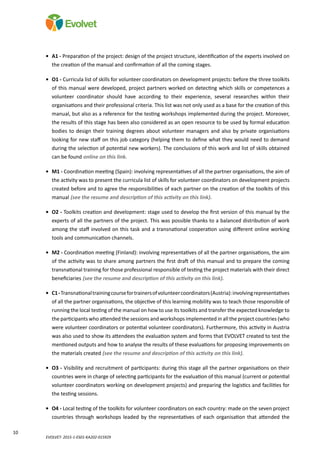
The process for the appropriate creation of this manual was developed along the whole project calendar in
order to offer its participants not only environments for the creation of new training materials on volunteer
coordination, but also the scenarios to test them and the working spaces for their improvement. According
to this, different phases were agreed and carried out in the seven project countries by all its partners and
beneficiaries:
EVOLVET- 2015-1-ES01-KA202-015929
10
Evolvet
•	 A1 - Preparation of the project: design of the project structure, identification of the experts involved on
the creation of the manual and confirmation of all the coming stages.
•	 O1 - Curricula list of skills for volunteer coordinators on development projects: before the three toolkits
of this manual were developed, project partners worked on detecting which skills or competences a
volunteer coordinator should have according to their experience, several researches within their
organisations and their professional criteria. This list was not only used as a base for the creation of this
manual, but also as a reference for the testing workshops implemented during the project. Moreover,
the results of this stage has been also considered as an open resource to be used by formal education
bodies to design their training degrees about volunteer managers and also by private organisations
looking for new staff on this job category (helping them to define what they would need to demand
during the selection of potential new workers). The conclusions of this work and list of skills obtained
can be found online on this link.
•	 M1 - Coordination meeting (Spain): involving representatives of all the partner organisations, the aim of
the activity was to present the curricula list of skills for volunteer coordinators on development projects
created before and to agree the responsibilities of each partner on the creation of the toolkits of this
manual (see the resume and description of this activity on this link).
•	 O2 - Toolkits creation and development: stage used to develop the first version of this manual by the
experts of all the partners of the project. This was possible thanks to a balanced distribution of work
among the staff involved on this task and a transnational cooperation using different online working
tools and communication channels.
•	 M2 - Coordination meeting (Finland): involving representatives of all the partner organisations, the aim
of the activity was to share among partners the first draft of this manual and to prepare the coming
transnational training for those professional responsible of testing the project materials with their direct
beneficiaries (see the resume and description of this activity on this link).
•	 C1-Transnationaltrainingcoursefortrainersofvolunteercoordinators(Austria):involvingrepresentatives
of all the partner organisations, the objective of this learning mobility was to teach those responsible of
running the local testing of the manual on how to use its toolkits and transfer the expected knowledge to
the participants who attended the sessions and workshops implemented in all the project countries (who
were volunteer coordinators or potential volunteer coordinators). Furthermore, this activity in Austria
was also used to show its attendees the evaluation system and forms that EVOLVET created to test the
mentioned outputs and how to analyse the results of these evaluations for proposing improvements on
the materials created (see the resume and description of this activity on this link).
•	 O3 - Visibility and recruitment of participants: during this stage all the partner organisations on their
countries were in charge of selecting participants for the evaluation of this manual (current or potential
volunteer coordinators working on development projects) and preparing the logistics and facilities for
the testing sessions.
•	 O4 - Local testing of the toolkits for volunteer coordinators on each country: made on the seven project
countries through workshops leaded by the representatives of each organisation that attended the
EVOLVET- 2015-1-ES01-KA202-015929
11
Evolvet
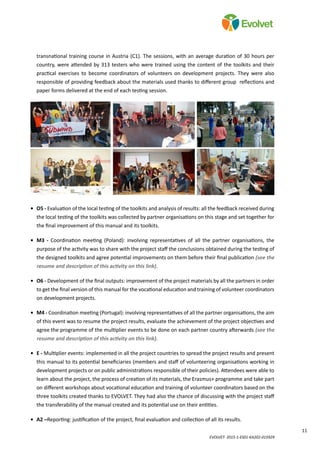
transnational training course in Austria (C1). The sessions, with an average duration of 30 hours per
country, were attended by 313 testers who were trained using the content of the toolkits and their
practical exercises to become coordinators of volunteers on development projects. They were also
responsible of providing feedback about the materials used thanks to different group reflections and
paper forms delivered at the end of each testing session.
•	 O5 - Evaluation of the local testing of the toolkits and analysis of results: all the feedback received during
the local testing of the toolkits was collected by partner organisations on this stage and set together for
the final improvement of this manual and its toolkits.
•	 M3 - Coordination meeting (Poland): involving representatives of all the partner organisations, the
purpose of the activity was to share with the project staff the conclusions obtained during the testing of
the designed toolkits and agree potential improvements on them before their final publication (see the
resume and description of this activity on this link).
•	 O6 - Development of the final outputs: improvement of the project materials by all the partners in order
to get the final version of this manual for the vocational education and training of volunteer coordinators
on development projects.
•	 M4 - Coordination meeting (Portugal): involving representatives of all the partner organisations, the aim
of this event was to resume the project results, evaluate the achievement of the project objectives and
agree the programme of the multiplier events to be done on each partner country afterwards (see the
resume and description of this activity on this link).
•	 E - Multiplier events: implemented in all the project countries to spread the project results and present
this manual to its potential beneficiaries (members and staff of volunteering organisations working in
development projects or on public administrations responsible of their policies). Attendees were able to
learn about the project, the process of creation of its materials, the Erasmus+ programme and take part
on different workshops about vocational education and training of volunteer coordinators based on the
three toolkits created thanks to EVOLVET. They had also the chance of discussing with the project staff
the transferability of the manual created and its potential use on their entities.
•	 A2 –Reporting: justification of the project, final evaluation and collection of all its results.
EVOLVET- 2015-1-ES01-KA202-015929
12
Evolvet
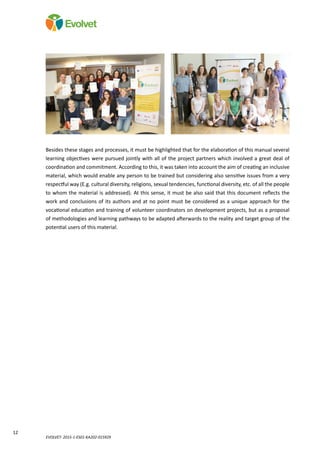
Besides these stages and processes, it must be highlighted that for the elaboration of this manual several
learning objectives were pursued jointly with all of the project partners which involved a great deal of
coordination and commitment. According to this, it was taken into account the aim of creating an inclusive
material, which would enable any person to be trained but considering also sensitive issues from a very
respectful way (E.g. cultural diversity, religions, sexual tendencies, functional diversity, etc. of all the people
to whom the material is addressed). At this sense, it must be also said that this document reflects the
work and conclusions of its authors and at no point must be considered as a unique approach for the
vocational education and training of volunteer coordinators on development projects, but as a proposal
of methodologies and learning pathways to be adapted afterwards to the reality and target group of the
potential users of this material.
EVOLVET- 2015-1-ES01-KA202-015929
13
Evolvet
About the use of this manual
This manual is divided on three separate toolkits containing different information about issues related to
the vocational education and training of volunteer coordinators and managers on development projects.
Each toolkit is divided in:
a) Introduction to the toolkit: brief summary of the toolkit content.
b) Toolkit theory: explanation of the pedagogical approach, description of the toolkit topics and basic
knowledge to be transferred to its potential users and their beneficiaries.
c) Toolkit practice: exercises mixing formal and non formal methodologies to transfer in a practical way
all the theoretical content included on each toolkit’s theory.
Besides this basic structure that can be seen on each toolkit, the reader will be also able to find other
elements that will facilitate the use of this material and its understanding:
Out of these regular sections, the manual also contains a full bibliography at its end and a section related
to the authorship, ownership and legal use of this output.
These green boxes contain the link to the
specific exercise or practice related to a concrete
parragraph or theoretical content of the toolkit.
These orange boxes contain external links to
references or documents that could be suitable
to consult by the manual reader to understand its
content better or increase the knowledge on it.
These blue boxes contain tips, recommendations
or quotations related to a concrete parragraph or
theoretical content mentioned on each toolkit.
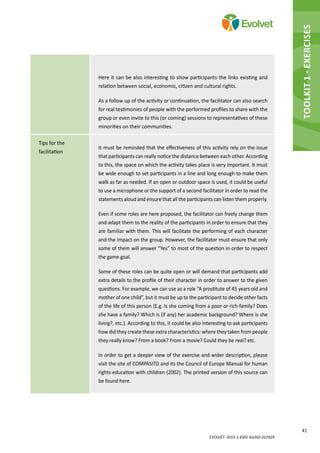
Exercise 1.1:
A mosque in Sleepyville
Pág 88
Israel R. (2012). Global
citizenship. A Path
to Building Identity
and Community in
a Globalized World.
Paperback.
“Not being able to do
everything is no excuse
for not doing everything
you can.” Ashleigh
Brilliant
EVOLVET- 2015-1-ES01-KA202-015929
14
Evolvet
EVOLVET- 2015-1-ES01-KA202-015929
15
Evolvet
volve
Toolkit 1
Understanding
volunteering
EVOLVET- 2015-1-ES01-KA202-015929
16
Evolvet
“If our hopes of building
a better and safer world
are to become more than
wishful thinking, we will
need the engagement
of volunteers more than
ever.” Kofi Annan
After World War II, a large number of initiatives and international organisations that promoted and
developed volunteering appeared. One of them was UNESCO, which established an institution with the aim
of facilitating the cooperation and coordination of voluntary organisations; CCIVS (Coordinating Committee
for International Voluntary Service). The institution currently joins together approx. 140 organisations.
The creation of the European Union also had an impact on the development of the voluntary movement.
In the late 80’s and early 90’s, the European Commission took some action regarding issues such as of non-
formal and informal learning, mobility, solidarity, tolerance, active citizenship and mutual understanding
among young Europeans. One of such activities was the European Voluntary Service, which was established
as a pilot programme in 1996. In 2007, the “Youth in Action” programme included for the implementation of
activities related to volunteering. In January 2014 Erasmus+ (Erasmus Plus) took over this programme which
listed among its priorities the support for the European Voluntary Service. In 2017, this approach went
further with the so called European Solidarity Corps a new initiative to promote volunteering among young
people in their own countries or in other organisations abroad (on the private and public sector).
According to the Eurobarometer survey of 2007, three out of ten Europeans indicated that they are involved
in volunteering. According to some estimates, the total number of volunteers in the EU ranges from 92-
94 million adults (23 per cent of all Europeans over 15 years of age). In the last ten years there has been
an overall increase in the number of active volunteers and voluntary organisations in the EU. Accordingly,
in 2011 the European Commission launched the European Year of Volunteering, to honour the effort of
nearly 100 million Europeans engaging in volunteering (An initiative also aiming at reducing the barriers to
volunteering and improving its quality in Europe.
Due to the importance and universality of volunteerism, it seems to be vital to standardize the definitions
of concepts associated with this topic. According to this, the first toolkit of this manual was attempted to
define the basic concepts related to volunteering, from its definition, through the presentation of different
categories of volunteers and their role in today’s changing
world.
The idea of volunteering in the modern shape has its roots in
each of the current and ancient cultures. It can be found in
assumptions of Catholic doctrine, UBUNTU people philosophy
or Arab countries religious duties. Regardless of the roots and
approach to volunteering or its implementation forms, three
elements should be indicated to ensure that the action taken can be called volunteering: free will, no
remuneration, work and benefit for others.
Such a definition shows the importance of volunteering as a driving force in the development of local
communities. Volunteering supports local democracies, increases social and economic cohesion of actions
taken, strengthens and builds social relations. Thus it is the engine of development of societies and by
means of local actions it also affects the image of the entire modern world.
Introduction
EVOLVET- 2015-1-ES01-KA202-015929
17
Evolvet
This toolkit explores the idea that voluntary work can be taken by practically anyone. A change, whether
local or at global level, can be made by each person: the volunteer. Apart from an attempt to define the term
“volunteer”, this section also isolates and characterizes different categorizations of volunteering: skilled
(skilled online), unskilled, voluntourist, corporate, etc. including other additional types of classifications
based on various factors such as time (full-time - part time, long term - short term, etc.) or age of volunteers
(young -senior). The strengths and benefits of each of these types as well as difficulties and dangers
associated with managing them have been also described.
The chapter highlights the responsibility associated with participation in volunteering. Each volunteer being
involved in a mission or project must be able to look at every single thing from the perspective of others,
taking the importance of cultural and social differences. Volunteers need to take into account that their local
actions can have an impact on the lives of people in other communities or regions of the world and that any
power of change comes a responsibility.
1. Definition of volunteering
1.1. The concept of “volunteer”
The term ‘volunteer’ has been recently introduced in the lexicon of the social sciences and not without
ambiguity and vagueness connected to its original connotation of common sense.
It is agreed almost unanimously that the term ‘voluntary action’ identifies a particular type of social action and
it is often characterized by the gratuity, that is without financial reward some reimbursement for expenses,
stipend-type payments or payments in kind such as provision of meals and transport. Indeed, these kinds of
payments are often regarded as good practice as they make opportunities for volunteer action more accessible
and inclusive. (Treccani, 1996)
The action that qualifies as a form of social altruism or philanthropy (but also, in a broader meaning, social
solidarity) is a type of action that takes “a form of gift generously offered”, although most of the times is
produced and delivered on an organized basis. (Mauss, 1925)
However the gratuity alone does not appear a sufficient criterion to distinguish the voluntary action by other
forms of action (such as leisure) that are not performed in order to obtain in return an economic reward. The
voluntary action goal is in fact geared to produce benefits for the exclusive advantage of individuals clearly
distinguished from those who perform the action and it is configured as a service or distribution of goods to
others, for the common good. It should directly or indirectly benefit people outside the family or household,
even though the volunteer normally benefits as well from the experience. In many cultures, a volunteer is
often described as “someone who works for community wellbeing”.
Thenotionofthecommongoodmaybecontentious.Forexample,whenpeopleparticipateinpeacefulactivism
fororagainstanimalresearchorthebuildingofadam(bothsidesseekwhattheyconsiderbeneficialoutcomes).
These points of view are included in this manual definition and they need to be considered in common good
concept. Activities involving, or inciting, violence that harm society and actions not corresponding to the
values attributed to volunteering are not included in that definition too.
EVOLVET- 2015-1-ES01-KA202-015929
18
Evolvet
“Volunteering” can be therefore defined as every action that is
characterized by the “three criteria of free will, non-pecuniary
motivation, and benefit to others” (Hockenos, 2011), even if
volunteerism can be declined in varied forms in very different
social and cultural settings.
1.2. Who is a volunteer?
A volunteer is a citizen whose life (both public and private) is free and not under social or legal
obligations,inspiredbysolidaritypurposes.Therefore,oncefulfilledtheircivicduties,volunteersmake
themselves selflessly available to the community by promoting a creative response to the emerging needs
with priority attention to the poor, the marginalized and the powerless ones. They commit their energy,
skills, time and any mean available, in sharing initiatives implemented preferably through group actions (E.g.
open events in partnership with public and private institutions and social actors) conducted with adequate
preparation and implemented with continuity of interventions at two different levels: immediate essential
services and restoring social justice and freedom in a medium/long period. (LVIA, 2010)
This question appears simple, but scholarly literature and national legal frameworks reveal a multitude
of definitions. In some areas of the developing world the term “volunteer” is a recent import from the
North and it essentially refers to expressions of international volunteering. However, other forms of mutual
support and self-help could be considered under the definition of volunteering (such as the one adopted by
the United Nations General Assembly in 2001, discussed also on the next sections of this manual) and they
deserve to be studied and recognized as such.
Thedecisiontovolunteermaybeinfluencedbypeerpressure,personalvaluesorculturalorsocialobligations
but the individual must be able to choose whether to act. There is no value judgment here on such forms
of service.
1.3. Volunteering and traditional values
Volunteering is an expression of the individual’s involvement in their community. Participation, trust,
solidarity and reciprocity, grounded in a shared understanding and a sense of common obligations,
are mutually reinforcing values at the heart of governance and good citizenship. Volunteering is not a
nostalgic relic of the past. It is our first line of defence against social atomisation in a globalising world.
Today, maybe more than ever before, caring and sharing are a necessity, not a charitable act.
(United Nation, 2001)
Volunteering is one of the most basic of expressions of human behaviour and arises out of
long- established ancient traditions of sharing and reciprocal exchanges. At its core there are
relationships and their potential to enhance the well-being of individuals and communities.
Exercise 1.1:
A mosque in Sleepyville
EVOLVET- 2015-1-ES01-KA202-015929
19
Evolvet
Volunteering is not only the backbone of civil society organisations and social and political movements,
but also of many health, education, housing and environmental programs and a range of other civil
society, public and private sector programs worldwide. Moreover, it is an integral part of every society
around the world, often expressed through the giving of one’s time. (UNESCO, 2015, Agree to differ)
Volunteering comes from the desire to act on one’s feelings
about justice and fairness in the face of inequality and to foster
social harmony based on a shared interest in the welfare of
one’s community. In most languages, there are words to express
the concept of volunteering. Often inspired by indigenous
traditions, they describe the principal ways by which people
collectively apply their energy, talents, knowledge and other
resources for mutual benefit.
For example, elements of the philosophy of Ubuntu, common
throughout southern Africa, are found in many traditions
around the world. Ubuntu is caring for one another’s well-
being in a spirit of mutual support. It is based on communal
relationships, human values and respect for the natural
environment and its resources. “Each individual’s humanity is ideally expressed through his or her
relationship with others. Ubuntu means that people are people through other people”. (Zandberg, J. 2010).
Inmanycountries,volunteeringisdeeplyrootedintraditionalbeliefsandcommunitypractices.
Hereafter some significant examples of volunteer experiences from different societies are listed:
•	CATHOLIC DOCTRINE - CHARITY
The Catholic Church’s social doctrine proposes the principles and values that can sustain a society worthy of
the human person. Among these principles, solidarity includes all the others in a certain way. It represents
“one of the fundamental principles of the Christian view of social and political organisation”. Personal
behaviour is fully human when it is born from love, manifests love and is ordered by love. This truth also
applies in the social sphere; Christians must be deeply convinced witnesses of this and they must show
with their lives the love, the only force that can lead to personal and social perfection. It allows society to
make progress towards the common good. This love may be called “social charity” or “political charity”
and must embrace the entire human race.
•	ARAB WORLD - TATAWA’A
In the Arab world, the tatawa’a means a volunteer act that is not required by religious obligation. In fact,
volunteering has been often associated with the religious duty to help people in celebrations or in difficult
times. It originates from the word (al-taw’a) which means compliance, smoothness and flexibility.
•	NORTH OF EUROPE - DUGNAD
The ancient concept of dugnad is an expression of the Norwegian society. It is about the thinking that our
communities are stronger and healthier places when we collectively share our skills and begin to work
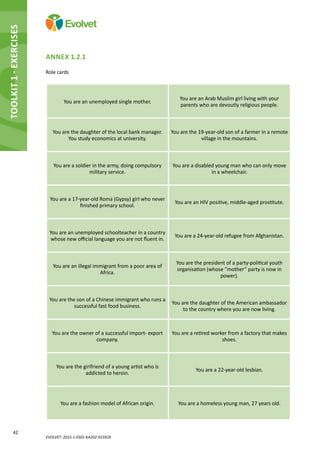
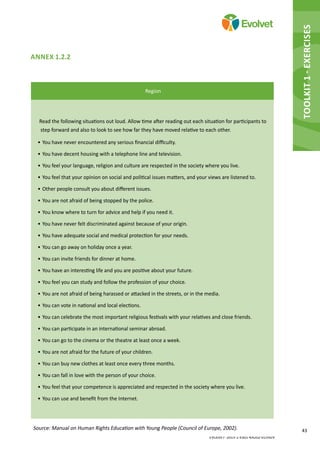
Exercise 1.2:
Take a step forward
UNESCO, 2015, Agree
to differ. See document
online here.
EVOLVET- 2015-1-ES01-KA202-015929
20
Evolvet
2. Global citizenship
2.1. Volunteering as social change of action
Volunteering represents one of the best examples of civic participation and active citizenship
because it gives people a strong sense of belonging to the community together with a feeling of being useful
and responsible for the wellbeing of others. Besides this, it helps to expand our knowledge by developing
new abilities and skills. For instance, most positively-affected aspects are:
•	Volunteering is crucial for active citizenship and democracy, because it puts values such as solidarity and
non discrimination into action, contributing to the harmonious development of different societies.
•	Volunteering is a vital element for social progress and to increase social and economic cohesion through
solidarity.
•	Volunteering conveys the positive message that everyone has a role to play, that everyone can help
building a better society for the current generations and future ones.
•	Volunteering is a great expression of human relationships. People act on behalf of their communities,
because of a desire to contribute and help. (UNV, 2014)
All these aspects became crucial in development projects. Volunteers should promote development process
by working to empower individuals, households and communities through training and by supporting
organized collectives that increase bargaining power. In this context, volunteer action should consider all
the vital aspects of beneficiaries such as vulnerability, social exclusion, and give greater legitimacy and moral
force to their demands according to different development theories - like the livelihood approach or Rights-
based approach to development.
together towards a greater good, with a sense of community to build relationships between neighbours
and community members.
•	SOUTHERN AFRICA - UBUNTU
The concept of Ubuntu defines the individual in relation to each others. Ubuntu comes from a Zulu word
and has generally been described as a world-view of African
societies, a philosophy of life, a metaphor that describes
solidarity group where the core is the survival of communities
with a scarcity of resources. Ubuntu does not mean that
people should not enrich themselves, but lead to think with
this approach: “are you going to do this action to allow the
community around you to be able to improve?”
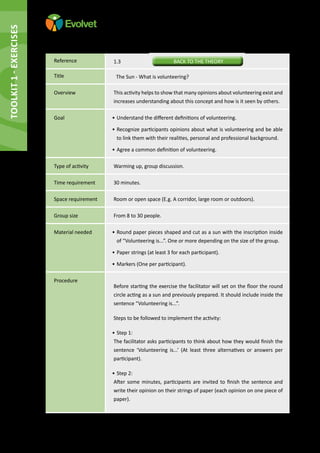
Exercise 1.3:
The sun - What is
volunteering?
EVOLVET- 2015-1-ES01-KA202-015929
21
Evolvet
2.2. Rights and responsibilities of volunteers as global citizens
The concept of global citizenship is one of the ideas that the United Nations is actively promoting in recent
years. In the current context of deep global interdependencies, the world community feels the need of
having global citizens able to give a more significant contribution to the interlinked challenges of the 21st
century and to find solutions based on innovative ways of thinking that transcend national boundaries and
ideas.
Global citizens can be defined as those whose actions support the values and practices of the
“glocal community” they are living, according to political, economic, humanitarian valuesoften
influenced by the common ethics and morals that underlie the world’s great religious and philosophical
traditions (Christianity, Judaism, Islam, Hinduism, Buddhism, and others).
This conception requires the provision of education, training and raising awareness of the new global
citizens, starting at an early age and extending through secondary and postsecondary education, in order to
lead them to fulfil the following responsibilities, well described by Israel R.:
•	Responsibility to understand the perspectives of others on global issues that affect their lives;
•	Responsibility to respect the principle of cultural diversity;
•	Responsibility to understand the many ways in which their lives are inter-connected with people and
countries in different parts of the world;
•	Responsibility to work with one another and advocate for global solutions.
Israel R. (2012). Global
citizenship. A Path
to Building Identity
And Community in
a Globalized World.
Paperback.
Exercise 2.3:
Take a step upwards - How
much depends on you?
Exercise 2.1: My social profile
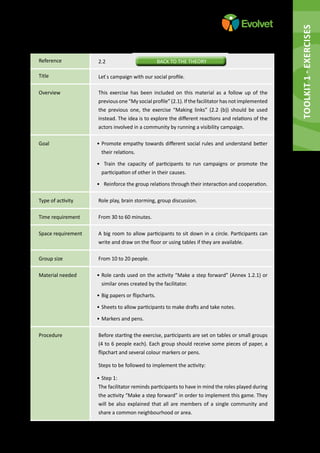
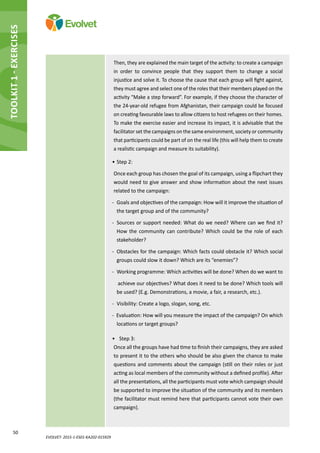
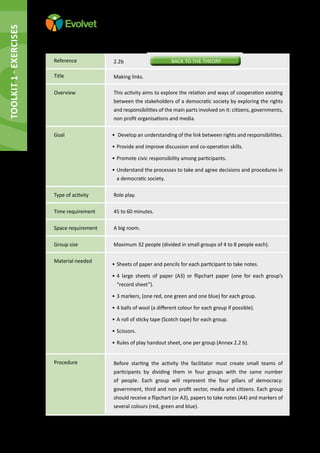
Exercise 2.2: (or 2.2 b): Let ́s campaign with our social profile
Chambers, R., & Conway, G. (1992). Sustainable rural livelihoods: practical concepts for the 21st
century. IDS Discussion Paper 296. Sussex: IDS, University of Sussex.
Tsikata, D. (2004). The Rights-based Approach to Development: Potential for Change or More of
the Same. IDS Bulletin 35
EVOLVET- 2015-1-ES01-KA202-015929
22
Evolvet
2.3. Why it is important to have volunteers at international level
The international community recognizes the role that international volunteering plays in
the global development by promoting intercultural dialogue, reducing poverty, addressing
environmental issues, integrating immigrants, providing job opportunities, contributing
to the personal development, self-esteem and self-confidence, creating ‘social capital’, etc.
Since all these aspects have a positive influence on economic, cultural and social growth, volunteering also
contributes to the Lisbon Agenda and to EU politics.
Volunteering contribution to social inclusion links different generations, different communities and different
cultural and religious backgrounds that can work together for the common good with an approach of mutual
understanding.
In addition to the above-mentioned social aspects, connected to the promotion of values such as the active
participation of citizens and the enhancement of solidarity and democracy, international volunteering also
has economic relevance. In fact, volunteers are economically active (since, in many cases, they provide
services, sell products and create surplus which related costs are covered by their entities, so that they are
not used to create a profit for their members, but and added value for the organisation and a reinvestment
of its sources).
Moreover, non-profit organisations expenditures represent an impressive percentage of Gross Domestic
Product (GDP) meanwhile civil society organisations’ recent grow (thanks to the development of new
social concerns and to the tendency of governments to engage voluntary organisations in the delivery of
services) creates new job opportunities. Non-profit organisations are related to the sector of employment
also because they provide valuable training to volunteers (that later find employment on conventional job
markets as a result of the expertise they have gained and of the social abilities they have developed) and due
to their implication in the ongoing education and retaining of unemployed people (for example, they could
help persons with fewer opportunities to find a place in the labour market).
2.3.1. International volunteering as a mind-opening experience
International volunteering is an organized involvement in development projects by volunteers working in
other countries. It includes both short and long-term experiences through either governmental or non-
governmental organisations. The idea of international volunteering pursuits the goal of rooting ideas,
projects, missions and values to promote progress in different territories. As territory is considered the
centre of the action, volunteers work in a defined one trying to animate it and raise awareness of the major
themes regarding human rights, fighting poverty and practising solidarity.
In the last decade the world has assisted to an increased number of volunteers abroad and to the evolution
of the ways they are engaged as fluid scenarios of post-modern society have a high structural and cultural
differentiation. Nowadays there are wide range of viewpoints and moral trends that are not consistent with
a one-way vision. Post-materialism arises in this multi-faceted and various society, where the individual feels
that the great ideologies collapsed. According to these scenarios, the role of international cooperation and
NGOs has fundamentally changed in developing countries. New players have claimed space and ownership,
EVOLVET- 2015-1-ES01-KA202-015929
23
Evolvet
from local authorities in decentralized cooperation to associations as the bearers of new demands: fair
trade, sustainable tourism, peace and rights.
Moreover, there are some fundamentals characteristics defining the actions and the policies of international
volunteers. For instance, it is very important to think and to be “glocal”: volunteers are the ‘arm’ of the
association in the territories and represent its operators, volunteers and members. This great principle can
be translated into the search for contacts with institutions, media, cultural and other non-profit associations.
It also translates into the ability to engage and aggregate, to take part with a proactive role in the events
and initiatives promoting a change and a more equitable system in the North as well as in the South (which
is consistent with the values and the mission of the association).
Another fundamental aspect is to be aware of being actors of change and promoters of a different culture:
being actors of change means to promote the public know how and the awareness around the crucial issues
of poverty reduction, international cooperation, development and integration. This is possible whether the
actors of change are people who have familiarity with the territory.
For all these reasons, volunteering abroad is a mind-opening experience that allows meeting other cultures,
languages and ways of life. By experiencing everyday life in an area of need, the volunteer learns to
appreciate his home culture, as well as the benefits of the new one. These volunteer opportunities
often offer additional professional benefits, as well.
Engaging in voluntary actions with an international organisation (association, institution, social movement,
etc.) at international level can be translated into different commitments:
•	Personal: an individually lifestyle focusing on adhesion and witnessing the values of the organisation.
•	Political and social: participation as a form of active
citizenship which also includes the application of the
organisation’s mission, which speaks of reporting the causes
of injustice.
•	A commitment to a designed project: operating with
professionalism, appropriateness in a perspective of “rights
and responsibilities” and defining the relationship with
other social actors (both in the South and North) in terms of
establishing a real “partnership”.
3. Sample models of volunteering classification
3.1. Different categories of volunteering
There are probably almost as many definitions of what it means to be a volunteer as there are people
performing the practice. Depending on who is asked, a new definition of what it means to be a volunteer
and how to categorize volunteers can be found. It is important to understand volunteering according to a
diversity of communication, recruitment and management processes on different volunteering practices.
Exercise 2.4:
Flower power.
EVOLVET- 2015-1-ES01-KA202-015929
24
Evolvet
This section introduces a categorization based on volunteering abroad in a development project, but there
are other ways to do it, taking into account other issues related to the volunteering process such as the
location, time, with whom, duration, what type of organisation, project or work, etc. The present categories
are major ones, and organisations can (and must) organize volunteering categories according to their own
policy options, projects, recruitment needs and management style.
3.1.1. Skilled volunteering
These types of volunteering placements were common in the beginning of volunteer travel history.
Volunteering placements were typically from religious organisations offering educational or medical help
in development countries. There are still many international organisations that focus mainly on this type of
volunteering (E.g.: Red Cross or Doctors Without Borders (MSF)). Since those early volunteering days, skilled
volunteering has developed more and more as also younger and older people have discovered volunteering.
Volunteersinskilledplacementstendtohavedeepermotivationforvolunteeringandarealisticunderstanding
of their impact in the community. They have specific education and/or experience for volunteering
tasks. This type of volunteering is quite common in home countries as skilled volunteers are typically full
time workers or retired. As travel related volunteering has
gained popularity also among younger and older volunteers,
some skilled volunteers are also looking for placements abroad,
either short or long term. University students are also looking
for internships (different from volunteering work) or work
experience abroad on their study field and they can also be
placed in skilled volunteer placements.
A NGO abroad offering skilled volunteering placements face several challenges. One of the most commonly
observed is that according to the definition of volunteering, volunteers shall not spend money on their
activities (except voluntourist). This together with the idea of many skilled volunteers who consider their
skills as equal valued to room and board (living expenses), reduce the possibility of receiving from them
any economic support (even if it is open as it can never be imposed to volunteers). Supporting these costs
may be impossible for the host organisation, especially if the main income is volunteer contributions. This
incompatibility may be responsible for reducing skilled volunteering placements availability, although they
could contribute to the community in large scale. Another typical challenge with skilled volunteering is the
preconception or attitude towards their tasks implementation, as they often position themselves as one-
sided knowledge providing and not as bilateral or cooperation issue.
Strengths of skilled volunteering:
•	May empower the host organisation programmes and benefit the community (especially in long term
volunteering).
•	May support and perform needed complex tasks that host organisation have no resources for. Commonly,
NGO have no funds available to use paid skilled work force.
“Not being able to do
everything is no excuse
for not doing everything
you can.” Ashleigh
Brilliant
EVOLVET- 2015-1-ES01-KA202-015929
25
Evolvet
•	May potentiate a real difference and large impact in the development project (especially in long term
volunteering).
Challenges of skilled volunteering:
•	Short term skilled volunteering placement needs to be very well planned to reflect immediate benefits, as
not well thought through participation will not have enduring and fully realized benefits on the community.
•	An attitude of superiority (“my skills are better than yours and you should adapt”) may cause failure on
knowledge sharing and adapting ways of working with local culture and skills.
3.1.2. Skilled online volunteering
Part of the skilled volunteering is performed by people who want to use their skills at home
to support an organisation abroad or in their home country. This online volunteering has become
more popular as people offer help in various tasks in social media, web page development, supporting
visibility campaigns, designing newsletters, promoting activities, fundraising and grant writing, etc. Also
some universities have online volunteering options for their students as practical in the campus training
exercises. The online volunteering presents two major issues to deal with: the first being how to evaluate
the skills of the volunteer; and the second related with how to manage the work and share information
about the targets and goals of the task.
Strengths of online volunteering:
•	Easy access to needed skills as location is not an issue.
•	Minimum cost for both the organisation and the volunteer due to no travelling involvement.
•	Especially beneficial in fundraising and marketing tasks for the development project as volunteers can
perform advocacy and activities where the target groups for these tasks are.
Challenges of online volunteering:
•	If volunteers do not visit the development project, there is a risk that there is no clear understanding of
what would benefit most the organisation and the community.
•	When the host organisation doesn’t have the capacity to manage and guide the online efforts, the
volunteers lose motivation and may give up volunteering.
3.1.3. Unskilled volunteering
These volunteers could be categorized as “motivational volunteers” as they are usually available to “do
whatever is needed”. These persons are, despite of their academic skills and professional competences,
focused more on volunteering efforts rather than tourist and social related aspects of the volunteering
abroad experience. Typically, they are deeply interested to contribute to the community
(contribution that can become deeper depending on the duration of the placement). Everybody
EVOLVET- 2015-1-ES01-KA202-015929
26
Evolvet
can be an “unskilled volunteer” as they don’t necessarily have higher education and experience or they have
chosen not to volunteer on their field of experience/competence, but rather prefer doing something totally
different or new to them. These volunteers need to be trained for their tasks, as they need to make efforts
meaningful (for them and for the NGO) and have a tutor or manager available to direct their work.
Among other examples of this category, there are cases on which unskilled volunteers may choose a
volunteering placement because it is a cheaper way of being abroad or just because they aim to help a
religious organisation. In these cases their primary motivation is saving money or religious values and
secondary motivation is to volunteer. This type of volunteer is, typically, not yet fully in the workforce or
wants to gain experience in a new field. This type of volunteering can also take place in home countries, but
many want to gain experience abroad.
Strengths of unskilled volunteering:
•	In well implemented projects, the participation of unskilled volunteers can make meaningful and beneficial
effects for the community.
•	In well managed programmes, these volunteers are value-added elements as they provide a much needed
continuity, especially in labour intensive environmental projects.
•	Participants will gain skills and get new perspectives and knowledge about the development project.
Challenges of unskilled volunteering:
•	When placed on tasks that the volunteer has no skills on, and if not well trained and managed for them,
there is a possibility that volunteer delivers negative impact. It is important to provide proper information,
guidance, orientation and management throughout their placement.
•	The potential of volunteers is not fully used for the development project, as their skills could be more
beneficial in other tasks. When placing unskilled volunteers or skilled volunteers on unskilled-based
tasks, a strong coordination is needed, regardless of age, gender, religion, etc., to assure fulfilment of
the tasks and benefits to all (volunteers, project and community) as well as manage motivations. The
volunteer coordinator has to have strong management skills to manage the volunteer’s daily impact at
the placement.
3.1.4. Voluntourists
When looking for volunteers to join a development project abroad, some organisations likely run into
volunteer-tourists. Voluntourism is a rapidly growing phenomenon in the tourism industry attracting
more than 1.6 million international volunteer-tourists annually. Voluntourism involves people often from
developed regions such as Europe, USA, UK, Canada, Australia or New Zealand travelling to developing
countries in Latin America, Asia and Africa to work in projects focused as teaching, medical or health support
and construction.
Voluntourism is seen as a way to gain more authentic experience compared to mass tourism since
voluntourists are able to become more emotionally and physically immersed in the local culture and
EVOLVET- 2015-1-ES01-KA202-015929
27
Evolvet
See website online of the
UK based Tourism Concern
here .
community. Voluntourism can be considered as a form of alternative tourism and it is closely related to
cultural, scientific, educational, adventure and agritourism.
Even if voluntourism is developed since a long time, it started to gain popularity in the 1990’s when the
move from different NGOs to commercial companies (so called agencies) started. Tourism Research and
Marketing (2008, 5) estimates the monetary value of the volunteer market in between £832m and £1.3bn
(US$ 1.7bn–2.6bn) a year. (Tourism Research and Marketing, 2008)
Ultimately volunteer-tourism projects have a positive direct
impact on social, economic and/or natural environments of
the destination and they contribute towards the volunteer’s
personal development. However, voluntourism has been widely
criticized for not only doing more harm than good for the local
communities and environment but also for poorly organized
projects and programmes that don’t meet the voluntourists’ expectations (Vase, 2015).
UK based Tourism Concern has been raising awareness against voluntourism especially in orphanages.
According to their research, voluntourism has “raised the need” for local organisations to pretend to have
orphan care centres but the reality is that the children are not orphans, but bought from their poor parents
to the centres.
Voluntourists are people travelling with the aim to volunteer on their vacation so the activity always involves
a journey outside their home geographical area. These people might also have the intention to
perform other tourist activities while away from home, being actual volunteering a secondary
motive for vacation. This kind of volunteers usually tend to stay for a short period of time and the purpose
of participating in the project is often related to how this will affect their lives rather than the people,
communities or causes that they are aiming to help. Voluntourists may have the will to do good, but because
of the nature of their support (for a short period of time) is required more guidance in which activities truly
support the community.
The most seen profile of voluntourists according to their participation on development projects on the last
years is typically young women ages 20-25 years, from wealthy families having a gap-year from university or
wanting a study-related experience. (Vase, 2015, Tourism Research and Marketing 2008, 5). Voluntourists
could be said to be the shallowest type of volunteers, whose main motivations are self-centered and who
tend to join projects through agencies that are attracting people with heavy marketing and big promises.
(Vase, 2015, Callanan& Thomas (2005, in Holmes & Smith 2009, 35-36). This has made that voluntourism has
gained plenty of positive and negative publicity according to its strengths and challenges that it produces.
Strengths of voluntourism:
•	Better understanding on realities and needs of developing countries.
•	Great personal learning experience when well implemented.
•	Ethical tour trips due to local people involvement on tourism in destination country.
•	Accommodation cost is low when volunteering instead of staying in commercial accommodation (Young
EVOLVET- 2015-1-ES01-KA202-015929
28
Evolvet
people may choose voluntourism to cut cost of their holiday).
•	Possibility of cultural exchanges.
•	Assisting communities in destination country when well implemented.
•	Can become a source of economic incomes for the entities involved on it (what can contribute to the
hosting entity local programmes).
•	Motivation to long-term volunteering based on good experience on international volunteerism. Challenges
of voluntourism:
•	Unscrupulous providers and agents in sending volunteers.
•	Fake organisations in destination countries receiving volunteers.
•	Many of the programmes on destination countries are not adequate for short term and/or non skilled,
non-educated or non-prepared volunteers. Schools and orphanages may be exploited.
•	Poorly implemented programmes may wrongly have a negative impact and publicity to others that are
serious on the field and that bring real benefits to development countries.
•	Voluntourists’ motivations can be very self-centered as they are looking for an experience for themselves
rather than thinking about the volunteering as a service for the community.
3.1.5. Corporate volunteering
According to an advisory group of non-profit experts and a Technical Experts Group, assembled by the
International Labour Organisation (UN/ILO), definition of “volunteer work” comprehends unpaid non-
compulsory work “that is, time individuals give without pay to activities performed either through an
organisation or directly for others outside their own household.” (ILO, 2011, p. 13).
The same assembly provides some key features and considerations to better understand this definition,
namely about corporate volunteering programmes (ILO, 2011, p. 11-17). :
“(a) It in volves work. (...)
(b) It is unpaid. (...) However, some forms of monetary or in-kind compensation may still be possible
without violating this feature of the definition: (...)
(vii) Corporate volunteering programmes present a different situation since some businesses
provide incentives for workers to participate in such programmes, such as offering paid time
off. Where such incentives exist, the resulting activity violates the “unpaid” provision of the
recommended definition and should therefore not be counted as volunteer work. Rather,
this should be considered a corporate in-kind contribution. On the other hand, where the
encouragement takes the form of organizing employee group volunteer activities without financial
compensation being paid to the participants, the resulting activity does qualify as volunteer work;
(c) It is non-compulsory. (...)
(d) It embraces both “direct” volunteering (...) and “organisation-based” volunteering (...).
(e) It does not embrace work done without pay for members of the volunteer’s own household. (...)
EVOLVET- 2015-1-ES01-KA202-015929
29
Evolvet
(f) It includes volunteering done without compulsion in all types of institutional settings: (...).
(g) It does not limit the scope of volunteer work to a particular beneficiary. (...)”.
According to McCurley and Lynch (2011, p. 170-173), “corporate volunteering is becoming one of the great
‘social’ institutions, as many corporations and businesses recognize that like other social institutions, they
have an obligation to contribute to the well-being of the community”.
Corporatevolunteeringisexploredbytheseauthorsasabigissueofthecorporateworld’ssocialresponsibility.
As they refer, companies are now actively structuring and supporting volunteering from within, as they
are no longer apart from the “social world”. Companies want to be present in the community by
promoting volunteering through a wide range of self-structured programmes and projects
that include their employees.
These programmes and projects can go “from simply acting as a conduit for information local volunteer
opportunities up to actively participating as a full partner in providing organized teams of employees who
plan and perform volunteer work.” (McCurley and Lynch, 2011, p. 170-173).
To the companies, volunteering programmes may represent a way to develop employee’s personal
competences and establish strong trust relations between employees and company. To the employees,
volunteeringmaybeawayofskillspracticingor“simplybeattemptingtodosomething‘real’asanalternative
to a boring job.” (McCurley and Lynch, 2011, p. 170-173).
According to the same authors, there are three steps to create an ambient recruitment campaign, something
very suitable to obtain a positive environment to corporate volunteering:
1.	 Philosophy of involvement: creating involvement is creating an official philosophy statement that
explains how becoming involved is an important value of the group.
2.	 Early indoctrination: educating the group about the value is the way to get them involved and it is
easiest done early in their membership with the group.
3.	 Support involvement: building a support system is an effective way to bring people to volunteer,
assisting them on their involvement, ensuring that the volunteers enjoy and succeed at their volunteer
assignments.
Samuel, Wolf and Schilling looked at corporate volunteering from non-profit organisations point of view. In
an article published in the Non-profit Management and Leadership magazine (Nr. 24, 2013), these authors
focus “on the perspective of managers of nonprofit organisations on volunteer partnership projects with
for-profit companies.” (Samuel, Wolf and Schilling, 2013).
Their key findings suggest that non-profit organisations “lack strategic behaviour and management tools for
undertaking volunteer partnership projects with companies.”, although “corporate volunteering is widely
perceived as an opportunity and a promising method of raising donations for non-profit organisations.”
(Samuel, Wolf and Schilling, 2013). Organisations’ managers or volunteer managers are not prepared and,
in many cases, face the lack of a structure and resources to partner with companies and hosting corporate
volunteering programmes.
EVOLVET- 2015-1-ES01-KA202-015929
30
Evolvet
Conclusions of the article point into a “key to successful future cooperation” between non-profit and profit
sectors that relies on creating management competences inside non-profit organisations, as well as internal
evaluation and strategy development processes to be able to develop relations based on similar principles
and methodologies.
Strengths of corporate volunteering:
•	Recognition of corporate obligation to contribute to the well-being of the community.
•	Internal support from companies to employees who volunteer.
•	Creating volunteering structured programmes and building support systems.
•	People designated to connect employee volunteers and organisations.
•	Creating competences beyond the professional context.
•	Creating corporate and employees’ engagement and culture of involvement.
Challenges of corporate volunteering:
•	Companies using volunteering for the wrong (publicity) reasons.
•	Management changes often bring volunteering programme changes.
•	Professional engagement often overcomes volunteering efforts.
At the global level, the participation of the private sector in poverty reduction initiatives in developing
countries is an unstoppable and promoted fact from the United Nations through its so called Global
Compact. The globalization of the economy has impacted the company’s overall performance in all its
activities, including its Corporate Social Responsibility (CSR) and, as part of it, its Corporate Volunteering
(VC). (Fundación CODESPA, 2012).
Among the many initiatives that exist to boost economic and social growth in developing countries, one of them
is Corporate Volunteering for Development. Unlike other types of corporate volunteers, VC for Development is
more expensive and the number of employees involved is lower but its overall impact is greater. It is very useful
not only to fight against poverty, but also to promote other dimensions of a company such as its human resources
management or the development of innovative business strategies at a social level. To allow that corporate
volunteering has a real impact on the resolution of social problems, it is necessary to take advantage of the
experience and knowledge in their specific area of the workers involved. The challenge is to see how to direct the
skills of the company and its workers to improve the different global problems.
See website online of the Global Compact here.
Fundación CODESPA, 2012. Voluntariado Corporativo para el Desarrollo. See document online here.
EVOLVET- 2015-1-ES01-KA202-015929
31
Evolvet
3.1.6. Other dimensions of volunteering
Categories here presented are not necessarily exclusive as some volunteering positions can have several
dimensions. When doing the categorization, organisations have to consider their own needs and what
is the most important dimension for the positions. Here are some examples of other categories that are
sometimes used by volunteering entities:
Long term – short term volunteering
Long-term volunteers Short-term volunteers
•	They often have a strong personal and
psychological investment in their volunteer
role and in the sense of personal worth and
identity gained from their participation.
•	They will tend to shape their own job and
determine the duration of their work,
adapting their time and energies to whatever
is necessary to make the cause succeed.
•	They tend to be “generalists”, willing to do
whatever work is required and necessary, but
not necessarily in an exciting or rewarding in
itself for the person.
•	They are motivated by “achievement” and
“affiliation” and often recognition is best
expressed as a greater opportunity for
involvement or advancement in the cause or
the organisation.
•	 They want a well-defined job of limited
duration. They want to know at the beginning
of their volunteering what exactly they are
being asked to do and for how long they are
committing to do it.
•	They can be considered “focused” because
they are only with the organisation long
enough to learn one job or are only willing
to perform one kind of work. Usually the
more limited the expected time commitment
and the better delineated the scope of work,
the easier it will be to recruit the short-term
volunteer.
Source: Steve McCurley and Rick Lynch, 2011
Group – individual volunteering
Group volunteers Individual volunteers
•	They can be created from a hobby club,
family, work colleagues, friends, students etc.
•	They want to volunteer together instead of
committing to volunteer individually.
•	They can be used in events and situations
where a large amount of volunteers is
needed due to the high support demanded in
a defined period and concrete area.
•	They commit to volunteering individually.
•	They are placed in a position that requires
one single person.
•	They can be part of a bigger team but always
be responsible of their own tasks.
•	They require a deeper self-sufficient
commitment of the person.
EVOLVET- 2015-1-ES01-KA202-015929
32
Evolvet
Continuous – episodic volunteering
Continuous volunteers Episodic volunteers
•	Theyaresimilartolongtermvolunteering,but
without the need for a full time commitment.
•	They are interested in smaller and more
manageable commitments.
•	They may choose an episodic volunteer task
to test an organisation before they become
involved in significant tasks or projects.
•	They can be used for example in crisis and
emergency situations where volunteers are
needed on quick notice.
Full time – part time volunteering
Full time volunteers Part time volunteers
•	They assume tasks in a long term or
continuous volunteering context.
•	They can exist (E.g. with the UN) and should
work like a work contract in full time (7-8
hours/day).
•	They can be a subdivision of long term or
continuous volunteering as it is about time
aspectandnotnecessarilytothecommitment
aspect.
•	They can be used in activities or tasks that
require longer term commitment.
EVOLVET- 2015-1-ES01-KA202-015929
33
Evolvet
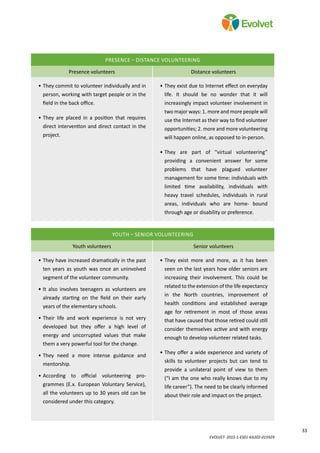
Presence – distance volunteering
Presence volunteers Distance volunteers
•	They commit to volunteer individually and in
person, working with target people or in the
field in the back office.
•	They are placed in a position that requires
direct intervention and direct contact in the
project.
•	They exist due to Internet effect on everyday
life. It should be no wonder that it will
increasingly impact volunteer involvement in
two major ways: 1. more and more people will
use the Internet as their way to find volunteer
opportunities; 2. more and more volunteering
will happen online, as opposed to in-person.
•	They are part of “virtual volunteering”
providing a convenient answer for some
problems that have plagued volunteer
management for some time: individuals with
limited time availability, individuals with
heavy travel schedules, individuals in rural
areas, individuals who are home- bound
through age or disability or preference.
Youth – senior volunteering
Youth volunteers Senior volunteers
•	They have increased dramatically in the past
ten years as youth was once an uninvolved
segment of the volunteer community.
•	It also involves teenagers as volunteers are
already starting on the field on their early
years of the elementary schools.
•	Their life and work experience is not very
developed but they offer a high level of
energy and uncorrupted values that make
them a very powerful tool for the change.
•	They need a more intense guidance and
mentorship.
•	According to official volunteering pro-
grammes (E.x. European Voluntary Service),
all the volunteers up to 30 years old can be
considered under this category.
•	They exist more and more, as it has been
seen on the last years how older seniors are
increasing their involvement. This could be
related to the extension of the life expectancy
in the North countries, improvement of
health conditions and established average
age for retirement in most of those areas
that have caused that those retired could still
consider themselves active and with energy
enough to develop volunteer related tasks.
•	They offer a wide experience and variety of
skills to volunteer projects but can tend to
provide a unilateral point of view to them
(“I am the one who really knows due to my
life career”). The need to be clearly informed
about their role and impact on the project.
EVOLVET- 2015-1-ES01-KA202-015929
34
Evolvet
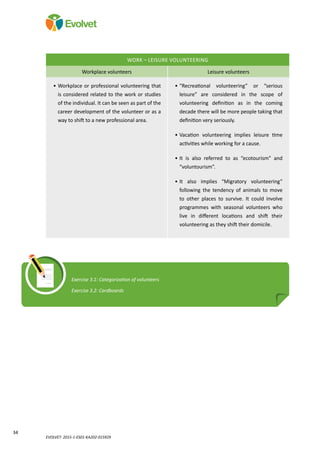
Work – leisure volunteering
Workplace volunteers Leisure volunteers
•	Workplace or professional volunteering that
is considered related to the work or studies
of the individual. It can be seen as part of the
career development of the volunteer or as a
way to shift to a new professional area.
•	“Recreational volunteering” or “serious
leisure” are considered in the scope of
volunteering definition as in the coming
decade there will be more people taking that
definition very seriously.
•	Vacation volunteering implies leisure time
activities while working for a cause.
•	It is also referred to as “ecotourism” and
“voluntourism”.
•	It also implies “Migratory volunteering”
following the tendency of animals to move
to other places to survive. It could involve
programmes with seasonal volunteers who
live in different locations and shift their
volunteering as they shift their domicile.
Exercise 3.1: Categorization of volunteers
Exercise 3.2: Cardboards
EVOLVET- 2015-1-ES01-KA202-015929
35
Evolvet
XERCISE
Toolkit 1
Exercises
EVOLVET- 2015-1-ES01-KA202-015929
36
Evolvet
volve
Toolkit
1
-
Exercises
Reference 1.1
Title A mosque in Sleepyville
Overview This activity is very useful to explore and experience disputes generated
by intercultural conflicts or situations (in this case, the building of a new
mosque in a traditionally Christian neighbourhood through the simulation
of a town council meeting).
Goal •	Experience real conflicts that can arise in meeting the needs of
multicultural and diverse communities.
•	Explore the right to freedom of religion and belief in different contexts.
Also the freedom of opinion, information and from discrimination.
•	Develop and practice skills of debate and analysis.
•	Promote the acquisition of competences such as active listening, empathy
and assertiveness.
Type of activity Role game, simulation.
Time requirement From 45 to 60 minutes.
Space requirement In a room with some chairs.
Group size At least 8 people.
Material needed •	Sheets of paper for name-tags.
•	Flip chart paper or a board for the facilitator to write on it.
•	A clock or device to manage the time used.
•	Small bell for the person on the role of “Mayor”.
•	Rules of debate, problem description and roles cards handout (click here
to access to the online materials).
Procedure Before implementing the activity the facilitator must photocopy the role-
cards included on the handout, the description of the problem and the
rules of debate. It is also important to prepare name-tags for the different
parties and groups that will be represented at the meeting so they can
identify each other during the exercise.
Related to Unit 1
BACK TO THE THEORY
EVOLVET- 2015-1-ES01-KA202-015929
37
Evolvet
Toolkit
1
-
Exercises
Steps to be followed to implement the activity:
•	Step 1:
The facilitator introduces the activity and describes to the group the topic
of the debate (Construction of the mosque) and context on which they are
supposed to be for the simulation. It is important here to list the different
roles that participants will have using a flip chart so that everyone can see
them. The roles can be randomly assigned or the facilitator can choose
who will be who during the activity. If roles are pointed by the person
leading the activity, it can be a good idea to challenge participants by giving
them roles that are very different to their own personality in order to train
their empathy.
•	Step 2:
The facilitator spreads the roles among the participants and makes sure
that before the “Council meeting” everybody can have a “pre-meeting
time” to prepare their strategies, characters and arguments.
•	Step 3:
Once all the teams know how to act, they are given with a couple of
minutes to walk around the space if needed and speak with other
participants to persuade them to soften their position about the mosque
construction.
•	Step 4:
Participants sit in a circle by groups according to their role and the “Mayor”
opens the “Council meeting”. Already in their role, participants will
introduce themselves and the group they represent. After this, the debate
starts under the coordination of the “Mayor” who should perform the role
of moderator.
Debriefing and
follow-up
At the end of the activity and already out of their roles, participants must
share their feedback about the simulation and the comments or behaviors
experienced on it. Depending on the social context participants work in, it
could be interesting to invite institutional representatives in order to build
a dialogue between citizens and politics and to develop a participatory
decision process. This will be useful in order to learn to take in care different
values of the communities.
Tips for the
facilitation
In order to get a deeper view of the exercise and wider description, please
visit the site of the Council of Europe and its Compass: Manual for human
rights education with young people (2002).
EVOLVET- 2015-1-ES01-KA202-015929
38
Evolvet
Reference 1.2
Title Take a step forward
Overview As George Orwell claimed on its book Animal Farm (1945), even if we are
all equal, some are more equal than others. Using a role play this activity
will allow participants to experience what it means to be in the shoes of
someone else in their society and the challenges and obstacles faced by
different social groups.
Goal
•	Promote empathy with others who are different but live on a similar
community or context.
•	Raise awareness about the inequality of opportunities in society.
•	Foster an understanding of possible personal consequences and
prejudices related to varied social minorities, classes or cultural groups.
•	Explore and discuss issues such as social inequality as a source of
discrimination and exclusion or the importance of social empathy and
where its limits are.
Type of activity Role game, group simulation, group discussion.
Time requirement From 45 to 60 minutes.
Space requirement A big and open space that could allow participants to make a line and walk
forward during the questions that will be made to them.
Group size From 10 to 30 people.
Material needed •	Role cards for participants (Annex 1.2.1).
•	List of situations and events (Annex 1.2.2).
•	Tape or CD player and soft relaxing music (optional).
Procedure
Even is this exercise include different annexes, it is recommended that be-
fore doing the activity the facilitator reads the cards for participants and
review the list of situations and events in order to adapt them if needed to
the group that will be involved on the activity. Once this is done, role cards
must be printed and cut (one per participant).
volve
Toolkit
1
-
Exercises
BACK TO THE THEORY
EVOLVET- 2015-1-ES01-KA202-015929
39
Evolvet
Steps to be followed to implement the activity:
•	Step 1:
The facilitator must create a calm atmosphere (E.g. With some soft
background music) and ask the participants for being in silence.
•	Step 2:
Role cards are randomly handed out to participants (one per person). They
must keep the information of the cards to themselves and not to show
them to anyone else. It is important to provide them some minutes to sit
down (preferably on the floor) and to read their roles quietly.
•	Step 3:
The facilitator asks participants to start getting into role and helps them by
reading out some questions (Pausing after each one to give people time
to reflect and build up a picture of themselves and their lives). Samples of
questions to be used here could be:
- What was your childhood like?
- What sort of house did you live in?
- What kind of games did you play?
- What sort of work did your parents do?
- What is your everyday life like now?
- Where do you socialize?
- What do you do in the morning, in the afternoon, in the evening?
- What sort of lifestyle do you have?
- Where do you live?
- How much money do you earn each month?
- What do you do in your leisure time?
- What you do in your holidays?
- What excites you and what are you afraid of?, etc.
•	Step 4:
Reminding the people to remain absolutely silent, participants are set in
a line up beside each other (like on a starting line of race). Once they are
ready, the facilitator starts to read aloud the list of situations or events
(one by one and making a pause after each question to allow people time
to step forward and to look around to take note of their positions relative
to each other.).
Toolkit
1
-
Exercises
EVOLVET- 2015-1-ES01-KA202-015929
40
Evolvet
Every time those participants can answer “yes” to the statement, they
should take a step forward. Otherwise, they should stay where they are
and not move.
•	Step 5:
Attheendoftheexerciseandoncethequestionsarefinished,thefacilitator
must invite everyone to take note of their final positions on the space and
distance with other participants.
Debriefing and
follow-up
In order to obtain an appropriate feedback the facilitator must start the
debriefing by asking participants first what happened during the exercises.
Some sample questions could be:
•	How do you see the distribution of participants in the room? Is it fair?
•	How did you feel when the others were going further than you?
•	How did you feel when seeing that the others were behind you?
•	Did you ask yourself why the others were not moving or you were just
focused on going further?
•	Did you feel that your role had any opportunity to promote socially?
None? A lot? A few?
•	Do you consider that all the basic human rights of all the participants were
respected on the same way?
•	How do you feel performing your role? Good? Bad?
•	Which kind of feelings did you experience? Frustration? Motivation?
•	Have you develop any empathy or shared feeling with your character?
After doing some of these questions, the facilitator can also ask participants
if they are able to guess the roles of each person due to their position on
the room. After several guesses, participants can be invited to introduce
the other their role in the game and encouraged to share their feelings
when walking forward or staying stuck on the same place. The facilitator
can also tell participants to think about real examples or people on their
communities with the same profile as the roles performed and reflect about
how they behave in reality (Do they understand now better their realities?).
They can also share any life stories or anecdotes with the group. It can be
a good moment to explore the concepts of stereotyping and prejudicing.
Finally, the facilitator must ensure that participants understand that the
problems faced by their characters are basically related to a lack of access
to their human rights rather than only be based on their formal rights.
volve
Toolkit
1
-
Exercises
EVOLVET- 2015-1-ES01-KA202-015929
41
Evolvet
Here it can be also interesting to show participants the links existing and
relation between social, economic, citizen and cultural rights.
As a follow up of the activity or continuation, the facilitator can also search
for real testimonies of people with the performed profiles to share with the
group or even invite to this (or coming) sessions to representatives of these
minorities on their communities.
Tips for the
facilitation
It must be reminded that the effectiveness of this activity rely on the issue
that participants can really notice the distance between each other. According
to this, the space on which the activity takes place is very important. It must
be wide enough to set participants in a line and long enough to make them
walk as far as needed. If an open or outdoor space is used, it could be useful
to use a microphone or the support of a second facilitator in order to read the
statements aloud and ensure that all the participants can listen them properly.
Even if some roles are here proposed, the facilitator can freely change them
and adapt them to the reality of the participants in order to ensure that they
are familiar with them. This will facilitate the performing of each character
and the impact on the group. However, the facilitator must ensure that only
some of them will answer “Yes” to most of the question in order to respect
the game goal.
Some of these roles can be quite open or will demand that participants add
extra details to the profile of their character in order to answer to the given
questions. For example, we can use as a role “A prostitute of 45 years old and
mother of one child”, but it must be up to the participant to decide other facts
of the life of this person (E.g. Is she coming from a poor or rich family? Does
she have a family? Which is (if any) her academic background? Where is she
living?, etc.). According to this, it could be also interesting to ask participants
how did they create these extra characteristics: where they taken from people
they really know? From a book? From a movie? Could they be real? etc.
In order to get a deeper view of the exercise and wider description, please
visit the site of COMPASITO and its the Council of Europe Manual for human
rights education with children (2002). The printed version of this source can
be found here.
Toolkit
1
-
Exercises
EVOLVET- 2015-1-ES01-KA202-015929
42
Evolvet
Annex 1.2.1
Role cards
You are an unemployed single mother.
You are an Arab Muslim girl living with your
parents who are devoutly religious people.
You are the daughter of the local bank manager.
You study economics at university.
You are the 19-year-old son of a farmer in a remote
village in the mountains.
You are a soldier in the army, doing compulsory
military service.
You are a disabled young man who can only move
in a wheelchair.
You are a 17-year-old Roma (Gypsy) girl who never
finished primary school.
You are an HIV positive, middle-aged prostitute.
You are an unemployed schoolteacher in a country
whose new official language you are not fluent in.
You are a 24-year-old refugee from Afghanistan.
You are an illegal immigrant from a poor area of
Africa.
You are the president of a party-political youth
organisation (whose “mother” party is now in
power).
You are the son of a Chinese immigrant who runs a
successful fast food business.
You are the daughter of the American ambassador
to the country where you are now living.
You are the owner of a successful import- export
company.
You are a retired worker from a factory that makes
shoes.
You are the girlfriend of a young artist who is
addicted to heroin.
You are a 22-year-old lesbian.
You are a fashion model of African origin. You are a homeless young man, 27 years old.
volve
Toolkit
1
-
Exercises
EVOLVET- 2015-1-ES01-KA202-015929
43
Evolvet
Annex 1.2.2
Region
Read the following situations out loud. Allow time after reading out each situation for participants to
step forward and also to look to see how far they have moved relative to each other.
•	You have never encountered any serious financial difficulty.
•	You have decent housing with a telephone line and television.
•	You feel your language, religion and culture are respected in the society where you live.
•	You feel that your opinion on social and political issues matters, and your views are listened to.
•	Other people consult you about different issues.
•	You are not afraid of being stopped by the police.
•	You know where to turn for advice and help if you need it.
•	You have never felt discriminated against because of your origin.
•	You have adequate social and medical protection for your needs.
•	You can go away on holiday once a year.
•	You can invite friends for dinner at home.
•	You have an interesting life and you are positive about your future.
•	You feel you can study and follow the profession of your choice.
•	You are not afraid of being harassed or attacked in the streets, or in the media.
•	You can vote in national and local elections.
•	You can celebrate the most important religious festivals with your relatives and close friends.
•	You can participate in an international seminar abroad.
•	You can go to the cinema or the theatre at least once a week.
•	You are not afraid for the future of your children.
•	You can buy new clothes at least once every three months.
•	You can fall in love with the person of your choice.
•	You feel that your competence is appreciated and respected in the society where you live.
•	You can use and benefit from the Internet.
Source: Manual on Human Rights Education with Young People (Council of Europe, 2002).
Toolkit
1
-
Exercises
EVOLVET- 2015-1-ES01-KA202-015929
44
Evolvet
Reference 1.3
Title The Sun - What is volunteering?
Overview This activity helps to show that many opinions about volunteering exist and
increases understanding about this concept and how is it seen by others.
Goal •	Understand the different definitions of volunteering.
•	Recognize participants opinions about what is volunteering and be able
to link them with their realities, personal and professional background.
•	Agree a common definition of volunteering.
Type of activity Warming up, group discussion.
Time requirement 30 minutes.
Space requirement Room or open space (E.g. A corridor, large room or outdoors).
Group size From 8 to 30 people.
Material needed •	Round paper pieces shaped and cut as a sun with the inscription inside
of “Volunteering is...”. One or more depending on the size of the group.
•	Paper strings (at least 3 for each participant).
•	Markers (One per participant).
Procedure
Before starting the exercise the facilitator will set on the floor the round
circle acting as a sun and previously prepared. It should include inside the
sentence “Volunteering is...”.
Steps to be followed to implement the activity:
•	Step 1:
The facilitator asks participants to think about how they would finish the
sentence ‘Volunteering is...’ (At least three alternatives or answers per
participant).
•	Step 2:
After some minutes, participants are invited to finish the sentence and
write their opinion on their strings of paper (each opinion on one piece of
paper).
volve
Toolkit
1
-
Exercises
BACK TO THE THEORY
EVOLVET- 2015-1-ES01-KA202-015929
45
Evolvet
•	Step 3:
Once they are ready, the facilitator tells participants to complete the
sentence by attaching their pieces around the Sun. Each new opinion will
became a new ray
from the Sun. According to this, opinions that are repeated or similar
should be joined to previous ones and form a longer ray (the more people
add the same opinion, the longer the ray is).
Debriefing and
follow-up
The facilitator must start by asking participants to read out loud all. Discuss
how many opinions appeared, how many were similar or repeated. Once all
of them are commented, the group should try to agree a shared definition
for volunteering.
For this part of the activity the facilitator can also search for official
definitions of volunteering in order to compare them at the end with the
one built by participants
(E.g. definitions from United Nations, The European Commission, a
transnational NGO, etc.).
Volunteering
is... Toolkit
1
-
Exercises
EVOLVET- 2015-1-ES01-KA202-015929
46
Evolvet
Reference 2.1
Title My social profile
Overview This exercise has been included on this material as a follow up of the
one called “Make a step forward” (1.2). However it can be also used
independently by asking participants to use their own profiles or
personalities and allow them to introduce each other to the rest of the
group. The original aim of the game is to get more into the character
assigned previously, empathize using the social profile metaphor and
interact with the others to raise the awareness to live in a complex society
with different life styles, feelings and experiences.
Goal •	Go deeper into the roles and profiles used in previous activities.
•	Promote empathy towards different social minorities and groups.
•	Explore the reactions of others towards the assumed role, their prejudices
and stereotyping.
Type of activity Name activity, warming up, group dynamic, role playing.
Time requirement From 15 to 30 minutes.
Space requirement A big room to allow participants to walk around freely.
Group size From 6 to 20 people.
Material needed •	Role cards used on the activity “Make a step forward” (Annex 1.2.1) or
similar ones created by the facilitator (participants can also introduce
themselves if the aim of the exercise is changed).
•	Paper (at least one A4 per participant).
•	Markers (at least one participant).
Procedure Steps to be followed to implement the activity:
•	Step 1:
The facilitator reminds participants that they are going to keep the roles
played during the activity “Make a step forward” in order to implement the
activity. All of them receive a piece of paper (A4) and a marker.
Related to Unit 2
volve
Toolkit
1
-
Exercises
BACK TO THE THEORY
EVOLVET- 2015-1-ES01-KA202-015929
47
Evolvet
•	Step 2:
Every participant, thinking in the role assigned, describes it using the
metaphor of a social profile and draw on the white paper the following
boxes:
1. A box for the “Profile picture”
2. A box for the “Cover picture”
3. The sentence “I am thinking in...”
4. 3 pictures (drawings) representing the most important moments of the
person’s life.
•	Step3:
After each participant has designed a profile of the role given, the group
began to walk freely in the room and to introduce their profiles to other
participants by describing their content and pictures. Everyone must
comment on photos and sentences of others using the markers and writing
“I like” or using emoticons of sadness, happiness next to the photos and
sentences.
Debriefing and
follow-up As a warming up or name activity the exercise does not demand a deep
debriefing. However it could be useful to allow the facilitator to make more
questionsandgodeeperintotheprofilesoftherolesdescribed.Participants
can be also asked about their impressions when the others were introduced
or the reactions of the people who listened their presentations.
Toolkit
1
-
Exercises
EVOLVET- 2015-1-ES01-KA202-015929
48
Evolvet
Annex 2.1
Cover picture
Profile picture I am thinking in...
Picture 1 Picture 2 Picture 3
volve
Toolkit
1
-
Exercises
EVOLVET- 2015-1-ES01-KA202-015929
49
Evolvet
Reference 2.2
Title Let ́s campaign with our social profile.
Overview This exercise has been included on this material as a follow up of the
previous one “My social profile” (2.1). If the facilitator has not implemented
the previous one, the exercise “Making links” (2.2 (b)) should be used
instead. The idea is to explore the different reactions and relations of the
actors involved in a community by running a visibility campaign.
Goal •	Promote empathy towards different social rules and understand better
their relations.
•	 Train the capacity of participants to run campaigns or promote the
participation of other in their causes.
•	 Reinforce the group relations through their interaction and cooperation.
Type of activity Role play, brain storming, group discussion.
Time requirement From 30 to 60 minutes.
Space requirement A big room to allow participants to sit down in a circle. Participants can
write and draw on the floor or using tables if they are available.
Group size From 10 to 20 people.
Material needed •	Role cards used on the activity “Make a step forward” (Annex 1.2.1) or
similar ones created by the facilitator.
•	Big papers or flipcharts.
•	Sheets to allow participants to make drafts and take notes.
•	Markers and pens.
Procedure Before starting the exercise, participants are set on tables or small groups
(4 to 6 people each). Each group should receive some pieces of paper, a
flipchart and several colour markers or pens.
Steps to be followed to implement the activity:
•	Step 1:
The facilitator reminds participants to have in mind the roles played during
the activity “Make a step forward” in order to implement this game. They
will be also explained that all are members of a single community and
share a common neighbourhood or area.
Toolkit
1
-
Exercises
BACK TO THE THEORY
EVOLVET- 2015-1-ES01-KA202-015929
50
Evolvet
Then, they are explained the main target of the activity: to create a campaign
in order to convince people that they support them to change a social
injustice and solve it. To choose the cause that each group will fight against,
they must agree and select one of the roles that their members played on the
activity “Make a step forward”. For example, if they choose the character of
the 24-year-old refugee from Afghanistan, their campaign could be focused
on creating favourable laws to allow citizens to host refugees on their homes.
To make the exercise easier and increase its impact, it is advisable that the
facilitator set the campaigns on the same environment, society or community
that participants could be part of on the real life (this will help them to create
a realistic campaign and measure its suitability).
•	Step 2:
Once each group has chosen the goal of its campaign, using a flipchart they
would need to give answer and show information about the next issues
related to the campaign:
-	 Goals and objectives of the campaign: How will it improve the situation of
the target group and of the community?
-	 Sources or support needed: What do we need? Where can we find it?
How the community can contribute? Which could be the role of each
stakeholder?
-	 Obstacles for the campaign: Which facts could obstacle it? Which social
groups could slow it down? Which are its “enemies”?
-	 Working programme: Which activities will be done? When do we want to
achieve our objectives? What does it need to be done? Which tools will
be used? (E.g. Demonstrations, a movie, a fair, a research, etc.).
-	 Visibility: Create a logo, slogan, song, etc.
- Evaluation: How will you measure the impact of the campaign? On which
locations or target groups?
•	 Step 3:
Once all the groups have had time to finish their campaigns, they are asked
to present it to the others who should be also given the chance to make
questions and comments about the campaign (still on their roles or just
acting as local members of the community without a defined profile). After
all the presentations, all the participants must vote which campaign should
be supported to improve the situation of the community and its members
(the facilitator must remind here that participants cannot vote their own
campaign).
volve
Toolkit
1
-
Exercises
EVOLVET- 2015-1-ES01-KA202-015929
51
Evolvet
Debriefing and
follow-up
The debriefing of this activity must be run by the facilitator in cooperation
with the whole group with two main aims. On the one side, exploring
the quality of the campaigns, their message, structure, frankness, good
practices seen to create them, etc. On the other side, to clarify why the
“winner campaign” was chosen and why the other don’t. On this second
point it is important to ask participants about the criteria that they set to
vote: were they thinking about the whole community interest? About the
interests of their characters? About the target group?, etc.
Tips for the
facilitation
An alternative exercise on the same line as this one can be also found
on the students handbook Steps to Campaigning Success (British Library,
Museums Libraries Archives, consulted online in 2016) accessible here.
Toolkit
1
-
Exercises
EVOLVET- 2015-1-ES01-KA202-015929
52
Evolvet
Reference 2.2b
Title Making links.
Overview This activity aims to explore the relation and ways of cooperation existing
between the stakeholders of a democratic society by exploring the rights
and responsibilities of the main parts involved on it: citizens, governments,
non profit organisations and media.
Goal •	 Develop an understanding of the link between rights and responsibilities.
•	Provide and improve discussion and co-operation skills.
•	Promote civic responsibility among participants.
•	Understand the processes to take and agree decisions and procedures in
a democratic society.
Type of activity Role play.
Time requirement 45 to 60 minutes.
Space requirement A big room.
Group size Maximum 32 people (divided in small groups of 4 to 8 people each).
Material needed
•	Sheets of paper and pencils for each participant to take notes.
•	4 large sheets of paper (A3) or flipchart paper (one for each group’s
“record sheet”).
•	3 markers, (one red, one green and one blue) for each group.
•	4 balls of wool (a different colour for each group if possible).
•	A roll of sticky tape (Scotch tape) for each group.
•	Scissors.
•	Rules of play handout sheet, one per group (Annex 2.2 b).
Procedure Before starting the activity the facilitator must create small teams of
participants by dividing them in four groups with the same number
of people. Each group will represent the four pillars of democracy:
government, third and non profit sector, media and citizens. Each group
should receive a flipchart (or A3), papers to take notes (A4) and markers of
several colours (red, green and blue).
volve
Toolkit
1
-
Exercises
BACK TO THE THEORY
EVOLVET- 2015-1-ES01-KA202-015929
53
Evolvet
Steps to be followed to implement the activity:
•	Step 1:
The facilitator introduces to participants the main aim of the activity: to
design a map of the relations between the four actors (groups) that should
exist on a perfect democratic society. Then, participants within their groups
are asked to make a brain storming and discussion about the role and func-
tions that their actor assigned should have on this ideal system. After that,
they should choose and list by order of importance four principle functions
of the mentioned actor.
•	Step 2:
After some minutes to agree their functions, each group must create their
“record sheets” using the flipcharts given to them. With a red marker, each
group will write down the most important four functions agreed on the
previous stage of the activity and the name of the stakeholder or actor
they represent. Once this is done, each group must share its “record sheet”
with the others and collect their feedback about it. Here groups will have
the opportunity of changing or modifying their functions according to the
other actors proposals and if they consider it necessary.
•	Step 3:
After the step 2, participants go back into their groups and are invited to
think about what they would require from the other actors on the ideal
democratic society created to promote its development. They must use
the green markers in order to write on their “record sheet” the two most
important demands from each of the other teams. These demands will be
presented afterwards to all the participants by each group, but very briefly
as discussions or negotiations about them should take place during the
step 5 and not now. It is important to remind participants that they would
need that their demands are accepted by others, so they should be realistic
and acceptable by the other groups.
•	Step 4:
The facilitator spread among participants the rules to play (Annex 2.2 b)
and read them aloud ensuring that they have been understood by all and
solving potential doubts. After that, each group must set its “record sheet”
on the floor of the room leaving a separation of around one meter be-
tween each of them and making a square (see handout). The groups must
also stand on the corner of their record sheets. At this moment, each group
receive six threads of wool, a tape and a blue marker.
Toolkit
1
-
Exercises
EVOLVET- 2015-1-ES01-KA202-015929
54
Evolvet
•	Step 5:
Following the rules previously given, groups will start to implement the
negotiation rounds among them as society actors. It is important that the
facilitator reminds here that the general target of the exercise is to create a
map or relations so the cooperation between groups is essential. To show
that demands are accepted, threads of wool must be fixed between the
“record sheets” of the groups involved by taping them to the floor.
•	Step 6:
Once all the rounds have finished, the facilitator must give participants
some minutes to go back to their starting positions, take a look to the
map created and reflect about its meaning and the agreements achieved
between the different actors existing on the game.
Debriefing and
follow-up To debrief and after participants have had some time to study the final
map obtained, the facilitator must drive a group discussion using questions
about its implementation such as:
•	Was it hard to think of the functions that the government, non profit
organisations, media and citizens perform in a democracy?
•	Were there any disagreements within the groups about which claims
should be accepted or rejected?
•	Which of the claims made on other groups did they not accept as
responsibilities? Why was this? Do you think that such cases would cause
any problems in reality?
•	Were there responsibilities that each group accepted but which they had
not recognised before? How do they feel about this now?
•	 Did the activity show people anything new about democratic society that
they did not know before? Were there any surprises?
•	Which rights are at stake in this activity?
•	Article 29 of the UDHR states: ‘Everyone has duties to the community in
which alone the free and full development of his personality is possible’.
•	Which are the most important duties you have at present in your life?
•	What are the roles of the different actors in ensuring that nobody’s rights
are violated?
•	What are the different actors’ roles in ensuring that everyone has access
to human rights education?
volve
Toolkit
1
-
Exercises
EVOLVET- 2015-1-ES01-KA202-015929
55
Evolvet
Toolkit
1
-
Exercises
As a follow up of this activity, the facilitator can invite participants to
mention other actors that should be involved on the ideal society created
and discuss which role, functions, demands and cooperation could be set
with the already existing groups on that map.
Tips for the
facilitation
In order to make easier the visual interpretation of the map obtained, it is
recommended that each group or actor receives a different colour of wool. That
willmakeeasiertoidentifyagreementsbetweenpartsattheendoftheexercise.
Several guidelines could be also provided by the facilitator to participants
during the implementation of the activity in case they could be stuck on
their role or negotiations with other actors:
•	Governments draft legislation, decide on general policy, and ensure that
the country meets its budget.
•	NGOs lobby for minority interests, take up issues which the government
(or opposition) fails to address, and campaign for changes in legislation.
•	The media reports on government policy, investigates issues, and provides
analysis and commentary.
•	The “functions” of citizens include everything that is important in a
democratic society: ideas may range from standing for parliament,
engaging in human rights activism, setting up organizations to protect
particular groups, questioning and becoming involved in political life, and
so on.
At step 5, the negotiations should not be presented as a “competition”, nor
should they occupy too much time. The facilitator must emphasize to the
groups that they should see themselves as co-operating with each other:
the purpose is to establish a society in which all actors work together for
everyone’s satisfaction. Therefore, the transactions should be relatively
quick. According to this, the facilitator should tell groups to accept claims
if they seem to be reasonable, and otherwise to reject them, with any
controversial ones to be discussed at a later stage.
EVOLVET- 2015-1-ES01-KA202-015929
56
Evolvet
Annex 2.2 b
Handouts
Source: Council of Europe. Compass – Manual for human rights education with young people (2002).
volve
Toolkit
1
-
Exercises
EVOLVET- 2015-1-ES01-KA202-015929
57
Evolvet
Toolkit
1
-
Exercises
Reference 2.3
Title Take a step upwards - How much depends on you?
Overview The main aim of the activity is to make participants reflect on and discuss
about different ways of increasing their own participation in the local
community and the facts that could affect or empower it.
Goal •	 To consider different degrees of social involvement and participation.
•	To reflect on factors which obstacle or facilitate citizens participation.
•	To empower people to participate more actively in local life.
Type of activity Role play, group discussion.
Time requirement From 45 to 60 minutes.
Space requirement Any open space or room.
Group size Any (to be done in small groups from 4 to 6 people each).
Material needed •	Papers and markers for participants.
•	Colour pens or markers for the facilitator (At least three).
•	Any of the models current existing of the “Ladder of Participation”
(Annex 2.3.1, Annex 2.3.2 or Annex 2.3.3 depending on the participants
characteristics, learning expectations and age).
•	One chair per participant and one table per group to be created.
Procedure Steps to be followed to implement the activity:
•	Step 1:
To begin with and as an introduction, the facilitator starts and opens
a discussion with the participants asking them if they consider that the
participation in their communities or societies if the appropriate one:
Are there any social groups not participating? Which are the symptoms
of a low participation in society? What are the obstacles or barriers for
this participation?, etc. Answers provided by participants must be written
down by the facilitator in a flipchart that will be set on the activity room in
a visible way for all (so participants can take a look to it during the rest of
the activity).
•	Step 2:
The facilitator introduces to the group the Ladder of Participation of
BACK TO THE THEORY
EVOLVET- 2015-1-ES01-KA202-015929
58
Evolvet
Arnstein (1969) and explains them the levels or steps that compose it by
providing them a photocopy of the exercise handout or showing it with a
projector. It is important that the facilitator studies properly this model
before the activity in order to solve potential questions that could be made
by participants about it. After this, the facilitator must give several minutes
to participants in order to reflect and write down aspects or their real life
that could be linked with any of the steps of the ladder (Related to their
work, relatives, organisations, neighbors, studies, etc.).
•	Step 3:
Participants are put together in small teams of 4 to 6 people each. Sitting
around a table or in circle of chairs, participants must share with the rest
of the members of their team the list of aspects created during the Step 2.
Once this is done, each team will need to create two lists:
- Obstacles to climb the ladder and not allowing going up.
- Enablers that helps to climb the ladder and going up.
•	Step 4:
Once all the teams have finished, all the participants sitting in a big circle
will share their lists and teams work done. On the meantime, the facilitator
will use a flipchart to write down their outcomes and creating two big lists
representing the conclusions of all the teams of participants.
•	Step 5:
When all the teams have finished, the facilitator must go through the two
lists of items created and ask participants which of the mentioned factors
depend on themselves as citizens (that will be marked in color with a pen
(E.g. blue)) and which are based on external factors out of their control
(that will be marked in another color with another pen (E.g. red)).
Debriefing and
follow-up
For the debriefing of the activity, it is important that the facilitator closes the
exercise by comparing with participants the lists obtained on the Step 5 with the
feedback obtained from them during the Step 1. Several questions that could be
used to guide this discussion could be:
•	Did the activity help you to reflect on or clarify your own contributions
during a participative process?
•	Did it help with any other issues?
•	Why does it matter whether citizens participate actively or not?
•	Would people in the group like to be able to participate at a higher level
than they do at the moment?
•	What are the reasons for doing so, and what are the reasons against?
volve
Toolkit
1
-
Exercises
EVOLVET- 2015-1-ES01-KA202-015929
59
Evolvet
Toolkit
1
-
Exercises
•	How do people feel when they are able to participate in a genuine sense?
in other words, when their participation is not just tokenistic?
•	Do they regard low participation as a result mostly of internal
(psychological) factors or mostly as a result of external factors?
•	How many people feel they could participate more than they do at
present, and how many feel that they will do so?
As a follow up of the exercise, participants can be asked to draw their own
ladders and creating an action plan on their organisations adapted to the
participation of their staff or potential volunteers.
Tips for the
facilitation
Several tips or procedures can be used at the different stages of this exercise
by the facilitator:
-	 On the Step 1, the facilitator can invite participants to make short role
plays in order to show in a visual way different ways of participation on
their communities (one per step of the ladder).
-	 On the Step 2, the facilitator must use any of the annexes proposed here
(Annex 2.3.1, Annex 2.3.2 and Annex 2.3.3) or create a new ladder of
participation according to the characteristics of the learners group (and
in order to facilitate that they understand it better). It is important to
remind them that there is not a direct relation between the levels of the
steps and the participation success (the highest does not have to be the
best). A deeper explanation of the Arnstein, Sherry R. (1969) model can
be found online here (A Ladder Of Citizen Participation. Journal of the
American Planning Association, JAIP, Vol. 35, No. 4, pp. 216-224).
-	 On the Step 3, the facilitator must remind participants that there can be
a lot of different type of obstacles (E.g. physical, legal, environmental,
cultural, etc.). To explore these obstacles and help participants to reflect
about them, the facilitator can make direct questions to them: Are this
real obstacles? Have you tried to face them? Have you asked for help or
support to overcome them? Are there any consequences if we do not pay
attention to them? From whom?, etc.
-	 On the Steps 4 and 5, the facilitator could take advantage of the exercise
and evaluate the participation of learners not only on this activity but
in all the training sessions. It could be a good moment to analyze their
motivation and detect potential improvements that could promote their
active participation on future activities.
EVOLVET- 2015-1-ES01-KA202-015929
60
Evolvet
Annex 2.3.1
Source: Arnstein, Sherry R. A Ladder of Citizen Participation. JAIP, Vol. 35, No. 4, pp. 216-224 (1969).
volve
Toolkit
1
-
Exercises
EVOLVET- 2015-1-ES01-KA202-015929
61
Evolvet
Toolkit
1
-
Exercises
Annex 2.3.2
Source: Council of Europe. Compass – Manual for human rights education with young people (2002).
EVOLVET- 2015-1-ES01-KA202-015929
62
Evolvet
Annex 2.3.3
Source: Council of Europe. Companion - A campaign guide about education and learning for change in
Diversity, Human Rights and Participation (2007)
volve
Toolkit
1
-
Exercises
EVOLVET- 2015-1-ES01-KA202-015929
63
Evolvet
Toolkit
1
-
Exercises
Reference 2.4
Title Flower power
Overview The main aim of this activity is to show in a visual way what human rights
represent and how they are seen by all the participants involved on the
exercise.
Goal •	Promote understanding about the connection between human needs,
personal well-being and human rights.
•	Improve the skills to reflect and analyse of participants.
•	Foster solidarity and respect for diversity.
Type of activity Association exercise, handcraft, group discussion.
Time requirement From 45 to 60 minutes.
Space requirement A big room.
Group size Any (small groups of 3 or 4 people each).
Material needed •	A plain wall or window with enough space to hang all the drawings.
•	Pencils for participant, erasers and coloured markers to share (3 or 4 per
participant).
•	Paper (A4) for participants (at least one per each).
•	Tape to hang the drawings on the wall.
•	Flipchart and markers.
Procedure Steps to be followed to implement the activity:
•	Step 1:
The facilitator introduces the activity with a short speech about which
basic needs do people have as humans and the importance of covering
them. Even if the categories could be listed by the facilitator, it is important
to allow participants to give examples or concepts under them. Issues that
can be listed here could be:
- Physical needs: related to food, sleeping, breathing, water supplies, being
warm, etc.
- Safety needs: medical support, economic security, physical protections, etc.
BACK TO THE THEORY
EVOLVET- 2015-1-ES01-KA202-015929
64
Evolvet
Procedure
- Belonging and being love: having a family, relatives, friends, personal
space, etc.
- Esteem and values: to be recognized by others, independency,
entrepreneurship, beliefs, etc.
- Other that the facilitator could consider important for the concrete
profile of learners in the session or their learning expectations.
•	Step 2:
After the group reflection and introduction, the facilitator asks participants
to create in a piece of paper (A4) a flower with eight petals. Each petal will
represent their needs as human beings:
- Basic needs.
- Personal security.
- Economic security.
- Health.
- Friendship.
- Family.
- Esteem.
- Personal fulfilment.
It must be explained to participants that when drawing the petals,
their size must have a direct relation between their meaning and how
important they are for them. According to this, each petal will be bigger
or smaller depending on the consideration of each participant or person.
It is important to remind them that there are as many answers or flowers
as people in the world, and that there is not a concrete way of making the
flowers and decide the size of their petals.
•	Step 3:
When the flowers are ready, the facilitator asks participants to write on
each petal concepts, facts or issues that they consider that are related or
important for them under each category (E.g. under economic security
participants can add their salaries, bank support, public funding, family
resources, etc.).
•	Step 4:
Once all the flowers are finished, the facilitator must highlight how the
flowers represent each person and ask participants to think about other
volve
Toolkit
1
-
Exercises
EVOLVET- 2015-1-ES01-KA202-015929
65
Evolvet
Toolkit
1
-
Exercises
aspects or issues that they think they could complement the flower and
make them “blossom” as human beings. These conditions or facts must be
drawn by participants as leaves of their flowers.
•	Step 5:
When the final flowers with leaves are ready, the facilitator with the
support of participants collects all the papers and put them in a wall as a
mural. Once this is done, participants must be provided with some minutes
to see the others work and contemplate it. The flowers can be anonym or
participants can put their name of them (this should be up to them).
•	Step 6:
Participants are divided in small groups (3 to 5 people each) and asked to
discuss as a team several questions provided by the facilitator:
- Are there any links between human rights and the flowers and the
leaves? If so, what are the links?
- Are human rights important? Why?
- What do the words “human rights” mean to you?
After some minutes, each group is invited to share with the rest of the
group its conclusions and answers given to the previous questions.
Debriefing and
follow-up
The debriefing of this activity must be focused in both, exploring the
difficulties or process faced by participants in order to create their flower,
and linking it with human rights and their importance. According to this, an
open discussion must be established and guided by the facilitator through
different questions. Some samples could be:
•	Can you describe the whole process that we went through to create the
flowers?
•	Which were the bigger petals for you? And the smaller?
•	Did you have any problems to decide the size of the petals?
•	Would you add more petals or needs to your flower as a human being?
•	Are there any general similarities between all the flowers? Which are the
main differences between them that you can notice?
•	What did you write on each petal? And on the leaves?
•	Has the exercise helped you to get to know better yourself and your identity?
•	What does it happen if the flower or any of its petals is broken?
•	Which is the relation between the flower, its petals and the human rights?
EVOLVET- 2015-1-ES01-KA202-015929
66
Evolvet
•	Which human rights are the most basic and important ones? Why?
•	Are any of these rights not covered or available in your community or
place where you work or live?
•	Whatcanwedotopromotethesehumanrightsandmakethemaccessible
to all?
•	Do you think that the current human rights conventions cover all the
needs that people could have?
Tips for the
facilitation
To motivate participants during the task of creating the flowers, the
facilitator must try to provide them markers of different colours or even
papers so they can make a collage.
It could happen that participants aim to create new petals based on
needs that they could consider out of the eight categories proposed by
the facilitator (E.g. faith security, freedom, cultural security, etc.). In this
case, they must be allowed to include them but it is important that the
facilitator make them share or reflect during the debriefing about these
new categories, why they were included and which kind of needs they
make reference to.
Participants should be aware and the end of the activity about how human
rights are the base for achieving that the needs of everyone are covered.
According to this, participants can be invited to link the exercise and its
conclusions with the preamble of The Universal Declaration of the Human
Rights (click here to access to the plain version of the document) that could
be also printed and delivered to them as a supporting material.
Example of flower model
volve
Toolkit
1
-
Exercises
EVOLVET- 2015-1-ES01-KA202-015929
67
Evolvet
Toolkit
1
-
Exercises
Reference 3.1
Title Categorization of volunteers
Overview Categorization of volunteers is very important as it affects the volunteer
recruitment and management later on. It is also essential to consider the
different types of volunteers that can possibly benefit a development
project and plan placements suitable for them.
Goal •	Explore different categorizations based on organisations characteristics,
communities needs and possible volunteers available for the positions.
•	Promote the understanding among participants about the different types
of profiles and volunteers currently involved on their entities (so they can
easily detect their needs and expectations).
•	Invite learnes to check the internal structures of candidates categorization
of their organisations to include on them potential improvements.
Type of activity Group work, brainstorming.
Time requirement 90 minutes.
Space requirement Working space that could allow both, to have a whole group discussion but
also to make and work on smaller teams of participants.
Group size 10 to 20 people (that should be divided in teams of 3 to 5 people depending
on the number of participants).
Material needed •	Paper and pens to take notes.
•	Computer and projector to show presentations and the theoretical
content.
•	Markers and flipcharts.
Procedure Steps to be followed to implement the activity:
•	Step 1:
To introduce the activity, it is recommended that the facilitator carries out
a brain storming together with participants about the different types of
organisations offering volunteer placements and their characteristics.
Related to Unit 3
BACK TO THE THEORY
EVOLVET- 2015-1-ES01-KA202-015929
68
Evolvet
The types of entities must be chosen according to the profile of learners,
their learning expectations or the pedagogic objectives that the facilitator
could have towards the exercise. Some examples of entities to have into
account could be: home organisation working with people with fewer
opportunities; human rights NGO offering placements both in headquarters
and development countries; an organisation in a development country
offering volunteering services in clinics or schools; NGOs looking for support
on its management, marketing or fundraising departments; conservation
organisations abroad offering volunteering related to animal protection; etc.
•	Step 2:
Once the types of volunteering and development entities have been
described, participants are divided in small groups in order to work on
the activity (3 to 5 people each). Their target (explained by the facilitator)
is to consider and list the different types of categories that could be
created or useful to classify volunteers. It must be explained to them
that categorization is essential for the volunteering management and the
influence that it has on the logistical preparation of development projects
and it success. After the explanaition, participants would be given with 20
or 30 minutes to think on their teams about the volunteer categories and
list them in a flipchart.
•	Step 3:
When all the teams have finished their work, the facilitator invites them
to share their categories and criteria by presenting their flipcharts to
the whole group. Here the facilitator can open a discussion about the
similiarities and differences between the different flipcharts obtained and
categories.
•	Step 4:
To finish the activity, the facilitator could show to the participants the
theoreticalcontentofthismanualrelatedtothisexerciseandthecategories
proposed on it in order to see if they coincide with their own ones.
Debriefing and
follow-up
As final debriefing, it is important that during the Step 4 the group takes part
in a conclusions discussion to evaluate the exercise and get the feedback of its
learners. Some useful questions to be done during this part or that the facilitator
should consider for it could be:
•	Did participants understand the need for categorization of volunteers?
•	Did participants consider different motivations and needs of different
type of volunteers?
volve
Toolkit
1
-
Exercises
EVOLVET- 2015-1-ES01-KA202-015929
69
Evolvet
Toolkit
1
-
Exercises
•	Did participants consider different aspects of categorization? Did they
leave something out?
•	Did participants consider creative or new ways of categorization?, etc.
As a follow up, participants can be asked to document the categorizations of
their organisations by taking photos of their volunteers or listing their profiles.
They can then highlight their main points, similarities,differences and share with
the other participants their conclussions. The facilitator should here encourage
participants to provide feedback and additions afterwards.
Tips for the
facilitation
The facilitator must encourage participants during the exercise to think about
the criteria, matching volunteers to placements and how the categorization
influences recruitment or management of volunteers.
EVOLVET- 2015-1-ES01-KA202-015929
70
Evolvet
Reference 3.2
Title Cardboards
Overview This activity helps to show that many opinions about volunteering exist and
to increase understanding about what is volunteering among participants.
Goal •	Recognize and share participants’ opinions about what is volunteering.
•	Makeparticipantsawareaboutthedifferenttypesofvolunteeringdefinition
and explore if they are related to the personal experience or organisational
backgrounds of volunteer managers involved on the activity.
Type of activity Warming up, group discussion, brain storming.
Time requirement 30 minutes.
Space requirement Training room with tables and chairs.
Group size From 10 to 30 people.
Material needed •	Exercise cards (Annex 3.2).
•	Pens and papers to take notes.
Procedure This exercise can be done in a big group or dividing participants into smaller
teams. However, it is recommended to try to work in small amounts of people
(5 to 7 people groups) to ensure an active participation of all the learners.
Steps to be followed to implement the activity:
•	Step 1:
Participants sit down around a table and are given the cards included on
the exercsise (printed and cut). They are faced down on the table and
mixed all.
•	Step 2:
One by one and following an order in the group (E.g. clockwise direction),
each person picks up one cardboard, reads it out loud and says if the
sentence is “true” or “false” according to the opinion of this person that
must be properly justified. Then a small discussion can be opened inside the
group to discover the points of view of all its members about the concept
exposed by the card. This process is repated as many times as needed till
all the cards have been read. When participants take a card with the text
“Volunteering is...” they would need to provide their own definition of
volve
Toolkit
1
-
Exercises
BACK TO THE THEORY
EVOLVET- 2015-1-ES01-KA202-015929
71
Evolvet
volunteering or use the card to put on the table controversial prejudices
about voulnteering.
Steps to be followed to implement the activity:
•	Step 1:
Participants sit down around a table and are given the cards included on
the exercsise (printed and cut). They are faced down on the table and
mixed all.
•	Step 2:
One by one and following an order in the group (E.g. clockwise direction),
each person picks up one cardboard, reads it out loud and says if the
sentence is “true” or “false” according to the opinion of this person that
must be properly justified. Then a small discussion can be opened inside
the group to discover the points of view of all its members about the
concept exposed by the card. This process is repated as many times as
needed till all the cards have been read. When participants take a card
with the text “Volunteering is...” they would need to provide their own
definition of volunteering or use the card to put on the table controversial
prejudices about voulnteering.
Debriefing and
follow-up
The whole activity is a debriefing exercise but it is important that at its end
the facilitator asks participants how many opinions appeared, how many
were similar, comment them and present a current existing description of
volunteering (It could be used the one included on the theoretical part of this
manual related to this exercise).
Toolkit
1
-
Exercises
EVOLVET- 2015-1-ES01-KA202-015929
72
Evolvet
Annex 3.2
Volunteering is relatively
uncoverced
Volunteering is intended
to help
Volunteering is done without
primary or immediate
thought of financial gain
Volunteering is work,
not play
Volunteering is a way into
workplace
Volunteering is a way to
free vacations
Volunteering is a form of
occupation for unemployed
people
Volunteering is a form
of occupation for
retired people
Volunteering is a way to get
social promotion
Volunteering is … Volunteering is … Volunteering is …
volve
Toolkit
1
-
Exercises
EVOLVET- 2015-1-ES01-KA202-015929
73
Evolvet
volve
Toolkit 2
Volunteering in a
globalized world
EVOLVET- 2015-1-ES01-KA202-015929
74
Evolvet
A well-developed system of voluntary work and a broad experience in carrying out volunteer management
are particularly useful in the implementation of development projects. Each development project requires a
wide variety of different skills and the knowledge of the mechanisms of the functioning of the modern world.
Therefore, in the second toolkit of this manual, it is attempted to define the basic concepts and notions
inextricably connected with the involvement of volunteers in a globalized world. According to this, the
next pages will raise the question “Can a volunteer transform the contemporary world?” meanwhile they
provide milestones related to the concept of diverse societies that compose this scenario and briefly describe
those indicators that base their variety (E.g.: genders, religions, languages, etc.). Additionally, the term of
globalization and its positive and negative impact on societies ́ development is comprehensively described.
The toolkit also presents in detail the volunteers’ involvement in development projects, starting with an
explanation of what does the development cooperation consist in, followed by information about issues
related to the participation of the volunteers and finishing with identifying their role in such projects. This
includes a description of the essential knowledge and skills for the volunteer to carry out such projects and
succeed on the implementation of their task and responsibilities. To define this, the next pages also mention
the different stages on which volunteers are involved during a development project (Before, In Action and
After) and analyze the main issues that volunteer coordinators should have in mind when training volunteers
about their new hosting country and the standards or rules for maintaining their safety while staying abroad.
This toolkit also includes a series of practical exercises that allow volunteer coordinators to better understand
what globalization is, how does the modern world work and to experience the cultural and social differences
existing on it (in order to be transferred afterwards to those volunteers under their responsibility).
4. Can volunteers transform the world?
A provocative question stands at the beginning of this unit
and second toolkit of this manual. And it must be denied
immediately. Of course, volunteers cannot change the world,
but their effort makes a difference for the facilities in which they
work, for the people or the environment they are involved in.
With volunteering to understand, implement and inspire.
Volunteers get to know new cultures and different lifestyles. Dive into the lives of the local people. Only by
reflecting and understanding volunteers can use their strengths during their volunteering and
pave the way for a better future for the people and the area (not immediately, but long term).
Moreover, with their own experiences they will be able to inspire their families, friends and colleagues.
Volunteering in a foreign country is a strong experience and will surely leave traces in the lives of volunteers
especially after their return.
“Do a little bit of good
wherever you are; it’s
those little bits of good put
together that overwhelm
the world.” Desmond Tutu,
South African Nobel
Peace Prize Winner
Introduction
EVOLVET- 2015-1-ES01-KA202-015929
75
Evolvet
What does this mean for the work with volunteers? Primarily,
it is important that the volunteers critically questioning their
own intention for the job and getting a clear idea about what
they will expect: Why do I do this? What do I want to achieve?
What am I willing to invest? Where do I go? Can I arrange
myself with the local conditions? Can I adjust sufficiently?
Secondarily, this self study will foster on them skills and
attitudes which are needed for volunteering in a development
project, such as:
•	Building knowledge, skills and values that promote a
willingness to take responsibility (in the global context).
•	Understanding that people have different points of view,
values and attitudes.
•	Practicing change of perspective, assertiveness and empathy.
•	Identifying the causes, characteristics and effects of conflict.
•	Getting to know ways of resolving conflicts and peace work.
5. How to live and learn in a diverse society?
5.1. What is diversity?
The term diversity has a wide range of used terminology. However, all the current literature shares the
consensus that the concept should be formulated holistically to equally include the variety of dimensions.
Diversity refers to those human identities and characteristics that are distinctive to other people. Here,
diversity may refer to various forms of symptoms and it is not just about the classic visible
difference characteristics such as gender, age or ethnicity, but also about not immediately
recognizable features such as religious beliefs, sexual orientation, cultural background, care
responsibilities or work functions (Schwarz-Wölzl and Maad, 2004: 7).
Additionally two more definitions should be mentioned as a reference to define the point of view that this
material wants to offer and outline about what diversity is:
The core concept of the diversity discourse can be summed up as the recognition of human diversity
and the pluralisation of life forms in their individual, social and political dimensions. Diversity
approaches differentiate themselves from other approaches which define difference as a problem
which has to be remedied. By contrast, differences are viewed here as a source of enrichment which are
worth promoting. (Rosenstreich, 2011: 232)
“You must be the change you
want to see in the world.”
Mahatma Gandhi
Exercise 4.1:
World game
Exercise 4.2:
Globalisation Bingo
EVOLVET- 2015-1-ES01-KA202-015929
76
Evolvet
Diversity stands for social plurality, and for the heterogeneity and variety of life situations and life
plans which are characteristic for late modernist societies. The causes behind this development are
considered to be not merely the diversification of social situations, but also the increasing significance
of globalised mobility. (Eggers, 2011: 256)
According to all of this, different facts or components (As well as its balance or inequality) should be
considered in order to evaluate not only if a community can be considered as diverse, but also how it
accepts and promotes (or not) this diversity among its members and on its policies:
•	Gender identities. Also if they influence the role or position of each person in the community at both,
personal and professional level.
•	Sexual orientations. Also their recognition, rights or status from the legal point of view.
•	Ages. Children, teenagers, youth, adults, elderly, etc. and the relation among them.
•	Socioeconomic classes, castes, lineage, tribes, etc..
•	Religions, beliefs, faiths and worships.
•	Societal inequalities, groups on risk of exclusion or citizens with fewer opportunities.
•	Ethnicities, cultural backgrounds and nationalities.
•	Languages spoken (both, official ones related to the community and not official but spoken by those who
are part of it).
5.2. Educational dimension of diversity in the work with volunteers
The globalization is increasing, the world population is on the move and societal changes are reasons why
people, families, cities and countries are becoming melting pots of different people, lifestyles and cultures.
Everybody is facing this reality and that is why it is important to foster attitudes like respect, justice, fairness
and equality among learners around the globe. The goal is to promote on them the respect towards
differences, noticing similarities, valuing diversity and reflecting about their own identity. This approach is
based on different main principles:
•	Perceiving and recognizing similarities and differences.
•	Developing respect for other ways of life, cultures, societies and traditions.
•	Learning that diversity is a precious asset and enriching.
•	Seeing the influence of habitats and living conditions on
cultures and societies.
•	Recognizing and acknowledging different perspectives.
•	Providing the ability to investigate the causes of prejudice and
discrimination; being able to reverse these and work actively
against that.
Exercise 5.1:
Barnga
Exercise 5.3:
Surprise, surprise!
Exercise 5.2:
On the pasture
EVOLVET- 2015-1-ES01-KA202-015929
77
Evolvet
6. How to deal with global interdependencies?
6.1. What is globalisation?
The term “Globalisation” is relatively new. Remarkably enough it became a well known term illustrating
global relations in politics and the economy within a few years. Meanwhile the term is used without any
hesitation to describe and explain a range of developments, if we look into the past, we can see quite
a lot of examples matching the requirements which nowadays would be considered as consequences of
globalisation.
In most of the cases, globalisation is associated with economic issues such as the borderless trade of goods
and services or the outsourcing of production into so called low-wage countries. In the year 2002 the
OECD defined globalisation as follows: “The term globalisation is generally used to describe an increasing
internationalisation of markets for goods and services, the means of production, financial systems,
competition, corporations, technology and industries. Amongst other things this gives rise to increased
mobility of capital, faster propagation of technological innovations and an increasing interdependency and
uniformity of national markets.”
In reality, the focus on economic relations is insufficient. When talking about the dimensions of globalisation
a lot more perspectives have to be taken into consideration. In the Millennium Report the UN states (UN,
2000): “The greatest challenge we face today is to ensure that globalisation becomes a positive
force for all the world’s people, instead of leaving billions of them behind in squalor.
Inclusive globalisation must be built on the great enabling force of the market, but market forces alone will
not achieve it. It requires a broader effort to create a shared future, based upon our common humanity in
all its diversity.”
The phenomenon of globalisation encompasses various dimensions, besides economy and politics, such as:
•	Culture: The process of globalisation could lead (in a pessimistic way of thinking) to a threat for the
variety of cultures. In the current discussion there exists the populist assumption, that increasing global
relations would inevitably lead to a mishmash of culture and would mean the end of unique traditions.
This reasoning is based on the assumption, that culture is something completed and stagnant. In reality
culture is always fluent and subsists on exchange and new influences.
•	Environment: The global climate change, the steadily decrease of rainforest or the amount of plastic in
our oceans are phenomena are concrete consequences of the world’s development in the last decades.
The rising consumption of goods, the increasing mobility and the use of dirty sources of energy have lead
to a point, where we more and more feel and experience the negative consequences of globalisation in
our environment. Those problems are no more regional or local. They are global and should therefore
become matters of global responsibility.
•	Technological: The great promoter of globalization has been the technological revolution. All the changes
related to ICTs (internet, e-mail, social networks, etc.) have globalized communication and information.
EVOLVET- 2015-1-ES01-KA202-015929
78
Evolvet
•	Employment: The technological revolution also has direct consequences on work. However, it is not only
about the destruction of employment, it is a much more complex process with important changes in the
relations among companies, technology, trade unions, labor force, national economy, etc. (Castells, M.
2000).
•	Migration: Due to economic crises and natural catastrophes, persecutions, wars, etc. globalization has
had an exponential growth in migrations.
In any case, whether one is for or against, globalization is an irreversible phenomenon as explained by Beck,
U. 1998 in “What is Globalization? Fallacies of Globalism, Responses to Globalization”
6.2. Educational dimension of global interdependencies in the
work with volunteers
In our globalised world education can and should help people to meet the challenges they are confronted
with (now and in the future, especially for volunteers working in the global South).
However, the wide variety of personal profiles and learning approaches existing when training potential
volunteer coordinators and volunteers demand the use of interactive and playful methods that could
provide learners the knowledge, skills, understanding and values to contribute to a world, in which global
citizens live together to ensure a liveable environment for themselves and future generations.
According to this, learning procedures on this sense must produce accessible materials for different types
of users that could make them understand that the people, economy, places and circumstances are so
inextricably linked that decisions and events have impact on a global level. The goal must be to make
learners perceive themselves as part of the interconnections previously mentioned and explored during the
implementation of the exercises on this field also proposed on this toolkit. According to this, learners should
have the capacity of:
•	Naming global aspects in daily life.
•	Realizing that their own decisions have personal and global consequences.
•	Recognizing and considering to deal with the connection between their own lives and the lives of others.
•	Seeing the world as a global community.
•	Being aware that decisions are taken in their country, can also affect people in other parts of the world
and vice versa.
Castells, M. (2000). Globalización, sociedad y política en la era de la Información. See document online
in Spanish here
Beck, U. (1998). What is Globalization? Fallacies of Globalism, Responses to Globalization.
Barcelona. Paidós. (pp. 35-36)
EVOLVET- 2015-1-ES01-KA202-015929
79
Evolvet
7. How to be a volunteer in a development project
7.1. What is development cooperation?
José Alonso and Jonathan Glennie (2015) say that is the
“Activity that aims explicitly to support national or international
development priorities, is not driven by profit, discriminates
in favour of developing countries, and is based on cooperative
relationships that seek to enhance developing country
ownership”
According to them, development cooperation is different from international cooperation as the first must be
considered as a part of the second. However, they underline that there are fields of international cooperation
that are not directly related to development such as sharing laws about international flights or adopting
preventive measures against terrorism.
Development projects try to contribute to the
development cooperation, being its “hands”. They can
be implemented by several agents, such as NGOs, religious
institutions, governments, intergovernmental organizations
and enterprises. Often some of them even work together in
a cooperative relationship that wishes to improve developing
country ownership.
7.2. What are the challenges in the field abroad and how to deal
with them?
The challenges in the field are as much diverse as the complexity of the world problems, so there are many
kinds of relief support depending on various factors such as country, culture, religion, political situation and
context, demography, security issues or the problems that their population encounter.
It is important to realize that in the field, the persons who carry out a project face (in a very
brief description) three phases: before, in action and after.
Alonso, J. and Glennie J.
(2015). What is development
cooperation?
“This Earth is our only home.
Together, we must protect
and cherish it.” Ban Ki-moon
Exercise 6.1: The beads game
Exercise 6.2: I agree, I disagree
EVOLVET- 2015-1-ES01-KA202-015929
80
Evolvet
Figure 1 - based on the phases from the mission cycle (Fernandes, 2009, p.23)
These three stages must be clearly recognized by the volunteer coordinators and it must be the goal of their
facilitator and trainer to make them able to identify them when working with volunteers:
•	Before: the first phase begins before being deployed and not when volunteers travel. What might be more
determinant to volunteers’ experience is how they are prepared (by both, the volunteer coordinator or
themselves). So, before every mobility or action, it is important to make volunteers reflect about their
motivations to be part of a project as a volunteer, search the causes and organisations they want to help to
achieve their mission. Before taking a decision, volunteer should properly evaluate the terms of reference,
conditions and logistics that the organisation is offering them: Do they agree and accept them? To find the
way to be aware about the results of this reflection is essential for volunteer coordinators in order assign
volunteers to concrete projects in an efficient way.
•	In Action: it is natural that volunteers get across several challenges during the implementation of a project,
so is important that the volunteer coordinator have in mind and remind them that volunteers should:
-	 Be able to adjust to the toughness of field work and having the strength to face each challenge.
- Be flexible enough to adjust to different situations that shock with their values and maintain the
equilibrium throughout the time of their assignment.
- Although they are away from their beloved ones and relatives is important that they keep their emotions
under control, with a loving heart towards the ones in need, themselves and even the ones who try to
abort their work.
- Maintain healthy routines such as enough sleeping hours, keep social relationships with people who care
Before
•	Reflect on volunteering
motivations and purposes;
•	Search for causes, organizations
and jobs;
•	Evaluate conditions and logistics
IN ACTION
•	Get installed at location;
•	Get to know team and related
persons;
•	Get the job done (fulfil tasks and
goals)
AFTER
•	Evaluate tasks and goals
achievement;
•	Return, reintegrate and readapt
EVOLVET- 2015-1-ES01-KA202-015929
81
Evolvet
about them (even if it is with their relatives by phone or internet), practice regular physical exercise, try
to establish a clear working schedule (avoiding too much working hours that can lead to exhaustion) and
also not skipping meals.
To take care of all of this and guarantee that volunteers follow these guidelines will contribute to maintain
their lucidness in order to make them take right decisions in a very particular ambience and on their
volunteer assignment (something that can be sometimes out of the control of volunteer coordinators due
to geographical and distance issues).
•	After: It is often forgotten by volunteer coordinators to invest time and energy in the ending of the
cooperation and debriefing with their volunteers. If this reflection does not happen, volunteers could
not be aware about what happened during their project and fully realize about the impact that they
had on it (and that the project had on their lives). According to this, it must be an obligation of the
volunteer coordinator to offer volunteers the time and space to make this evaluation possible and ensure
that it is done. During this process, volunteers must be given the time to analyze the profoundness
of their experience in the achievement of their life project. Especially after longer periods of time in
development projects, volunteers may encounter some challenges on the readaptation to their home
places as they may feel maladjusted. Even if this is a natural
issue, volunteer coordinators should always being available
to support volunteers during the time needed to readapt
and readjust themselves.
7.3. What is the role of a volunteer in a development project?
When volunteers are assigned to a development project they will serve the purposes of the organization
who leads the activities and the objectives or goals defined to that specific action. So, it is important,
before accepting the task, to realize if those aims fits with the personals aims of the volunteer.
That combination is the key to the course of the project experience.
“Volunteering fosters empowerment and broad-based ownership, through which even the most
disadvantaged groups can contribute to more stable and cohesive communities. Volunteering is both a
manifestation and driver of social capital and civic participation, involving more people in the decisions that
affect their lives. In particular, it can help disadvantaged populations move from being passive recipients to
becoming engaged actors in their own development. As a component of peace or development programmes,
particularly at the community level, volunteering provides a sense of belonging and ownership, putting
marginalized communities at the centre of their reconciliation and/or development processes. It is also an
important means by which individuals gain the skills necessary to realize their economic potential”.
United Nations Volunteers, 2010
“Poverty is an artificial, external
imposition on a human being;
it is not innate in a human
being. And since it is external,
it can be removed. It is just a
question of doing it.”
Muhammad Yunus
EVOLVET- 2015-1-ES01-KA202-015929
82
Evolvet
7.4. What is “the personal project” within a development project?
Decide to choose or not a project is a part of a wider personal
plan from the volunteer’s point of view. According to this, it is
important to make a profound reflection about what
moves volunteers to join on a development or relief
project: what are their motivations and expectations.
For this reason, it is also fundamental that volunteer
coordinators understand that volunteers’ decisions will have
an impact not only on them, but also on those who are closer
to them, their family and friends. Volunteers must be aware
that when they compromise to be a part of a development
project, they decide (even if it is for a short period of time)
to leave “things” behind that when they come back most
probably will have to encounter them again.
7.5. What is the expected behaviour from a volunteer within the
Development Projects?
Among other things, organizations who carry out development
projects expect that their volunteers follow their values, rules
and that they accomplish the terms of reference given to
them. Everybody on the project is expected to do everything
in their power to fulfill the goals defined to each specific
development project. However that doesn’t mean that the
volunteer shouldn’t have or show a critical sense while is doing
it. One of the most remarkable aspects of being a volunteer is the independence generated by
the fact that they exercise their work for no other reasons besides the accomplishment of a
development project.
To have an active attitude and communicate to the volunteer
coordinator and other project staff their opinion will make a
huge difference in the mission of the volunteers. However it
is not an easy thing to do. According to this, it is vital that the
volunteer coordinators train volunteers on how to express
opinions and be prepared to deal with the persons who don’t
receive them well. For this reason, it is important to make
volunteer coordinators also reflect and point those non-admissible behaviors a volunteer could have and
list them for their potential management.
Exercise 7.1:
What are my
motivations?
“We can do anything we
want, if we stick long
enough.” Helen Keller
“I like it when someone tells
me ‘I don’t agree.’ This is a
true collaborator. When they
say ‘Oh, how great, how
great, how great,’ that’s not
useful.” Pope Francis
Exercise 7.2:
Volunteer’s behaviour in
development projects
EVOLVET- 2015-1-ES01-KA202-015929
83
Evolvet
7.6. What should a person know about the destination country?
In the Before phase volunteer coordinators must properly prepare volunteers, including getting
to know in advance the country they are traveling to and, if possible, the region they will be
displaced. There are many aspects that the volunteer coordinator must motivate the volunteer to learn
such as the history of the country, religion(s), safety guidelines, political situation, climacteric and sanitary
conditions, economic values, culture aspects of the country, etc. To have a deeper knowledge of the country
that volunteers will encounter will make their integration easier.
That knowledge will allow volunteers to behave properly in a different context. For instance if the region
they will be deployed is cold and rainy, they will take the appropriate clothes; if there is no potable water,
they should try to learn how to live in those conditions; if there are rules to dress in an specific manner, they
should consider to follow them; if they do not know the religion, they should study it; and so on.
Naturally, a deep understanding of the country or region where volunteers are going to be deployed will
influence their behavior and the load of work of the volunteer coordinator while they are there. Volunteers
must understand that as foreigners, they are guests of that country. As when they go to the house of a
person they don’t know, they should behave also as guests and being respectful and following the “rules of
the house” (in this case, the country).
7.7. What should volunteers know to protect themselves in the field?
One of the critical issues in a development project
is the personal security of the people involved on it.
It is crucial that their safety is taken in consideration, even
if they go to the field as a group. There are some practical
small things that on this sense volunteer coordinators must
invite volunteers to do even before the trip, such as put on
the suitcase a small first aid kit, in order to ensure some basic
health issues and make an appointment to a doctor specialized
in travels.
The first thing to do at their arrival is that volunteers present themselves at the embassy or consulate of
their country, and if it doesn’t exist, to go to the one who represents it. There they fill the forms requested
so their presence on the area is registered. There they will be also be informed about the evacuation plan
defined, in case there is the need to do that.
It is important that volunteer coordinators shows the volunteers under their responsibility and make them
understand about the security circumstances and the dangers they might encounter in the place they are
deployed, so they can avoid them or act on them.
“Volunteerism benefits society
at large and the individual
volunteer by strengthening
solidarity and
reciprocity among citizens. It
can transform the pace and
nature of development and
peace initiatives.” United
Nations Volunteers
EVOLVET- 2015-1-ES01-KA202-015929
84
Evolvet
EVOLVET- 2015-1-ES01-KA202-015929
85
Evolvet
XERCISE
Toolkit 2
Exercises
EVOLVET- 2015-1-ES01-KA202-015929
86
Evolvet
volve
Toolkit
2
-
Exercises
Reference 4.1
Title World game
Overview Own assumptions are not always in line with reality. Based on world’s
population and wealth for certain regions personal assumptions and real
relations are compared. The unequal allocation of wealth gets visible and
allow to learners involved on this exercise to notice it properly
Goal •	Participants become aware of their own estimations regarding the world’s
population and wealth and their allocation.
•	Those estimations get confronted with the real numbers and allocation
realities.
•	Statistical data gets tangible and comparable.
•	The unequal distribution of the world’s total wealth gets visible.
Type of activity Simulation game / exemplified game.
Time requirement 30 minutes.
Space requirement There should be enough space for the participants to split up into 6 groups.
Group size 10 to 30 people.
Material needed •	Region Cards (sheets with the name of the world continents or areas
written on them.
•	Chairs (as many as participants)
•	Statistical data that could be considered interesting by the facilitator
(Annex 4.1).
Procedure
Steps to be followed to introduce the activity:
•	The facilitator spread the region cards (symbolizing the world’s regions)
in the room so that there is enough space in between them (Count the
number of participants and figure out the appropriate allocation of
participants).
Related to Unit 4
BACK TO THE THEORY
EVOLVET- 2015-1-ES01-KA202-015929
87
Evolvet
Toolkit
2
-
Exercises
•	Explain that there are now 6 region cards in the room illustrating Europe
(incl. Russian Federation), Africa, Asia, North America, South America and
Australia and Oceania.
Steps to be followed to implement the activity
•	Step 1: World’s population.
The facilitator tells the participants to imagine that they are 100 % of the
world’s total population. They will be asked to split up and gather around
the region cards, so that the participants (representing 100 % of the
total population) match the real proportions (E.g. 5 will stand on Asia, 3
in Europe, 2 in Africa, etc.). Afterwards the facilitator explains them the
proportion mentioned in the statistical data sheet (see below). Some useful
questions at this stage to make to learners could be: What do you think
about the allocation now in comparison to the one you chose yourself?
Are you surprised by the number of people in any region? Why? Why not?
•	Step 2: World’s wealth
There should be as many chairs as learners in the room. The facilitator tells
the people to imagine that these chairs represent the world’s total wealth
(measured as absolute GDP). Then, they are asked to distribute the chairs
around the region cards in the ratio,the world’s wealth is allocated between
the regions. Afterwards they go back to the regions, where they have been
before when representing the real world’s population, and should try to sit
on the available chairs. The logical consequence is that some have got a lot
chairs to sit down (E.g. in North America, where a relatively small number
of people live in great wealth). In other regions there are fewer chairs as
participants and they have to struggle to find enough place to sit (e.g. in
Africa). The unequal allocation of wealth gets visible and experienced.
Some useful questions at this stage to make to learners could be: How do
you feel now? Does anybody feel uncomfortable? Why this distribution?
Debriefing and
follow-up
Out of the reflections made by participants after each step, it is important
that the facilitator explains them the reasons why this exercise was chosen
(To notice the disparity between people’s wealth).
At this stage other types of world maps biased with the factors population
and wealth can be also showed to illustrate participants (they can be easily
found here: www.worldmapper.org). As a follow up of this exercise, the
facilitator can also present further statistical data to the participants or
start a discussion about unequal wealth distributions and possible reasons.
EVOLVET- 2015-1-ES01-KA202-015929
88
Evolvet
Annex 4.1
Population
Wealth
Region
Absolute
(in Millions)
Percentage 10P 15P 20P 25P 30P
Europe and Russian
Federation
738 10,1 1 2 2 3 3
North American 358 4,9 0 1 1 1 1
South and Middle
America
634 8,6 1 1 2 2 3
Asia 4.393 59,9 6 9 12 15 18
Africa 1.186 15,9 2 2 3 4 5
Australia and
Oceania
39 0,6 0 0 0 0 1
World 7.057 100 10 15 20 25 30
Source: Deutsche Stiftung Weltbevölkerung 2015: http://de.statista.com
Region
Absolute
(in Billion US$)
Percentage 10P 15P 20P 25P 30P
Europe and Russian
Federation
21.987 31,56 3 5 6 8 9
North American 16.831 24,16 2 4 5 6 7
South and Middle
America
5.614 8,06 1 1 2 2 2
Asia 21.678 31,12 3 5 6 8 9
Africa 1.880 2,70 0 0 1 1 1
Australia and
Oceania
1.669 2,40 0 0 0 1 1
World 69.659 100 10 15 20 25 30
Source: United Nations Conference on Trade and Development (UNCTAD): Handbook of Statistics 2014
www.unstats.un.org
volve
Toolkit
2
-
Exercises
EVOLVET- 2015-1-ES01-KA202-015929
89
Evolvet
Reference 4.2
Title Globalisation Bingo
Overview The main idea is to allow participants to use all the room space by walking
around meanwhile they discover more about their colleagues and notice
the global relations that they have and in connection with their everyday
lives.
Goal
•	Get to know each other, interests and training expectations.
•	Reduce personal barriers and promote the team spirit of the group.
•	Get conscious of global influences and the relation to learners’
experiences.
•	Introduction to the topic of globalization (or other that could be
considered as needed by the facilitator).
Type of activity Introduction game, name game, energizer.
Time requirement 15 to 20 minutes.
Space requirement The space should be big enough to allow participants to walk around freely.
Group size 10 to 30 people.
Material needed •	Bingo Sheets (Annex 4.2).
•	Pencils or pens.
Procedure
To begin with, participants receive a pen or pencil and one bingo sheet to
be handed out by the facilitator (one per person).
Then, the facilitator starts the activity by telling participants to walk around
and ask the questions written on the bingo sheets to the other persons (no
more than one question each time they meet someone). If the answerer
can affirm the question, the name of this person is noted on the bingo
sheet and square related to the question done (E.g. Speak Spanish). The
person, who achieves to have nine names on the sheet shouts out “BINGO”
(names can be repeated). The winner might be rewarded with a small price
for the effort.
Toolkit
2
-
Exercises
BACK TO THE THEORY
EVOLVET- 2015-1-ES01-KA202-015929
90
Evolvet
Debriefing and
follow-up
To debrief the activity, the facilitator tells participants to get back on their
chairs and ask them some questions. The following questions could be
asked:
•	 Was it difficult to get together the names on the bingo sheet?
•	Which were the most difficult ones? And the least?
•	Why do you think we have done this activity?
As a follow up and for other sessions or topics, the facilitator can ask
participants to create their own Bingo sheets by giving them empty ones
which content they should agree or decide.
Tips for the
facilitation
It is important to make participants aware about the global relations that
link them: “As we all realised, our everyday life is full of influences from
other parts of the world. We consume Flowers from Kenya, T-Shirts made
in India or listen to South American Tango. This way of living has become
ordinary reality”.
volve
Toolkit
2
-
Exercises
EVOLVET- 2015-1-ES01-KA202-015929
91
Evolvet
Annex 4.2
Knows where
his/her mobile
phone was
produced
Knows, who was Bob
Marley
Speaks Spanish Eats regularly
tropical fruits
(e.g. Oranges,
Mangos, Bananas)
Knows where
his/her T-Shirt c
omes from
Has consumed a
“fair” product in
the last week
Goes to work by foot or
bicycle
Has got friends
from other
countries
Has got a
Facebook©/
Twitter©/ Skype©
Account
Has got a car Has already been in a
developing country
Has ever been
out of Europe
Toolkit
2
-
Exercises
EVOLVET- 2015-1-ES01-KA202-015929
92
Evolvet
Reference 5.1
Title Barnga
Overview
Barnga is a card game that helps to experience diversity in a very interactive
and accessible way. It simulates many situations where people with a
different set of rules meet. The game makes it possible to experience how
it feels to come to a different place where the “local rules” are not obvious.
The participants deal with the situation in a matter of routine, as they do
not know it is a simulation game. It is possible to self-reflect one’s own
behaviour in dealing with the unknown.
Goal
•	Experiencing how to deal with different rules or strangers, who are not
familiar with the “local” rules.
•	Promote empathy towards migrating groups and allow to participants
to put themselves in the shoes of other people meanwhile they analyze
their own behaviour towards them.
Type of activity Group simulation, card game.
Time requirement 70 minutes.
Space requirement 1 room with 5 tables with 4 to 6 chairs (depending on group size).
Group size 12 to 30 people.
Material needed
•	General rules on a flipchart or printed on A3 (Annex 5.1.1).
•	Flipchart and pen.
•	5 sets of cards (28 cards from Ace to 7).
•	5 different rules, printed (1 copy for each table) (Annex 5.1.2).
•	5 signs with a table number (1 to 5).
•	Bell, to mark start and end of a round.
Related to Unit 5
volve
Toolkit
2
-
Exercises
BACK TO THE THEORY
EVOLVET- 2015-1-ES01-KA202-015929
93
Evolvet
Procedure
Before starting with the activity, the facilitator must prepare the room with
5 tables and chairs and mark all tables with their numbers (from 1 to 5).
A deck of cards must be then set on each table. A wide space must be left
between the tables in order to allow that participants will not notice what
is going on on the other groups.
Steps to be followed to implement the activity
•	Step 1:
The facilitator invites participants to take a seat (they can choose where
to seat but all the groups should have a similar amount of people) and
welcomes them to take part on “Tournament on Five Tricks”.
•	Step 2:
Once all the tables are ready and participants on their places, the facilitator
explains the general rules (Annex 5.1.1 Sheet) to the whole group and set
them in a visible place (written or printed). The rules are:
1.	 You will have 5 minutes to study the rules for and practice playing “Five
Tricks”.
2.	 Then the rules will be taken away and no verbal communication will be
allowed. From then on, you may gesture or draw pictures (not words!),
but you may not speak or write or use sign language.
3.	 Then the Tournament will begin. Scoring begins, too.
4.	 Game Winner: Player with the most tricks in the game. Round Winner:
the player winning the most games in the round. (Usually, several
games will be played during a round).
5.	 Each round lasts a few minutes.
6.	 Players move like this at the end of each round:
-	 The player who has won the round moves up to the next highest
numbered table. If there are more the than 4 players at a table, the 2
players who have won the most games during a round move up to the
next highest numbered table.
-	 The player who has won the fewest games in a round moves down to
the next lowest numbered table. If there are more the than 4 players
at a table, the 2 players who have won the fewest games during a
round move down to the next lowest numbered table.
-	 The other players remain at their table.
Toolkit
2
-
Exercises
EVOLVET- 2015-1-ES01-KA202-015929
94
Evolvet
•	Step 3:
Start of testing round on which the facilitator reminds to participants to be
silent from now on. The facilitator hands out then the rules “Five Tricks”.
Every table should get different rules so the facilitator must ensure that the
other tables do not recognize that the rules are different. As a tip for the
facilitator, it is recommended to print out only one copy of each rule, so it
looks all the same and the person responsible does not have to think about
who got which rule.
•	Step 4:
After 5 minutes, the facilitator takes away all the rules from all the tables
and gives permission to start the tournament by ringing the bell.
•	Step 5:
After a couple of minutes, the facilitator announces the end of the round.
Winners and losers would need them to change tables according to the
rules. It is important that participants are totally in silence during the
process.
•	Step 6:
The facilitator declares the beginning of the second round. From
experience, this is the moment people get to be confused and want to talk,
because nearly everybody feels like being treated wrong. This is the most
important situation in the whole game! The facilitator must remind them,
that talking is not allowed! The strategies are as diverse as the people are:
some want that the facilitator should interfere, some are getting strong in
expressing with gestures, some want to resign, etc. The facilitator must
then stay strong and does not let them talk. It is important to remind them
that they have to solve this amongst themselves and that they are free to
draw signs, but not to talk or write.
•	Step 7:
The game is repeated another 3 or 4 rounds. In the end, the facilitator
writes down the overall winner and announces the end of the tournament
(Which also means, that now talking is allowed again).
•	Step 8:
Once the game has finished, the facilitator will leave the participants on
their last table but letting them talk for several minutes. They need to
express their experiences in this very moment. Afterwards the conversation
must be brought back into the plenary and the reflection round starts (it
is recommended that participants are seated in a circle and they can see
each other properly).
volve
Toolkit
2
-
Exercises
EVOLVET- 2015-1-ES01-KA202-015929
95
Evolvet
Debriefing and
follow-up
The facilitator will lead a reflection round on which the experiences and
knowledge gained by learners will be compared with real life situations.
According to this, it is important that participants describe first what
happened during the game in order to establish afterwards parallelism
with reality. The facilitator therefore asks questions such as:
- What happened during the game?
- What are the different ways of playing the game?
- How did you feel when you noticed that something was strange?
- How did you feel in the different roles? (E.g. staying on the table with one
or two others (being the majority?).
- How did you feel to change tables?
- How was the feeling/atmosphere on different tables? Did the people
come up with strategies how to deal with the “issue”? What was it?
- What does the game suggest about what to do when you are in a similar
situation in the real world?
- How does this game focus our attention on the hidden aspects of culture?
Afterwards and as a follow up, the facilitator could let the participants
think about real life situations according to the simulated ones in the
game. Some examples:
a) “My mother tongue didn’t help me any longer, because the local people
didn’t understand me” = not understood in this game simulates the speech
prohibition and the difficulty occurring, to explain their own rules.
b) “At one table came together 2 players who were originally from the
same “home table”. Being two they started to push their “home rules”
through” = in reality the example Berlin Kreuzberg might be called, where
the Turkish language has become the language of majority in the daily life.
In a foreign country it is easier for the migrants to “join forces”.
This part and reflection can be also closed with a discussion on volunteer
work which can lead to another chapter and issues:
- How to cope with diversity being a volunteer in a foreign country?
- How to prepare before coming?
- How to manage a volunteer work?
Toolkit
2
-
Exercises
EVOLVET- 2015-1-ES01-KA202-015929
96
Evolvet
Tips for the
facilitation
This game can only be played once in order to have this “Aha-moment”
on participants as for them the rules are unknown. According to this, the
facilitator must really make sure beforehand that everybody in the room
doesn’t know the game. It is one of the learning tools of developed by
SivasailamThiagarajan and taken from his main works (Barnga. A Simulation
Game on Cultural Clashes. 25th Anniversary Edition. Intercultural Press.
USA. 2006.).
More Methods by Thiagi group can be found online here.
volve
Toolkit
2
-
Exercises
EVOLVET- 2015-1-ES01-KA202-015929
97
Evolvet
Annex 5.1.1
Tournament Guide Sheet
1.	 You will have 5 minutes to study the rules for and practice playing “Five Tricks”.
2.	 Then the rules will be taken away and no verbal communication will be allowed. From then on, you may
gesture or draw pictures (not words!), but you may not speak or write or use sign language.
3.	 Then the Tournament will begin. Scoring begins, too.
4.	 Game Winner: Player with the most tricks in the game.
Round Winner: the player winning the most games in the round. (Usually, several games will be played
during a round).
5.	 Each round lasts a few minutes.
6.	 Players move like this at the end of each round:
•	 The player who has won the round moves up to the next highest numbered table. If there are more
the than 4 players at a table, the 2 players who have won the most games during a round move up
to the next highest numbered table.
•	 The player who has won the fewest games in a round moves down to the next lowest numbered
table. If there are more the than 4 players at a table, the 2 players who have won the fewest games
during a round move down to the next lowest numbered table.
•	 The other players remain at their table.
Toolkit
2
-
Exercises
EVOLVET- 2015-1-ES01-KA202-015929
98
Evolvet
Annex 5.1.2
Five Tricks: A card game - easy to learn and easy to play
Cards	 Only 28 cards are used: Ace, 2, 3, 4, 5, 6 and 7 in each suit. Ace is the highest card.
Players 	 4 to 6 players.
Deal	 The dealer shuffles the cards and deals them one at a time. Each player receives 4 to 7
	 cards (depending on group size).	
Start	 The player to the left of the dealer starts by playing any card. Other players take turns
	 playing a card. The cards played (one from each player) constitute a trick. For the last trick,
	 there may not be enough cards for everyone to play.
	 Each player plays only one card one after another. The played cards together make a
	 trick. Maybe there are not enough cards for all at the last trick. That means the round
	 before last already determines the outcome.
Winning tricks	 When each player has played a card, the highest card wins the trick. The one who played
	 this card gathered up the trick and puts it face down in a pile.
Continuation	 The winner of the trick leads the next round, which is played as before. The procedure is
	 repeated until all cards have been played.
Suit	 The first player for each round may play any suit.
	 All other players must follow suit. (This means that you have to play a card of the same suit
	 as the first card.)
	 If you do not have a card of the first suit, play a card of any other suit. The trick is won by
	 the highest card of the original lead suit.
Trumps	 In this game, spades are trumps.
	 If you do not have a card of the first suit, you may play a spade. This is called trumping.
	 You win the trick even if the spade you played is a low card. However, some other player
	 may also play a trump (because s/he does not have a card of the first suit). In this case, the
	 highest trump wins the trick.
End/Win	 The game when all cards have been played. The player with the most tricks wins the round.
3 5 6 4 7
2
Ace
volve
Toolkit
2
-
Exercises
EVOLVET- 2015-1-ES01-KA202-015929
99
Evolvet
Five Tricks: A card game - easy to learn and easy to play
Cards	 Only 28 cards are used: Ace, 2, 3, 4, 5, 6 and 7 in each suit. Ace is the lowest card.
Players 	 4 to 6 players.
Deal	 The dealer shuffles the cards and deals them one at a time. Each player receives 4 to 7
	 cards (depending on group size).	
Start	 The player to the left of the dealer starts by playing any card. Other players take turns
	 playing a card. The cards played (one from each player) constitute a trick. For the last trick,
	 there may not be enough cards for everyone to play.
	 Each player plays only one card one after another. The played cards together make a
	 trick. Maybe there are not enough cards for all at the last trick. That means the round
	 before last already determines the outcome.
Winning tricks	 When each player has played a card, the highest card wins the trick. The one who played
	 this card gathered up the trick and puts it face down in a pile.
Continuation	 The winner of the trick leads the next round, which is played as before. The procedure is
	 repeated until all cards have been played.
Suit	 The first player for each round may play any suit.
	 All other players must follow suit. (This means that you have to play a card of the same suit
	 as the first card.)
	 If you do not have a card of the first suit, play a card of any other suit. The trick is won by
	 the highest card of the original lead suit.
Trumps	 In this game, spades are trumps.
	 If you do not have a card of the first suit, you may play a spade. This is called trumping.
	 You win the trick even if the spade you played is a low card. However, some other player
	 may also play a trump (because s/he does not have a card of the first suit). In this case, the
	 highest trump wins the trick.
End/Win	 The game when all cards have been played. The player with the most tricks wins the round.
3 5 6 4 7
2
Ace
Toolkit
2
-
Exercises
EVOLVET- 2015-1-ES01-KA202-015929
100
Evolvet
Five Tricks: A card game - easy to learn and easy to play
Cards	 Only 28 cards are used: Ace, 2, 3, 4, 5, 6 and 7 in each suit. Ace is the highest card.
Players 	 4 to 6 players.
Deal	 The dealer shuffles the cards and deals them one at a time. Each player receives 4 to 7
	 cards (depending on group size).	
Start	 The player to the left of the dealer starts by playing any card. Other players take turns
	 playing a card. The cards played (one from each player) constitute a trick. For the last trick,
	 there may not be enough cards for everyone to play.
	 Each player plays only one card one after another. The played cards together make a	
	 trick. Maybe there are not enough cards for all at the last trick. That means the round
	 before last already determines the outcome.
Winning tricks	 When each player has played a card, the highest card wins the trick. The one who played
	 this card gathered up the trick and puts it face down in a pile.
Continuation	 The winner of the trick leads the next round, which is played as before. The procedure is
	 repeated until all cards have been played.
Suit	 The first player for each round may play any suit.
	 All other players must follow suit. (This means that you have to play a card of the same suit
	 as the first card.)
	 If you do not have a card of the first suit, play a card of any other suit. The trick is won by
	 the highest card of the original lead suit.
Trumps	 In this game, diamonds are trumps. If you do not have a card of the first suit, you may play
	 a diamond. This is called trumping. You win the trick even if the diamond you played is a
	 low card. However, some other player may also play a trump (because s/he does not have
	 a card of the first suit). In this case, the highest trump wins the trick.
End/Win	 The game when all cards have been played. The player with the most tricks wins the round.
3 5 6 4 7
2
Ace
volve
Toolkit
2
-
Exercises